About Elizabeth

What the Market Is Actually Doing Right Now
The honest characterization of Hillsboro's market through 2025 is this: values have been stable, but appreciation has been essentially flat. Sellers who priced correctly moved homes. Those who stretched the number sat on their listings and eventually took reductions. That's a meaningful shift from the frenzy of a few years ago, and buyers today have more room than they've had in a long time — but it's not a soft market in the way some assume.
The typical home price in Hillsboro sits at $518,047 as of July 2026 (Zillow Home Value Index). That figure reflects the full city, and the spread within it is wide. New construction has been a significant slice of sales — roughly 27.8% of all closed sales between 2023 and 2025 came from new builds, largely projects that were planned and underway before Intel began reducing its local workforce. That supply has kept prices from moving upward the way tighter markets have, which is a real advantage if you're buying but something to think carefully about if you're buying for near-term appreciation.
The effective property tax rate is 0.84% — relatively modest by Oregon standards, which matters when you're running the numbers on monthly carrying costs.
The Intel Question
I want to name this directly because every serious buyer I talk to about Hillsboro is asking about it. Intel is Hillsboro's largest private employer and has been the engine of this city's economic identity — what people call the Silicon Forest — for decades. Between late 2024 and the end of 2025, Intel eliminated more than 4,400 positions in Oregon, with the majority concentrated in Hillsboro. That's a real contraction, and pretending otherwise wouldn't serve you.
The counterweight worth knowing: the federal government took an $8.9 billion stake in Intel in exchange for public funding — an unusual arrangement that has created both cautious optimism and genuine uncertainty about the long-term trajectory. Hillsboro's elected officials are hopeful. Some economists are more measured. What I tell buyers is this: Intel is not the only employer in this city, but its concentration here is real. City officials have reported that 78% of Oregon's semiconductor workers are employed in Hillsboro, with 89% of local manufacturing jobs tied to high-tech industries. You're buying into a city whose economic identity is closely tied to one sector, and that's worth pricing into your decision.
The diversification story is also real, though. Companies like Qorvo, Thermo Fisher Scientific, Tokyo Electron, and Lam Research all operate here. Nike's campus is a major employment anchor in the broader metro. Washington County government and Hillsboro Medical Center add stability. The employer base is broader than Intel alone — but Intel's shadow is long.
Neighborhoods: Where You Actually Want to Land
Hillsboro is Oregon's 5th-largest incorporated city by population — 111,126 residents — and that size means neighborhoods feel genuinely distinct from one another. The wrong neighborhood choice here isn't just a lifestyle miss; it can mean a longer commute, a different school boundary, and a very different daily experience.
Orenco Station
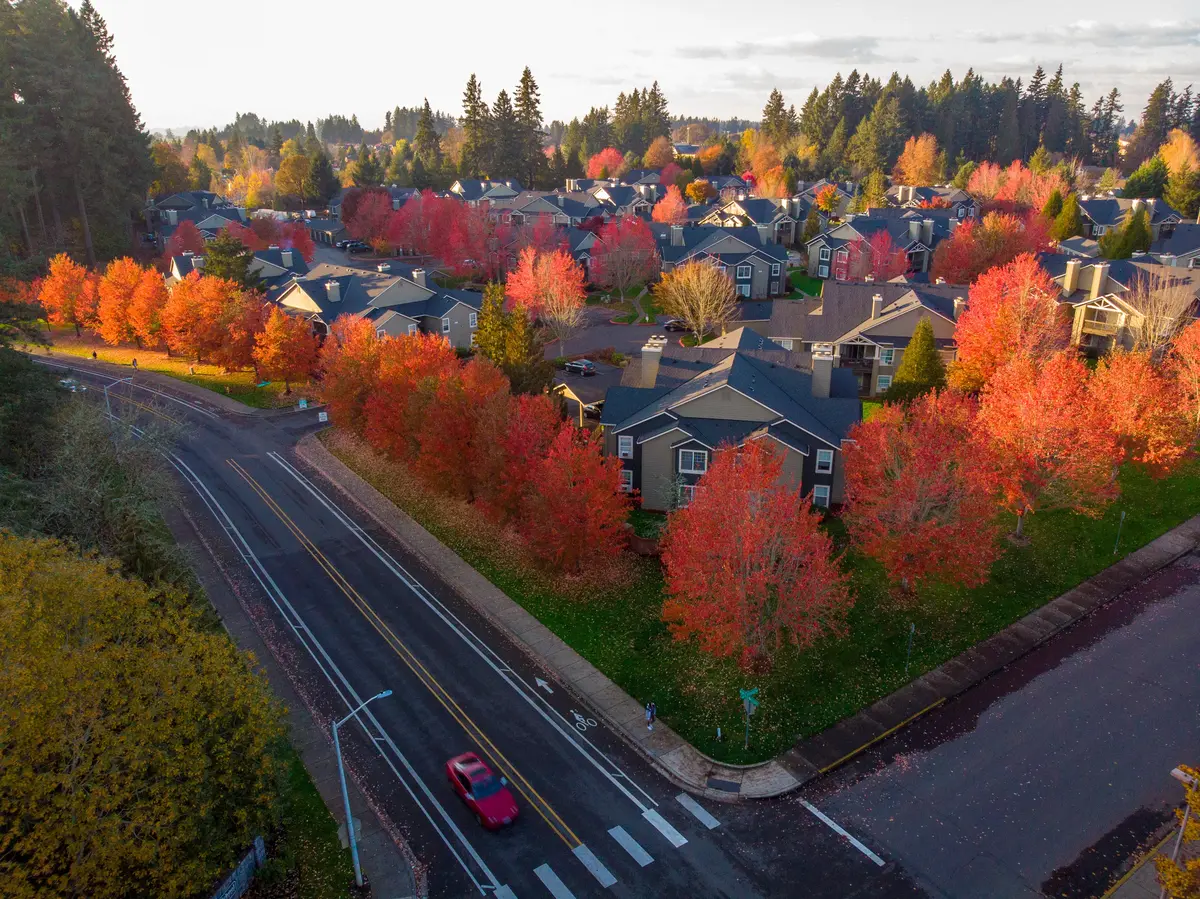
This is the neighborhood most buyers have heard of before they call me, and it delivers on what people expect. It was designed as a walkable, transit-oriented community built alongside TriMet's MAX light rail — the Blue Line and Red Line both run through Hillsboro, connecting directly to Beaverton, Portland City Center, and Portland International Airport. The town center format, the farmers market at Orenco Station Plaza, and the ability to run genuine errands on foot make it unlike almost anywhere else in the city. Buyers who want on-foot access to coffee, food, and transit, and who don't mind density, almost always end up happy here.
South Hillsboro — Reed's Crossing
This is the city's most ambitious new development — described as the largest mixed-use master-planned community in Oregon by density, at 474 acres, ultimately planned for about 4,000 homes and up to 20,000 residents. The South Hillsboro District incorporates 286 acres of parks and 15 miles of pedestrian trails. Reed's Crossing Town Center opened its first buildings in spring 2025, anchored by Market of Choice, with the center about 80% leased at opening. For buyers who want new construction in a planned environment with trails and amenities built in from the start, this is where I'm taking them first.
AmberGlen / Tanasbourne
This corridor functions as Hillsboro's commercial and retail spine. The Streets of Tanasbourne brings real retail density, and the surrounding neighborhoods offer a mix of townhomes, condos, and single-family homes within easy reach of employment. It's a practical choice for buyers who want to minimize driving for everyday life without committing to Orenco's density.
Brookwood
Brookwood sits at the city median in terms of price tier — it's the market's middle ground, which makes it the most competitive and most accessible part of the city for buyers working at that price point. The housing stock is a mix of eras, which means more variety and more opportunity to find something with good bones.
Jackson School, Reedville, and Witch Hazel Village
These neighborhoods are where buyers tend to land when they're prioritizing space and quiet over walkability. Jackson School has an established, residential feel. Reedville sits on the city's western edge and attracts buyers who work in both Hillsboro and Forest Grove. Witch Hazel Village is newer and more suburban in character. For families with kids who want a yard and a calmer street, these three areas consistently come up in my buyer conversations.
Downtown Hillsboro / West End
Downtown has been working through a slow evolution — the Walters Cultural Arts Center and the Hillsboro Farmers' Markets Downtown Hillsboro location give it a civic identity, and the West End adds some neighborhood texture. It's not yet a dining-and-walkability destination in the way Orenco is, but it's where the city's long-term urban identity is being built, and buyers who buy early in that story tend to do well.
Best for: Use the neighborhood descriptions above to match your lifestyle — transit-oriented living points toward Orenco; new planned communities toward South Hillsboro; established mid-range toward Brookwood; space and quiet toward Jackson School or Reedville.
Schools: What the Numbers Show
Hillsboro School District serves 18,521 students enrolled in 2025-26, making it one of the larger districts in the Portland Metro. On 2024-25 state assessments, 29.4% of students reached math proficiency and 39.1% reached reading proficiency — figures the Oregon Department of Education publishes. Those numbers are below statewide averages, and I won't minimize that for families weighing the district seriously.
What I tell buyers is that district-wide averages can obscure real differences between schools within a district this size. Individual school performance, the programs available at a given building, and the specific boundary for a particular address all matter more to your family's experience than the district-wide figure. The Hillsboro School District also offers active OSAA athletics programs across its high schools, and the community texture around those programs — Friday night football, strong activity programs — is part of the fabric of the city.
My genuine advice: if schools are a deciding factor in your search, confirm the assigned school for any specific address with the district directly before you make an offer, and review the data the Oregon Department of Education publishes themselves. I can tell you which neighborhoods fall within which boundaries, but the school assignment is yours to verify — and that due diligence is worth doing early in the process, before you've fallen in love with a house.
Looking to buy in Hillsboro? Estimate your payment.
Enter your numbers to see an estimated monthly mortgage payment.
Estimate only. Excludes HOA fees and mortgage insurance. The interest rate above is a starting point, not a quoted rate — replace it with your own to see real numbers. Insurance is a flat placeholder, not a Hillsboro quote.
Hillsboro vs Nearby Cities
| City | Typical Home Price | Typical Rent | Cost vs Hillsboro |
|---|---|---|---|
| Hillsboro (this city) | $518,047 | $1,946/mo | — |
| Beaverton | $527,947 | $1,880/mo | About the same |
| Forest Grove | $526,407 | $1,753/mo | About the same |
| Cornelius | $485,070 | $2,357/mo | 6% lower |
Source — home prices: Zillow ZHVI, July 2026; rent: Zillow ZORI, July 2026. Nearby-city figures are the same series, refreshed together.
The comparison I'm asked about most often is Hillsboro versus Beaverton. The honest answer is that on price, they're running about the same — so that decision usually comes down to what you're trying to live near. Beaverton sits closer to Nike's campus and has its own robust MAX access, with a slightly more established retail and dining scene in places like the Beaverton Town Square corridor. Hillsboro gives you more new construction — South Hillsboro is genuinely the most active new-build environment in the metro right now — and if your work is in Hillsboro itself, the commute calculus tilts clearly in this direction.
Forest Grove is the comparison that surprises buyers. Prices there run about the same as Hillsboro, but the feel is completely different — a smaller, slower-paced college town that attracts buyers who are actively seeking to step down in pace and scale. If someone tells me they want Hillsboro but quieter, I ask whether they've considered Forest Grove seriously. The tradeoff is real amenity density for a more distinctive small-city character.
Cornelius sits just west of Hillsboro and comes in somewhat lower on price — which matters at a market rate of $518,047 (July 2026) for those trying to stretch their budget. It has a more working-class, agricultural character and a smaller commercial footprint. I work with buyers who choose Cornelius deliberately for the price entry point, knowing they're trading some convenience for it.
Tigard sits southeast and competes more with Beaverton than with Hillsboro directly — it draws buyers who want a quick connection toward Lake Oswego or Tualatin as much as toward Portland. The thread that runs through all of these comparisons: Hillsboro's strongest argument is the combination of MAX access, new construction availability, and a genuine employment center right in the city. When all three of those matter to a buyer, the neighboring cities have a hard time competing.
Crime, Safety, and What the Numbers Mean
I've learned to walk buyers through crime data carefully, because the raw numbers rarely tell the full story on their own — and Hillsboro's picture is more reassuring than most people expect for a city of 111,126.
Hillsboro has a violent crime rate of 3.18 per 1,000 residents and a property crime rate of 23.8 per 1,000 residents. To put those in context: the Oregon statewide figures are 3.3 per 1,000 for violent crime and 24.5 per 1,000 for property crime, and the national figures are 3.7 per 1,000 for violent crime and 18.4 per 1,000 for property crime. Hillsboro runs below the state on both counts, and below the national rate for violent crime — though above the national property crime figure, which is a pattern common across Oregon's larger cities.
What that means on the ground: property crime — car break-ins, theft from vehicles — is the category that residents notice and talk about, particularly in commercial areas. The neighborhoods I described earlier vary in feel, and I'm always honest with buyers about which parts of the city generate more of those calls. It's not a reason to avoid the city, but it is a reason to ask specific questions about a specific street, not just the citywide average.
The neighborhoods that consistently feel quietest to my clients are the established residential pockets of Jackson School, Reedville, and South Hillsboro's planned community environment. Orenco Station has strong pedestrian activity and natural eyes on the street, which matters for perceived safety even in a denser setting.
Weekends and Local Favorites
One of the things I tell buyers who are new to Hillsboro is that the city has more going on than it gets credit for, and that the experience varies a lot depending on which part of town you're in on a given Saturday.
The farmers markets are genuinely one of Hillsboro's best assets. The Hillsboro Farmers' Markets at Orenco Station and the Downtown Hillsboro location both run through the warm months and draw serious crowds — locally grown produce, prepared food, and the kind of weekly social anchor that makes a neighborhood feel like a community. If you're considering Orenco Station as a place to live, going to the market there first is the best research you can do.
Jackson Bottom Wetlands Preserve and Rood Bridge Park are where you go when you need to remember that you live in the Pacific Northwest. Jackson Bottom is a legitimate wildlife habitat — herons, egrets, waterfowl — right at the edge of the city. The Orenco Nature Trail gives residents a greenway connection that threads through the northeast part of the city without requiring a car. Tualatin Hills Nature Park and Shute Park round out a parks system that punches above its weight for a suburban city.
For coffee and a slower morning, the independent café scene includes Longbottom Coffee & Tea, The South Store Cafe, Cabana do Cafe, and TOUS les JOURS Bakery Café. For dinner or drinks, Copper River Restaurant & Bar, Syun Izakaya, Hale's Restaurant & Lounge, Stanford's Tanasbourne, and Thirsty Lion give you a real range of options without driving to Portland. Syun Izakaya in particular has a devoted following and is the kind of place you mention to out-of-town guests without hesitation.
The Gordon Faber Recreation Complex — Ron Tonkin Field — is home to the Hillsboro Hops, the High-A affiliate of the Arizona Diamondbacks. A summer evening at a Hops game is one of those genuinely local pleasures that newcomers discover and then wonder how they didn't know about it sooner. Hillsboro Airport hosts the Oregon International Air Show, which draws crowds from across the metro and is one of those events that reminds you this is a real city with its own calendar.
What surprises people after they've been here six months is usually the same thing: they didn't expect to feel this settled this fast. The farmers market becomes their Saturday routine. They find a trail they run three times a week. The Hops game becomes the summer social anchor. Hillsboro earns loyalty slowly, and then firmly.
Final Advice From Elizabeth
Quick Takeaways & FAQs
✅ Hillsboro combines genuine MAX light rail access with the most active new-construction pipeline in the Portland Metro, particularly in South Hillsboro's Reed's Crossing.
⚠️ Intel's workforce reductions have added real economic uncertainty to a city where 78% of Oregon's semiconductor workers are based — something buyers should factor in honestly.
📍 The Hillsboro Hops play summer baseball at Ron Tonkin Field, and a warm evening there is one of the best introductions to what living in this city actually feels like.
What is the commute from Hillsboro to Portland really like?
How do Hillsboro's schools perform, and how do I find out which school my address is assigned to?
Should Intel's layoffs make me nervous about buying in Hillsboro?
Which part of Hillsboro is right for my family — Orenco, South Hillsboro, or one of the older neighborhoods?
What does $518,000 actually buy in Hillsboro right now?
How fast are homes moving in Hillsboro, and do I need to act quickly?
How does Hillsboro compare to Beaverton for someone who isn't sure which to choose?
What surprises buyers most after they've lived in Hillsboro for six months?
Moving to Oregon?
Tell us what you need help with and we'll connect you with local resources.
