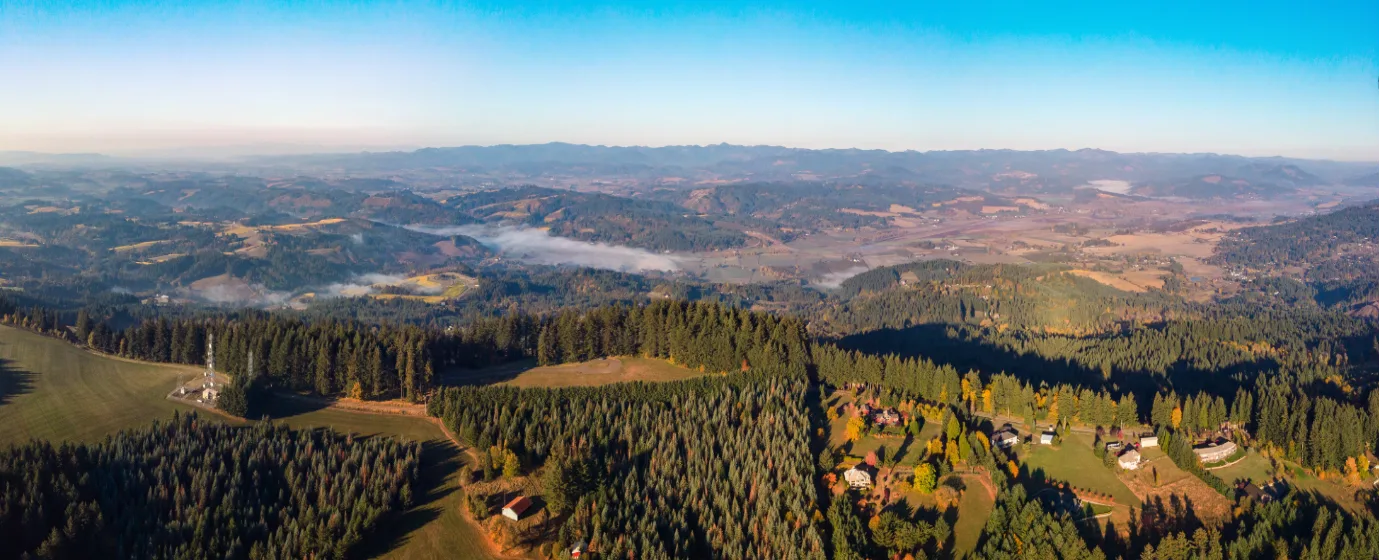
Most people researching Hillsboro lead with Intel, light rail, and home prices. What catches newcomers off guard — usually around month three — is how much green space a city this size has packed inside its own limits. More than 30 parks across 1,600 acres is not a rounding error; it is the result of deliberate land preservation decisions made while the city was still growing into a semiconductor hub. You can be standing at a wetland trail watching a river otter and be ten minutes from a MAX station. That combination is genuinely unusual for a city of 111,126 people.
The park system's anchor points are also its most distinctive ones: a 635-acre wildlife preserve on the Tualatin River that the Audubon Society has designated an Important Bird Area, the largest park in the city where Rock Creek meets that same river and provides the only public Tualatin River water access in town, a 90-plus-acre sports complex with a minor-league ballpark, and the oldest park in the city that has been serving downtown residents since 1906. These are not amenities that feel borrowed from Portland — they are Hillsboro's own, and residents use them differently than a metro visitor would.
Oregon's 142 sunny days a year make the question of when to use these spaces real and relevant. The Willamette Valley's wet winters push most trail and water recreation into a May-through-October window, and Hillsboro's parks are designed around that rhythm. Rood Bridge Park's watercraft launch runs from Memorial Day through Labor Day. Jackson Bottom's wetland trails attract birders hardest in winter, when migratory waterfowl arrive. The Shute Park Aquatic and Recreation Center solves the rain problem for families who need a year-round option. Understanding these seasonal rhythms is the difference between a park system that disappoints and one that genuinely enriches daily life here. For context on the neighborhoods closest to each of these parks, see the Hillsboro neighborhoods guide.
Whether you're already under contract or still comparing Hillsboro to Beaverton, the sections below break down the city's signature parks, water access, trail network, and recreation facilities — and what living near each of them is actually like.
Signature Parks: Rood Bridge, Jackson Bottom, and Shute
Rood Bridge Park — Where the River Finally Shows Up
The Tualatin River runs along Hillsboro's southern edge, and for all the water that defines the broader valley, it is surprisingly hard to reach from inside city limits. Rood Bridge Park is the exception — and for that reason alone it punches above its 58 to 60 acres.
The park sits where Rock Creek flows into the Tualatin, and the terrain reflects that confluence: paved paths give way to soft-surface trails that wind through wetland edges and wooded corridors. A Rhododendron Garden, three picnic shelters, tennis courts, and a large open lawn make it the obvious choice for weekend family gatherings. But the real draw for active residents is the watercraft launch, which accepts canoes, kayaks, paddleboards, and car-top boats up to 15 feet during the warm-weather season — the only spot in the city where you can put a paddle in the Tualatin River. This is also the southern end of the Rock Creek Regional Trail and the eastern terminus of the Tualatin River Regional Water Trail, which means Rood Bridge functions as a trailhead for a much larger regional system than its acreage suggests.
One honest note: the park draws crowds on warm-weather weekends, and the parking area can fill earlier than newcomers expect. Arriving before late morning on a July Saturday is not overthinking it.
Jackson Bottom Wetlands Preserve — 635 Acres Inside City Limits
Jackson Bottom is the kind of place that makes people reconsider what a city park is supposed to be. At 635 acres, it is not a park in the neighborhood sense — it is a full wildlife preserve within Hillsboro's city limits, and the Audubon Society's Important Bird Area designation reflects what is actually happening there.
The preserve is a working mosaic of wetlands, wet prairie, riparian forest, and oak woodland. Deer, river otters, beavers, and amphibians share the habitat with a bird list that expands substantially in winter, when Northern Pintail, Ring-Necked Duck, Green-winged Teal, Canvasback, American Wigeon, buffleheads, dusky Canada geese, and tundra swans arrive. The 4.5 miles of gravel and bark-chip trails are open daily from sunrise to sunset, and the on-site Nature Center includes an exhibit hall, interpretive displays, and the only authentic bald eagle nest exhibit in the continental United States.
Two things to know before you go: admission to the trails is free, with a suggested $2 donation for visitors ten and older at the Nature Center. And pets are not allowed anywhere in the preserve — the restriction is firm and exists to protect the habitat that makes the place worth visiting. If you are moving here with a dog and assumed this would be your morning walk spot, plan differently.
Shute Park — The Downtown Anchor Since 1906
Hillsboro's oldest park is also its most civic in character. Shute Park's 13 acres sit near downtown, adjacent to a branch of the Hillsboro Public Library and a community senior center — a cluster of public amenities that reflects how the city thinks about its urban core.
The park itself is the kind of place families from nearby neighborhoods use on a weekday afternoon without planning anything. What extends its range considerably is the Shute Park Aquatic and Recreation Center (SHARC) next door: three pools, a spa and sauna, a cardio room, weight room, spin room, group fitness classes, on-site child care, and outdoor pools with water slides and diving boards in summer. For parents with young children, SHARC is the answer to six months of Oregon rain. It is not a luxury amenity — it is infrastructure.
Trails and Water: The Rock Creek and Tualatin River Corridors
The Trail Network That Holds It Together
Hillsboro's trail system is better understood as a series of connected corridors than as individual park paths. The Rock Creek Regional Trail is the spine of the north-south network, running through the city and terminating at Rood Bridge Park in the south. The Orenco Nature Trail provides a paved urban option through the Orenco Station neighborhood, where it connects to the MAX light-rail station and serves as a genuine commuter route — one of the few trails in the metro area that is used as heavily on a Tuesday morning as on a Saturday afternoon.
The combined result is a system where a resident in Orenco Station can reach the Tualatin River on foot or by bike without driving. That linkage is not seamless in every section, and some stretches require navigating streets between trail segments. But the underlying framework exists, which puts Hillsboro meaningfully ahead of most Oregon cities its size in connected green infrastructure.
Water Access: What You Can Do and Where
| Water Feature | What's Available | Seasonal Notes |
|---|---|---|
| Tualatin River at Rood Bridge Park | Car-top watercraft launch — canoes, kayaks, paddleboards, boats up to 15 ft | Memorial Day through Labor Day |
| Tualatin River Regional Water Trail | Eastern terminus at Rood Bridge; connects to a regional paddling network | Best May–October; river levels vary |
| Jackson Bottom Wetlands | Observation from trail network; no watercraft or swimming | Wildlife viewing peaks in winter |
| SHARC Outdoor Pools | Water slides, diving boards, lap swimming | Summer season only |
| SHARC Indoor Pools | Lap lanes, recreation swim, lessons, spa | Year-round |
The watercraft launch at Rood Bridge is the city's single most underused amenity among newcomers — most people don't know it exists until they've lived here for a year. If paddling is part of your life, it should be the first thing you check off the list after moving in.
Gordon Faber Recreation Complex and Spectator Sports
More Than a Ballpark
The Gordon Faber Recreation Complex sits on more than 90 acres and operates at a scale that surprises people who assume Hillsboro's sports facilities are purely recreational. Ron Tonkin Field is the home of the Hillsboro Hops, the city's High-A minor-league baseball affiliate, and attending a Hops game on a warm July evening is the most distinctly local summer experience the city offers. The ballpark seats 4,500 and doubles as home to the Portland Cascade professional softball team and Portland State University softball.
The adjacent Hillsboro Stadium is a separate 7,000-seat facility with 170,000 square feet of all-weather FieldTurf — home to Portland State University football and soccer. Six natural-grass softball and baseball fields round out a complex that hosts everything from youth tournaments to PSU away games. For families with kids involved in organized athletics, this is the venue they will come to know well. For everyone else, a Hops game is simply a good summer evening, and the community culture around it is one of the things people mention most often when they describe what they like about living here.
The Seasonal Reality of Spectator Sports Here
The Hops season runs through summer and into early fall, which aligns neatly with the stretch of weather when being outdoors in the Willamette Valley is most reliable. The complex also hosts regional youth tournaments on many weekends, which means parking and the surrounding streets can be busier than the Hillsboro Hops schedule alone would suggest. If you live near the complex, that is worth factoring in — it is an asset for the city and a source of occasional weekend congestion for the immediate neighborhood.
Families weighing how youth athletics fit into daily life here will find the GFRC central to that conversation. For more on youth programs and school-connected activities, see the Hillsboro schools page.
Looking to buy in Hillsboro? Estimate your payment.
Enter your numbers to see an estimated monthly mortgage payment.
Estimate only. Excludes HOA fees and mortgage insurance. The interest rate above is a starting point, not a quoted rate — replace it with your own to see real numbers. Insurance is a flat placeholder, not a Hillsboro quote.
Seasonal Recreation, Local Rhythms, and What to Expect Year-Round
How the Seasons Shape Outdoor Life
Oregon's 142 sunny days a year concentrate outdoor recreation in a way that takes transplants from sunnier states a full year to internalize. The parks here do not operate the same in February as they do in July — and planning around that reality is the difference between a park system that enriches daily life and one that feels like it was designed for someone else's climate.
| Season | Best Activities | What to Know |
|---|---|---|
| Spring (Mar–May) | Trail hiking at Jackson Bottom and Rood Bridge, Rhododendron Garden at peak bloom | Trails can be muddy through April; the garden is worth timing a visit around |
| Summer (Jun–Sep) | Tualatin River paddling, SHARC outdoor pools, Hillsboro Hops games, farmers markets | The watercraft launch and outdoor pools operate seasonally; Hops games sell out warm-weather weekends |
| Fall (Oct–Nov) | Trail running, birding as migratory species arrive at Jackson Bottom | Wet weather returns quickly; bark-chip trails at Jackson Bottom hold up better than paved routes in rain |
| Winter (Dec–Feb) | Jackson Bottom wildlife and birding, SHARC indoor pools and fitness, Shute Park community programming | Jackson Bottom's wetland species — tundra swans, canvasbacks, dusky Canada geese — peak in winter; SHARC is the primary year-round athletic anchor |
Where Families Actually Gather
Hillsboro Farmers' Markets run at two locations during the warm months — one at Orenco Station Plaza and one in Downtown Hillsboro — and both function as genuine community gathering points rather than purely transactional markets. The Orenco Station location is walkable for residents of that neighborhood and frequently draws people who arrive on the MAX. The downtown location sits closer to Shute Park, making it an easy pairing with a morning at the park or a stop after SHARC.
What long-time residents tend to say is that Hillsboro's outdoor social life is quieter and more self-directed than what you would find in Portland neighborhoods with dense commercial strips. The parks here do the social work that coffee-shop clusters do elsewhere. That suits a lot of families with school-age children; it is a harder sell for people who want outdoor recreation bundled with a visible scene. Neither answer is wrong — it depends on what you are looking for. For a fuller picture of what daily life feels like across the city's different neighborhoods, the living in Hillsboro guide covers the broader lifestyle context.
One Thing Newcomers Consistently Underestimate
The scale of Jackson Bottom. People arrive expecting a pleasant nature walk and find themselves inside a genuine wildlife preserve that requires more than an hour to explore meaningfully. The 4.5 miles of trail are not a loop — they branch and connect through distinct habitat types, and the experience changes significantly across seasons. Birders who discover it in winter sometimes rearrange their mornings around it. It is the single amenity in Hillsboro's park system that earns the most genuine local pride, and it is almost entirely invisible in the marketing materials newcomers typically see first.
Local Expert Takeaway: Hillsboro's parks system is quietly one of the strongest in the Portland metro for a city that is not Portland. The combination of Jackson Bottom Wetlands Preserve — a 635-acre Audubon-designated Important Bird Area — and Rood Bridge Park's Tualatin River water access puts genuine wilderness-caliber outdoor recreation inside city limits. Add SHARC's year-round aquatic facility and the Hillsboro Hops at Ron Tonkin Field, and you have a system that covers trail hiking, paddling, structured fitness, and live sports without leaving town. The catch is the climate: Oregon's rainy season compresses the peak outdoor window to roughly May through September, and residents who thrive here are the ones who plan their recreation calendar around that reality rather than fighting it.
Quick Takeaways & FAQs
✅ Hillsboro's 1,600-acre park system includes a 635-acre Audubon-designated wildlife preserve and the only public Tualatin River access in the city — genuinely unusual for a Portland-area suburb.
⚠️ Pets are prohibited at Jackson Bottom Wetlands Preserve, and the watercraft launch at Rood Bridge Park is seasonal — two details that matter immediately if either is part of your outdoor routine.
📍 The Hillsboro Hops play High-A minor-league baseball at Ron Tonkin Field inside the Gordon Faber Recreation Complex — a 90-acre sports destination that also hosts Portland State University football and professional softball.
Can I kayak or paddleboard on the Tualatin River in Hillsboro?
Are dogs allowed at Hillsboro's parks and trails?
What is Jackson Bottom Wetlands Preserve, and is it worth visiting?
What indoor recreation options exist for Hillsboro residents during the rainy season?
Do the Hillsboro Hops play in Hillsboro, and how is the game-day experience?
Moving to Oregon?
Tell us what you need help with and we'll connect you with local resources.
