About Gary
The Florence Market at a Glance
The first thing buyers notice about Florence's market is that it doesn't behave like a typical Oregon city. There's no dominant tech employer pushing prices, no massive apartment surge on the fringe. What drives this market is retirement migration — consistent, steady, and unlikely to reverse anytime soon.
With a median age of 60.8 years and 44% of residents aged 65 or older, Florence has one of the oldest age profiles of any incorporated city on the Oregon Coast. That shapes everything: what gets built, what sells, what sits. The typical home price as of July 2026 sits at $452,369, and I'll say plainly that the median household income here — $53,333 — is well below what it takes to carry a home at that price. Florence is not a market for first-time buyers on local wages. It is a market for people arriving with equity from somewhere else, a pension, or both.
The effective property tax rate of approximately 0.86% is one of the things that genuinely surprises buyers comparing Oregon to California or Washington. On a home at the typical price, the annual tax burden is modest by coastal standards. That math matters to retirees running fixed budgets.
The crime picture here is better than most people expect from a tourist-heavy coastal town. Florence has a violent crime rate of 1 per 1,000 residents — well below the Oregon state rate of 3.3 per 1,000 and the national rate of 3.7 per 1,000. Property crime is where you'd expect a visitor economy to show strain: a property crime rate of 21.3 per 1,000 residents, which sits modestly below Oregon's state rate of 24.5 per 1,000, though above the national figure of 18.4 per 1,000. Lock your car in Old Town during peak tourist season. That's the practical takeaway.
Tourism generates roughly $200 million annually for Florence's economy and accounts for approximately a quarter of all local jobs. That's not background noise — it shapes who's hiring, what retail survives here, and why the hospitality sector is one of the city's more stable economic pillars alongside healthcare and education.
Florence Neighborhoods: What Each One Is Actually Like
Historic Old Town Florence
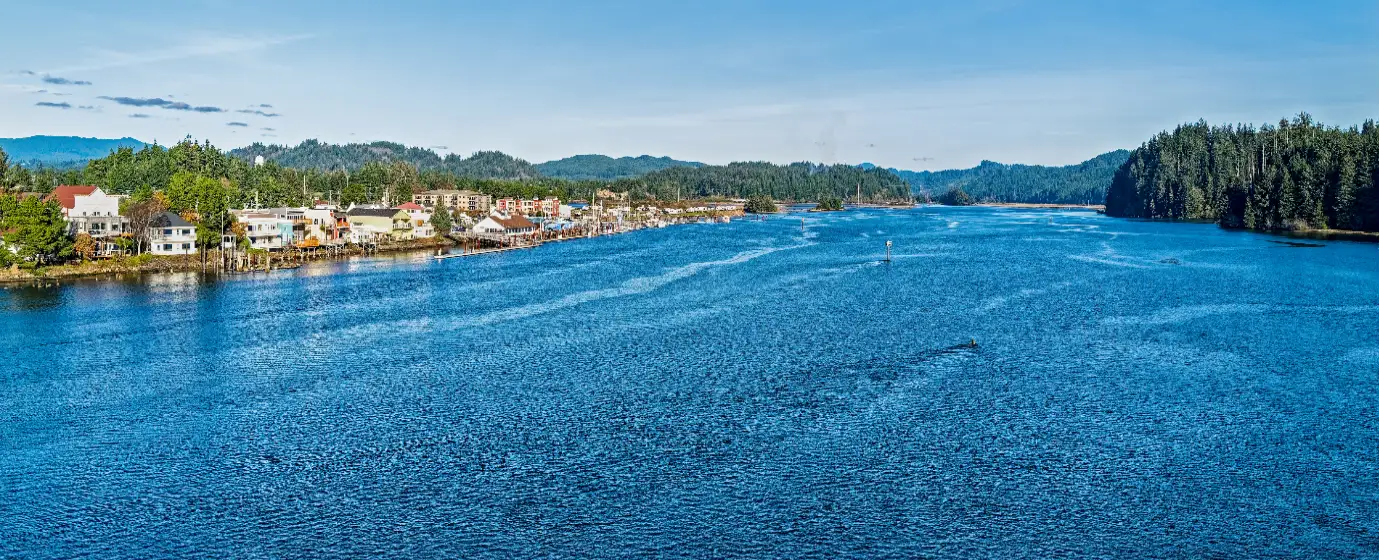
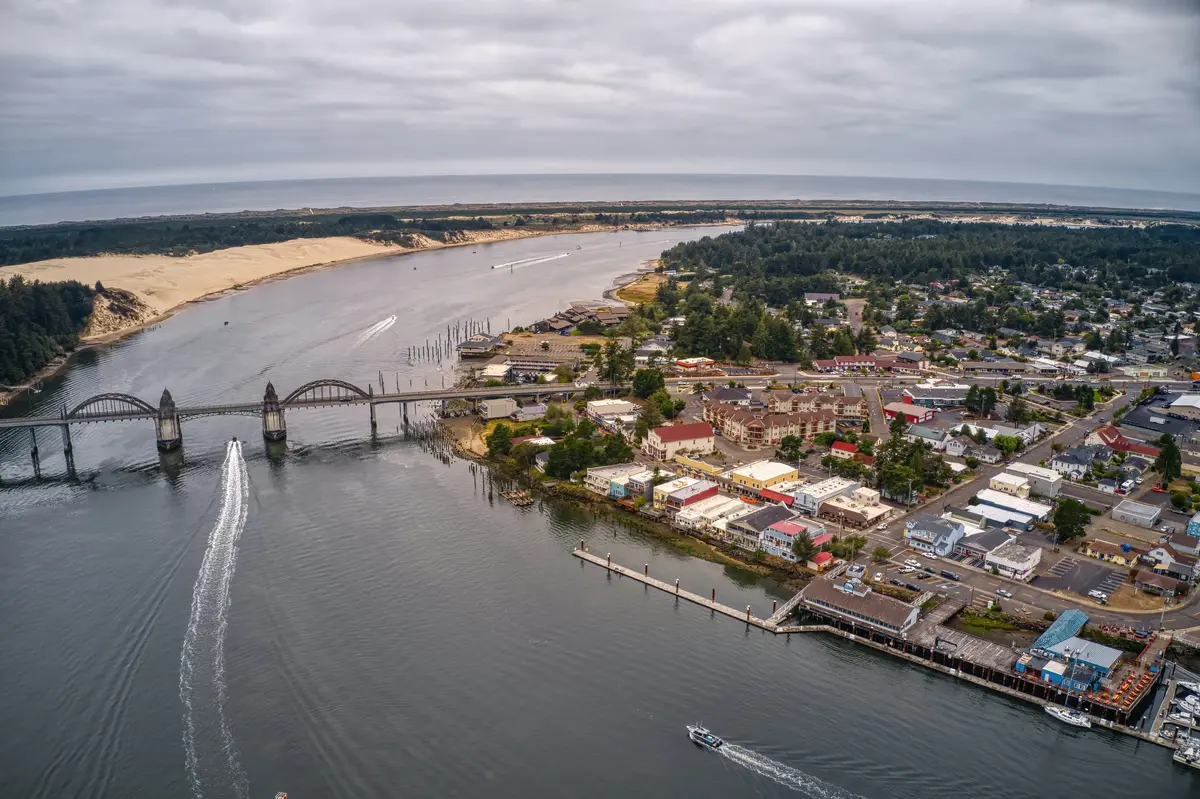
Old Town is the heart of what most people picture when they imagine Florence. The Siuslaw River Bridge — an Art Deco structure completed in 1936 and designed by Conde B. McCullough — frames the waterfront, and the district along it is genuinely walkable by Oregon Coast standards. Locally owned shops, galleries, and restaurants line the blocks closest to the water. Buyers drawn here tend to prioritize walkability and atmosphere over square footage. Housing stock is older, lots are smaller, and on-foot access to the boardwalk and river is hard to replicate elsewhere in the city.
Best for: Retirees who want walkable streets and coastal character without driving for every errand.
Florentine Estates
This is Florence's most established 55+ community — gated, resident-owned, situated with the Pacific and forested foothills as its backdrop. I work with a lot of buyers who shortlist Florentine Estates specifically because of the community structure and the shared amenities. It's not for everyone, but for buyers who want neighbors at a similar life stage and a maintained environment, the fit is usually strong.
Best for: Quiet 55+ buyers who want a managed, gated setting.
Three Mile Prairie
Sitting east of the coastal core, Three Mile Prairie offers more land, more privacy, and a more rural feel than the waterfront neighborhoods. Buyers here are typically trading waterfront proximity for elbow room — larger parcels, fewer tourist neighbors in summer, and a quieter road environment. It attracts people who want a true Oregon property feel without being deep in the forest.
Best for: Privacy Nature buyers who want space over scenery.
Munsel Lake / Munsel Creek Estates
This is one of the areas I find myself showing more often to buyers who want the outdoors genuinely integrated into daily life, not just nearby. Munsel Lake anchors a neighborhood that feels distinct from the tourist corridors. Buyers here tend to be active, independent-minded, and often arriving from the Pacific Northwest rather than California.
Best for: Nature Views buyers who prioritize lake access and quiet over walkability.
Florence West and Heceta Beach
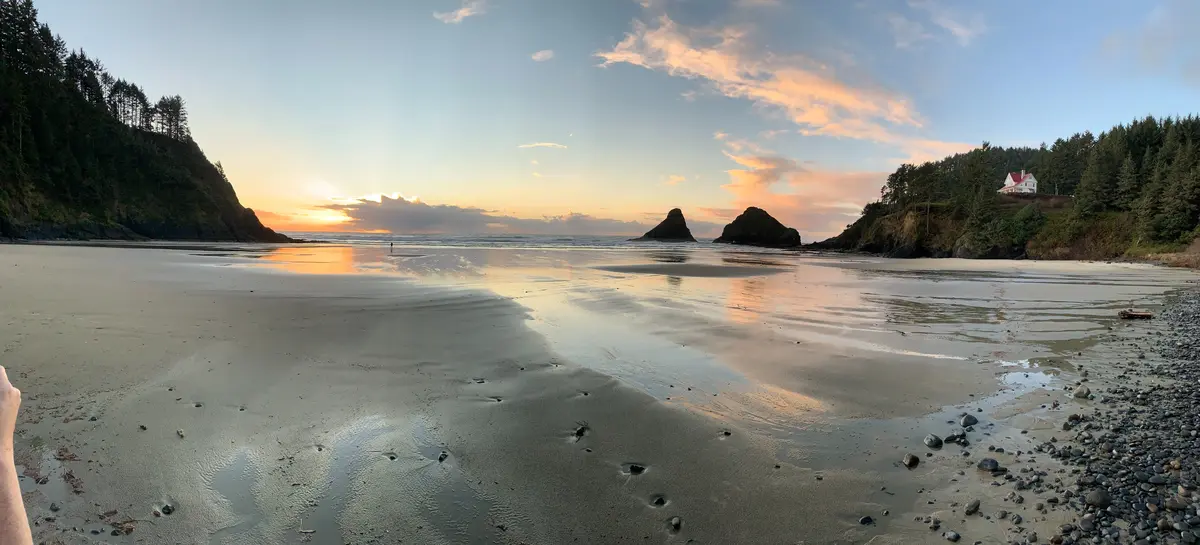
Florence West is the city's most conventional suburban zone — closer to the commercial strip along US-101, where most of the everyday retail and services are concentrated. It's where you find newer construction and more inventory movement. Heceta Beach, by contrast, sits north of the river and draws buyers who want direct beach access and are comfortable with a slightly more isolated feel. These are two very different propositions wearing similar price tags.
Best for: Florence West — Commuters and buyers who want convenience. Heceta Beach — Views and oceanfront lifestyle.
South Florence and Shelter Cove
South Florence is where I steer buyers who want to be in the city but away from the summer tourist volume. It's the quietest residential corridor, with Shelter Cove offering some of the most interesting waterfront and near-waterfront parcels in the market. If someone tells me they want coastal property but they never want to feel like they're living in a vacation destination, this is usually where the conversation ends up.
Best for: Quiet Privacy buyers and those seeking waterfront parcels away from the tourist core.
Florence vs Nearby Cities
| City | Typical Home Price | Typical Rent | Cost vs Florence |
|---|---|---|---|
| Florence (this city) | $452,369 | — | — |
| Reedsport | $330,394 | $1,100/mo | 27% lower |
| Mapleton | $350,000 | $1,300/mo | 23% lower |
| Waldport | $420,000 | $1,900/mo | 7% lower |
Source — home prices: Zillow ZHVI, July 2026. Nearby-city figures are the same series, refreshed together.
The comparison I get asked about most is Florence versus Eugene. The honest answer is that they're almost incomparable — Eugene is a university city with a genuine job market, an urban core, and a significantly larger range of housing types. Florence is a coastal town of 9,480 where the main draw is the environment, not the economy. Buyers trying to split the difference with a property in Florence and a job in Eugene need to understand what the commute means in practice: OR-126 is the only route between them, the drive is about 60 minutes to Eugene each way, and it winds through mountain terrain that can slow significantly in winter. That's two hours a day. Most people who try it long-term either move closer to Eugene or go fully remote.
The comparisons to other coastal neighbors are a different calculation. Reedsport, about 20 miles south on US-101, offers prices noticeably lower than Florence — the trade is that Reedsport has a smaller service base and far less of the Old Town infrastructure and community amenities that draw buyers to Florence in the first place. For buyers on a tighter budget who genuinely don't need the Florence amenity set, Reedsport can make sense. For buyers who want the Florence lifestyle at a Reedsport price, that combination doesn't exist.
Mapleton, inland along OR-126, is even more rural than Florence and sits noticeably lower in price. It attracts a specific kind of buyer — someone who wants significant land, accepts distance from services, and is often working remotely. I rarely have a client who is genuinely torn between Florence and Mapleton; they're different enough that the choice tends to make itself.
Waldport, north on US-101 in Lincoln County, is somewhat lower in price than Florence and has its own quiet coastal appeal. The difference is that Florence has a substantially more developed service ecosystem — the performing arts center, Lane Community College classes, the senior center, PeaceHealth Peace Harbor Medical Center — that Waldport simply doesn't match. For retirees especially, that infrastructure gap matters more over time than it does on move-in day.
The table below gives you the specific price comparison across these neighbors. What it can't show is the amenity and lifestyle gap that underlies each of those numbers.
Looking to buy in Florence? Estimate your payment.
Enter your numbers to see an estimated monthly mortgage payment.
Estimate only. Excludes HOA fees and mortgage insurance. The interest rate above is a starting point, not a quoted rate — replace it with your own to see real numbers. Insurance is a flat placeholder, not a Florence quote.
Schools in Florence
The Siuslaw School District 97J serves Florence and the surrounding area. It's a small district — with 1,178 students enrolled in 2025-26, according to Oregon Department of Education figures — which means it has the intimacy and community texture you'd expect from a coastal town where everyone knows the football coach and the high school principal by name. Friday night games fill the stands, and the active OSAA athletics programs are genuinely woven into the social fabric of the community. The local high school's teams have a loyal following here.
On academic performance, on 2024-25 state assessments, 28.2% of students reached math proficiency and 36% reached reading proficiency, according to figures the Oregon Department of Education publishes. Those numbers are below state averages, and I think it's important to say that plainly rather than paper over it. What they don't tell you is everything else that shapes a child's experience here — class sizes, relationships with teachers, the outdoor education opportunities that a coastal and dunes environment makes possible, and the general safety and cohesion of a small-town school community.
For families with school-age children making this decision, my honest advice is to do your own due diligence. Confirm the assigned school for the specific address you're considering directly with the district, and review the full data the Oregon Department of Education publishes yourself. Academic performance profiles look different at the elementary, middle, and high school level, and the raw proficiency numbers are only one part of the picture.
Florence is not, in my observation, where buyers with school-age children typically land when academics are the primary decision driver. The buyers I work with here who have kids in the district tend to be deeply committed to the coastal lifestyle and actively supplement what the district provides — in some cases homeschooling for part of the curriculum, in others driving to Eugene for enrichment programs. That's a real part of the picture for families considering this move.
Healthcare, Retirement, and Why Florence Works for the Life Stage It Serves
The healthcare question is one of the first things my retired and near-retired buyers raise, and Florence has a more substantive answer than most small coastal towns can give. PeaceHealth Peace Harbor Medical Center is inside city limits and serves as the anchor medical facility for the entire stretch of coast from Waldport south to Reedsport. Its Emergency Department holds a Level III Trauma designation, staffed with board-certified emergency physicians and surgeons and equipped with MRI, CT, and digital radiography.
What changed meaningfully in late 2024 is that Peace Harbor added an Ear, Nose & Throat clinic and surgical care on-site — services that previously required patients to drive to Eugene or Springfield. That kind of specialty expansion matters enormously to someone who is planning to age in place here. The calculus for a 68-year-old buyer is different from a 38-year-old's: reducing the frequency of 60-minute drives over the mountains for routine specialist care is not a small quality-of-life improvement.
Florence is widely recognized as one of the more cost-effective and well-served retirement destinations on the Oregon Coast, and the demographic data backs that reputation: a median age of 60.8 years and 44% of residents 65 or older means Florence has genuinely organized itself around retirement, not just marketed to it.
For buyers specifically looking at 55+ communities, Florence has two: Florentine Estates, the gated resident-owned community I described in the neighborhood section, and Greentrees Village. Those are the two options in the city. Buyers who want a third option within Florence don't have one, which sometimes surprises people who've been looking in larger markets.
The city also has a performing arts center, an active senior center, and Lane Community College classes offered locally. For buyers who worry that a town of 9,480 won't have enough to fill a retirement — that concern tends to dissolve after about six months. The social infrastructure here punches well above what the population size would suggest.
What Buying in Florence Actually Looks Like
Who This Market Is For
I'll be direct: Florence is not a starter-home market for local buyers. The typical home price of $452,369 as of July 2026 sits well above what the local median household income can support. The buyers who succeed here are arriving with equity — from a sold home in the Bay Area, Portland, or the Willamette Valley — or they're on a pension or retirement income that doesn't depend on what Florence's wage economy pays.
The buyers who are happiest here, in my experience, are the ones who've made peace with the trade-offs before they arrive. They know that a serious shopping run means driving. They know 160 sunny days a year is the honest count, not the 300 that coastal marketing sometimes implies. They know the commute to Eugene is about 60 minutes each way and they've either eliminated that commute or built it into their lives deliberately.
What the Money Buys
At the typical price point, Florence gives you meaningful square footage, a real yard, and often a single-story layout that retired buyers specifically seek. The inventory leans toward 1970s-through-1990s ranch-style homes in the residential corridors, with newer construction scattered across Florence West and some of the southern reaches. Old Town properties at similar prices are smaller and older, but what they're selling is location and the river view — not square footage.
What Surprises Buyers After Six Months
The grey sky is the one everyone mentions. 160 sunny days a year is the accurate figure, and for buyers arriving from the Willamette Valley it can feel like a lateral move. For buyers arriving from California or the Mountain West, the adjustment is more significant. I've seen buyers who were genuinely prepared for an Oregon coast winter hit month three of January fog and question the decision. It passes, but it's real, and I'd rather a client know it going in.
The other surprise, a welcome one, is the community density — how quickly people build a social network here. The performing arts center, the Florence Farmers Market, the senior center, the waterfront boardwalk along the Siuslaw River — these are places where the same faces show up regularly, and for transplants from larger cities that can feel unexpectedly comfortable very quickly.
The Honest Downside
Retail is limited. There is no large-format grocery beyond what Florence's commercial corridor supports, and buyers accustomed to the variety of a metro area learn to plan shopping trips deliberately or to rely on delivery. OR-126 is the lifeline to Eugene's fuller retail and medical landscape, and that road, beautiful as it is, is not always an easy drive. Anyone buying in Florence needs to be honest with themselves about how much the relative isolation of coastal living will suit them over years, not just on a weekend visit.

Final Advice From Gary
Quick Takeaways & FAQs
✅ Florence has a violent crime rate of 1 per 1,000 residents — well below state and national averages and one of the more secure communities on the Oregon Coast.
⚠️ The typical home price sits well above what the local median household income can support, making this primarily an equity-driven or retirement market rather than a first-time buyer one.
📍 OR-126 is the only route between Florence and Eugene — that 60-minute drive is beautiful but demanding, and buyers who underestimate it are the ones I hear from later.
What is the realistic commute from Florence to Eugene?
How are the schools in Florence?
Which neighborhood in Florence should I be looking at?
What does the typical home price in Florence actually buy?
Is Florence a good place to retire?
How does Florence compare to Reedsport or Waldport for buyers on a tighter budget?
What surprises people after they've lived in Florence for six months?
Is Florence the right fit for someone choosing between here and Eugene?
Moving to Oregon?
Tell us what you need help with and we'll connect you with local resources.
