
You may have landed on Central Point because someone mentioned the Rogue Valley's 192 sunny days a year, or because you ran the numbers and realized you could stop renting in Sacramento and actually own something here. The typical home price sits at $423,657 (July 2026), which lands well below what most California coastal markets have charged for a decade — and below most of the Pacific Northwest cities that tend to get the retirement press. What surprises people after six months is how complete the package feels for a city of 19,171: a full-service hospital about 5 miles away, a 20-mile paved greenway out your back door, and a regional airport about 3 miles out that flies nonstop to eight major cities.
Central Point is not Ashland. It does not have a Shakespeare Festival or a downtown full of wine bars. What it has is a quieter, more affordable version of Rogue Valley living, with Medford's full commercial and medical infrastructure about 10 minutes to the south. That proximity is the engine that makes retirement here work: you get small-city calm with a genuine regional hospital, specialty clinics, and big-box retail all reachable without a long drive. The trade-off is that Central Point itself is car-dependent for most errands, and the downtown core is still a work in progress.
Oregon's tax picture is mixed for retirees — no sales tax is a genuine daily benefit, Social Security is fully exempt from state income tax, but pension and IRA distributions face some of the steeper graduated rates in the country. The effective property tax rate here runs approximately 0.74%, which is low enough that monthly ownership costs stay manageable on a fixed income. For context on how that and other costs stack up, the full breakdown lives on the cost of living page.
Whether you are weighing a downsizing move from a larger Oregon city or making the jump from out of state, this guide covers what actually matters for retirees in Central Point: healthcare access and depth, the retiree tax picture, daily walkability, senior communities, and how the city compares to nearby Rogue Valley alternatives.
Why Retirees Are Choosing Central Point
The clearest argument for retiring here is the combination of an accessible home price and a hospital you can actually count on. At $423,657 (July 2026, Zillow Home Value Index), Central Point lets buyers who are downsizing from higher-cost markets free up real equity — and keep more of it liquid in retirement. That figure is lower than most of coastal Oregon and well below the Bay Area or Seattle prices many arrivals are leaving behind.
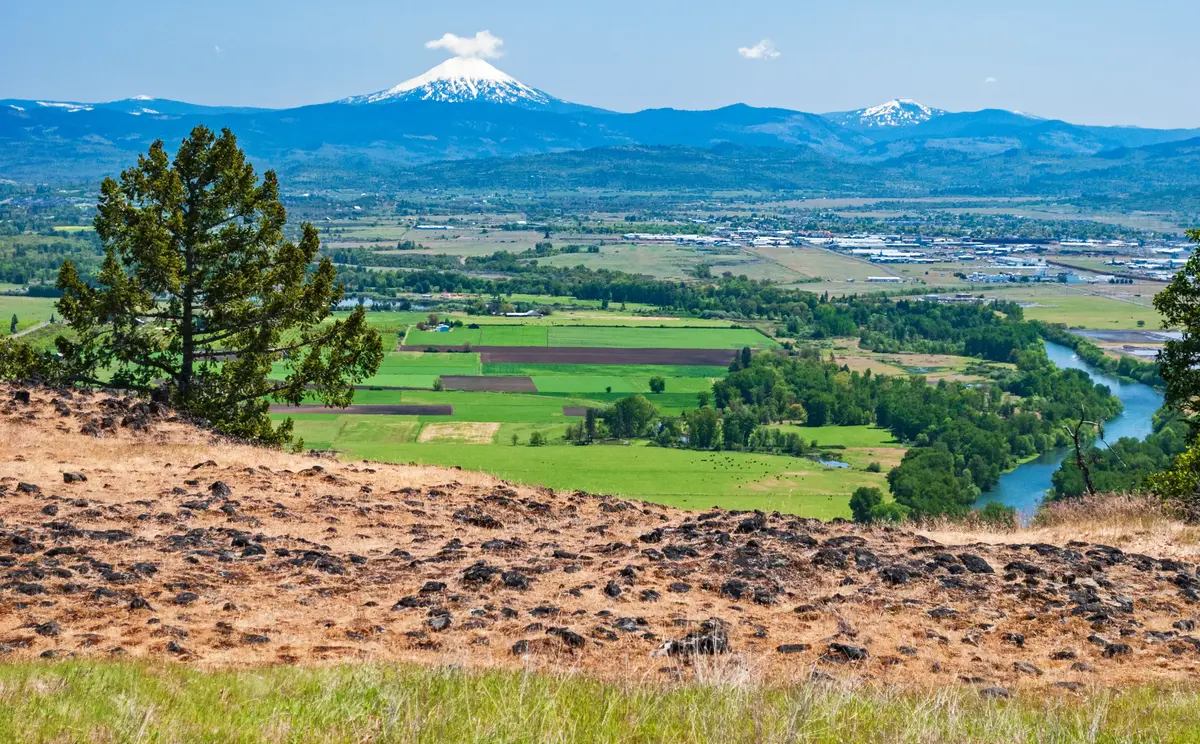
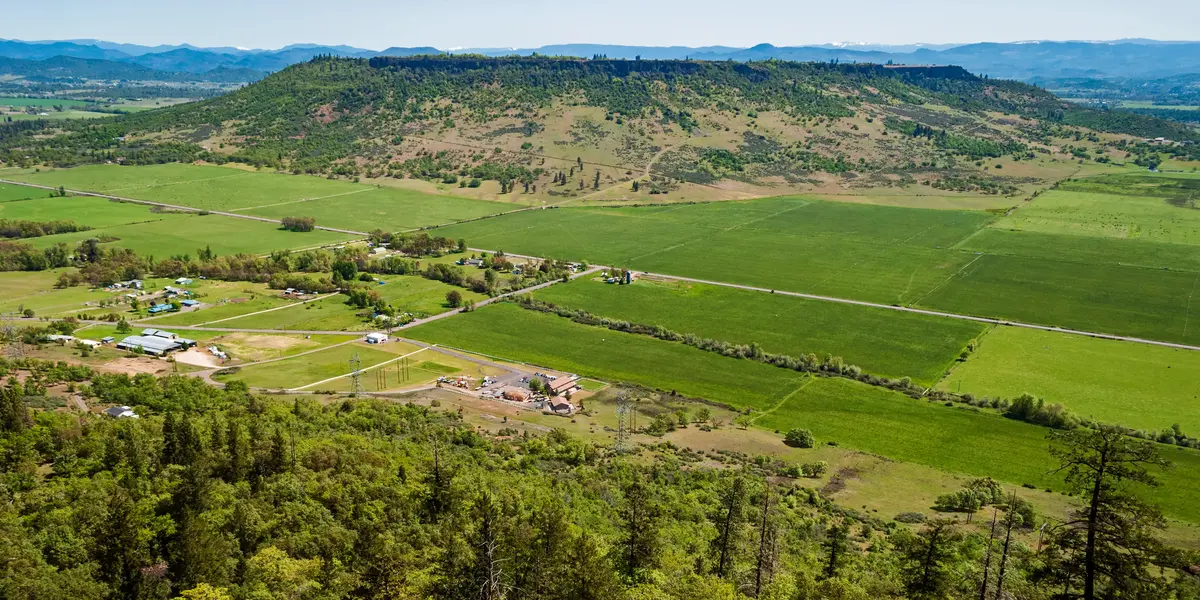
The city also suits retirees who want outdoors access without wilderness remoteness. The Bear Creek Greenway runs from near the Jackson County Fairgrounds right through the heart of the valley, flat enough for daily walking well into older age. Upper and Lower Table Rock rise just outside the city — dramatic hiking landmarks you can see from the street. And Rogue Valley International–Medford Airport is about 3 miles away, making it realistic to stay connected to family in Seattle, Portland, or the Southwest without a brutal drive to catch a flight.
Who should look elsewhere? If walkable urban amenities — a coffee shop at the end of the street, a farmers market downtown, a theater within walking distance — are central to how you picture retirement, Ashland is a more natural fit, and Jacksonville offers historic-downtown character on a smaller scale. Retirees who need the density of a large hospital system with on-campus subspecialties beyond what a regional hospital carries may also want to weigh Eugene or Portland more seriously. Central Point rewards those who want affordability, outdoor access, and a low-key pace more than those who want a walkable cultural district right outside their door.
Healthcare & Medical Access in Central Point
The nearest hospital to Central Point is Providence Medford Medical Center, about 5 miles away. That proximity matters enormously in retirement planning, and the depth of care there goes well beyond what most comparably sized regional hospitals offer.
Providence Medford is a 120-bed acute care, not-for-profit community hospital with emergency services, stroke care, cardiac and vascular care, total joint replacement, spine health, robotic surgery, pain management, and one of the more comprehensive rehabilitation programs in southern Oregon. For retirees, the orthopedic and cardiac capabilities are particularly relevant — these are the procedures that tend to define quality of life in the later decades.
The oncology side is also worth noting. The hospital's Cancer Center holds Commission on Cancer approval from the American College of Surgeons, and its Breast Center carries a Breast Center of Excellence designation from the same body. That is a level of cancer infrastructure you rarely find this close to a city of Central Point's size.
The realistic limitation to name plainly: this is a strong community hospital, not an academic medical center. Highly complex neurosurgery, rare disease management, or pediatric subspecialties that require a quaternary facility will mean a drive to Portland or Eugene — roughly three to four hours by car. That is not unusual for southern Oregon living, and most retirees will never need that level of care. But it is worth knowing before you commit, particularly if you are managing a complex chronic condition that already requires frequent specialist contact.
For day-to-day primary care, specialist visits, and the most common serious health events of retirement, Central Point's proximity to Providence Medford puts it in a genuinely strong position relative to most small Oregon cities.

The Retiree Budget in Central Point
Oregon's tax treatment of retirement income is the first thing to understand, because it cuts both ways. Social Security and Railroad Retirement benefits are fully exempt from Oregon state income tax — a meaningful advantage that many retirees relocating from states that tax Social Security will notice immediately. The exemption is clean and unconditional, regardless of income level.
The catch is everything else. Pension income, 401(k) distributions, and IRA withdrawals are taxed at Oregon's graduated state rates, which run from 4.75% up to 9.9% — among the steeper schedules nationally. A retiree drawing primarily from pre-tax retirement accounts will feel that. A small Retirement Income Credit was previously available to lower-income seniors, but it expired after tax year 2025 and no longer applies. Anyone building a retirement income plan around that credit should confirm the current status directly with the Oregon Department of Revenue.
Property taxes here are manageable. The effective rate runs approximately 0.74%, which is low by Oregon and national standards. Oregon also runs a senior property tax deferral program: homeowners age 62 or older with household income at or below $60,000 (the 2025 threshold, which can adjust annually — confirm with the Oregon Department of Revenue) who have owned and lived in their home for at least five years may defer property taxes until the home is sold. For retirees on tighter fixed incomes, that program can meaningfully reduce monthly cash obligations. Oregon has no state sales tax, which provides steady, quiet savings on every purchase — groceries, prescriptions, home goods — that adds up noticeably over the course of a year on a fixed income.
For the full cost-of-living picture including utilities, groceries, and transportation, see the cost of living page. The engine's mortgage calculator below this section lets you run current purchase scenarios at your own numbers.
Looking to buy in Central Point? Estimate your payment.
Enter your numbers to see an estimated monthly mortgage payment.
Estimate only. Excludes HOA fees and mortgage insurance. The interest rate above is a starting point, not a quoted rate — replace it with your own to see real numbers. Insurance is a flat placeholder, not a Central Point quote.
Walkability, Community & Staying Active in Central Point
The Walkability Reality
Most daily errands in Central Point require a car. The city's commercial areas are spread out in the way that suburban Oregon development tends to produce — functional but not pedestrian-friendly in the traditional sense. A retiree who gives up driving entirely will find it difficult here, and that is an honest thing to know before committing to the move.
That said, the Bear Creek Greenway changes the active-life equation significantly. The 20-mile paved, multi-use trail links Central Point through Medford all the way to Ashland, passing through eight parks along the route. It is flat, well-maintained, and wheelchair-accessible — the kind of infrastructure that makes daily walking or cycling genuinely part of life rather than a project. The greenway's northern terminus sits near the Jackson County Fairgrounds, putting it at the edge of the city for Central Point residents. Twin Creeks Park and Don Jones Memorial Park round out the close-in options for lower-intensity outdoor time.
Senior Community Life
Central Point is a city where community tends to gather around specific anchors rather than a walkable downtown. The Twin Creeks neighborhood, which holds both senior residential communities described in the section below, has walking trails and nearby medical offices that allow residents to handle a good share of health-related errands without a long drive. The Jackson County Fairgrounds and Expo hosts major regional events that pull the whole valley together — a different kind of community rhythm than a monthly farmers market, but a real one.
Volunteering opportunities connect naturally to the school district, the parks system, and county-level organizations. Medford, about 10 minutes away, expands the options considerably: senior centers, arts programs, and organized social groups that Central Point residents can access without relocating. The Rogue Valley is an active outdoor culture — you will find hiking groups, cycling clubs, and river-adjacent recreation that skew toward an older demographic more than you might expect from a small city. For a fuller picture of parks and outdoor programming, the parks and recreation page covers the specifics.
Right-Sizing: Downsizing in Central Point
No 55+ age-restricted communities were found in Central Point. That is an honest gap for retirees who want the specific social and legal structure of a deed-restricted 55+ development — the option simply does not exist within city limits in that form.
What does exist is meaningful. Twin Creeks Retirement Community offers independent living, assisted living, and memory care, with both apartment homes and cottage-style units serving up to 120 seniors. For retirees planning for the full continuum of care in one place, that combination matters. Central Point Retirement Community, in the same Twin Creeks area, provides affordable senior housing with views of Table Rock and Mount McLoughlin. Residents there have access to walking trails, medical offices, retail shops, and on-site amenities including a library/lounge and a community room — a notably complete package for a smaller senior housing development. Alderwood Assisted Living is a separate facility serving up to 64 seniors, focused on assisted living and memory care with individualized care plans.
Beyond those communities, the broader Central Point housing stock includes the kind of single-story ranch homes on modest lots that downsizers tend to prioritize — built-out neighborhoods like Twin Creeks, Cascade Meadows, and New Haven Estates include flat, single-level homes that suit aging-in-place well. Patio homes and smaller footprint properties exist, though the market here is not saturated with them the way a purpose-built retirement town might be. Buyers looking specifically for single-level construction should be explicit with any agent about that requirement, since two-story homes are common throughout the city's newer subdivisions.
For neighborhood-by-neighborhood character and what the housing stock actually looks like across each area, the best neighborhoods page breaks it down in detail.
Central Point vs Nearby Retirement Destinations
| City | Cost vs Central Point | Primary Hospital | Walkability | Senior Living Depth | Overall Retirement Fit |
|---|---|---|---|---|---|
| Central Point | Anchor | Providence Medford ~5 mi, strong specialty depth | Car-dependent for errands; excellent greenway access | Two senior communities, assisted living on-site; no 55+ deed-restricted | Strong value, good healthcare proximity, quiet pace |
| Medford | About the same | Providence Medford on-campus; additional facilities in city | More commercial density; still largely car-dependent | Wider range of senior housing and care options | Best for retirees who want more services without leaving the valley |
| Jacksonville | Pricier | Relies on Medford (~8 mi) | Genuinely walkable historic downtown; small footprint | Limited; most seniors draw on Medford resources | Best for retirees who prioritize historic character and walkable charm |
| Ashland | Pricier | Relies on Medford (~17 mi) | Most walkable in the valley; arts and dining on foot | More senior housing options than Central Point | Best for culturally active retirees; higher cost is the trade |
| Eagle Point | Somewhat higher | Relies on Medford (~10 mi) | Rural feel; car essential | Limited in-city options | Appeals to retirees wanting space and quiet over amenity access |
| Gold Hill | Noticeably lower | Relies on Medford (~15 mi) | Very limited; small town | Minimal formal senior infrastructure | Best for retirees prioritizing low cost above everything else |
Central Point holds an unusual middle position in this comparison: it is not the cheapest option — Gold Hill undercuts it clearly — but it offers hospital proximity that none of the smaller towns can match on their own. Jacksonville and Ashland beat it on walkable downtown character, and both carry a higher price for that privilege.
Medford is the most direct competitor. At roughly the same cost, it gives you more commercial density and puts you directly adjacent to Providence Medford rather than 5 miles out — the difference matters if you are managing a health condition that requires frequent visits. Central Point makes the most sense for retirees who want a slightly quieter address while staying tethered to Medford's infrastructure, rather than living inside it.
For retirees who genuinely need the most walkable daily life in southern Oregon, Ashland is the honest answer — but the cost premium is real and the hospital drive is longer. Central Point is the call for buyers who want affordability, a solid greenway, good healthcare access, and a low-key community without paying Ashland prices for it.
Local Expert Takeaway: Central Point's retirement case rests on three things working together: a typical home price well below most of the Pacific Northwest, Providence Medford Medical Center about 5 miles out with genuine specialty depth, and the Bear Creek Greenway giving you 20 miles of flat, paved trail from your back door toward Ashland. The city is not walkable for errands and has no deed-restricted 55+ community, so anyone who needs either should weigh Ashland or Medford directly. But for retirees coming out of higher-cost markets who want to own something outright, stay active outdoors, and keep a strong hospital within a short drive, Central Point delivers a package that the Rogue Valley doesn't often get credit for.
Quick Takeaways & FAQs
✅ Providence Medford Medical Center, about 5 miles away, covers emergency care, cardiac and vascular procedures, total joint replacement, and a Commission on Cancer-approved oncology program — strong regional infrastructure for a city of 19,171.
⚠️ Oregon exempts Social Security from state income tax, but pension and IRA distributions face rates up to 9.9% — retirees drawing heavily from pre-tax accounts will feel that, and the Retirement Income Credit that helped lower-income seniors expired after tax year 2025.
📍 The Bear Creek Greenway's northern trailhead sits near the Jackson County Fairgrounds, giving Central Point residents flat, paved access to a 20-mile multi-use trail that runs all the way to Ashland — one of the best walkable-without-a-car amenities in the valley.
Is Central Point a good place to retire on Social Security alone?
What is the closest hospital to Central Point?
Are there 55+ communities in Central Point?
How does Oregon's tax situation affect retirees in Central Point?
What do retirees in Central Point typically do for daily activities and socializing?
Moving to Oregon?
Tell us what you need help with and we'll connect you with local resources.
