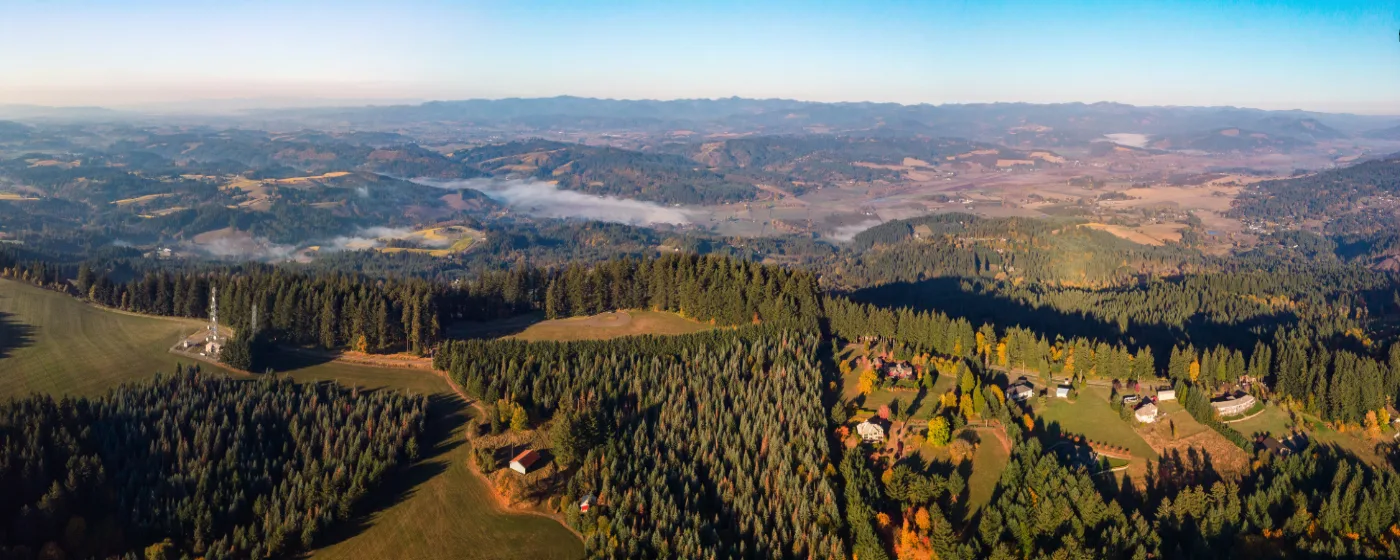
People researching Aloha almost always ask the same question before anything else: is it safe? The honest answer is that Aloha sits in the middle of the Portland metro safety spectrum — not the cleanest record in Washington County, not the worst — and the more useful question is where in Aloha, because the southwest corner and the central corridor are genuinely different stories. Understanding that internal geography matters more than any single city-wide statistic.
Aloha is a census-designated place with a population of 52,389, which shapes its safety picture in a specific way: it has no municipal police department. Policing falls to the Washington County Sheriff's Office, which serves the area through the Enhanced Sheriff's Patrol District (ESPD) — a voter-funded program that delivers 911 response, major-crime investigation, crisis intervention, and community outreach across Aloha and neighboring unincorporated communities. The Sheriff's Office has held continuous national accreditation from the Commission on Accreditation for Law Enforcement Agencies (CALEA) since 2004. Sheriff Caprice Massey has described the ESPD as "an important reason we call Washington County the safest major urban county in Oregon."
The crime numbers bear out a mixed but manageable picture. Aloha records a violent crime rate of 2.9 per 1,000 residents and a property crime rate of 20.8 per 1,000 residents. Those figures sit below Oregon state averages on the violent side and below state averages on property crime as well, though property crime runs noticeably higher than the national figure. The comparison table below puts those numbers in context. Fire protection and emergency medical services come from Tualatin Valley Fire and Rescue, and for healthcare emergencies, a regional medical center is approximately 3 miles away.
This guide breaks down Aloha's crime statistics against state and national benchmarks, explains the law enforcement structure that serves the community, walks through the neighborhood-level variation that city-wide rates can mask, covers practical steps for evaluating safety in a specific area, and addresses the livability questions that come up most often from people considering a move here.
Aloha Crime Rates in Context
Aloha records a violent crime rate of 2.9 per 1,000 residents and a property crime rate of 20.8 per 1,000 residents — both below Oregon's state averages. Oregon's violent crime rate runs at 3.3 per 1,000 and its property crime rate at 24.5 per 1,000. Against national figures, Aloha's violent crime rate also comes in below the national rate of 3.7 per 1,000. Property crime is the category where Aloha diverges from the national picture: the national rate of 18.4 per 1,000 is meaningfully lower, and Aloha records a property crime rate of 20.8 per 1,000 residents.
That property crime gap deserves honest attention. It does not mean residential neighborhoods are uniquely at risk. Crime-pattern analysis consistently shows that property crime in communities like Aloha concentrates along higher-traffic commercial and retail corridors — the kind of areas where more vehicles, more foot traffic, and more opportunity converge. Residential streets in the quieter parts of the community tend to look quite different from what the aggregate rate suggests.
The violent crime picture is the more reassuring half of the data. With a violent crime rate of 2.9 per 1,000 residents, Aloha comes in below both the state and national comparisons. For context, that rate is lower than many incorporated cities of similar size in the Portland metro. The combination of a CALEA-accredited Sheriff's Office, the ESPD's dedicated patrol structure, and Washington County's broader safety record gives Aloha a law enforcement foundation that punches above what the raw numbers might imply.
What the Comparison Table Tells You
The engine-rendered comparison table that follows this section shows Aloha against Oregon and national benchmarks side by side. The key takeaway: on violent crime, Aloha outperforms both state and national averages. On property crime, it outperforms the state but runs above the national rate. Neither figure tells you much about the block you are considering — that context comes in the next section.
How Aloha Is Policed — and Why It Matters
One of the first things people learn when they research Aloha is that it has no city hall, no mayor, and no municipal police department. Because Aloha is an unincorporated community, Washington County Sheriff's Office carries the full law enforcement responsibility here. For some newcomers that sounds like a downgrade. The reality is more nuanced.
The Enhanced Sheriff's Patrol District
Aloha sits inside the Enhanced Sheriff's Patrol District, a voter-approved, levy-funded program that brings service levels comparable to what incorporated cities receive. The ESPD covers more than 240,000 residents across urban unincorporated Washington County — Aloha, Bethany, Cedar Hills, Reedville, Rock Creek, and others — with 130 dedicated Sheriff's Deputies. The levy funds a Mental Health Response Team alongside traditional patrol, which matters for how the community handles calls that involve behavioral health crises rather than criminal activity.
Patrol is structured around 14 geographic beats, each with a lieutenant, sergeant, and assigned deputies. Beat deputies are expected to know their area — working with schools, community groups, and residents rather than cycling through as anonymous patrols. That structure is what makes the ESPD more than a contract arrangement; it creates accountability at the neighborhood level.
What This Means Practically
When you call 911 in Aloha, the Washington County Sheriff's Office responds. The CALEA accreditation the office has held since 2004 is a meaningful benchmark — it requires agencies to meet more than 480 professional standards and submit to periodic external review. That is not a claim every county in Oregon can make.
The September 2025 focused mission in Aloha — which brought in detectives from the Westside Interagency Narcotics team and the Washington County Community Violence Reduction Team to address drug-activity livability concerns — illustrates both sides of the picture. Drug-related activity is a real and acknowledged issue in parts of Aloha. It also shows a Sheriff's Office that deploys specialized resources to address it rather than leaving it to standard patrol alone.

Neighborhood Safety: Where the Numbers Land in Aloha
| Measure | Aloha | Oregon | National | vs. national |
|---|---|---|---|---|
| Violent crime (per 1,000) | 2.9 | 3.3 | 3.7 | 22% lower |
| Property crime (per 1,000) | 20.8 | 24.5 | 18.4 | 13% higher |
State and national figures — Bureau of Justice Statistics, Crime Known to Law Enforcement, 2024 (tables 2 and 3). City figures — AreaVibes (FBI Uniform Crime Reports, 2024). City rates come from a different reporting series than the state and national benchmarks, so read the comparison as a direction, not a precise multiple.
City-wide crime rates are the starting point, not the answer. The internal geography of Aloha creates meaningful variation, and understanding that variation is the most useful thing a prospective resident can do before settling on a specific area. For a full neighborhood character breakdown, see the best neighborhoods in Aloha guide.
The Southwest: Cooper Mountain and the Quieter Edge
The southwest portion of Aloha — anchored by the Cooper Mountain – Aloha North and Cooper Mountain – Aloha South neighborhoods — is consistently identified as the most settled and lowest-incident part of the community. Proximity to Cooper Mountain Nature Park and the topography of the area keeps density lower and through-traffic limited. Families who prioritize a quieter residential environment generally land here.
Copperwood and Cross Creek, also in the western reaches, share a similar profile: newer construction, lower traffic volumes, and the kind of neighborhood texture — neighbors who recognize each other, cul-de-sacs that dead-end rather than cut through — that tends to correlate with lower property crime rates.
Central and Eastern Aloha: A Different Calculation
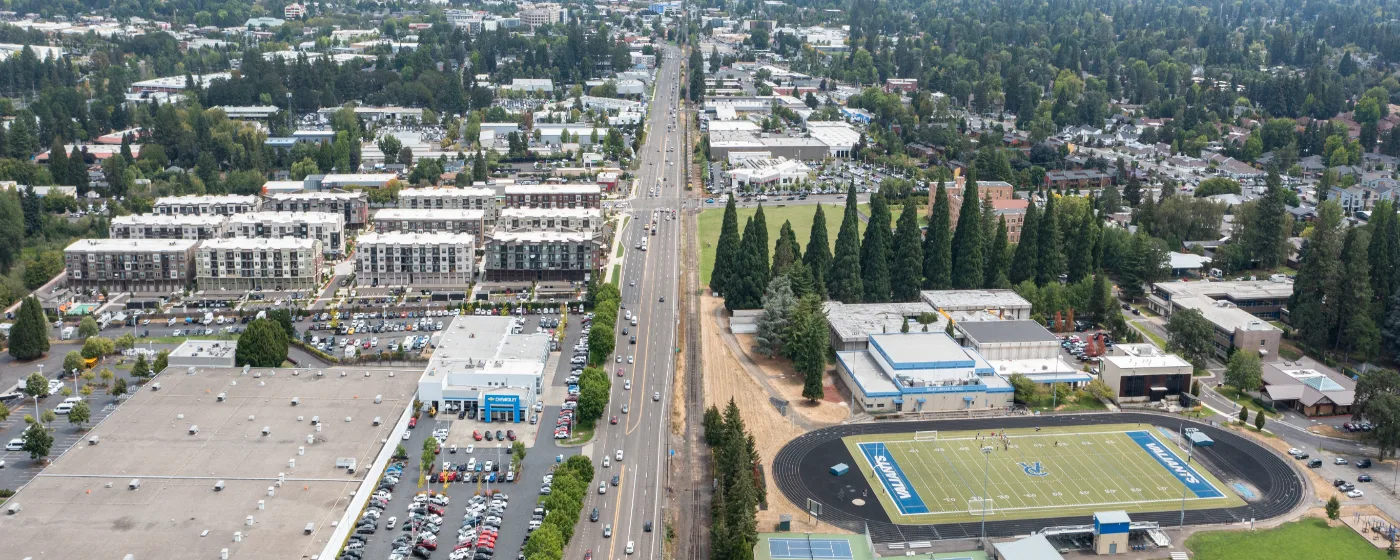
Central Aloha, including Five Oaks and the areas near the main commercial corridors along OR-8 (Tualatin Valley Highway), sees higher incident counts. Some of that is retail-corridor inflation — property crime reported at commercial addresses inflates the per-resident rate for surrounding neighborhoods even when the residential streets themselves are unremarkable. That is the same dynamic seen in retail-dense areas across the metro, not something specific to Aloha.
Bany Hill and East Hillsboro, on the eastern edge of Aloha, sit closer to the transition between Aloha and Hillsboro proper. These are established, working neighborhoods — not high-crime by any objective measure, but more activity than the quieter western side. Reedville sits at the southern fringe and shares characteristics with both the calmer western areas and the busier central corridor, depending on the specific block.
The Practical Read
The southwest is the safest corner by pattern data. Central Aloha is more mixed, with commercial-area activity inflating the aggregate picture. Eastern Aloha is solidly middle-ground. None of this makes any part of Aloha a place to avoid outright — the violent crime rate across the whole community is below state and national averages — but it is the kind of internal differentiation that matters when you are choosing between two specific neighborhoods a half-mile apart.
Looking to buy in Aloha? Estimate your payment.
Enter your numbers to see an estimated monthly mortgage payment.
Estimate only. Excludes HOA fees and mortgage insurance. The interest rate above is a starting point, not a quoted rate — replace it with your own to see real numbers. Insurance is a flat placeholder, not a Aloha quote.
Livability Concerns: The Honest Picture
Six months after moving to Aloha, the thing residents most commonly mention is not what they expected from the crime statistics: it is the visible presence of drug activity in specific pockets of the community, particularly along the main commercial corridors. The September 2025 Sheriff's Office focused mission — publicly announced and targeted at locations with frequent illegal drug activity — confirms this is an acknowledged and active issue, not a rumor. That kind of transparency from the Sheriff's Office is worth noting: it signals a department that names problems rather than managing impressions.
The ESPD levy funds a Mental Health Response Team precisely because many of these livability calls are behavioral health situations that a traditional law enforcement response handles badly. That team exists, it is operational, and it is the kind of infrastructure that separates Washington County from smaller counties that still send patrol officers to every call regardless of its nature.
What Residents Do About It
The Washington County Sheriff's Office runs a Neighborhood Watch program with a practical design: residents connect with a dedicated Outreach Specialist who helps develop a specific action plan for their block rather than simply handing out brochures. Beat deputies also engage directly with community groups and residents in their assigned areas. Residents who participate consistently describe a responsive relationship with their assigned deputies — not a distant agency that shows up after the fact.
The Aloha Community Farmers' Market and Aloha Community Park both serve as informal community anchors where neighbors recognize each other and where the social texture of a neighborhood becomes visible. That kind of community cohesion is not a crime-prevention program, but it is one of the most consistent predictors of neighborhood resilience in areas navigating livability challenges.
Tualatin Valley Fire and Rescue handles emergency medical response, and its coverage area includes Aloha. Response infrastructure here is not the gap; the livability challenges that exist are concentrated, specific, and well-mapped by the agencies that work them.
How to Evaluate Safety Before Choosing a Neighborhood
The most common mistake people make when researching safety is stopping at the city-wide rate. That number tells you roughly where Aloha sits relative to Oregon and the nation — useful context, not a neighborhood verdict. Here is how to go deeper before committing to a specific area.
Use Pattern Data, Not Just Rates
The southwest-to-central gradient in Aloha is directional but real. Neighborhoods near Cooper Mountain Nature Park and along the quieter western side of the community consistently show lower incident patterns than central or eastern areas. When you are narrowing down to two or three blocks, the beat-level structure of Sheriff's Office patrol means that asking deputies directly about activity in a specific area is a reasonable and often productive step — they are assigned to know their beat, not just respond to it.
Look at What Surrounds the Property
A house on a residential street in Five Oaks is not the same safety picture as a property backing up to a commercial corridor. The retail-corridor inflation effect on property crime is well-documented: incidents at commercial addresses get reported for the surrounding area, pulling up its aggregate rate. If a neighborhood's rate looks elevated, check whether the surrounding land use explains it before drawing conclusions about the residential streets themselves.
Talk to the ESPD
Washington County Sheriff's Office is unusually accessible for an agency of its size. Residents can contact a Neighborhood Watch Outreach Specialist directly, and beat deputies attend community events in their assigned areas. If you are seriously considering a specific neighborhood, reaching out before you decide — not after — is a legitimate and underused step. A five-minute conversation with a beat deputy can tell you more about a block than several hours of online research.
Factor in the Broader Infrastructure
CALEA accreditation, a Mental Health Response Team, 130 ESPD-dedicated deputies, and a Sheriff's Office that conducts and publicly reports focused missions on livability concerns — that is the structural context behind Aloha's numbers. For a community of 52,389 without a municipal police department, it is a more robust safety infrastructure than the unincorporated designation might suggest. For more on daily life and what the community actually feels like to live in, the living in Aloha guide covers that ground in full.
Local Expert Takeaway: Aloha records a violent crime rate of 2.9 per 1,000 residents, which sits below both Oregon and national averages — and the Washington County Sheriff's Office, backed by the ESPD levy and CALEA accreditation since 2004, delivers a more structured law enforcement presence than the unincorporated label might suggest. The real safety story in Aloha is geographic: the southwest, including neighborhoods near Cooper Mountain, is notably quieter than the central and eastern corridors where commercial-area activity inflates the aggregate numbers. Property crime running above the national rate is the honest downside, and drug-related livability concerns in specific pockets are real and acknowledged by the Sheriff's Office itself. Buyers who prioritize safety should look at the western neighborhoods first and take the time to speak with a beat deputy about the specific block they are considering — that conversation is more useful than any aggregate statistic.
Quick Takeaways & FAQs
✅ Aloha records a violent crime rate of 2.9 per 1,000 residents, coming in below both the Oregon state average and the national average.
⚠️ Property crime runs above the national rate, with activity concentrated along commercial corridors rather than quiet residential streets — the aggregate figure overstates the risk on most neighborhood blocks.
📍 The southwest corner of Aloha, particularly near Cooper Mountain, is consistently identified as the community's safest area by crime-pattern data.
Does Aloha have its own police department?
How does Aloha's crime rate compare to the rest of Oregon?
Which part of Aloha is considered the safest?
Is drug activity a problem in Aloha?
What emergency services cover Aloha residents?
Moving to Oregon?
Tell us what you need help with and we'll connect you with local resources.
