
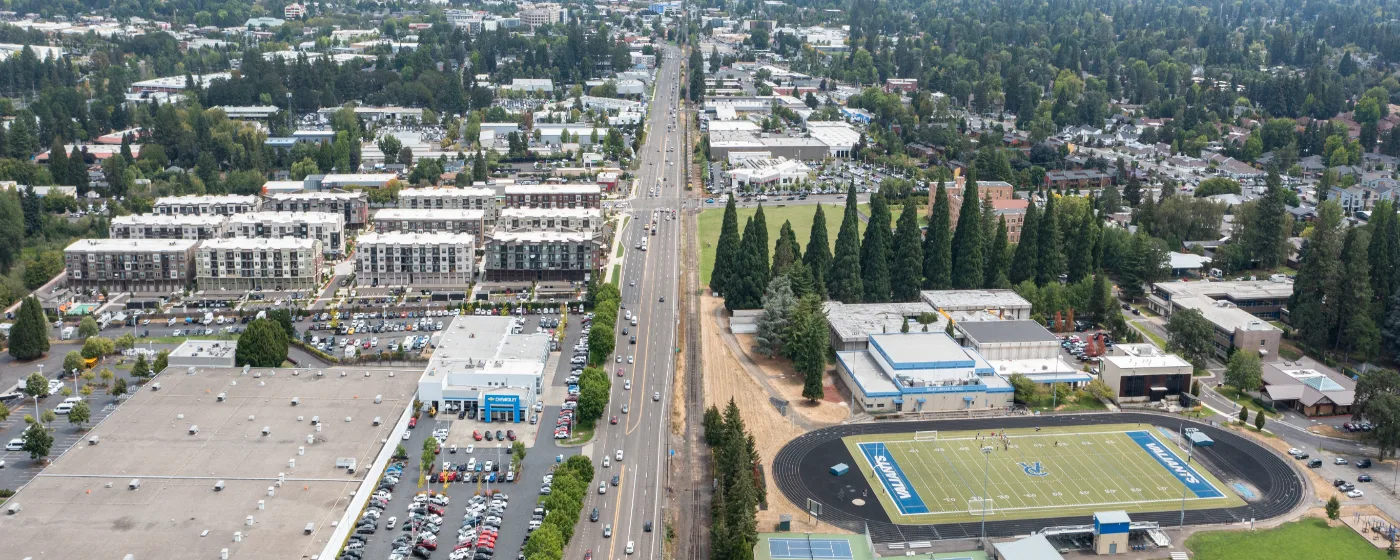
Maybe you've been priced out of Beaverton and someone mentioned Aloha. Maybe you're relocating to the Portland Metro and trying to figure out which side of Washington County actually fits your budget. Aloha — an unincorporated community of 52,389 people sitting along OR-8 (Tualatin Valley Highway) about 11 miles west of downtown Portland — occupies an interesting position: it's priced below its better-known neighbors but still well above the national average, and that gap surprises buyers who arrive expecting a true budget option. Housing is the engine that drives everything. The Zillow Home Value Index puts the typical home at $493,280 as of May 2026, and that number shapes every other financial decision you'll make here.
The economic backbone of the surrounding area is genuinely strong. Intel's semiconductor campus, Nike's headquarters, and Kaiser Permanente all draw workers to Washington County, and the Beaverton School District — which holds an A- rating, according to Niche — serves Aloha students. Median household income in Aloha runs $101,934, which is a solid number, but it still falls short of what a conventional buyer needs to comfortably carry the typical home here. That affordability tension is real, and it's worth understanding before you start making offers. Many residents are dual-income households, remote workers, or buyers who relocated from higher-cost metros and found Aloha's prices genuinely manageable by comparison.
On the lifestyle side, no state sales tax takes some of the sting out of everyday spending — groceries, clothing, and household goods clear the register at sticker price. Oregon does collect a meaningful state income tax, so take-home pay feels the difference. Utilities run modestly above the national average, and most errands here require a car; transit exists along the OR-8 corridor but won't replace a vehicle for most households. The tradeoff for driving is that OR-8 and OR-10 get you to Portland's employment centers in about 30 minutes on a normal day, which is a reasonable commute by metro standards.
Whether you're weighing a purchase against renting, trying to compare Aloha's sticker price against Beaverton or Hillsboro, or just trying to build an honest monthly budget, the sections below break down housing costs, everyday expenses, the nearby-city comparison, and the tax picture that makes Oregon different from most of the country.

What It Really Costs to Live in Aloha
Aloha sits about 26% above the national cost-of-living average, and housing is doing most of that work — tracking roughly 80% above the national housing baseline. That's not a Portland anomaly or a luxury-market story; it's what happens when a mid-sized unincorporated community sits inside one of the Pacific Northwest's most in-demand labor markets. Workers at Intel, Nike, and the major health system nearby need somewhere to live, and Aloha absorbs a lot of that demand at prices that are at least somewhat more accessible than Beaverton or Hillsboro.
Compared to those neighbors, Aloha comes in noticeably lower. Beaverton runs somewhat higher on typical home prices, and Hillsboro runs somewhat higher as well — Aloha's position as the more affordable edge of Washington County is real, not marketing copy. Against the state of Oregon as a whole, Aloha is roughly in line with the broader Portland Metro, which is to say: elevated. Against the national average, the gap is significant.
What keeps the overall number from feeling catastrophic is what Oregon does not charge. There is no state sales tax — none on groceries, clothing, or hardware. Utilities run only modestly above the national norm. And the effective property tax rate of approximately 0.84% is below the national median, which matters at this price point. The income tax is where Oregon takes its share, and it takes a meaningful one. The full picture is a city where housing sets the ceiling, the tax structure shifts the load, and everything else stays relatively close to national norms.
Housing: Rent vs Buy in Aloha
The typical home in Aloha was priced at $493,280 as of May 2026 (Zillow Home Value Index). Entry-level inventory — older ranch-style homes, smaller mid-century builds — can be found below that figure, while newer construction and larger family homes push well above it. For neighborhood-by-neighborhood character, the best neighborhoods guide covers the distinctions across Aloha's communities in detail.
The effective property tax rate in Aloha is approximately 0.84%. At the typical home price, that's a notably lower annual tax burden than buyers coming from many parts of California, Texas, or the Midwest might expect. Washington County's rate is among the more favorable in the Portland Metro, and it provides a real offset to the above-average purchase price. The engine below this section will show you how that rate, combined with current financing terms and a down payment, translates into a monthly obligation — the calculator is the right tool for that math.
The honest case for renting is straightforward: the median household income of $101,934 sits below what a buyer typically needs to carry the typical home here. Dual-income households and buyers bringing equity from a prior sale are the most natural fit for ownership in this market. Renters get flexibility, lower upfront costs, and no maintenance exposure — but they also miss the property tax advantage and the equity position in a market where prices have historically tracked the broader Portland Metro upward.
One thing newcomers sometimes underestimate: the down payment threshold at this price point is significant, and buyers who move here from lower-cost markets without existing equity sometimes find the entry hurdle more demanding than the monthly payment alone suggests. If you're evaluating financing options for the first time in Oregon, the first-time homebuyer guide covers programs and mechanics specific to this market.
What Renters Are Paying
The rental market in Aloha is tighter than the home-purchase market for a simple reason: the same demand that drives purchase prices also competes for apartments and rental homes. Two-bedroom units in the broader area range from modest older complexes to newer suburban construction, and vacancy stays low enough that well-priced rentals rarely sit. The engine below the comparison section carries current rent figures updated from the source data.

Everyday Costs Beyond Housing in Aloha
| Category | Typical Monthly Cost | Notes |
|---|---|---|
| Utilities | $190–$270/mo | Electricity, gas, water, sewer, trash |
| Groceries | $580–$780/mo | Food at home, household of 2–3 |
| Transportation & Gas | $200–$340/mo | Fuel, and transit where it is a real option |
| Phone & Internet | $110–$180/mo | Mobile plan plus home broadband |
| Misc / Discretionary | $250–$480/mo | Dining out, entertainment, subscriptions |
Non-housing figures are estimates for a household of two to three, not a sourced index; housing is the city-wide typical rent. Refreshed with the rest of the city data.
Oregon's 141 sunny days a year means the Portland Metro — Aloha included — runs cooler and wetter than most of the country for a good chunk of the year. Natural gas heating costs are a real line item from November through March, and electric bills, while close to the state average, carry the weight of a Pacific Northwest winter. The statewide baseline for electricity runs approximately $150–$153 per month, with water and sewer adding around $76 and trash removal around $30 — putting a combined utility baseline in the $260–$280 range before internet or gas. Aloha's utility index runs about 3.8% above the national average, which is a modest premium rather than a shock.
Groceries in the Portland Metro run roughly 7–8% above the national average — a real premium, but one that the absence of sales tax partially softens. You're paying more for the items themselves, but nothing extra at the register. Most Aloha households rely on personal vehicles for everything: OR-8 and OR-10 connect the community to the broader metro, and TriMet's bus service along the corridor connects to MAX Light Rail for those who can work the schedule. Transportation costs track about 3.5% above the national average, driven by insurance, fuel, and the commute miles that suburban living requires. One friction point that catches newcomers off guard: late-evening bus service on the main corridor line was reduced in late 2025, so transit-dependent households need to plan around that limitation more carefully than they might have a year earlier.
Looking to buy in Aloha? Estimate your payment.
Enter your numbers to see an estimated monthly mortgage payment.
Estimate only. Excludes HOA fees and mortgage insurance. The interest rate above is a starting point, not a quoted rate — replace it with your own to see real numbers. Insurance is a flat placeholder, not a Aloha quote.
Aloha vs Nearby Cities: Cost Comparison
| City | Typical Home Price | Typical Rent | Cost vs Aloha |
|---|---|---|---|
| Aloha (this city) | $493,280 | — | — |
| Beaverton | $527,947 | $1,880/mo | 7% higher |
| Hillsboro | $518,047 | $1,946/mo | 5% higher |
| Cornelius | $485,070 | $2,357/mo | About the same |
Source — home prices: Zillow ZHVI, May 2026. Nearby-city figures are the same series, refreshed together.
Aloha holds a genuine price advantage over its immediate neighbors — the table below shows how the typical home price and rent stack up against Beaverton, Hillsboro, and the other communities buyers most often consider alongside it.
Taxes & the Bottom Line for Aloha
The Oregon Tax Structure
Oregon's income tax is the defining feature of the state's fiscal picture. Four progressive brackets apply for tax year 2025, ranging from 4.75% at the low end to 9.90% on taxable income above $125,000 for single filers — a top marginal rate that sits among the highest in the country. Because there is no sales tax, the income tax does the heavy lifting for state revenue, which means take-home pay reflects Oregon's structure more directly than it would in a state that splits the load.
For a household earning $101,934 — the Aloha median — the effective income tax rate lands in the middle brackets, not the top. But any household with two earners or significant W-2 income will feel the Oregon rate in a way that surprises people relocating from income-tax-light states like Washington or Nevada.
Property Tax: The Bright Spot
The effective property tax rate of approximately 0.84% is meaningfully below the national median and represents real money at the price point described above. Washington County's rate structure has historically been more restrained than the national norm, and that restraint provides a genuine offset to the area's above-average home values. Buyers moving from high-property-tax states — Illinois, New Jersey, Texas — often find this the most pleasant surprise in the Oregon tax picture.
No Sales Tax — For Real
Oregon's sales-tax-free status isn't a technicality. Groceries, clothing, furniture, hardware, cars — none of it carries a sales tax line. For a household spending meaningfully on consumer goods, the savings are real and recurring. It doesn't close the gap created by high home prices, but it does reduce the monthly friction on everyday spending in a way that residents consistently notice.
Who Aloha's Budget Actually Fits
Aloha makes the most financial sense for dual-income households, buyers bringing equity from a prior sale, and remote workers who can command salaries from higher-cost markets while living on Aloha's side of the price curve. Buyers who find Beaverton or Hillsboro priced just out of reach often land here and find the tradeoff — slightly longer drives to some amenities, an unincorporated rather than incorporated city — worth the savings. Single-income buyers near the median income tend to find the entry point a stretch, particularly at current financing rates, and the first-time homebuyer page covers the programs that can help close that gap. For anyone still comparing Aloha to a California baseline, the full picture — no sales tax, low property tax rate, and home prices well below the Bay Area or Southern California — makes the case quickly; the moving-from-California guide works through that comparison in depth.
Local Expert Takeaway: Aloha's cost story comes down to one honest tension: housing is the number that strains most budgets, and the things Oregon does well — no sales tax, a low property tax rate, a real transit corridor on OR-8 — help at the margins but don't close that gap alone. Households who arrive with equity, a dual income, or a remote salary from a pricier market tend to feel at home here quickly. Those stretching to buy on a single income near the median will need to run the numbers carefully, factor in financing costs at the current rate, and likely look hard at the entry-level inventory before committing.
Quick Takeaways & FAQs
✅ Oregon's 0% sales tax means every grocery run, hardware store trip, and clothing purchase rings up at sticker price — a genuine everyday savings that adds up over the year.
⚠️ The typical Aloha home priced at $493,280 (May 2026) sits above what the median household income comfortably supports on a single salary, making dual-income or equity-backed buyers the natural fit for ownership here.
📍 TriMet's bus corridor along OR-8 connects Aloha to MAX Light Rail and Portland, but late-evening service was reduced in 2025 — most residents should plan around car ownership rather than transit alone.
How does the cost of living in Aloha compare to Portland?
What is the property tax rate in Aloha, Oregon?
Does Oregon have a sales tax that affects everyday costs in Aloha?
Is it cheaper to rent or buy in Aloha right now?
How much do utilities cost in Aloha, Oregon?
Moving to Oregon?
Tell us what you need help with and we'll connect you with local resources.
