
South Texas Border · Best Places to Retire · 2026
Best Places to Retire in South Texas Border — Every City Ranked
Cities ranked on healthcare access, walkability, affordability, climate, and overall quality of life for retirees.
Cities ranked on healthcare access, walkability, affordability, climate, and overall quality of life for retirees.
Choosing a place to retire along the South Texas border is genuinely different from choosing a suburb of a Sun Belt metro. The Rio Grande Valley and the cities strung along the river corridor share the same broad geography — flat, sunny, close to Mexico — but the retirement experience varies enormously from one city to the next. Some places have a full-service regional hospital within walking distance; others require a causeway or a long drive when a health emergency hits. Some offer a walkable downtown where you can meet neighbors on foot; others are built entirely around the car. That spread, not just the sticker price of a home, is what shapes whether a retiree will thrive here or quietly regret the move.
What ties these cities together is affordability that is hard to find elsewhere in Texas — home prices across most of this corridor sit well below statewide norms, and the mild Gulf-influenced winters draw thousands of so-called Winter Texans every year. What separates them is the depth of services that surround that low price. The cities with full urban infrastructure — hospitals, walkable districts, cultural anchors — tend to draw retirees who want a settled, year-round life. The smaller and more remote towns suit buyers willing to trade amenity density for quiet and exceptional value. The sections below cover each city's healthcare picture, walkability, climate trade-offs, lifestyle options, and available retirement communities, so you can match the right place to what retirement actually looks like for you.
Each city is scored 1-10 on every dimension below against a fixed statewide scale — never against the other cities in this region — then combined into one weighted Composite score out of 10.
Ranked by overall composite score. Click any city to jump to the full breakdown.
| # | City | Composite | Healthcare | Walkability | Median Price |
|---|---|---|---|---|---|
| 1 | Mission Hidalgo County | 8.9/10 | 10 | 10 | $218,831 |
| 2 | Weslaco Hidalgo County | 8.7/10 | 10 | 8 | $176,825 |
| 3 | Brownsville Cameron County | 8.5/10 | 8 | 10 | $196,626 |
| 4 | McAllen Hidalgo County | 8.5/10 | 10 | 10 | $228,710 |
| 5 | Harlingen Cameron County | 7.8/10 | 8 | 8 | $200,595 |
| 6 | Laredo Webb County | 7.2/10 | 8 | 6 | $223,127 |
| 7 | Edinburg Hidalgo County | 7.1/10 | 10 | 2 | $216,017 |
| 8 | Eagle Pass Maverick County | 6.8/10 | 8 | 6 | $222,003 |
| 9 | Del Rio Val Verde County | 6.8/10 | 8 | 6 | $208,595 |
| 10 | Rio Grande City Starr County | 6.8/10 | 8 | 6 | $147,646 |
| 11 | San Juan Hidalgo County | 6.3/10 | 6 | 6 | $180,294 |
| 12 | Pharr Hidalgo County | 6.2/10 | 6 | 6 | $163,130 |
| 13 | Alamo Hidalgo County | 5.7/10 | 6 | 4 | $173,228 |
| 14 | South Padre Island Cameron County | 5.3/10 | 4 | 4 | $451,700 |
#1 Top Overall · Hidalgo County
Best for retirees who want healthcare, walkability, and proven community options.
Mission sits at the heart of the Rio Grande Valley with a $218,831 typical home price, making it one of the more affordable mid-size cities in Texas while still offering the full infrastructure of a real urban place. A hospital is right in town, and the regional medical hub is a short drive away — retirees here are not guessing about emergency care. Downtown Mission gives the city a genuine walkable core, and enough density to support independent restaurants, parks, and everyday errands on foot. Winters here are reliably mild and sunny, though anyone considering this move should understand that summer heat is the honest price of those pleasant February mornings. Established retirement communities including Aladdin Villas, La Hacienda, and Retama Village at Bentsen Palm give retirees structured options if they want neighbors in the same life stage.
Mission suits retirees who want the full package — healthcare close to home, a real downtown, proven affordability — without sacrificing the settled, community feel that makes a place actually livable year-round. Compared to some of the smaller towns in this region, Mission offers a noticeably more urban daily rhythm, which works well for retirees who are used to having things within reach and do not want to spend retirement behind the wheel.
#2 Top Healthcare · Hidalgo County
Best for budget-focused retirees who want a real town with healthcare in reach.
Weslaco carries a $176,825 typical home price, reflecting a market built around local wages and a community that has not been repriced by outside demand. A full-service hospital is located in town, and the regional medical center is a short drive east — healthcare access here is genuinely strong for a city of this size. Downtown Weslaco has a real commercial core, and the city's population supports neighborhood amenities that make daily errands manageable without a long drive. The birding parks along the wildlife corridor are a particular draw for retirees who want outdoor recreation woven into everyday life, not just a weekend trip. The honest trade-off is climate: summers here are long, humid, and relentlessly hot in a way that surprises retirees who focused on the mild-winter brochure.
Weslaco is a strong fit for budget-conscious retirees who want genuine healthcare access and a real town feel without the price of a larger city. No dedicated retirement communities were found in Weslaco, so buyers looking for that kind of structured neighborhood should weigh nearby options — but the overall value proposition and the birding scene make this a city worth taking seriously on its own terms.
#3 Top Walkability · Cameron County
Best for retirees who want history, walkability, and a genuine urban downtown.
Brownsville is the 18th-largest incorporated city in Texas, and at a $196,626 typical home price, it delivers urban scale at a fraction of what that costs in most Texas metros. A regional hospital serves the city directly, and the Historic Downtown core is one of the most genuinely walkable districts in South Texas — brick streets, mature trees, and a density of local restaurants and cultural institutions that most border cities cannot match. The city's position at the southern tip of Texas, close to the Gulf and the Rio Grande, gives it a distinct character: more cosmopolitan, more historically layered, and more connected to cross-border culture than anywhere else on this list. The climate runs hot and humid in summer, and the sunshine total is decent rather than exceptional, but winter here is the envy of most of the country. Winter Haven Resort is a structured retirement community option for buyers who want that kind of setting.
Brownsville suits retirees who want a real city — history, walkability, arts, and a hospital in town — at a price that would be a bargain in almost any other Texas metro. It has more going on day-to-day than any of the smaller towns in this region, and that depth of daily life is exactly what retirees who come from urban backgrounds are looking for.
#4 Top Healthcare · Hidalgo County
Best for retirees who want the Valley's most urban, connected daily life.
McAllen is the 22nd-largest incorporated city in Texas and the commercial capital of the Rio Grande Valley, with a $228,710 typical home price that still sits well below the cost of comparable urban living elsewhere in the state. Healthcare access is exceptional — a major hospital anchors the city and the regional medical infrastructure surrounding it is the strongest in the Valley. Downtown McAllen and the De Palmas entertainment district give the city genuine pedestrian life, including a density of restaurants, live music venues, and cultural attractions that retirees who want something happening most evenings will appreciate. Summers are the same brutal story as the rest of the Valley — relentlessly hot and humid — but the city's sheer size means there is always something air-conditioned to do. Adobe Wells is the named retirement community option for buyers who want that setting.
McAllen is the right choice for retirees who want the most urban experience this region offers — the largest event calendar, the widest restaurant selection, the strongest healthcare network — and are comfortable paying a modest premium over the smaller towns nearby. It compares to Brownsville as a different kind of big border city: McAllen leans commercial and contemporary where Brownsville leans historic and Gulf-coastal.
#5 Steady Mid-Valley Town · Cameron County
Best for retirees who want a comfortable mid-size city at an accessible price.
Harlingen sits in Cameron County with a $200,595 typical home price and a local hospital that handles everyday healthcare needs without requiring a long drive. The city has a true downtown core that supports walkable errands and a real dining scene, and close to two hundred thirty sunny days a year means winters here are genuinely pleasant — the kind that draw RV parks full of seasonal residents every November. The quality-of-life picture is solid: parks, local restaurants, and a handful of cultural landmarks give retirees enough variety for daily life without relying entirely on a car. The honest assessment is that Harlingen's lifestyle amenities, while real, are a step behind the larger Valley cities — it is a comfortable, affordable place to live rather than an exciting one. Sunshine Country Club Estates is a named retirement community option in the city.
Harlingen tends to suit retirees who want a mid-size city feel — big enough for real services, small enough to feel like a community — at a price that leaves room in the budget for travel or home improvements. It is a grounded, unpretentious choice in a region where the larger cities can feel more transactional and the smaller ones can feel isolated.
#6 International Trade City · Webb County
Best for retirees drawn to bold border-city culture and international energy.
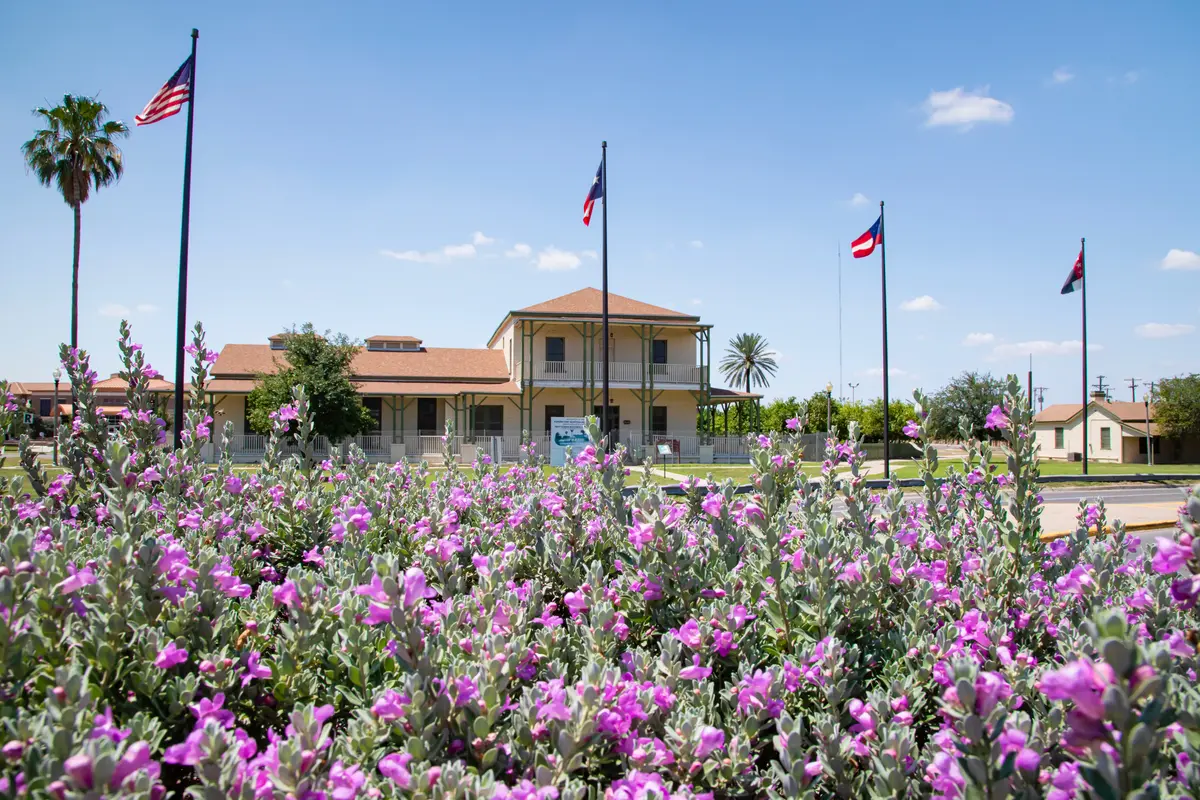
Laredo is the 11th-largest incorporated city in Texas — a genuine major city by state standards — with a $223,127 typical home price that makes ownership very accessible despite the city's size. Multiple hospitals serve residents directly, so healthcare is not a gap here. What Laredo trades for its size and its international character as one of the busiest trade ports on the US-Mexico border is walkable urban structure: neighborhoods tend to require a car, and the daily-life experience is more spread-out than the city's population might suggest. The climate runs extremely hot in summer, and the sunshine total is decent without being exceptional. Parks along the Rio Grande and a real local restaurant scene give retirees options, but the city rewards buyers who do their homework on specific neighborhoods rather than assuming the urban scale translates to pedestrian convenience.
Laredo fits retirees who are genuinely drawn to the city's border culture and its international energy — the cross-border commerce, the deep Tejano roots, the river setting — and who are comfortable driving for most daily needs. It is a different kind of retirement city than the Valley towns, less resort-oriented and more working-city in character. No structured retirement communities were found in Laredo.
#7 Top Healthcare · Hidalgo County
Best for retirees who prioritize healthcare access and university-town culture.
Edinburg is the 40th-largest incorporated city in Texas, home to the University of Texas Rio Grande Valley, with a $216,017 typical home price that keeps it well within reach for most retirees. Healthcare access is a genuine strength — multiple hospitals are in or immediately adjacent to the city, and the medical infrastructure built around the Valley's healthcare cluster is close at hand. The honest limitation for retirees is walkability: Edinburg is a car-dependent city in practice, and daily errands almost always require driving. The university presence gives the city a cultural dimension that smaller towns in the Valley lack — lectures, performances, sporting events — and plentiful sunny days throughout the year mean the weather works in winter. No structured retirement communities were found in Edinburg.
Edinburg suits retirees who prioritize healthcare access and affordability over walkability, and who appreciate the intellectual and cultural texture that a major university brings to a community. It pairs well with McAllen for retirees who want to be close to the Valley's commercial center without paying for a McAllen address — the two cities are genuinely close in daily life.
#8 Remote River Town · Maverick County
Best for retirees seeking a quiet, remote river town with healthcare in place.
Eagle Pass sits on the Rio Grande in Maverick County, the 119th-largest incorporated city in Texas, with a $222,003 typical home price that reflects a market far removed from the Valley's competitive core. A regional medical center is in town, which matters a great deal in a city this remote. Downtown Eagle Pass has a walkable character tied to its border-crossing identity and its historic river setting, but the overall density of amenities is modest: a handful of restaurants, local parks, and the river itself are the daily texture of life here. Summers are brutally hot with regularity, and the distance from larger cities is the defining practical reality — a serious shopping trip or a specialist appointment will almost always mean a significant drive. No structured retirement communities were found in Eagle Pass.
Eagle Pass suits retirees who are specifically drawn to a quiet, small-city border life — the river, the cross-border culture, the slower pace — and who have done the math on what it means to be far from a metro. It is not a good fit for retirees who expect the amenity variety of a larger city within easy reach.

#9 Reservoir Country Town · Val Verde County
Best for active retirees who want a reservoir and open country over urban amenity.
Del Rio is the 109th-largest incorporated city in Texas with a $208,595 typical home price, tucked against the Rio Grande in Val Verde County and backed by Amistad Reservoir — one of the largest international reservoirs in the country and the defining outdoor asset of the area. A regional medical center is in town, which provides meaningful baseline coverage for a mid-size city. The walkable downtown experience is limited; like many smaller Texas border cities, Del Rio is car-dependent in practice despite having a historic core. The quality-of-life picture is thinner than the larger Valley cities — dining variety is modest and the distance from a major metro is the honest constraint on day-to-day variety. Summers are hot and sunny, but the overall climate picture is decent rather than exceptional. No structured retirement communities were found in Del Rio.
Del Rio is best understood as an outdoor retiree's city — the reservoir, the canyon country, and the relative quiet of a remote border town are the draw, not urban amenities. Retirees who want fishing, boating, and open sky over restaurant variety and walkable streets will find the trade-off works in their favor here.
#10 Top Affordability · Starr County
Best for retirees who put price above all else and embrace small-town life.
Rio Grande City is the 193rd-largest incorporated city in Texas and carries a $147,646 typical home price, driven by a working agricultural economy and a community that sees little outside investment pressure. A local hospital serves the community, which matters enormously in a small city this far from the Valley's medical hub. The historic downtown district gives the city a genuine sense of place, and the Rio Grande setting connects it to the same river-and-border character that defines this entire region. The realistic limitation is the depth of everyday life: dining options are limited, cultural attractions are few, and most serious errands or appointments will require a significant drive. Summers are hot and humid, and the sunshine total is lower than the cities farther west. No structured retirement communities were found in Rio Grande City.
Rio Grande City suits retirees for whom price genuinely governs the decision and who are comfortable with a quiet, small-town daily life built around the river, the community, and the occasional drive to McAllen or Mission for broader services. It is an honest trade of amenities for accessibility, and for the right retiree, that trade makes complete sense.
#11 Top Affordability · Hidalgo County
Best for retirees who want Valley proximity at a quiet, affordable address.
San Juan sits in the heart of the Hidalgo County cluster, the 104th-largest incorporated city in Texas, with a $180,294 typical home price and proximity to the larger Valley cities that mitigates some of what the city itself lacks. There is no hospital in San Juan, but the nearest emergency room is a short drive and McAllen's full medical infrastructure is genuinely close. Most errands mean a drive, and the surrounding metro gives residents access to shopping, dining, and healthcare without living in a remote town. Summers are brutally hot and humid, in line with the rest of the Valley. Orangewood Estates is a named retirement community option for buyers who want that structure.
San Juan suits retirees who want Valley affordability and easy access to the larger cities without committing to the pace or price of McAllen or Mission directly. It functions more as a quiet bedroom community than a self-contained retirement destination, which works well for retirees who know they will be in their car regularly and are fine with that reality.
#12 Top Affordability · Hidalgo County
Best for retirees who want low prices with McAllen services a short drive away.
Pharr is the 52nd-largest incorporated city in Texas with a $163,130 typical home price, reflecting a working-community economy rooted in local wages rather than outside investment demand, despite sitting immediately adjacent to McAllen. There is no hospital in Pharr itself, but the nearest regional facility is just a short distance away — close enough that the gap is practical rather than alarming for most retirees. Most errands mean a drive, but the proximity to McAllen means the full range of Valley amenities is genuinely accessible without a long commute. The plentiful sunny days and warm winters are the same draw as the rest of the Valley, offset by the same brutal summer heat. No structured retirement communities were found in Pharr.
Pharr tends to suit retirees who want Valley pricing without sacrificing proximity to a major city's services — it is effectively a quieter, more affordable neighbor to McAllen rather than a standalone destination. Buyers who are comfortable knowing they will drive to McAllen for most things, and who see that as a quick errand rather than an imposition, get strong value here.

#13 Top Affordability · Hidalgo County
Best for retirees on a tight budget who want a structured retirement community.
Alamo is the 153rd-largest incorporated city in Texas with a $173,228 typical home price and a position in the mid-Valley cluster that keeps it close to larger city services even though it has few of its own. No hospital is in Alamo, but a regional medical center is a short drive away — meaningful coverage, though retirees who place a high priority on proximity to emergency care should weigh that gap carefully. Most errands mean a drive, and residents lean on the surrounding Valley cities for dining, shopping, and cultural options. Summers are hot and relentless in the same way as the rest of Hidalgo County. Alamo Country Club is a named retirement community option in the city.
Alamo is a sensible choice for retirees on a strict budget who want to be in the Valley's social orbit without paying for an address in one of the larger cities — Alamo Country Club gives that community a structured retirement setting, which is a genuine asset. It is not a city that rewards buyers hoping for urban walkability or rich daily-life variety within city limits.
#14 Top Quality of Life · Cameron County
Best for healthy retirees committed to Gulf Coast beach living.
South Padre Island is in a category of its own in this comparison — a small barrier island town with a $451,700 typical home price that reflects how little buildable land exists on the island and how much demand that scarcity sustains. The Gulf-front quality of life is extraordinary: beaches, birding, water sports, and a compact tourist-oriented restaurant scene give full-time residents a daily texture that no inland Valley city can replicate. The significant trade-off for retirees is healthcare — emergency care requires crossing the causeway, a journey that healthy retirees rarely need to make but that becomes a serious practical concern for anyone with chronic health conditions. No structured retirement communities were found on South Padre Island.
South Padre Island suits a specific kind of retiree: someone in good health who has wanted to live on the Gulf Coast their entire life and for whom the beach setting is genuinely non-negotiable, not just a pleasant bonus. It is the most distinctive choice on this list — and the most honest example of a retirement trade-off where what you gain and what you give up are both very real.
Healthcare access is the non-negotiable in this region — a city with a hospital in town changes daily life for a retiree in a way that a long drive never fully compensates for. Pair that with walkability and you narrow the list quickly; most of what looks like a bargain on paper is still a very good retirement if the services are genuinely there.
Tell us what you need help with and we'll connect you with local resources.
