
South Texas Border · Cost of Living · 2026
Cost of Living in South Texas Border, Texas: Every City Ranked
Cities ranked by hard financial data — home prices, income needed to buy, and estimated rent across the South Texas Border region.
Cities ranked by hard financial data — home prices, income needed to buy, and estimated rent across the South Texas Border region.
If you are comparing cities along the South Texas Border, you already know the region's broad appeal: housing costs that look almost impossible compared to what you left behind, a binational culture that shapes everything from food to commerce, and a climate that means your heating bill is never the problem. What most buyers do not expect is how much variety sits within this one corridor — between a small Starr County city where life runs at an agricultural pace and a Rio Grande island town driven almost entirely by tourism and second-home demand. The Rio Grande itself is the geographic spine, and proximity to international trade crossings, university campuses, and the Valley's hospital corridor does more to shape what a dollar buys here than any single policy or trend.
The spread across these cities comes down to a few durable forces: whether a city is anchored by a major university or medical complex, whether it sits at a high-volume international port of entry, and how much of its housing stock was built for full-time residents versus seasonal visitors or investment buyers. Working towns with local-wage economies tend to carry home prices that reflect what local families can actually afford. Cities with large university populations, significant retail draw from across the border, or Gulf-front appeal operate in a different demand environment entirely. The sections below break down each city's cost picture, what drives it, and which kind of buyer genuinely fits each place.
All prices reflect 2026 market data sourced from Zillow and cross-referenced with our individual city guides. County tax rates are verified effective rates.
Ranked by overall affordability. Click any city to jump to the full breakdown.
| # | City | Home Price | Monthly PITI | Income to Buy | Est. Rent |
|---|---|---|---|---|---|
| 1 | Rio Grande City Starr County | $147,646 | $1,052/mo | $49,308/yr | $850/mo |
| 2 | Eagle Pass Maverick County | $222,003 | $1,351/mo | $53,214/yr | $1,250/mo |
| 3 | San Juan Hidalgo County | $180,294 | $1,261/mo | $59,027/yr | $1,100/mo |
| 4 | Pharr Hidalgo County | $163,130 | $1,131/mo | $60,813/yr | $950/mo |
| 5 | Harlingen Cameron County | $200,595 | $1,343/mo | $61,352/yr | $1,150/mo |
| 6 | Edinburg Hidalgo County | $216,017 | $1,516/mo | $63,438/yr | $1,000/mo |
| 7 | Laredo Webb County | $223,127 | $1,512/mo | $65,531/yr | $1,150/mo |
| 8 | Del Rio Val Verde County | $208,595 | $1,450/mo | $66,141/yr | $1,050/mo |
| 9 | Mission Hidalgo County | $218,831 | $1,536/mo | $69,394/yr | $1,050/mo |
| 10 | McAllen Hidalgo County | $228,710 | $1,605/mo | $72,236/yr | $1,038/mo |
| 11 | Alamo Hidalgo County | $173,228 | $1,216/mo | $74,017/yr | $1,005/mo |
| 12 | Weslaco Hidalgo County | $176,825 | $1,241/mo | $75,443/yr | $1,000/mo |
| 13 | Brownsville Cameron County | $196,626 | $1,369/mo | $80,260/yr | $1,050/mo |
| 14 | South Padre Island Cameron County | $451,700 | $2,982/mo | $129,043/yr | $1,521/mo |
#1 Most Affordable · Starr County
Best for buyers who want an agricultural-town pace and accessible ownership costs
Rio Grande City carries a $147,646 typical home price, reflecting a small Starr County economy built around agriculture, local government, and US-83 commerce rather than a university or major retail draw. Life here is genuinely small-city in scale — the 193rd-largest incorporated city in Texas by Census count — and that scale is exactly what keeps the cost of homeownership within reach of a local income. The trade-off is limited services; a serious medical appointment or a major shopping run almost always means driving.
This city suits buyers who want an accessible ownership cost and are comfortable with a quieter, more self-sufficient daily life. It is a fundamentally different pace from a city like Edinburg or McAllen, and buyers who need urban conveniences nearby tend to find that gap harder to close than the spreadsheet suggested.
#2 International Trade Crossing · Maverick County
Best for buyers tied to international trade and border commerce
Eagle Pass sits at one of Texas's busiest international crossings, and that binational commercial energy shapes its housing market in ways a raw number does not fully capture. The $222,003 typical home price reflects a mid-size city — the 119th-largest in Texas — where trade activity along US-57 and US-277 supports a broader local economy than most cities of similar population along this corridor. Retail, logistics, and cross-border commerce all employ residents who would otherwise have to drive to a larger metro.
Buyers who work in international trade, government, or border-related industries will find Eagle Pass makes practical sense in a way it might not for a remote worker with no ties to the crossing. The city has more employment infrastructure than smaller towns to its east, but less of the university-driven amenity layer that cities like Edinburg have built around their campuses.
#3 Valley Metro Suburb · Hidalgo County
Best for families wanting Valley metro access at a moderate price
San Juan occupies a mid-point in the Hidalgo County cluster, with a $180,294 typical home price and a geographic position — the 104th-largest incorporated city in Texas — that gives residents quick access to the broader McAllen metro without paying for a McAllen address. I-2 and the business spur of US-83 run through it, which means commutes into the Valley's commercial and medical core are measured in minutes rather than hours. Orangewood Estates is the one established 55+ community here for buyers in that stage of life.
San Juan tends to suit families and working households who want proximity to jobs and services in the larger Valley cities without the premium those addresses carry. It is a practical choice in a dense, interconnected corridor where the distance between cities is often shorter than buyers expect.
#4 Highway Crossroads City · Hidalgo County
Best for buyers who prioritize highway connectivity and local employment
Pharr punches well above its home price in terms of infrastructure. At a $163,130 typical home price, it is the 52nd-largest city in Texas and one of the most connected in the region — I-2, I-69C, and US-281 all run through it, and significant freight activity keeps a real employment economy operating nearby. That connectivity means residents have legitimate access to employment, retail, and services without depending on a single employer or corridor.
For buyers who want genuine highway access and proximity to the Valley's economic spine at a price that reflects local wages rather than university or resort demand, Pharr is worth serious attention. It does not have the name recognition of McAllen or the university energy of Edinburg, but it functions as a real city with real infrastructure at a cost of entry that reflects neither of those premiums.
#5 Cameron County Hub · Cameron County
Best for buyers and retirees who want a self-contained city in Cameron County
Harlingen is the most self-contained city in the Cameron County part of this corridor — a mid-size city, the 57th-largest in Texas, with its own hospital infrastructure, retail base, and highway network that includes I-2, I-69E, US-77, and US-83. The $200,595 typical home price sits at a level where local professional incomes — healthcare, education, government — can realistically sustain ownership. Sunshine Country Club Estates is the established 55+ community here for buyers considering retirement.
Harlingen tends to attract buyers who want a real city with services in place and do not need to be in the densest part of the Valley metro. It is a quieter, more self-contained daily life than McAllen or Edinburg, and for many buyers — especially those in or near retirement — that trade-off lands in Harlingen's favor.
#6 University City · Hidalgo County
Best for buyers who want university-city energy and growth momentum
Edinburg's cost picture is shaped almost entirely by the University of Texas Rio Grande Valley campus, which has turned this city into one of the Valley's fastest-developing addresses. The $216,017 typical home price reflects that demand — this is the 40th-largest city in Texas, served by I-69C and US-281, and its housing market draws students, faculty, healthcare workers, and families who want to be near the Valley's fastest-growing institutional employer base.
Buyers who want a city with genuine growth momentum and a built-in demand floor from university and medical employment will find Edinburg compelling. Those who want a quieter pace or are sensitive to student-neighborhood density near campus will want to look carefully at which part of the city they are buying into — the areas near TX-107 (University Drive) feel very different from the city's residential edges.
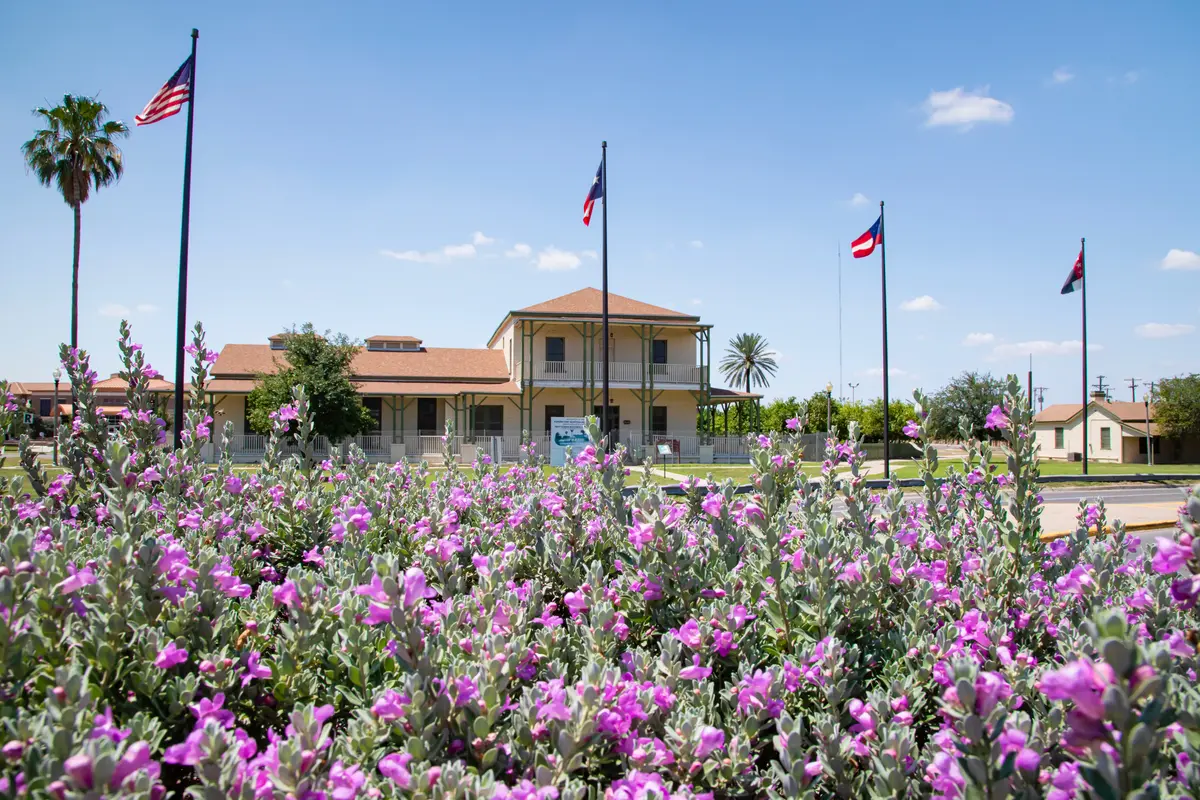
#7 Major Port of Entry · Webb County
Best for buyers who want full mid-sized-city services in South Texas
Laredo is the region's largest city by a significant margin — the 11th-largest incorporated city in Texas — and its $223,127 typical home price reflects both that scale and its status as one of the busiest inland ports of entry in North America. I-35, I-69W, and US-83 converge here, which means trade, logistics, and cross-border commerce generate a genuine private-sector job base rather than an economy dependent on a single anchor institution.
For buyers who want the services and employment diversity of a real mid-sized American city without leaving the South Texas Border, Laredo is the only option in this comparison that delivers at that scale. The trade-off is a larger, busier city where the pace and infrastructure feel closer to a regional hub than a small-town border community — which suits some buyers exactly and does not suit others at all.

#8 Military and Lake Town · Val Verde County
Best for military families and outdoor recreation buyers in Val Verde County
Del Rio is the western outlier in this comparison — a mid-size city, the 109th-largest in Texas, anchored by a major air force base and the international crossing into Ciudad Acuña rather than by a university or a major commercial port of entry. The $208,595 typical home price reflects a market where military families, government employees, and outdoor recreation enthusiasts drive demand alongside a local ranching and border economy. US-90, US-277, and US-377 are the primary routes in and out.
Buyers with a connection to the air force base or who are drawn to the lake and canyon recreation of Val Verde County will find Del Rio makes straightforward sense. For everyone else, the city's distance from the larger Valley metro means commuting to regional services is a real part of the calculus — it is a genuinely isolated city by the standards of this corridor.
#9 Western Valley Community · Hidalgo County
Best for retirees and families on the western edge of the Valley metro
Mission carries a $218,831 typical home price and a mid-size city profile — the 48th-largest in Texas — but its cost picture is shaped by the same Hidalgo County demand pressure that affects McAllen and Edinburg rather than by a standalone economy. I-2 and US-83 run through it, and the city's position on the western edge of the dense Valley metro means residents get real access to McAllen's retail and medical infrastructure. For 55+ buyers, Aladdin Villas, La Hacienda, and Retama Village at Bentsen Palm are the established communities here.
Mission tends to suit buyers who want proximity to the Valley's core without being inside McAllen proper — a slightly quieter residential feel with the same highway access. The 55+ community inventory here is notably varied compared to most cities in this corridor, which makes it a genuinely competitive option for retirees comparing the Valley's options.
#10 Rio Grande Valley Capital · Hidalgo County
Best for buyers who want the Valley's most complete urban infrastructure
McAllen is the commercial and medical capital of the Rio Grande Valley, and its $228,710 typical home price reflects what it costs to live at the center of the region's services. The 22nd-largest city in Texas, it sits at the intersection of I-2, US-83, and several state routes, and its concentration of hospitals, specialty retail, and professional employment means residents rarely need to leave the city for anything. Adobe Wells is the established 55+ community here for buyers in that stage of life.
Buyers who want the most complete version of urban life available in South Texas — and who have the income to match McAllen's demand — will find it the most functional city in the region. Those prioritizing a more modest cost of entry and willing to accept a drive for services will find that same income buys considerably more house in several of the smaller cities nearby.

#11 Small Valley Suburb · Hidalgo County
Best for buyers wanting Hidalgo County access at a smaller-city price
Alamo is a small city — the 153rd-largest in Texas — with a $173,228 typical home price that sits noticeably below the surrounding Hidalgo County cities it shares highway access with. I-2 and US-83 connect it to the broader Valley metro, which means the distance to McAllen, Mission, or Edinburg is short enough to make a daily commute realistic. Alamo Country Club is the one 55+ community here for buyers considering that option.
This city appeals most to buyers who want Hidalgo County access without Hidalgo County's more prominent city price tags. It is a quieter, smaller-scale daily life than Mission or McAllen, and buyers who have lived in dense Valley cities sometimes find the pace a genuine relief rather than a compromise.
#12 Mid-Valley Working Town · Hidalgo County
Best for working families seeking a practical mid-Valley address
Weslaco occupies a mid-Valley position — the 87th-largest city in Texas — with a $176,825 typical home price and access to I-2 and US-83 that keeps the larger Valley cities within reasonable reach. Its economy has historically been tied to agriculture and regional retail, which means the housing market reflects local wage levels more than it reflects institutional or resort demand.
No 55+ communities were found in Weslaco. The city tends to appeal to working families and first-time buyers who want Hidalgo County proximity without the price pressure of the cities that anchor the metro's eastern and western ends. It functions as a practical middle-of-the-Valley address more than a destination in its own right.
#13 Historic Southern Border City · Cameron County
Best for buyers who want a large, historically rooted South Texas city
Brownsville is the 18th-largest city in Texas and the region's southern anchor — a larger city with its own university, international crossing, and the beginning of the aerospace-driven development activity around Boca Chica. The $196,626 typical home price reflects a city where diverse employment drivers — education, healthcare, government, and an emerging aerospace corridor along SH-4 — create a demand floor that extends across a large and varied housing stock. Winter Haven Resort is the established 55+ community here.
Buyers who want a large, established South Texas city with real institutional employment and a distinct cultural identity from the Valley's Hidalgo County core will find Brownsville worth serious consideration. The aerospace activity near Boca Chica has added a genuinely new layer of demand and attention that was not part of the city's story a decade ago.
#14 Gulf Coast Resort Island · Cameron County
Best for buyers whose primary goal is a Gulf-front address
South Padre Island operates in a category of its own within this comparison. The $451,700 typical home price reflects resort-island demand — this is a small town, the 601st-largest incorporated city in Texas, connected to the mainland by a single highway link, where a meaningful share of ownership is driven by vacation use, seasonal visitors, and investors rather than full-time residents earning local wages.
For a buyer whose goal is a Gulf-front address, South Padre Island is the only option in South Texas that delivers it, and the price reflects that exclusivity. For a buyer whose primary goal is cost-effective full-time living, the island's demand structure, its isolation from the Valley's services, and the hurricane exposure that comes with any barrier island address represent trade-offs that the other cities in this comparison simply do not carry.
Across the South Texas Border, what you pay has less to do with amenities than with what drives local demand — a university, a port of entry, a Gulf-front location, or a working agricultural economy. Match the demand driver to your lifestyle before you match a price to your budget.
Tell us what you need help with and we'll connect you with local resources.
