What Is Living in Del Rio, Texas Like?
If you're choosing between Del Rio and somewhere larger in Texas, the decision usually comes down to one honest trade-off: you get more house, more water, and more sky than almost anywhere else in the state — and in exchange, San Antonio is about 150 minutes away. That distance shapes everything here. Del Rio is the county seat of Val Verde County, sitting where US-90 meets the Rio Grande and San Felipe Creek in southwest Texas. Directly across the river is Ciudad Acuña, Coahuila, Mexico, connected by the International Bridge on US-277. This isn't a suburb of anything. It's a self-contained border city of 34,496 people with its own economy, its own culture, and a lake that draws visitors from across the state.
The economic backbone here is Laughlin Air Force Base, home to the 47th Flying Training Wing and one of the most active pilot training installations in the country. As of 2023, Laughlin directly employed 3,043 people, and its ripple through the local economy is substantial. The San Felipe-Del Rio Consolidated Independent School District is the second-largest employer, with 9,510 students enrolled in 2025-26 anchoring a large workforce in education. Val Verde Regional Medical Center, Val Verde County, and the City of Del Rio round out the public-sector core. Manufacturing is a growing thread too — Caterpillar, Gentherm, Howmet Aerospace, and ParkOhio have all established operations in the area, drawn by the bilingual workforce and border logistics. The Del Rio–Ciudad Acuña corridor supports roughly $5.5 billion in annual cross-border commerce, which means this city's economy is more connected to international trade than its size suggests.
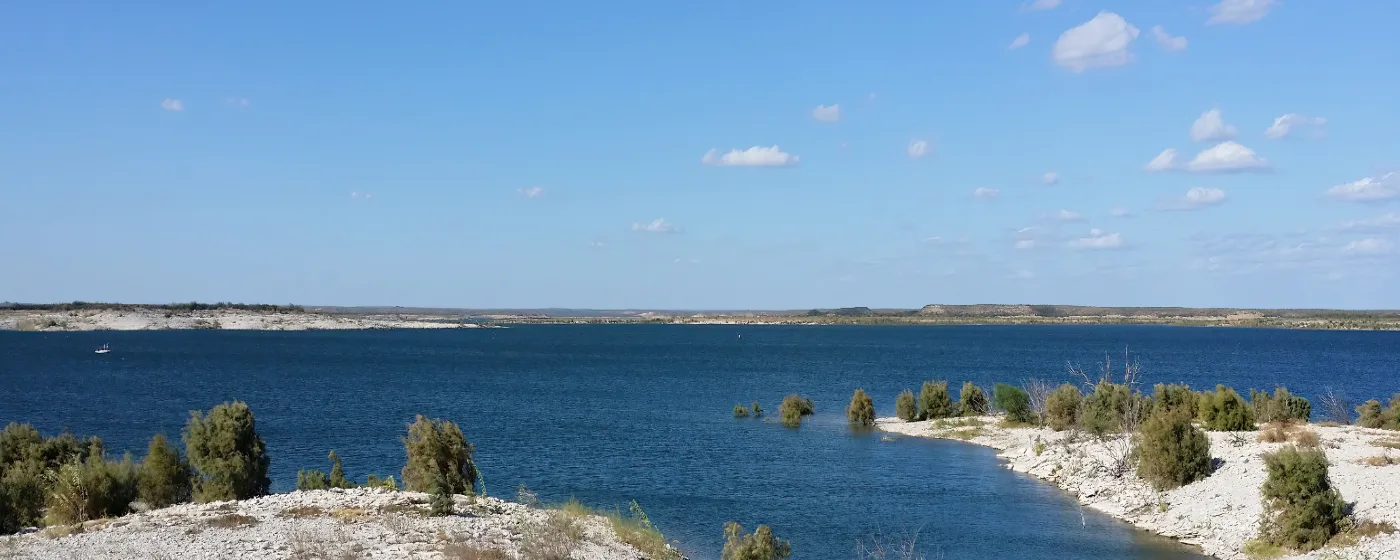
The typical home price in Del Rio sat at $208,595 as of July 2026 — well below the Texas statewide median — and the median household income here means the average family can realistically afford to buy, which is increasingly uncommon in this state. For the full cost-of-living picture, including rent, taxes, and what your dollars actually stretch to, see the Del Rio cost of living page. Day to day, 226 sunny days a year means outdoor life is a constant rather than a weekend bonus. Lake Amistad — cited as the third-largest lake in Texas — sits minutes from town, and San Felipe Springs has fed this community since its founding. The cross-border culture gives Del Rio a bilingual, binational character that's genuinely different from inland Texas cities of similar size.
Whether you're being relocated here by the military, drawn by the affordability, or simply researching whether this corner of southwest Texas fits your life, the sections below break down Del Rio's neighborhoods, cost of living, schools, local favorites, and what daily life here is really like.
Del Rio at a Glance
Looking to buy in Del Rio? Estimate your payment.
Enter your numbers to see an estimated monthly mortgage payment.
Estimate only. Excludes HOA fees and mortgage insurance. The interest rate above is a starting point, not a quoted rate — replace it with your own to see real numbers. Insurance is a flat placeholder, not a Del Rio quote.
Why Are People Moving to Del Rio?
The case for Del Rio is straightforward once you see it from the right angle. This is a city where a median-income household can actually afford the median home — without a second income, without heroic savings, and without buying something that needs six figures of work. That combination is rare enough in Texas that it drives real relocation decisions.
Laughlin Air Force Base is the single largest pull. Active-duty families arrive on orders and often stay past their assignment because housing is affordable, the community is welcoming, and the quality of life is better than the zip code suggests. Civilian contractors and support staff come for the same reason. If your household has one person on base and one working remotely, Del Rio can look like an unusually good deal.
The cross-border economy creates a second current. The Del Rio–Ciudad Acuña corridor handles billions in annual trade, and manufacturing operations from Caterpillar to Howmet Aerospace have found the area's bilingual workforce and logistics position to be worth the geography. If you work in international logistics, manufacturing operations, or cross-border services, this is one of the few small Texas cities where that career actually exists locally.
Who Tends to Move Here
Military families are the most visible group, but they're not the only one. Teachers and school administrators follow the district, which employs a significant local workforce. Remote workers who want space, sun, and a house they can own without stretching are an increasingly visible arrival, especially from higher-cost Texas metros. Retired federal employees — many with ties to Laughlin — choose to stay because the weather suits them and the pace is right.
What tends to surprise people is how much there is to do outdoors. Amistad National Recreation Area covers 58,500 acres, draws close to a million visitors annually, and costs nothing to enter. Bass fishing on Lake Amistad draws serious anglers from across the state. The limestone cliffs, the desert light, and the prehistoric pictograph sites inside the park give the area a texture that's hard to find anywhere else in Texas at this price point.
The honest friction: the isolation is real. A serious shopping trip, a specialist medical appointment, or a night at a large-venue concert all mean a significant drive. People who move here from Austin or San Antonio sometimes underestimate how much that changes daily life. Those who thrive here have made peace with the trade-off — or never needed what they left behind.
What Daily Life Feels Like in Del Rio
Del Rio operates at a pace that people either find deeply comfortable or quietly frustrating, depending on what they came from. The city covers 20.51 square miles, which means nothing is far from anything else — but the options within those miles are defined rather than expansive.
The Border Character
About 82% of Del Rio's residents identify as Hispanic, the median age is approximately 32.4 years, and Spanish functions as a genuine second language rather than an accommodation. Longtime residents cross into Ciudad Acuña for meals, for shopping, and for family. Newcomers who engage with that binational texture — rather than treating it as a curiosity — tend to feel at home faster. Those who don't can feel like they're living in a city they're adjacent to rather than part of.
The Fiesta de Amistad, held between Del Rio and Ciudad Acuña each fall, is one of the oldest binational friendship celebrations in the country. It's the kind of event that doesn't exist anywhere else — and it tells you something real about what this place values.
What Locals Actually Do
On weekends, the lake is the answer. Lake Amistad draws boaters, campers, bass anglers, and scuba divers — the clear Rio Grande impoundment makes it one of the few dive sites in Texas worth talking about. San Felipe Springs and the golf course built around them offer a quieter alternative closer to town.
The Whitehead Memorial Museum spans two and a half acres with multiple historic buildings and is the only full-time public museum in Val Verde County. The replica of Judge Roy Bean's Jersey Lilly saloon and the gravesites of Roy Bean and his son Sam are landmarks that genuinely belong only here. Val Verde Winery, founded in 1883, is recognized as the oldest winery in Texas — and it's in Del Rio, not in the Hill Country.
Higher education has a local presence: Sul Ross State University–Rio Grande College and Southwest Texas Junior College both operate here, which matters for families with college-age students and for residents seeking vocational and professional credentials without leaving town.
After Six Months, What People Notice
Six months in, most newcomers say the same thing: they stopped missing what they thought they'd miss. The commute to a grocery store is ten minutes, not forty-five. The neighbors know their names. The school pickup line is predictable. What they didn't expect to miss — and genuinely do — is a wider dining scene, faster internet options in some neighborhoods, and the easy access to a major airport. Del Rio International Airport (DRT) serves the city, but most longer trips still involve a drive east first.
School performance is an honest conversation point. The San Felipe-Del Rio Consolidated Independent School District holds a C rating, according to the Texas Education Agency, and on 2024-25 state assessments, 36% of students reached math proficiency and 48% reached reading proficiency. Active UIL athletics programs and a genuine Friday-night football culture are part of what the district does well — but families weighing academic outcomes should read the full picture on the schools page before deciding.
The Del Rio Housing Market Right Now
The typical home price in Del Rio was $208,595 as of July 2026, making it one of the more affordable mid-sized cities in Texas — and one of the few where the median household income is at or above what's needed to carry the typical home. That alignment is genuinely unusual and is a primary reason the market draws buyers relocating from higher-cost parts of Texas and the Southwest.
The typical city-wide rent runs $1,395 per month as of July 2026. For a full breakdown of what your money buys here — including property tax rates and how Del Rio compares to surrounding counties — see the cost of living page.
What the Market Actually Looks Like
Del Rio is not a hot market in the speculative sense. It's a stable, owner-occupant-driven market where most buyers are buying to live, not to flip. Military relocation creates a steady demand cycle — Laughlin brings families in and out on a regular cadence — which keeps the market from going cold even when broader Texas conditions shift.
The housing stock ranges from modest older construction in established neighborhoods to newer builds in areas like Lake Ridge Ranch and Kelley Ranch on the edges of the city. Some areas cost noticeably more than others, depending on proximity to the lake, the base, and newer development. For a neighborhood-by-neighborhood look at character and fit, the best neighborhoods page covers the full picture.
The effective property tax rate is 1.75%, which is worth factoring into your monthly budget. That's moderate by Texas standards — the state has no income tax, so property taxes carry more of the load here than in many other states.
Who the Market Works For
| Buyer Profile | What Works | Best For |
|---|---|---|
| Military families on orders | Affordable purchase, stable resale to the next rotation | Commuter Families |
| Remote workers from high-cost metros | Owns more house for the same mortgage payment | Value Nature |
| First-time buyers | Entry-level price point is genuinely accessible on one income | First-Time Value |
| Border economy workers | Proximity to trade corridor, bilingual community | Commuter |
| Retirees (especially federal/military) | Low cost base, outdoor access, familiar community | Quiet Nature |
| Investors seeking rental income | Steady military-cycle demand for rentals | Renter |
For buyers coming in from California, the cost delta is significant — see the moving from California page for the full comparison. First-time buyers will find that the fundamentals here are more forgiving than most Texas markets, and the first-time homebuyer page covers what you need to know about the buying process in Val Verde County.
Del Rio Neighborhoods
Del Rio has several distinct areas — each with its own character and appeal. Here’s a breakdown to help you narrow down where to focus your home search.
🏡 South Del Rio
South Del Rio is one of the city's more established residential areas, with a mix of older single-family homes and a community feel that longtime residents identify strongly with. It suits buyers who want a settled neighborhood with easy access to downtown.
🏠 Buena Vista
Buena Vista is a mid-city neighborhood with a quiet, residential character that attracts families and long-term owners. The housing stock leans toward modest single-family homes on consistent street grids.
🌳 Ceniza Hills
Ceniza Hills sits on elevated terrain that gives it a slightly different feel from the flatlands closer to the river — more open, with views that reflect the high-desert landscape Del Rio occupies. It draws buyers looking for space and a quieter setting.
🏘 San Felipe
San Felipe is one of Del Rio's more desirable established areas, anchored by proximity to San Felipe Springs and the golf course that winds around them. It suits buyers who want a sense of place and access to green space close to home.
🏔 North Heights
North Heights is a working neighborhood with a practical, unpretentious character — affordable single-family homes and easy access to US-90, making it a reasonable fit for commuters to Laughlin AFB and families on a tighter budget.
🌆 Lake Ridge Ranch
Lake Ridge Ranch is one of Del Rio's newer residential areas, with more recently built homes and a layout that appeals to buyers wanting newer construction and a neighborhood still taking shape. Its position on the edge of the city puts it close to the lake corridor.
Pros & Cons of Living in Del Rio
The Pros
- Low cost of living and affordable home prices relative to the rest of Texas
- Year-round warm, sunny climate
- Unique access to Lake Amistad for boating and fishing
- Stable job base anchored by Laughlin AFB, healthcare, and government employment
The Cons
- Remote location, roughly 150 miles from the nearest large metro (San Antonio)
- Below-average school test scores and limited dining/retail variety
- Long, very hot summers
Getting Around & Commuting in Del Rio
A car is not optional in Del Rio. It's the baseline for every errand, every commute, and every school run. That said, within the city limits, distances are short — most points in Del Rio are reachable in ten to fifteen minutes, which takes some of the edge off the car dependence for daily life.
The Local Commute
US-90 is the east-west spine of Del Rio and the main corridor for commuters heading toward Laughlin Air Force Base. US-277 handles the north-south movement and carries the cross-border traffic to Ciudad Acuña via the International Bridge. Loop 79 circles the city and is the practical route for moving between neighborhoods without cutting through downtown. US-377 and Spur 239 fill in the connective tissue between commercial corridors and residential areas.
For most residents, the daily commute is short. Laughlin AFB sits just east of the city, and even the farthest residential areas of Del Rio are a manageable drive to the main gate. Residents who work downtown, at the school district, or at the regional medical center often find their commute takes well under twenty minutes.
Getting Out of Town
The regional picture is different. The drive east to San Antonio is about 150 minutes — and that's the nearest major metro for shopping, specialty medical care, major-venue entertainment, and a large international airport. Most residents make that trip intentionally and infrequently, rather than as part of weekly life.
Del Rio International Airport (DRT) serves the city directly, with connections that cover regional travel. Amtrak's Sunset Limited and Texas Eagle both stop in Del Rio, offering rail connections west toward Los Angeles and east toward New Orleans and Chicago — genuinely useful for travelers who can plan around the schedule.
The City of Del Rio operates a fixed-route bus system with service to medical facilities and retail centers during weekday hours, which covers basic transportation needs for residents without a vehicle. It's not a system built for commuters, but it fills a meaningful gap for those who need it.
Eagle Pass and Uvalde as Reference Points
Eagle Pass, to the south, is Del Rio's most direct border-city neighbor and another crossing point into Mexico — residents with ties to both cities move between them on US-277. Uvalde sits to the east along US-90 and serves as a regional stop for some services. Neither replaces what San Antonio offers for a major-trip destination, but both are realistic day-trip distances for errands that Del Rio itself doesn't cover.
Schools in Del Rio
Families relocating to Del Rio have public, private, and higher-education options nearby. Here’s a quick overview.
🎓 School District
San Felipe-Del Rio Consolidated Independent School District serves K–12 students across Del Rio and the surrounding area. Rated C (source: Texas Education Agency, 2025 A-F accountability rating (2024-25 school year)).
🏆 Graduation Rate
The 4-year high-school graduation rate here is approximately 90.5%.
📚 Higher Education
Texas’s public universities — the University of Texas at Austin, Texas A&M University, and the University of Houston — offer four-year degrees statewide, with one of the largest community college systems in the country (50+ public community college districts) providing two-year and workforce programs.
🌐 Online Learning
UT Austin Online and Texas A&M University Online offer fully accredited online degrees for remote learners across the state.
Safety in Del Rio
A quick look at how Del Rio compares on the numbers that matter most when weighing a neighborhood or a move.
🛡 Violent Crime
Approximately 2 per 1,000 residents.
🔒 Property Crime
Approximately 13 per 1,000 residents.
Compared to the most recent national figures from the Bureau of Justice Statistics (2024), Del Rio’s violent crime is below the national average (about 3.7 per 1,000), and property crime is below the national average (about 18.4 per 1,000).
Against Texas as a whole, Del Rio’s violent crime is roughly half the state average, and property crime is roughly two-thirds of the state average (Bureau of Justice Statistics, Crime Known to Law Enforcement, 2024 (tables 2 and 3)).
Crime rates can vary a lot within a single city, so the citywide numbers above are only a starting point. Some neighborhoods in Del Rio run well below these averages, while others run higher — the kind of block-by-block detail that matters most when you’re actually choosing where to live. The full guide below breaks it down neighborhood by neighborhood.
Working in Del Rio
Del Rio’s largest employers span several industries — here are some of the anchors of the local job market.
🏛 Laughlin Air Force Base
Military aviation training
🎓 San Felipe-Del Rio Consolidated Independent School District
Education
🏥 Val Verde Regional Medical Center
Healthcare
🏛 Val Verde County
County government
🏛 City of Del Rio
Municipal government
Parks & Recreation in Del Rio
Some of the outdoor spaces that shape everyday life in Del Rio.
🌱 Amistad National Recreation Area / Lake Amistad
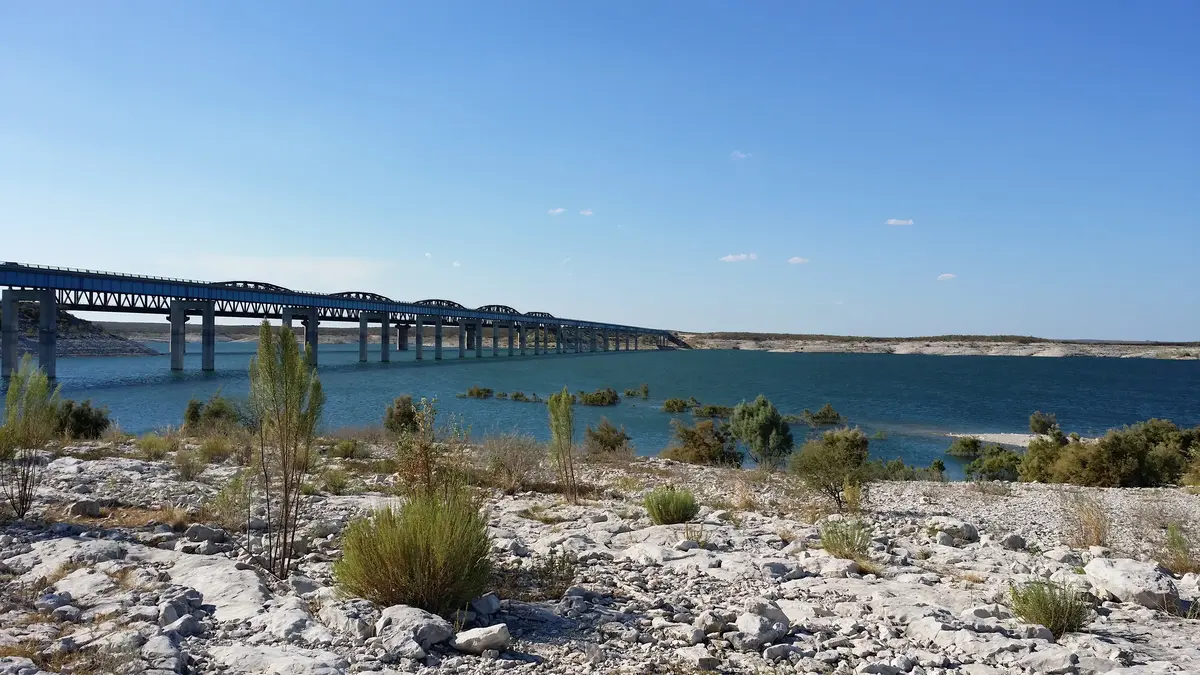
Del Rio residents don’t have to go far for green space — spots like Amistad National Recreation Area / Lake Amistad are part of everyday life here, whether that’s a morning walk, a weekend hike, or just somewhere to unwind outside. The full guide below covers more of what Del Rio has to offer for parks and outdoor recreation.
Retiring in Del Rio
Del Rio draws retirees for its balance of amenities, outdoor access, and cost. Here’s what to weigh.
🌤 Climate
Del Rio averages 226 sunny days a year, with mild winters that make outdoor life comfortable well into December and January. Summers are genuinely hot — July and August regularly push triple digits — so retirees who prefer to avoid heat should plan their outdoor activities for morning hours and the shoulder seasons of spring and fall, which are long and pleasant.
🍴 Lifestyle
The outdoor life here is the main draw for retirees: Lake Amistad, San Felipe Springs, and the golf course woven around the springs give plenty of options without leaving the county. Val Verde Winery, the Whitehead Memorial Museum, and the binational cultural life with Ciudad Acuña add texture to daily life. The local food and coffee scene is personal and consistent rather than expansive.
🏚 55+ Communities
No 55+ communities were found in Del Rio. Retirees typically buy in established single-family neighborhoods across the city, with San Felipe and the areas near the lake being common choices. For more on retiree-specific considerations in Del Rio, see the retiring in Del Rio page.
✈ Getting Around
Most retirees in Del Rio rely entirely on a personal vehicle for errands, medical appointments, and social life. A regional medical center is within city limits. Del Rio International Airport (DRT) serves the city for regional travel, though flights requiring a connection to a major hub typically mean planning ahead. The drive to San Antonio for larger medical centers or airport access is about 150 minutes.
🏛 Texas Taxes for Retirees — What to Know
- No state income tax — Texas has no personal income tax — constitutionally protected under Article VIII, Section 24. Social Security, pensions, 401(k)/IRA withdrawals, and annuity payments are all untaxed at the state level, with no state return to file.
- Sales tax is the tradeoff — The state sales tax is 6.25%, and local add-ons bring the combined rate in Del Rio to 8.25% (Texas Comptroller of Public Accounts, city sales and use tax rates, July 2026). Groceries and prescription drugs are exempt.
- Property taxes — the real tradeoff — Texas’s effective property tax rate averages about 1.40%, among the highest in the country, since property tax (not income tax) funds most local government and schools.
- Over-65 homestead exemption and school-tax freeze — Homeowners 65+ (or disabled) get an additional $60,000 exemption from their home’s value for school district taxes, on top of the general homestead exemption — $200,000 off school taxable value combined, following November 2025’s Proposition 11 (SB 23), which raised the over-65 exemption to $60,000, and Proposition 13 (SB 4), which raised the general homestead exemption to $140,000. Once claimed, your school district tax bill is frozen at that year’s amount and cannot increase as home values rise, and the ceiling can transfer if you move to a new home within Texas.
- Deferral option if cash is tight — Homeowners 65+ can defer property tax payment entirely for as long as they live in the home, rather than paying it currently — interest accrues, but no forced sale.
- No estate or inheritance tax — Texas has no estate tax, no inheritance tax, and no gift tax.
- No separate capital gains tax — Because Texas has no state income tax, capital gains — including on investments and home sales — are not taxed at the state level at all, unlike states such as Washington that tax capital gains separately from income.
Tax laws change frequently and individual situations vary. This is general information, not tax advice — always consult a qualified Texas tax professional or CPA for personalized retirement tax planning.
Weekends & Local Favorites in Del Rio
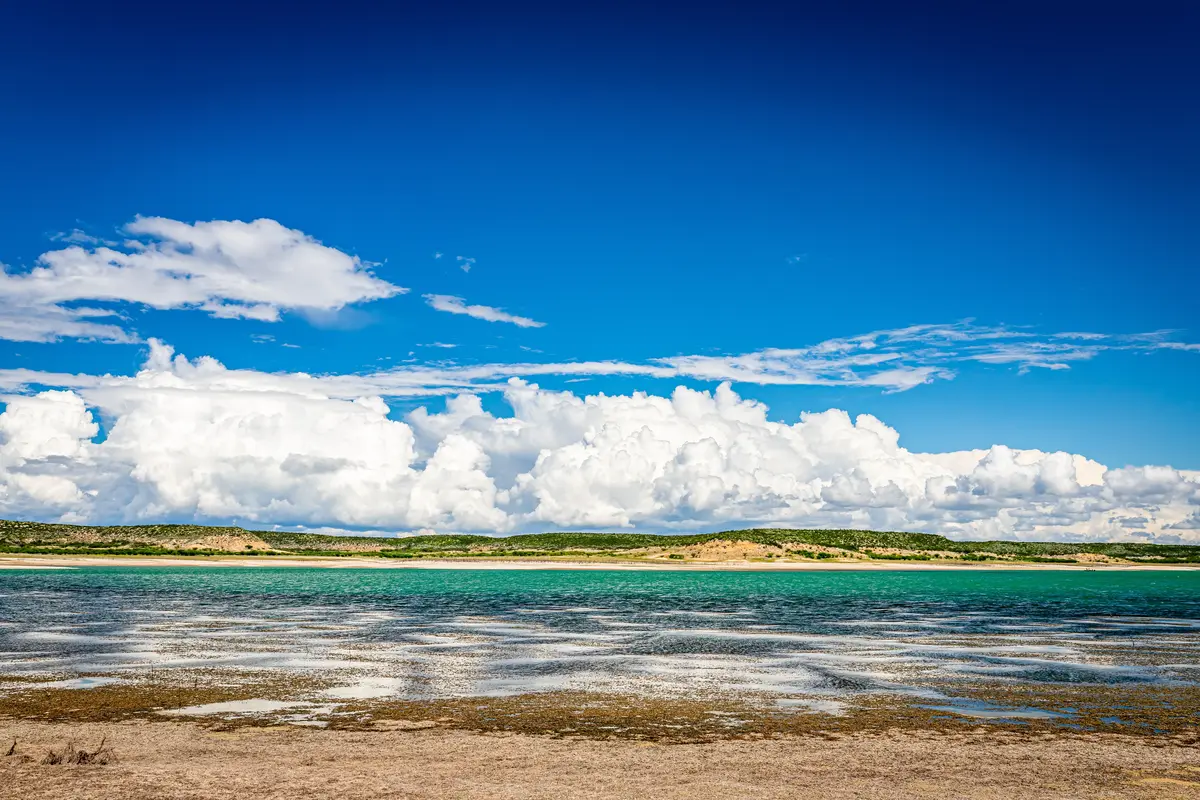
Del Rio's weekend life is genuinely anchored by water and sky. Lake Amistad is where a significant portion of the city heads on a warm Saturday — boating, fishing for largemouth bass, camping along the limestone cliffs, or simply watching the light change over the Rio Grande impoundment. Amistad National Recreation Area has no entrance fee and covers 58,500 acres, which means crowding is rarely an issue even close to peak season.
San Felipe Springs offers a different kind of outdoors — quieter, closer to downtown, with the springs themselves feeding the golf course and green space that has been part of Del Rio since the city's earliest days. It's where people go when they want to be outside without making a whole day of it.
History and Culture Worth Knowing
The Whitehead Memorial Museum is genuinely worth a visit — not in the obligatory local-museum sense, but because its historic buildings and exhibit sites cover a version of Texas history that doesn't get told anywhere else. The replica of Judge Roy Bean's Jersey Lilly saloon and the actual gravesites of Roy Bean and his son Sam are the kind of things that are remarkable precisely because they're here, in Val Verde County's only full-time public museum.
Val Verde Winery carries a distinction that surprises most newcomers: founded in 1883, it is the oldest winery in Texas. That's not a regional claim or a marketing reach — it predates the Hill Country wine scene by generations. Visiting it is a window into a side of Del Rio that most people outside the city don't know exists.
Food, Coffee, and the Weekly Routine
The local food scene is personal and unpretentious. Sirloin Stockade has been a Del Rio institution for years — the kind of place families return to out of genuine habit, not nostalgia. Rudy's "Country Store" and Bar-B-Q brings a Texas barbecue standard that holds up. For something more local in feel, Salas Better Burger and El Patio Del Río are the spots residents tend to point newcomers toward first. Skillet's Restaurant rounds out the sit-down options with a diner-style menu that serves the full range of Del Rio's daily rhythms.
Coffee runs tend to be loyal and specific. River City Doughnut & Coffee handles the morning rush for a significant portion of the city. Chapa's Bakery is the kind of place where people know the staff by name after a few visits. MoMo's Coffee, Cardinal Points Coffee Shop, and Cafe Sol Coffee & Bakery fill out a coffee scene that's more varied than the city's size would suggest — and where conversations about local politics, school board decisions, and base news happen at the same time.
The Five Points Market is where to find locally grown produce and a cross-section of the community in one place. It's a grounding weekly ritual for residents who want to stay connected to what's seasonal and what's local.
The cross-border dimension adds a layer most Texas cities don't have. Crossing into Ciudad Acuña for a meal, for crafts, or simply for an afternoon out is something Del Rio residents do as a normal part of weekend life — not as tourism, but as geography.
Local favorites in Del Rio
Restaurants
- Sirloin Stockade
- Rudy's "Country Store" and Bar-B-Q
- Salas Better Burger
- El Patio Del Río
- Skillet's Restaurant
Outdoors
- Lake Amistad / Amistad National Recreation Area
- San Felipe Springs
Coffee
- River City Doughnut & Coffee
- Chapa's Bakery
- MoMo's Coffee
- Cardinal Points Coffee Shop
- Cafe Sol Coffee & Bakery
Farmers Markets
- Five points market
Top Things Locals Say About Del Rio
The best intel about a city comes from the people who actually live there. Here’s what Del Rio residents say when newcomers ask the questions everyone’s thinking.
“I thought I'd miss having everything close by, but what actually surprised me was how much time I got back. My commute to the base takes twelve minutes and I'm home for lunch. I didn't expect to feel this settled this fast.”
— Recent Del Rio home buyer
“What's the most surprising thing about living in Del Rio?”
Most people are surprised by how much there is to do outdoors within a few minutes of home. Lake Amistad is basically in the backyard, and people who move here expecting nothing end up spending half their weekends on the water. The other surprise is the food — there are spots here that people are genuinely loyal to, not because there's nothing else but because they're actually good.
“What do locals love most about Del Rio?”
The pace and the affordability, together. You can own a house here on a normal salary, your neighbors know who you are, and the lake is always an option. The cross-border culture is something longtime residents take real pride in — the connection to Ciudad Acuña isn't a footnote, it's part of what makes Del Rio feel like its own place rather than a smaller version of somewhere else.
“What should newcomers to Del Rio know?”
Plan your San Antonio trips intentionally — that's where major shopping, most specialists, and the big airport are, and the drive is about two and a half hours each way. Get comfortable with the International Bridge early; crossing into Acuña for errands or a meal is something locals do regularly and newcomers sometimes hesitate on longer than they need to. And don't underestimate the heat in July and August — 226 sunny days a year sounds appealing until you're three weeks into a stretch of 100-degree afternoons.
“How much do you need a car in Del Rio?”
You need one for everything. Within the city, most errands are a short drive — Del Rio is compact enough that you're rarely more than ten or fifteen minutes from what you need. But there's no getting around town on foot for most of daily life. The city runs a fixed-route bus that covers medical facilities and retail, which helps residents who can't drive, but for most households a car is essential from day one.
Cities Near Del Rio
Other communities near Del Rio worth a look — each with its own character and price point.
| City | Distance | Best For | Vibe | Median Rent | Median Buy |
|---|---|---|---|---|---|
| Eagle Pass | 57 mi | Border economy workers & families | Active, binational, working-city feel | $1,206 | $222,003 |
| Uvalde | 71 mi | Budget buyers & rural lifestyle | Small-town, quiet, agricultural roots | $900 | $174,888 |
| Brackettville | 33 mi | Privacy seekers & rural acreage | Remote, historic, deeply rural | $800 | $78,455 |
More Helpful Guides for Del Rio
Going deeper on Del Rio? Our blog series covers everything from first-time buying to retiring here — explore the guides below.
Local Expert Takeaway: Del Rio rewards people who come in with realistic expectations and an appetite for outdoor life. The price point is real, Laughlin AFB creates a stable community backbone, and Lake Amistad delivers a weekend experience that costs nothing to access. The catch is distance — San Antonio is about 150 minutes away, and you feel that gap when you need a specialist, a major airport, or a wider retail selection. The families and remote workers who thrive here are the ones who planned for that drive rather than discovering it after closing.
Quick Takeaways & FAQs
✅ Del Rio's typical home price of $208,595 (July 2026) is well below the Texas statewide median, and the median household income here is at or above what's needed to buy — a combination that's genuinely rare in the current Texas market.
⚠️ The drive to San Antonio is about 150 minutes each way, which means major shopping, specialist medical care, and large-venue entertainment all require deliberate planning rather than a quick trip.
📍 Val Verde Winery, founded in 1883, is the oldest winery in Texas — and it's right here in Del Rio, not in the Hill Country.
Is Del Rio, Texas a good place to live?
How far is Del Rio from San Antonio?
What is the job market like in Del Rio?
How are the schools in Del Rio?
What is there to do in Del Rio on weekends?
Helpful Links for Moving to Del Rio
Moving to Texas?
Tell us what you need help with and we'll connect you with local resources.
