You've done the spreadsheet. Del Rio checks boxes that surprised you — a home price well under six figures compared to where you're coming from, no state income tax, and a national park essentially in the backyard. What the spreadsheet doesn't tell you is what it feels like to live here in retirement: a small border city of 34,496 with genuine warmth, a distinctly bicultural identity, and a pace that either suits you immediately or doesn't suit you at all. The city sits where the Chihuahuan Desert meets the Rio Grande, connected to the outside world by US-90 and US-277, and sharing daily cultural and commercial life with Ciudad Acuña just across the river.
The economic backbone is Laughlin Air Force Base, Val Verde Regional Medical Center, and the San Felipe-Del Rio Consolidated Independent School District — which together explain why so many retirees here are former military, former educators, or former healthcare workers who stayed after their careers ended. That employment base also keeps the city more stable than comparably small Texas border towns. Retirees moving from San Antonio or Austin typically land in Del Rio for the affordability; those moving from out of state often arrive because a family member is stationed at Laughlin.
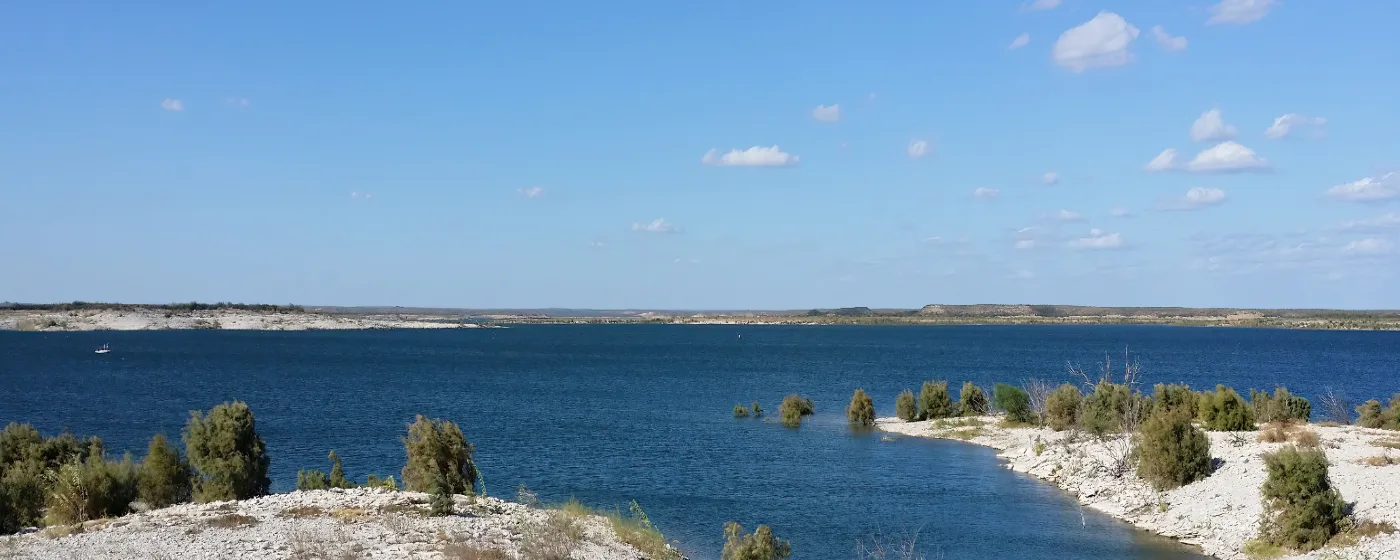
Daily costs — groceries, fuel, dining — run below the national average, which matters enormously on a fixed income. Amistad National Recreation Area, a 64,900-acre reservoir with no entrance fee, is the city's great equalizer: world-class bass fishing, boating, and hiking available to every resident at essentially no cost. The catch, and it's a real one, is distance — San Antonio is about 150 minutes away by road, and anything not available locally means a significant drive.
Whether you're seriously weighing a move or still in early research mode, the sections below cover what retirement in Del Rio actually costs, what healthcare access looks like, how the community supports an active retirement, and how the city compares to nearby alternatives.
Why Retirees Are Choosing Del Rio
Del Rio fits a specific retiree profile well: someone who wants to own a home outright, keep monthly expenses low, live somewhere genuinely uncrowded, and spend meaningful time outdoors. The typical home price sits at $208,595 (Zillow Home Value Index, July 2026) — a figure that makes debt-free homeownership realistic for retirees arriving with equity from a higher-cost market. The city is not trying to compete with Hill Country resort towns or Gulf Coast retirement corridors, and that's exactly the point.
The retiree community here is anchored by former military families from Laughlin Air Force Base, retired teachers and administrators from the school district, and a growing contingent of remote-working early retirees drawn by the low overhead. Many long-term residents have deep roots in the bicultural border community and would not trade that texture for a more polished retirement destination. The blend of Mexican and American culture shows up in the food, the festivals, and the ease of crossing into Ciudad Acuña for everyday errands.
The honest caution: Del Rio is not the right call for retirees who prioritize walkable neighborhoods, specialized medical subspecialties close at hand, or a robust selection of cultural institutions and fine dining. The city is remote by Texas standards, and the isolation that some find peaceful will frustrate others within a year. If frequent travel, specialist care, or urban conveniences are non-negotiable, the distance — about 150 minutes to San Antonio — is a real cost that compounds over time.
Healthcare & Medical Access in Del Rio
Val Verde Regional Medical Center is Del Rio's full-service hospital, located inside city limits, and it is the only hospital you should count on for routine and emergency care. It holds Joint Commission accreditation and offers a meaningful range of services: emergency care, surgical services, diagnostic imaging, cardiology, orthopedics, obstetrics and gynecology, pediatrics, and internal medicine. For a city of Del Rio's size and location, that breadth is genuinely solid.
The cardiology story got meaningfully better in February 2025, when Val Verde Regional Medical Center unveiled a new cardiac catheterization laboratory. That addition matters for retirees in particular — interventional cardiac care no longer requires an automatic transfer to San Antonio for every acute event. It's a significant upgrade to what was previously a gap in local capability.
Where the picture gets honest: complex subspecialty care — advanced oncology, neurosurgery, transplant services, certain orthopedic revisions — will almost always mean a referral and the drive to San Antonio. Retirees managing chronic conditions that require frequent specialist involvement should map those appointments carefully before committing to Del Rio. The one-way trip is about 150 minutes on a good day, and that's the planning reality.
Primary care access in a border community can sometimes mean longer wait times for new-patient appointments, and Del Rio is not an exception. Building a relationship with a local primary care physician early — before you need urgent access — is the practical move. The city does have federally qualified health center resources given its border designation, which can supplement private primary care. On the continuum-of-care front, Southwest Assisted Living handles assisted living and memory care, and Del Rio Nursing & Rehabilitation Center provides skilled nursing and long-term care — a meaningful safety net for retirees planning for the longer arc.
Healthcare costs in Del Rio index slightly above the U.S. average, which is the one line item that cuts against the city's otherwise favorable cost profile. Build that into your retirement budget honestly rather than assuming everything here is cheaper.
The Retiree Budget in Del Rio
Texas's tax posture for retirees is one of the strongest in the country, and Del Rio benefits from all of it. The state levies no income tax — Social Security benefits, pension income, IRA distributions, and 401(k) withdrawals are all free from state-level taxation. For retirees drawing from multiple retirement income sources, that adds up to a meaningful annual advantage compared with states that tax retirement income.
Property taxes are the offset. Del Rio's effective rate runs approximately 1.75%, which is above the national average and a real line item on a fixed income. Texas homeowners aged 65 or older, however, can qualify for a school-district property-tax ceiling — commonly called a freeze — that locks the school-tax portion of the bill and prevents it from rising as values climb. An enhanced homestead exemption is also available. Together, those two mechanisms meaningfully reduce the headline rate's bite for senior homeowners who apply for them. The freeze in particular is worth pursuing immediately upon turning 65, because it cannot be applied retroactively.
Beyond housing and taxes, daily costs run well below the national average. Groceries, transportation, and dining out all index favorably. The practical result is that a retirement income that feels tight in Austin or San Antonio can feel genuinely comfortable here.
The one exception in the budget is healthcare costs, which run slightly above the U.S. average. That gap is modest, but retirees should account for it rather than assuming across-the-board savings. For a full picture of the city's cost structure, including rent benchmarks and utility costs, see the Del Rio cost of living page.
Looking to buy in Del Rio? Estimate your payment.
Enter your numbers to see an estimated monthly mortgage payment.
Estimate only. Excludes HOA fees and mortgage insurance. The interest rate above is a starting point, not a quoted rate — replace it with your own to see real numbers. Insurance is a flat placeholder, not a Del Rio quote.
Walkability, Community & Staying Active in Del Rio
Del Rio is a car-dependent city. Most errands require a drive, the terrain is flat enough that cycling and walking are physically manageable, but the street grid and commercial layout aren't built around pedestrian life the way a denser Texas city might be. If you're used to walking to a coffee shop or pharmacy, adjust your expectations — though the flatness at least means the walks you do take are genuinely easy.
The social infrastructure for retirees is real, if not elaborate. The Val Verde County community has a strong tradition of civic engagement, and service organizations, church communities, and volunteer groups provide the recurring social anchors that matter most in retirement. The border setting adds a layer most retirement destinations don't offer: volunteering with cross-border outreach programs, language exchange, and binational community events that give daily life a distinct texture.
The outdoor recreation picture is where Del Rio genuinely overdelivers. Amistad National Recreation Area sits just west of the city off US-90 and is the kind of amenity that retirees in far more expensive places can't access at any price. The 64,900-acre reservoir is one of the premier bass fisheries in Texas — largemouth and striped bass draw serious anglers from across the state. Boating, paddling, hiking, wildlife viewing, and scuba diving on submerged archeological sites are all part of the same no-entrance-fee package. For retirees whose active lives center on the water or the outdoors, this is the decisive argument for Del Rio.
San Felipe Springs is another daily-life asset — a natural springs complex that has been the heart of the city's character for generations. The historic downtown is modest but genuine, and gathering spots like Cardinal Points Coffee Shop and Cafe Sol Coffee & Bakery serve as informal community hubs where retirees regularly cross paths with neighbors. The Five Points Market gives the city a weekly farmers market rhythm. Del Rio is not a retirement amenity destination in the Fredericksburg sense, but it has enough social infrastructure to support a full and connected retirement for people who are self-directed about building community.
Right-Sizing: Downsizing in Del Rio
The downsizing calculus in Del Rio is shaped by one unusual fact: at $208,595 (Zillow Home Value Index, July 2026), the typical home is already priced well below what most retirees arriving from a mid-size or large Texas city will have in equity. For many, the conversation isn't about trading down to free up capital — it's about buying outright and eliminating housing cost from the monthly budget entirely. Census data suggests that most senior homeowners here already carry no mortgage, which reflects both the home price reality and the tenure of longtime residents.
Single-level homes are available in Del Rio's established neighborhoods, though the inventory of purpose-built patio homes and lock-and-leave condominiums is limited compared with larger Texas retirement markets. South Del Rio and the San Felipe area have the oldest housing stock and tend to have more traditional single-family homes on manageable lots. Newer construction in areas like Lake Ridge Ranch and Quail Run leans toward larger footprints aimed at families — not a natural fit for right-sizing, but occasionally available. Buyers specifically seeking a single-level plan with minimal exterior maintenance should be prepared to be patient, or to work with what's available and adapt.
No 55+ communities were found in Del Rio. That's the honest answer, and it shapes what the downsizing market looks like: there is no planned active-adult campus with a clubhouse, pool, and organized programming. Retirees who want that structure will need to look at nearby larger markets or build their own social infrastructure within the broader community.
What Del Rio does offer on the care continuum is meaningful: Southwest Assisted Living provides assisted living and memory care, and Del Rio Nursing & Rehabilitation Center handles skilled nursing and long-term care. Those options matter for retirees planning not just where they'll land initially, but where they can age in place over a longer horizon. For a look at how neighborhoods compare in character and housing stock, see the Del Rio neighborhoods page.
Del Rio vs Nearby Retirement Destinations
| City | Cost vs Del Rio | Primary Hospital | Walkability | Senior Living Depth | Overall Retirement Fit |
|---|---|---|---|---|---|
| Del Rio | Baseline | Val Verde Regional Medical Center — Joint Commission accredited, on-site cath lab | Car-dependent; flat terrain | Assisted living and skilled nursing; no 55+ communities | Strong for budget-focused, outdoors-oriented retirees |
| Eagle Pass | Somewhat higher | Regional hospital access; similar border-city profile | Car-dependent | Limited senior living options | Similar border-city experience; slightly higher cost without a clear amenity advantage for retirees |
| Uvalde | Noticeably lower | Smaller community hospital; specialists require travel | Car-dependent; compact downtown | Limited; smaller market | Good fit for budget-first retirees who want a quieter Hill Country-adjacent setting |
| Brackettville | Noticeably lower | No local hospital; nearest care requires significant drive | Very limited; rural small town | Minimal formal senior services | Suits retirees seeking true rural quiet; healthcare access is a serious trade-off |
| Comstock | Noticeably lower | No local hospital | Minimal; unincorporated-feel community | Essentially none | Remote retreat rather than a retirement destination; for those prioritizing solitude above all else |
| Ciudad Acuña | Lower overall | Mexican healthcare system; lower out-of-pocket costs for some services | More walkable by local standards | Different system; limited English-language senior services | Some Del Rio retirees cross regularly for dental and pharmacy savings; not a primary retirement destination for most U.S. retirees |
Cost comparisons are qualitative and relative to Del Rio's baseline. For Del Rio's specific home price figure, see the cost of living page.
For retirees who want the lowest possible cost and can accept minimal local healthcare, Uvalde and Brackettville both undercut Del Rio noticeably — but Brackettville in particular requires making peace with driving significant distances for any hospital-level care. Eagle Pass offers a similar border-city profile at a somewhat higher price point, without a clear compensating advantage for retirees specifically. Comstock is genuinely remote and suits a narrow profile: the retiree who wants land, solitude, and proximity to the Devils River or Amistad's more remote reaches, and who has handled their healthcare logistics independently.
Del Rio's edge over all of them is the combination of a Joint Commission-accredited hospital with on-site cardiology, a cost of living that remains well below the national average, and a national recreation area that functions as a free daily amenity. That combination is hard to replicate in the region. Retirees for whom specialist proximity is the primary concern should honestly weigh whether the drive to San Antonio — about 150 minutes each way — fits their medical situation before choosing any of these options over a larger city.

Local Expert Takeaway: Del Rio rewards retirees who come in clear-eyed. The home prices are genuinely low, the Texas tax picture is as good as it gets for retirement income, and Lake Amistad is the kind of no-cost outdoor asset that makes a fixed-income lifestyle feel rich rather than constrained. The trade-offs are real and specific: no 55+ campus, a single community hospital that handles most but not all of what an aging body eventually needs, and a 150-minute drive to San Antonio for anything more specialized. Retirees who thrive here tend to be active, self-directed, comfortable with occasional long drives, and drawn to the border community's distinctive bicultural life — not people who expected a different city and are making do.
Quick Takeaways & FAQs
✅ Texas exempts all retirement income — Social Security, pensions, and IRA withdrawals — from state taxation, and homeowners 65+ can freeze their school-district property tax bill.
⚠️ Val Verde Regional Medical Center covers emergency, surgical, and cardiology needs locally, but complex subspecialty care still requires the roughly 150-minute drive to San Antonio — plan accordingly.
📍 No 55+ communities were found in Del Rio; retirees seeking a planned active-adult campus will need to look at larger markets, but the city's assisted living and skilled nursing options do provide a meaningful care continuum.
Is Del Rio, Texas a good place to retire?
What hospital serves retirees in Del Rio?
Are there any 55+ communities in Del Rio?
How does Texas's tax structure benefit retirees in Del Rio?
How does Del Rio compare to Uvalde or Eagle Pass for retirement?
Moving to Texas?
Tell us what you need help with and we'll connect you with local resources.
