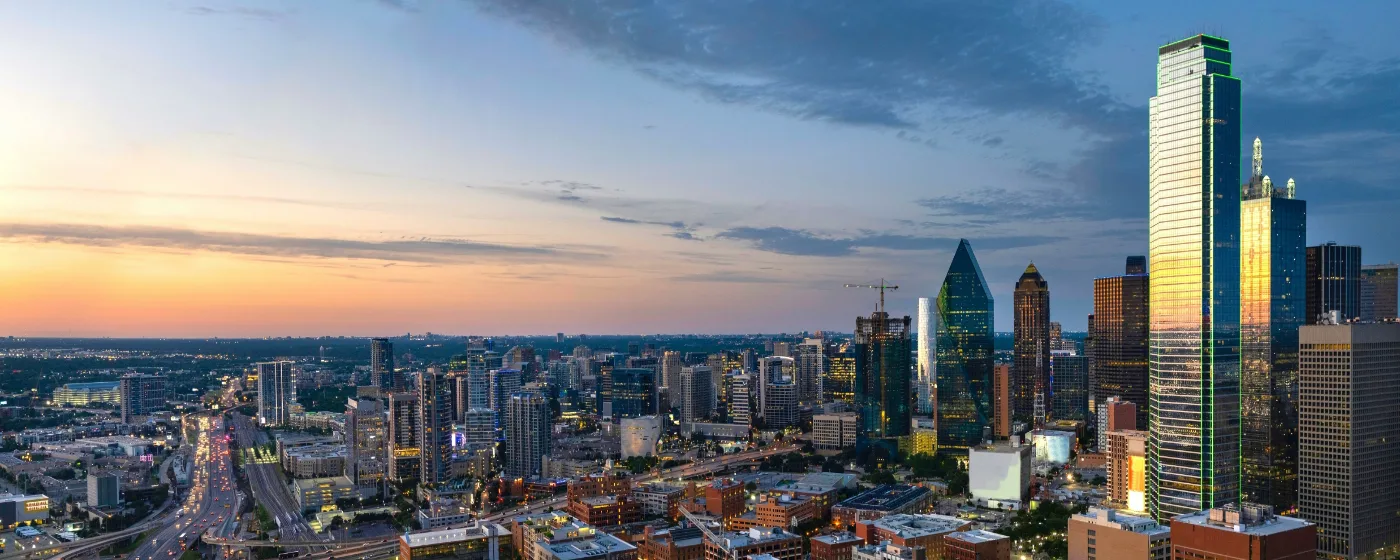
Maybe you've run the numbers and Texas's tax structure is what got your attention. Maybe you're leaving a colder state and someone in your network landed in Dallas and never looked back. The city has a way of surprising people who expect a flat, featureless sprawl — 1,329,491 residents spread across neighborhoods that feel genuinely distinct from one another, a cultural district that rivals cities twice its size, and a medical infrastructure that most metros can't match. The catch, and it's an honest one, is that Dallas is built around the car. That reality shapes retirement here more than almost anything else.
The economic case starts with Texas itself. There is no state income tax, which means Social Security checks, pension distributions, and IRA withdrawals land without a state-level cut. The city sits at the center of one of the most connected highway systems in the country — I-20, I-30, I-35E, and US-75 all converge here — and Dallas Love Field is six miles from downtown, making it genuinely easy to fly to family rather than waiting for family to come to you. UT Southwestern Medical Center, a major employer with an international research reputation, also happens to be the city's most important retirement asset: specialty-level care that most cities of any size can't offer.
Cost of living is the honest middle of the story. The typical home price in Dallas stood at $309,590 as of July 2026 (Zillow Home Value Index) — meaningful for buyers coming from coastal markets, though a household income at the city's median falls short of what's needed to carry that purchase comfortably at current rates. The property tax rate runs approximately 1.66%, which is typical for Texas but higher than many states retirees move from; the city's senior exemption program, however, meaningfully softens that for qualifying homeowners. Day-to-day expenses — groceries, utilities, dining — run noticeably below what retirees pay in Denver, Phoenix, or most of California.
Whether you're seriously weighing a move or still in the research phase, the sections below cover Dallas's retirement fit, healthcare access, the retiree budget, walkability and community, downsizing options, and how the city stacks up against nearby alternatives.
Why Retirees Are Choosing Dallas
The retiree who thrives in Dallas tends to fit a specific profile: comfortable driving, interested in world-class dining and arts without paying coastal prices, and ideally with family somewhere in the metro or an easy flight away. Dallas Love Field is six miles from downtown, and that proximity matters more in retirement than it did when you were flying for work — it means you're not anchored to the house the way you would be in a rural or semi-rural market.
The typical home price of $309,590 (July 2026, Zillow Home Value Index) sits noticeably below what comparable square footage runs in Fort Worth's more desirable pockets or in Plano, and dramatically below Sun Belt metros like Phoenix or Austin. For retirees selling a home in a higher-cost state and buying outright or with a small loan, that spread is real purchasing power. Single-story ranch homes, townhomes, and lock-and-leave condos exist across the city at a range of price points, and the supply of older, single-level construction in neighborhoods like Lake Highlands and North Dallas is genuinely useful for buyers who are thinking ahead about mobility.
The honest case against Dallas in retirement comes down to two things: summer heat and car dependency. From June through September, spending significant time outdoors becomes a planning exercise rather than a spontaneous one — 234 sunny days a year sounds appealing until you realize a large share of them arrive at 98 degrees. And if driving becomes difficult in your mid-70s or 80s, Dallas's citywide infrastructure offers little fallback. Retirees who want to age in place without a car should target Uptown or Oak Lawn specifically, not the city as a whole. For everyone else — active, mobile, and interested in a low-tax state with genuinely serious medical infrastructure — the case for Dallas is strong.
Healthcare & Medical Access in Dallas
Parkland Memorial Hospital is the nearest hospital to most Dallas residents, operating within city limits and serving as the county's safety-net institution with a full emergency department and broad inpatient capacity. For retirees, proximity matters — and Parkland's location inside the city means urgent care is accessible without a long drive.
The deeper story for retirement planning is what sits beyond emergency access. UT Southwestern Medical Center is consistently recognized as the leading academic medical institution in the Dallas-Fort Worth region, with deep specialist benches across cardiology, neurology, oncology, and geriatrics. That breadth of subspecialty care is what most retirees have to move to a major coastal city to access — in Dallas, it's within the metro. For someone managing a complex chronic condition or anticipating one, that proximity is the single strongest argument for Dallas as a retirement destination.
Baylor University Medical Center, also in Dallas, is independently regarded as one of the strongest hospitals in Texas, offering a genuine alternative for second opinions and subspecialty referrals without leaving the city. The fact that Dallas has two institutions of this caliber means retirees here have real options within the same metro — a level of redundancy that matters as medical needs become more specialized with age.
The honest caveat is that the city is large and these facilities are not evenly distributed. A retiree living in the far northern reaches of North Dallas or in East Dallas will have a meaningfully different drive time to UT Southwestern than someone in Oak Lawn or Uptown. Before committing to a specific neighborhood, map the drive to the specialty care you're most likely to need. In Dallas, five miles can mean ten minutes or thirty depending on which side of the freeway you're on.

The Retiree Budget in Dallas
Texas's tax posture for retirees is straightforward and genuinely favorable. The state has no individual income tax, which means Social Security benefits, pension income, IRA and 401(k) distributions, and annuity payments are entirely exempt from state taxation, regardless of how much you withdraw. Voters also approved a constitutional amendment in November 2025 that permanently bars the Texas Legislature from imposing a state estate, inheritance, or death tax — making wealth transfer planning somewhat simpler here than in states that retain those taxes.
Property taxes deserve careful attention. The effective rate in Dallas runs approximately 1.66%, which is real money on a typical home. The meaningful offset for retirees is the city's senior exemption: the Dallas City Council raised the over-65 homeowner exemption to $175,000, effective for the 2025 tax year. For eligible homeowners whose property is valued at $218,750 or less, the city exemption — stacked with the existing 20% homestead reduction — zeroes out the city-layer property tax entirely. This is a city-layer exemption, separate from any school-district or county exemptions that also apply; the combined effect for qualifying seniors is significant. If you're buying in Dallas specifically to reduce your tax burden in retirement, this exemption is worth modeling carefully before you close.
Day-to-day living on a fixed income runs lean relative to most metros retirees are moving from. Groceries, utilities, and restaurant meals all price noticeably below comparable spending in coastal cities. The Dallas Farmers Market and the White Rock Market give budget-conscious shoppers direct access to local produce. DART — Dallas Area Rapid Transit — offers seniors 65 and older a 50% discount off the standard public fare, covering buses, light rail, and the Trinity Railway Express via the DART GoPass Tap Card. For retirees living in transit-accessible neighborhoods, that discount makes car-optional living financially realistic even if it isn't geographically universal. See the full cost picture on the Dallas cost-of-living page.
Looking to buy in Dallas? Estimate your payment.
Enter your numbers to see an estimated monthly mortgage payment.
Estimate only. Excludes HOA fees and mortgage insurance. The interest rate above is a starting point, not a quoted rate — replace it with your own to see real numbers. Insurance is a flat placeholder, not a Dallas quote.
Walkability, Community & Staying Active in Dallas
The city's overall walkability is low — Dallas is among the least walkable large U.S. cities, a reality that retirees who've spent their adult lives walking to errands will feel acutely in most parts of the city. The answer isn't to dismiss Dallas; it's to choose the right part of it.
The Neighborhoods Where Walking Works
Uptown and Oak Lawn are the genuine exceptions. Uptown, with its dense street grid and proximity to the Katy Trail, puts coffee shops, restaurants, groceries, and medical offices within a genuine on-foot radius. Oak Lawn carries a walkable, mixed-use character that suits retirees who want urban convenience without a downtown high-rise. Downtown Dallas also delivers strong on-foot access, and Klyde Warren Park — the deck park built over I-345 — gives retirees a true civic gathering space with programming, open lawn, and food trucks, all walkable from Uptown. For retirees in the rest of the city, daily errands require a car, full stop.
Senior Services and Community Anchors
The City of Dallas Senior Services department supports residents 60 and older with a Senior Employment Program, the DART Rider Assistance Program, and connection to county resources. Dallas County's Older Adult Services Program separately provides meals, transportation, fitness activities, health and wellness programming, and benefits counseling to county residents in the same age bracket. The Senior Source, a Dallas-based nonprofit, offers free Medicare Open Enrollment guidance — a real service in a city where the choices are genuinely complex.
For active retirees, White Rock Lake provides miles of trail around a 1,000-acre lake in East Dallas, flat enough for daily walks and popular enough that you're never walking alone. The Trinity River Audubon Center, Trinity Overlook Park, and the Katy Trail offer additional outdoor options across a city that, despite its car dependence, has invested seriously in its trail and greenway network. The Dallas Arts District — the largest contiguous urban arts district in the country — gives culturally-minded retirees a calendar that punches well above what most cities its size can deliver.
Right-Sizing: Downsizing in Dallas
No 55+ communities were found in Dallas. That's an honest finding worth sitting with: retirees who specifically want an age-restricted community with shared amenities, a built-in social calendar, and maintenance-free living will need to look to the suburbs. Plano, Garland, and other nearby communities have more developed 55+ inventory than the city proper.
What the Downsizing Market Actually Looks Like
That said, Dallas's general housing stock has real options for retirees ready to right-size. Single-story ranch homes — the workhorses of Dallas's mid-century expansion — are widely available in neighborhoods like Lake Highlands, North Dallas, and parts of East Dallas. These homes were built in the 1950s through 1970s on slab foundations with minimal stairs, and while many have been updated, they still represent the most accessible entry point for buyers thinking about single-level living long-term.
The condominium and townhome market in Uptown and Oak Lawn skews toward younger buyers, but lock-and-leave units with elevator access do exist, particularly in newer mid-rise buildings. These are not typically entry-level purchases — buyers should expect pricing above the city's typical home price of $309,590 (July 2026) for anything recently built with accessibility features in a walkable neighborhood. A retiree selling a home in a high-cost market and buying in Dallas outright will find options; a buyer stretching a fixed income to buy new construction in Uptown will feel the gap.
The Trade-Off Worth Naming
Retirees who want single-level living in a walkable, transit-accessible neighborhood are working two constraints that don't overlap cleanly in Dallas. Walkable neighborhoods tend toward condos and townhomes, many of which are multi-story or lack elevator access. Single-story ranch homes tend to be in neighborhoods where driving is required for virtually everything. Finding the intersection of those two needs is possible but requires a deliberate search — it's the most common frustration buyers report after six months here. The workaround that works for many: buy a ranch home in a neighborhood with good trail access, keep one car, and plan around the city's transit discount for supplemental trips.
Dallas vs Nearby Retirement Destinations
| City | Cost vs Dallas | Medical Access | Walkability | Senior Living Depth | Overall Retirement Fit |
|---|---|---|---|---|---|
| Dallas | Anchor | Two major academic medical centers within city limits; deep subspecialty access | Car-dependent citywide; genuinely walkable in Uptown and Oak Lawn | No 55+ communities found; strong city senior services | Best for active retirees who drive and want serious specialty medical care nearby |
| Plano | Noticeably higher | Regional hospital access within the metro | Mostly car-dependent; some walkable pockets | More robust 55+ community inventory than Dallas proper | Strong for retirees who want suburban character, proximity to grandkids in good school zones, and age-restricted options |
| Fort Worth | About the same | Significant regional hospital presence | Car-dependent; Sundance Square area walkable | Growing active-adult inventory | Appealing for retirees who want a slightly smaller-city feel without sacrificing metro services |
| Irving | Somewhat higher | Regional hospital access; proximity to Dallas medical corridor | Mostly car-dependent | Modest senior living inventory | Better suited to commuter households than retirees; less distinct retirement infrastructure |
| Garland | Noticeably cheaper | Regional hospitals; Dallas medical corridor accessible by drive | Car-dependent throughout | More affordable senior housing options than Dallas proper | Budget-conscious retirees who don't need downtown access and want lower entry costs |
| Arlington | About the same | Regional hospital presence | Car-dependent; very limited transit | Some active-adult communities developing | Entertainment-focused, but thin on the transit and walkability retirees often need later in life |
On healthcare depth, Dallas is the clear standout in this group — no nearby city has two academic medical institutions with the subspecialty breadth available inside Dallas city limits, and that gap grows more consequential as retirees age into complex conditions. On cost, Garland offers genuine relief for budget-constrained buyers, and Fort Worth delivers roughly comparable pricing without sacrificing metro services. Plano is the right call for retirees who specifically want a 55+ community with shared amenities and don't mind paying more for it. Arlington appeals to retirees anchored to family in that part of the metro, but its near-absence of transit options makes it a difficult long-term choice for anyone thinking about what happens when driving stops. For retirees who want walkable urban retirement in a low-tax state with serious hospitals within city limits, Dallas — specifically Uptown or Oak Lawn — is the strongest option in the region.

Local Expert Takeaway: The retirement case for Dallas rests on three things the city actually delivers: a state that doesn't tax your retirement income, medical infrastructure anchored by two major academic medical centers that most retirees can only access by flying to a coast, and housing prices that let many buyers right-size without depleting savings. The honest caveat is that the city is built for drivers, summers are long and genuinely hot, and no 55+ community infrastructure exists inside city limits. Retirees who plant themselves in Uptown or Oak Lawn, take advantage of the city's senior property tax exemption, and use the Katy Trail or White Rock Lake for daily activity will find a version of Dallas that works well. Retirees who assume the city's price point also buys walkability or an age-restricted community will be surprised six months in.
Quick Takeaways & FAQs
✅ Texas's no-income-tax rule means Social Security, pensions, and 401(k) withdrawals are fully exempt from state taxation — one of the strongest retirement income advantages in the country.
⚠️ Dallas is among the least walkable large U.S. cities by citywide measure, and no 55+ communities were found within city limits — both matter significantly for long-term retirement planning.
📍 Dallas is home to two major academic medical centers within city limits, giving retirees access to deep subspecialty care without boarding a plane — a genuine differentiator from most Sun Belt alternatives.
Does Texas tax Social Security or retirement income?
What property tax breaks are available to Dallas seniors?
How good is Dallas for retirees who want to walk or use public transit?
Are there 55+ communities in Dallas?
How does Dallas compare to Fort Worth or Plano for retirement?
Moving to Texas?
Tell us what you need help with and we'll connect you with local resources.
