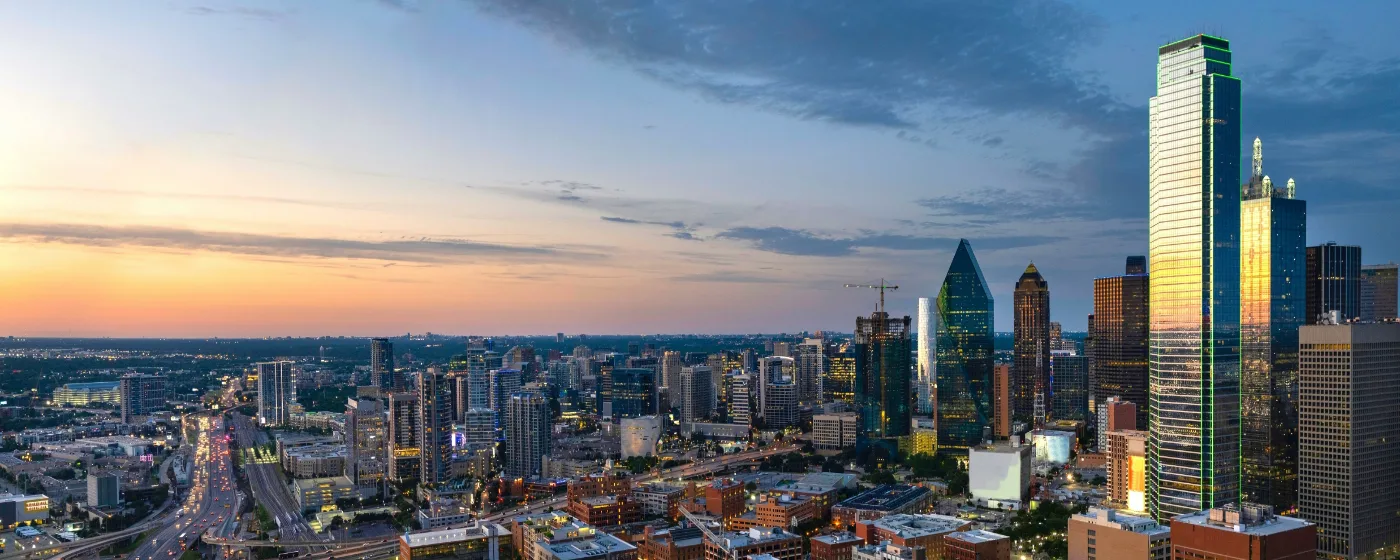
Dallas has a reputation that arrives before the data does. With 1,329,491 residents spread across a city that ranks as the 3rd-largest incorporated city in Texas, the headline crime numbers look alarming at first glance — but they don't tell the whole story. The city carries a violent crime rate of 6.58 per 1,000 residents and a property crime rate of 33.52 per 1,000 residents, both above state and national averages. What those numbers don't show is that Dallas has recorded four consecutive years of declining violent crime, that the large majority of its neighborhoods sit in the low-to-moderate risk range, and that the city's crime picture is more geographically concentrated than most outsiders assume.
The honest version of the safety question isn't "Is Dallas safe?" — it's "Which part of Dallas, and for what?" A 2026 neighborhood-level analysis of 386 Dallas neighborhoods found that 84% earned a combined A or B safety rating. The drag on the citywide average comes from a concentrated set of higher-risk corridors, not from danger spread evenly across the map. That distinction matters enormously when you're researching where to live, because choosing the right neighborhood here is a bigger safety variable than the city-level rate suggests.
The trend line has also moved consistently in one direction. Dallas recorded 183 murders in 2024 — a 26% reduction from 2023 and the city's lowest homicide total since before the pandemic. The first half of 2025 continued that arc, with homicides down more than 30% compared to the same period of 2024. These are not rounding-error improvements; they reflect sustained policy work and targeted enforcement programs that are producing measurable results in specific neighborhoods.
This guide breaks down the citywide crime data, maps it onto Dallas's actual neighborhoods, explains where the risks concentrate and where they don't, and gives you the practical context to evaluate safety before deciding on an area.
How Dallas Crime Rates Compare to State and National Benchmarks
The city carries a violent crime rate of 6.58 per 1,000 residents — above Texas's statewide rate of 4 per 1,000 and above the national rate of 3.7 per 1,000 (Bureau of Justice Statistics, Crime Known to Law Enforcement, 2024). The gap is real and shouldn't be papered over.
Property crime tells a similar story: a property crime rate of 33.52 per 1,000 residents, compared to the state figure of 20.7 per 1,000 and the national figure of 18.4 per 1,000. Dallas is a dense urban core, and property crime — car break-ins, package theft, catalytic converter theft — reflects that density. Locking your car and not leaving valuables visible is less optional here than it is in the suburbs.
This page shows a full comparison table directly below this section, so rather than duplicate those figures, the more useful thing to understand is what's driving them and whether the trend is improving. It is. Violent crime fell 8.2% in 2024 alone, totaling 9,029 incidents citywide. That marks four consecutive years of decline — a meaningful run, not a single good year.
The one exception to the downward trend: business robberies ticked up roughly 4% in 2024, from 451 to 469 incidents. The Dallas Police Department's community engagement unit responded with targeted outreach to local business owners. It's a narrow category, but worth noting if you're evaluating commercial corridors for safety.
The Geographic Reality: Where Dallas Is Safer and Where It Isn't
The single most important safety insight about Dallas is directional: the north side runs significantly safer than the east side, and the spread between them is wide. The northwest quadrant — anchored by neighborhoods like Preston Hollow and the corridor stretching toward Far North Dallas — sees far fewer incidents per resident than the east and southeast corridors. That's not a marginal difference; it's nearly double the risk across the same city, and it's the gap that makes the citywide average so misleading as a single number.
The south and southeast corridors carry the city's highest concentration of lower-rated neighborhoods. Only about 8% of Dallas's 386 analyzed neighborhoods received the lowest safety ratings, but they pull the citywide average up in ways that make the overall number look worse than what most residents actually experience day to day. A newcomer who walks away from Dallas entirely based on the headline rate is making a different mistake than one who researches specific zip codes.
What this means practically: the city-level rate is a starting point, not an answer. Before deciding on a neighborhood, pull the block-level crime map at the Dallas Police Department's crime dashboard or check an address on CrimeGrade.org. The variation within Dallas is wide enough that two neighborhoods a mile apart can have meaningfully different risk profiles — a research step that matters more here than it does in a smaller, more homogeneous city.
What Locals Know About the Dividing Lines
Residents tend to describe the north-south divide along roughly the I-30 corridor, with areas north of it generally carrying lower crime concentrations. That's a generalization with plenty of exceptions in both directions, but it's the mental map most people who've lived here for a few years carry. The east-west split is softer but still real — the northwest quadrant consistently outperforms the east on safety metrics, even accounting for wealth differences. For more on how neighborhoods are distributed geographically, see the best neighborhoods in Dallas guide.

Safest Neighborhoods in Dallas: What the Data Shows
Among the canonical Dallas neighborhoods, several stand out for consistently low crime — and they get there through different mechanisms, which is worth understanding.
Preston Hollow
Preston Hollow carries a crime rate well below the Dallas citywide average. Part of that reflects private patrols and gated access that supplement DPD coverage. It's among the quietest large neighborhoods in the city for both violent and property crime, and that reputation has held for years rather than fluctuating with broader city trends.
Best for: Luxury Quiet
Lake Highlands
Lake Highlands earns its reputation as one of Dallas's safest neighborhoods through community infrastructure rather than wealth alone. Strong neighborhood associations, active block-watch networks, and steady investment in public spaces have kept crime rates low in ways that hold even during periods when other parts of the city see upticks. It's a reminder that safety isn't only a function of income level.
Best for: Families Schools
Lakewood
Lakewood benefits from one of the most active neighborhood associations in Dallas. The constant foot traffic of joggers and cyclists around White Rock Lake creates natural surveillance that complements formal policing — more eyes on the street, fewer opportunities for property crime to go unnoticed. The trail corridor here functions as both an amenity and an informal safety mechanism.
Best for: Nature Walkable
Uptown
Uptown is heavily patrolled and well-lit at night, making it one of the safer choices for people who want genuine on-foot access to nightlife and restaurants without the tradeoffs that typically come with it. The density of foot traffic and commercial activity keeps the streets active late, which itself deters opportunistic crime.
Best for: Walkable Transit
Oak Lawn
Oak Lawn benefits from private patrols that keep crime rates well below the city average. It's a dense, walkable neighborhood with strong community identity, and the combination of active street life and organized safety infrastructure makes it consistently one of the lower-risk areas in the city.
Best for: Walkable Renters
Looking to buy in Dallas? Estimate your payment.
Enter your numbers to see an estimated monthly mortgage payment.
Estimate only. Excludes HOA fees and mortgage insurance. The interest rate above is a starting point, not a quoted rate — replace it with your own to see real numbers. Insurance is a flat placeholder, not a Dallas quote.
DPD Programs and the Trend Behind the Numbers
| Measure | Dallas | Texas | National | vs. national |
|---|---|---|---|---|
| Violent crime (per 1,000) | 6.58 | 4 | 3.7 | 78% higher |
| Property crime (per 1,000) | 33.52 | 20.7 | 18.4 | 82% higher |
State and national figures — Bureau of Justice Statistics, Crime Known to Law Enforcement, 2024 (tables 2 and 3). City figures — AreaVibes, based on FBI UCR 2024 data. City rates come from a different reporting series than the state and national benchmarks, so read the comparison as a direction, not a precise multiple.
Dallas's four-year decline in violent crime didn't happen by accident, and understanding what's driving it matters if you're trying to assess whether the improvement is durable.
In late 2024, DPD launched the Focused Deterrence Neighborhood Outreach (FDNO) program. Rather than relying only on enforcement, FDNO sends teams of uniformed officers, case workers, and community members — including people who have lost loved ones to gun violence — directly to individuals' homes and community spaces with support resources. It's a model that treats crime reduction as a community intervention, not just a policing problem, and early results have been cited as part of the sustained decline.
At the federal level, a Project Safe Neighborhoods initiative focused on two corridor areas in northeast Dallas produced a 12.2% reduction in violent-crime reports and a 14.9% reduction in nonviolent-crime reports from January through November 2025 compared to the same period the prior year. Those are meaningful numbers for a targeted geography, and they suggest the improvement in northeast Dallas specifically isn't coincidental.
Staffing: The Honest Caveat
DPD has publicly acknowledged operating below its own benchmark for sworn officer strength. The counterintuitive part: crime has continued to fall despite that staffing gap, and the department exceeded its goal of hiring at least 250 new officers in 2024. The trajectory is improving, but the department is still working toward its own targets — and that's worth knowing if patrol presence factors into how you think about long-term safety.
The first half of 2025 extended the trend further: homicides down more than 30% from the same period of 2024, rape down 13%, robbery down 13%, aggravated assaults down 15%. That breadth — improvement across multiple categories simultaneously — is a stronger signal than a single-category drop would be.
What to Research Before Choosing a Dallas Neighborhood
Six months after moving to Dallas, most people say the same thing: they wish they'd spent less time on the city-level crime rate and more time on the specific zip code they were considering. The variance within Dallas is wide enough that the headline number is almost beside the point once you've narrowed to a neighborhood.
The Research Steps That Actually Matter
Start with the DPD crime dashboard, which breaks incidents down by type and geography at a granular level. Layer that with CrimeGrade.org's neighborhood-level analysis, which synthesizes the same underlying data into a more readable format. Look at both violent and property crime — they don't always move together, and a neighborhood with low violent crime can still have frustrating rates of car break-ins or package theft.
Talk to the neighborhood association if one exists. In Dallas, active associations — Lakewood's is one of the most cited examples — tend to correlate with lower crime, better street maintenance, and faster DPD response times when incidents do occur. Neighborhood association activity isn't a guarantee, but its absence is worth noting.
A Seasonal Reality Newcomers Don't Expect
Property crime in Dallas has a seasonal rhythm that catches people off guard. The stretch from late November through January — when cars sit in driveways during the holidays and packages stack up on porches — tends to spike catalytic converter theft and package theft citywide, including in neighborhoods that run quiet the rest of the year. It's not a reason to avoid any particular area, but it's a practical detail worth knowing before your first Dallas winter so you're not caught off guard.
For a full breakdown of how neighborhoods compare on character, housing stock, and fit for different buyers, the best neighborhoods guide covers the complete picture. If you're still weighing Dallas against the broader region, the living in Dallas hub has the full context on what daily life here actually looks like.

Local Expert Takeaway: Dallas's city-level crime rate is above state and national averages, and that's not spin — it's real. But the number that matters most to a relocating buyer is the neighborhood-level picture, not the citywide one. A 2026 analysis found 84% of Dallas's 386 neighborhoods earned a combined A or B safety rating, and the city has posted four straight years of declining violent crime. Preston Hollow, Lake Highlands, Lakewood, Uptown, and Oak Lawn consistently rank as the safest options among the city's major neighborhoods, each getting there through a different combination of community infrastructure, private patrols, and natural foot traffic. Before settling on an area, spend time on DPD's crime dashboard and CrimeGrade.org — the variation within this city is wide enough that picking the right neighborhood is the biggest safety decision you'll make.
Quick Takeaways & FAQs
✅ Dallas has recorded four consecutive years of declining violent crime, including a 26% drop in murders in 2024 to the city's lowest total since before the pandemic.
⚠️ A property crime rate of 33.52 per 1,000 residents runs well above the national figure — car break-ins and package theft are genuine day-to-day concerns, even in safer neighborhoods.
📍 The northwest quadrant of Dallas sees dramatically fewer incidents per resident than the east and southeast corridors, making neighborhood selection the single most important safety variable for anyone moving here.
Is Dallas a safe city to live in?
Which Dallas neighborhoods are the safest?
Has crime in Dallas been getting better or worse?
Is property crime a serious concern in Dallas?
How does Dallas compare to Fort Worth and Plano for safety?
Moving to Texas?
Tell us what you need help with and we'll connect you with local resources.
