
About Ali

Stayton's Neighborhoods: What I Tell Every Buyer First
The single most important conversation I have with a Stayton buyer happens before we look at a single listing: which part of town actually fits your life? Stayton is compact enough — 8,292 residents as of the most recent count — that it can feel like one neighborhood from the outside. It isn't.
Downtown Stayton / Historic Downtown
This is the original grid, the walkable core, the part of town where you can get to the Stayton Public Library or the Stayton Farmers Market without starting your car. Homes here tend to sit on established lots with mature trees, older construction, and more character than the newer developments on the edges of the city. If you want to feel like you live in a town rather than near one, this is your neighborhood.
Westown
Westown is where a lot of families with school-age children land. It's still close to the core but has more of a suburban feel — slightly larger lots, more recently built homes, and easy access to OR-22 for anyone who commutes. I show a lot of first-time buyers here.
Heritage Oaks and Hollister Addition
These are two of the more established residential pockets, with single-family homes on generous lots. Heritage Oaks in particular tends to attract buyers who want something that feels settled — mature landscaping, quiet streets, a neighborhood that isn't still figuring out what it wants to be.
Riverhaven
The name tells you most of what you need to know. Riverhaven sits closer to the North Santiam River, and for buyers who want that proximity to the water and the green corridor it creates, this is the neighborhood to focus on. It's not a flashy section of town, but it has a quality of life that doesn't show up in a price comparison.
Village Creek and Fern Ridge
These are Stayton's growth edges — newer construction, more modern floor plans, and the kind of subdivision streetscape that people either love or find generic. Buyers who prioritize updated kitchens and open-concept layouts over lot character tend to end up here. The compromise is that the landscaping is younger and the community feel is still forming.
Green Acres Park
This neighborhood reads as residential and quiet — a good option for buyers who want to be in Stayton without being in the thicker commercial traffic near OR-22.
My practical advice: Figure out which neighborhood matches your actual daily life — commute direction, school boundary, preference for old trees versus new construction — before you fall in love with a specific home. In a city this size, moving two streets in the wrong direction can change your commute experience or your child's assigned school.
The Commute Reality
The commute question is the one I get most often, and I'll answer it the same way I do in person: Stayton to Salem is about 25 minutes under normal conditions via OR-22. That's the number to plan around.
What that number doesn't capture is what OR-22 feels like in winter. This highway runs east toward the Cascades, which means it also carries logging trucks, recreational traffic on summer weekends, and occasional weather-related delays when conditions deteriorate in the canyon to the east. The commute is easy on a clear Tuesday morning. It's a different calculation when there's fog in the valley or ice on the highway.
For Salem commuters, Stayton is genuinely practical. I have buyers who make that drive every day without complaint. Where I'd push back is if someone is hoping to commute to Portland regularly — that's roughly an hour and a half under good conditions, and the day you hit traffic on a Friday afternoon, it's longer. Portland International Airport is about 60 miles out, Eugene Regional Airport roughly 65 miles. Either way, you're planning ahead for flights.
The buyer who thrives on this commute is the one whose job is in Salem, or whose work is primarily remote. Stayton's estimated share of residents working from home is notable — and it makes sense. The infrastructure in town supports a good remote work life, and you're not paying Salem prices for it.
One thing people underestimate: OR-22 is also the reason Stayton gets weekend recreation traffic from the Willamette Valley heading up toward Silver Falls or the Cascades. That has no impact on your commute outbound, but it can affect inbound traffic on Sunday evenings in summer. It's a small thing, but locals know to time their grocery run accordingly.
North Santiam School District: What the Numbers Say
North Santiam School District 29J serves Stayton and the surrounding communities, with 2,078 students enrolled in 2025-26, according to figures the Oregon Department of Education publishes. It's a small district — which means your child is never just a number, but it also means the range of elective offerings and program depth is narrower than you'd find in a large suburban district.
On 2024-25 state assessments, 28.6% of students reached math proficiency and 40.8% reached reading proficiency, according to figures the Oregon Department of Education publishes. Those numbers are below state averages, and I won't dress that up. What I will say is that test scores are one data point in a much larger picture, and I've watched families move here with kids who thrived in this district's smaller-school environment in ways they hadn't in larger, higher-scoring districts.
The district runs active OSAA athletics programs — the Stayton Eagles have a real Friday night football culture — and the community shows up for those games in a way you don't see in suburban districts twice this size. There's something to be said for a school where your kid can make varsity without competing against 800 other freshmen for a roster spot.
My honest advice: anyone seriously considering a move to Stayton should do their own due diligence on the schools. Confirm the assigned school for any specific address directly with the district — boundary lines matter, and they can change — and review the data the Oregon Department of Education publishes themselves. I can tell you what the numbers say; I can't tell you how a school will fit your child.
Looking to buy in Stayton? Estimate your payment.
Enter your numbers to see an estimated monthly mortgage payment.
Estimate only. Excludes HOA fees and mortgage insurance. The interest rate above is a starting point, not a quoted rate — replace it with your own to see real numbers. Insurance is a flat placeholder, not a Stayton quote.
Stayton vs Nearby Cities
| City | Typical Home Price | Typical Rent | Cost vs Stayton |
|---|---|---|---|
| Stayton (this city) | $471,759 | $1,503/mo | — |
| Sublimity | $576,724 | $1,400/mo | 22% higher |
| Aumsville | $496,279 | $1,350/mo | 5% higher |
| Silverton | $557,308 | $1,775/mo | 18% higher |
Source — home prices: Zillow ZHVI, July 2026; rent: Zillow ZORI, July 2026. Nearby-city figures are the same series, refreshed together.
I show homes in Stayton, Sublimity, Aumsville, Silverton, and Salem — sometimes all in the same week — and the questions I get after those tours are almost always the same: what am I actually giving up, and what am I gaining?
Here's how I'd frame each comparison honestly, in plain terms:
Stayton vs. Sublimity: Sublimity is the next town over — you can drive between them in minutes — but the price difference is real. Sublimity runs noticeably higher than Stayton's typical home price. What you get there is a slightly more rural character and slightly larger parcels in some areas. Most buyers who compare the two end up in Stayton because the gap in feel doesn't justify the gap in cost.
Stayton vs. Aumsville: Aumsville is smaller and sits at a somewhat higher price point than Stayton. It has even less commercial infrastructure — if you want to walk to a coffee shop or a farmers market, Stayton wins. The buyers who choose Aumsville are usually buying specifically for a property type or lot size they couldn't find in Stayton.
Stayton vs. Silverton: This is the comparison I get most often, and it's the most honest trade-off in this part of the valley. Silverton is more expensive — noticeably higher than Stayton — and it has a more developed downtown, a stronger arts identity, and a longer-established sense of town character. If Silverton is in your budget, it's a real alternative. If it's not, Stayton gives you much of the same small-city feel at a more accessible price point.
Stayton vs. Salem: Salem is a city; Stayton is a town. If you need full urban services, an active restaurant scene, and proximity to everything, Salem is the answer and the drive is about 25 minutes. If Salem's price points are pushing you out, or you just want more breathing room and a quieter street, Stayton is where a lot of Salem-area buyers end up.
Stayton and the canyon towns: The small towns further up the OR-22 corridor are a different kind of small town — more isolated, oriented toward the recreation corridor rather than a Willamette Valley lifestyle. Buyers who choose them are usually making a deliberate choice to be deeper in the mountains. Stayton gives you the mountain access without giving up the services.
Daily Life and Weekends in Stayton
One of the things I tell buyers who've never spent a weekend in Stayton: give it one Saturday before you decide. The town has more going on than it looks like from OR-22.
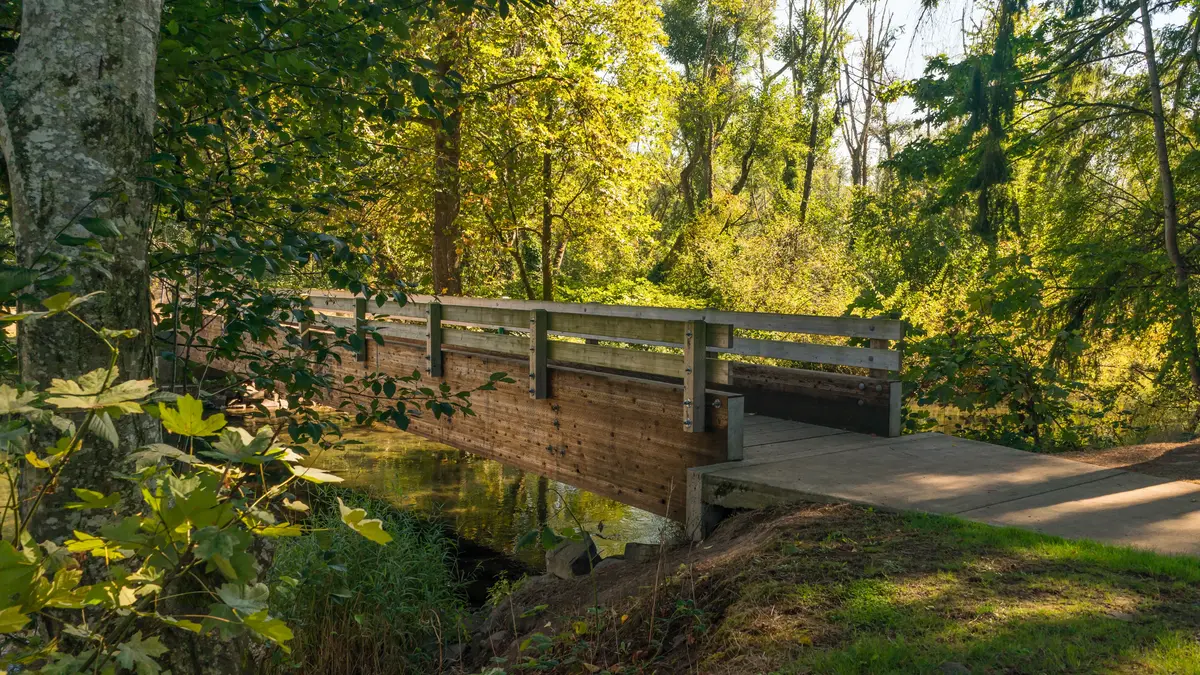
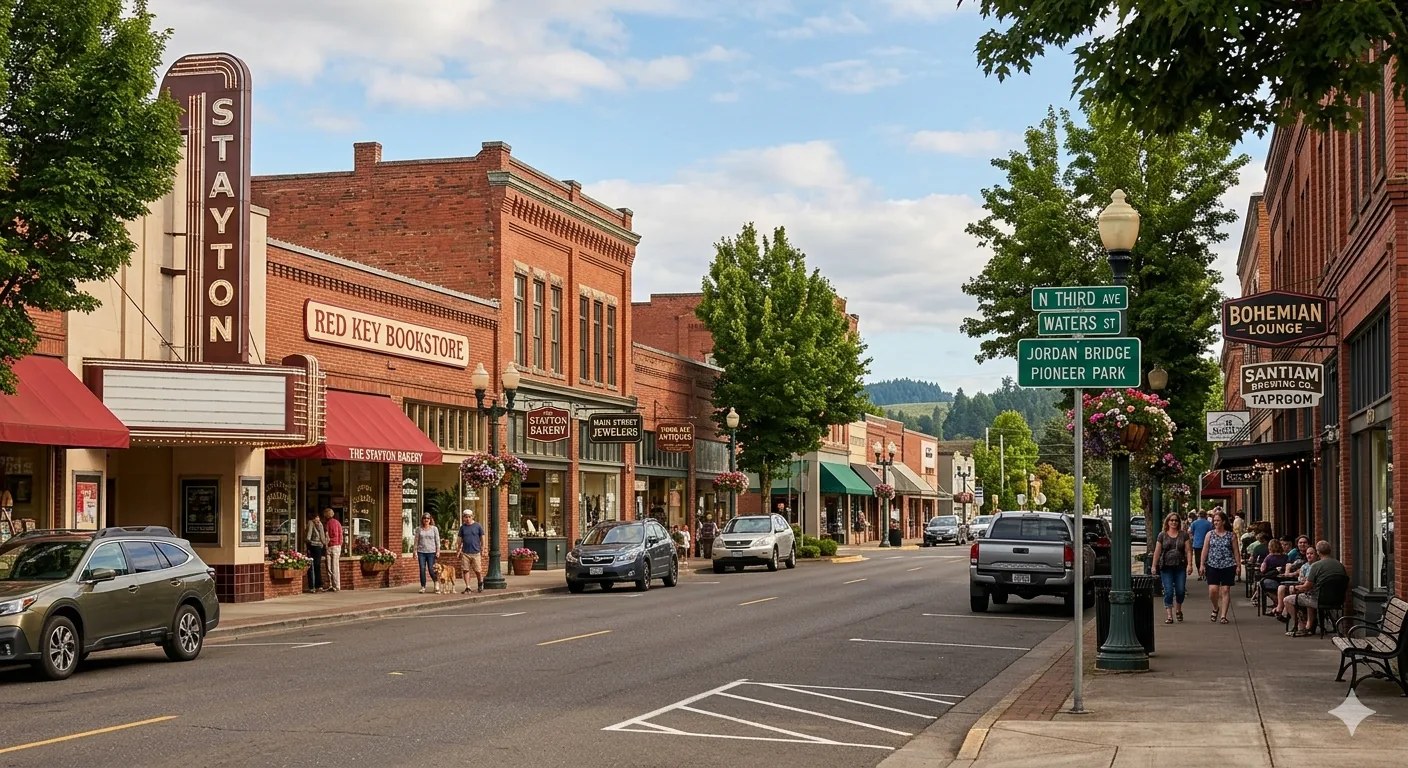
Downtown Stayton is genuinely worth spending time in. The Stayton Farmers Market draws a real crowd through the growing season — the kind of market where you'll see the same faces every week and eventually know all of them. Pioneer Park, a 10-acre green space anchoring the downtown core, connects via paved trails to the North Santiam River waterfront; the park features the historic Jordan Covered Bridge and a disc golf course that gets regular use. This is where the community actually gathers on a warm afternoon.
For food and coffee, there are good local options. Ixtapa Mexican Restaurant and The Gingerbread House are favorites among the buyers I work with, and Covered Bridge Cafe has a following. For coffee, Daily Buzz, Cuppa Joe, Kick Start Coffee, Canyon Coffee, and The Hub give you more than enough options for a town this size — you're not driving to Salem for a decent cup. A&W Restaurant and Mashita Teriyaki Restaurant round out the casual dining options. The Stayton Farmers Market is another reason to stay local on the weekend.
The community events calendar is more active than most people expect. The 4th of July celebration — parade, fun run, and a fireworks show the Stayton Fire Department puts on — is a proper small-town occasion. The summer car show series draws a crowd. The Sublimity Harvest Festival, a multi-day truck and tractor pull held just after Labor Day, is the kind of event you'd never find in a Portland suburb.
Silver Falls State Park is the outdoor anchor. At approximately 9,000 acres, it's Oregon's largest state park, and the Trail of Ten Falls — a designated National Recreation Trail with ten waterfalls ranging from 27 to 177 feet — draws visitors from across the region and well beyond. Stayton residents treat it as their backyard. The Santiam State Forest adds additional trail access for mountain bikers and equestrians. If outdoor access is part of why you're leaving the city, Stayton delivers on that promise in a way most small towns don't.
The one honest limitation: if you need a specific specialty retailer or a large-format shopping experience, you're making a trip. Stayton has the day-to-day covered — groceries, hardware, the basics — but a serious shopping run means driving out of town. Most residents have made their peace with that; a few have not, and those are usually the people who end up moving back to Salem within a year.
What $471,759 Actually Buys in Stayton
The typical home price in Stayton is $471,759 (Zillow Home Value Index, July 2026). That figure tells you something real: Stayton is not a bargain-basement market, but it is significantly more accessible than most of the Willamette Valley's more prominent small towns.
At that price point, you are shopping for a genuine single-family home with a real yard — not a townhouse, not a condo, not a starter home with a postage-stamp lot. Most of what I show buyers in the $440,000–$510,000 range is three-bedroom, two-bath construction on a quarter-acre or more, with a garage. In Heritage Oaks or Riverhaven, that's likely an established home with mature landscaping. In Village Creek or Fern Ridge, it's more likely a newer build with an open floor plan and fewer trees.
One thing worth being clear about: the typical home price in Stayton runs above what the median household income here — $78,268 — can comfortably carry without a significant down payment or a dual income. That's not unique to Stayton; it's the reality across most of the Willamette Valley. But it does mean that buyers stretching into this market on a single income need to do the math carefully before falling in love with a specific price range.
The effective property tax rate in Stayton is approximately 0.79%, which is relatively low by Oregon standards. That matters when you're calculating the true monthly cost of ownership and comparing it against renting — the typical citywide rent runs $1,380–$1,680 for a two-bedroom, with the overall citywide figure at $1,503 per month (Zillow, July 2026). For a lot of buyers who've been renting in this range, the gap between renting and owning here is smaller than they expected.
The crime picture is also worth knowing: Stayton has a violent crime rate of 2.45 per 1,000 residents and a property crime rate of 22.54 per 1,000 residents. For context, the Oregon state average is a violent crime rate of 3.3 per 1,000 and a property crime rate of 24.5 per 1,000, while the national figures are a violent crime rate of 3.7 per 1,000 and a property crime rate of 18.4 per 1,000. Stayton's violent crime rate runs below both the state and national figures; its property crime rate runs below the state figure but above the national one. I share that without editorial spin — it's one data point, and individual neighborhoods vary.
My practical read: Stayton gives you more home for the money than Silverton or Salem's more desirable pockets, and the quality of life per dollar is genuinely strong. The buyers who feel best about their purchase a year later are the ones who came in with clear eyes about the commute, the schools, and the shopping limitations — and decided those were trade-offs they could live with.
Final Advice From Ali
Quick Takeaways & FAQs
✅ Stayton gives buyers a genuine single-family home with a real yard at a price point that has mostly left Silverton and Salem's most desirable neighborhoods behind.
⚠️ The commute on OR-22 is easy on a clear day and a different calculation in winter — remote workers or Salem commuters will do fine; regular Portland commuters should plan carefully.
📍 Pioneer Park's paved trails connect directly to the North Santiam River waterfront, and Silver Falls State Park — Oregon's largest, with the Trail of Ten Falls — is a short drive away.
What is the commute from Stayton to Salem actually like day to day?
How do the schools in Stayton compare to what I might find elsewhere in the Willamette Valley?
Which neighborhoods in Stayton are best for families with kids?
What does the typical home price in Stayton actually get you?
What surprises people most after they move to Stayton?
How fast do homes move in Stayton, and how competitive is it?
I'm deciding between Stayton and Silverton — what's the honest trade-off?
Is Stayton a good fit for remote workers or people relocating from a larger city?
Moving to Oregon?
Tell us what you need help with and we'll connect you with local resources.
