
If you're choosing between staying in California and making the move to Stayton, the decision usually comes down to one thing: how much of your income you want the house to consume. Stayton sits in the Willamette Valley roughly an hour south of Portland, anchored to OR-22 along the North Santiam River corridor. It is a working small town of 8,292 people — not a suburb, not a resort town, not a destination that grew up around a tech campus. That distinction matters, because the life it offers is genuinely different from what most Californians are leaving behind, and the gap between expectation and reality can cut both ways.
The economic backbone here is grounded and unglamorous in the best sense: the North Santiam School District, Santiam Hospital, the City of Stayton, Marion County, and Wilco, the regional agricultural cooperative. These are stable, community-scale employers, not the kind of headquarters that flood a zip code with high salaries and drive up land values. The median household income of $78,268 reflects a working community, and the housing market — while affordable by California standards — does carry a gap between that income and what the typical home costs. For remote workers bringing a California salary into this cost structure, that gap largely disappears and the math becomes genuinely compelling.
Stayton's typical home price of $471,759 (July 2026) sits meaningfully below California's statewide typical home value of $773,735. The property tax picture shifts in your favor too. Oregon has no sales tax at all — not at the state level, not locally — and the Willamette Valley gives you Silver Falls State Park, the Santiam State Forest, and the North Santiam River waterfront essentially as backyard infrastructure. What you give up is density: the cultural amenities, the specialty retail, the medical specialists. Salem, about 25 minutes away via OR-22, handles most of what Stayton doesn't offer locally.
Whether you're a remote worker cashing out of a California market or a retiree looking for a quieter landing, the sections below break down Stayton's home prices versus California, the real tax comparison, what daily life looks like here, what surprises people after six months, and what you should know before you make an offer.

The Home Price Reality: What Your California Equity Actually Buys Here
The single most important number for a California buyer is this: Stayton's typical home price sits at $471,759 (Zillow Home Value Index, July 2026). Set that beside California's statewide typical home value of $773,735 and the gap is immediate and substantial.
For many Californians — especially those selling in the Bay Area, Los Angeles, or San Diego — the equity from a California sale arrives in Stayton as a down payment that clears 50 to 80 percent of the purchase price. That changes the entire conversation around monthly carrying costs. A buyer who was stretched thin on a California mortgage may find themselves genuinely comfortable here for the first time in years.
What the Housing Stock Looks Like
Stayton is not a luxury market. The housing stock is mostly single-family homes on modest lots, with a concentration of ranch-style and mid-century construction in established neighborhoods like Hollister Addition and Green Acres Park. Newer construction has appeared in areas like Heritage Oaks and Fern Ridge, and the city's Planning Commission approved annexation of approximately 17 acres zoned for higher-density residential in April 2026 — a signal that more supply is coming, not that the market is overheating.
Riverhaven and Village Creek offer proximity to the North Santiam River corridor, which carries its own appeal for buyers coming from California coastal markets. Westown and Downtown Stayton give you walkable access to the Stayton Farmers Market, the Stayton Public Library, and the historic commercial core — a compact, genuine downtown rather than a strip-mall substitute.
Nearby City Comparisons
If you're cross-shopping within the region, context helps. Silverton runs noticeably higher than Stayton's typical price. Sublimity, just a few minutes away, also runs noticeably higher despite its smaller size. Aumsville comes in somewhat higher. Stayton represents the most accessible entry point among its immediate neighbors, which partly explains why it draws buyers who get priced out of those markets.
One thing worth stating plainly: the median household income in Stayton is below what's needed to comfortably carry the typical home here. That gap is real and affects local buyers significantly. For a Californian bringing external equity or a remote income, the picture is different — but it does shape the local resale market and the long-term trajectory of prices. For a fuller breakdown of how Stayton's costs stack up overall, see the cost of living page.
One Inspection Step California Buyers Routinely Skip
Oregon's Willamette Valley sits in an elevated radon zone, and Stayton is no exception. Radon testing simply isn't standard practice in most California coastal markets — it's not a known issue there — and California transplants skip or rush the inspection at a higher rate than local buyers. Do not skip it. Budget the time for a full radon test before closing, not as an afterthought.
The Tax Comparison: Where Oregon Actually Wins (and Where It Doesn't)
The tax picture moving from California to Oregon is genuinely good news in some places and more complicated in others. Getting this right matters more than most relocation guides admit.
Sales Tax: The Real Win
Oregon has no statewide sales tax and prohibits local governments from imposing one either. It is truly sales-tax-free at every level. California's statewide base sales tax rate of 7.25% is the highest in the nation, and local additions push the combined average closer to 8.99% in many jurisdictions. On $40,000 a year in taxable purchases, that difference is worth roughly $3,600 annually — money that simply stays in your pocket in Oregon. For families with high consumer spending, this is the most immediate and tangible tax benefit of the move.
Income Tax: Read This Carefully Before Assuming You're Ahead
California's top state income tax rate of 13.3% applies only to the highest earners. Oregon's top rate is 9.9%, which sounds better. The catch is that Oregon's brackets are compressed and steep, reaching near their maximum rate well below where California's top rate kicks in. The income-tax savings favor high earners most directly; many middle-income households pay about the same or more in Oregon than they would in California. The sales-tax elimination is what tips the overall comparison in Oregon's favor for typical consumer spenders — not the headline rate alone.
Remote workers who relocate to Oregon from California pay Oregon income taxes on wages earned while physically working in Oregon. For high earners, Oregon's 9.9% top rate versus California's top state income tax rate of 13.3% does represent a real savings — but the further down the income scale you go, the more that advantage narrows or reverses.
Property Tax: Structurally Lower Here
Stayton's effective property tax rate is 0.79%. California's Proposition 13 base rate is 1%, but new buyers in California typically pay an effective rate of 1.1% to 1.3% or higher once local bonds, parcel taxes, and Mello-Roos fees are layered on. Stayton's rate is meaningfully lower than what most California buyers are actually paying at the point of sale — not the theoretical base rate, but the real bill on a new purchase.
| Tax Type | California | Oregon / Stayton | Practical Read |
|---|---|---|---|
| Sales Tax | 7.25% base statewide (higher with local additions) | 0% — prohibited at all levels | Immediate savings on every purchase |
| Top Income Tax Rate | 13.3% (California, top earners) | 9.9% (Oregon) | Income-tax savings favor high earners; many middle-income households pay about the same or more in Oregon |
| Effective Property Tax | 1.1%–1.3%+ for new buyers | 0.79% (Stayton) | Structurally lower in Stayton |
The honest summary: if you're a high earner who spends freely, Oregon wins on the combined tax picture. If you're a middle-income earner counting on income tax relief to make the budget work, model your actual Oregon liability before you move, not after.
Daily Life in Stayton: The Pace Shift Is Real
Most people who move here from California say the same thing around month three: the quiet is louder than they expected. Not in a bad way, necessarily — but it is a genuine adjustment. Stayton has 155 sunny days a year, which is more than most of the Pacific Northwest but less than anywhere you were likely living in California. The grey months run from November through March, and they are genuinely grey.
What the Town Center Offers
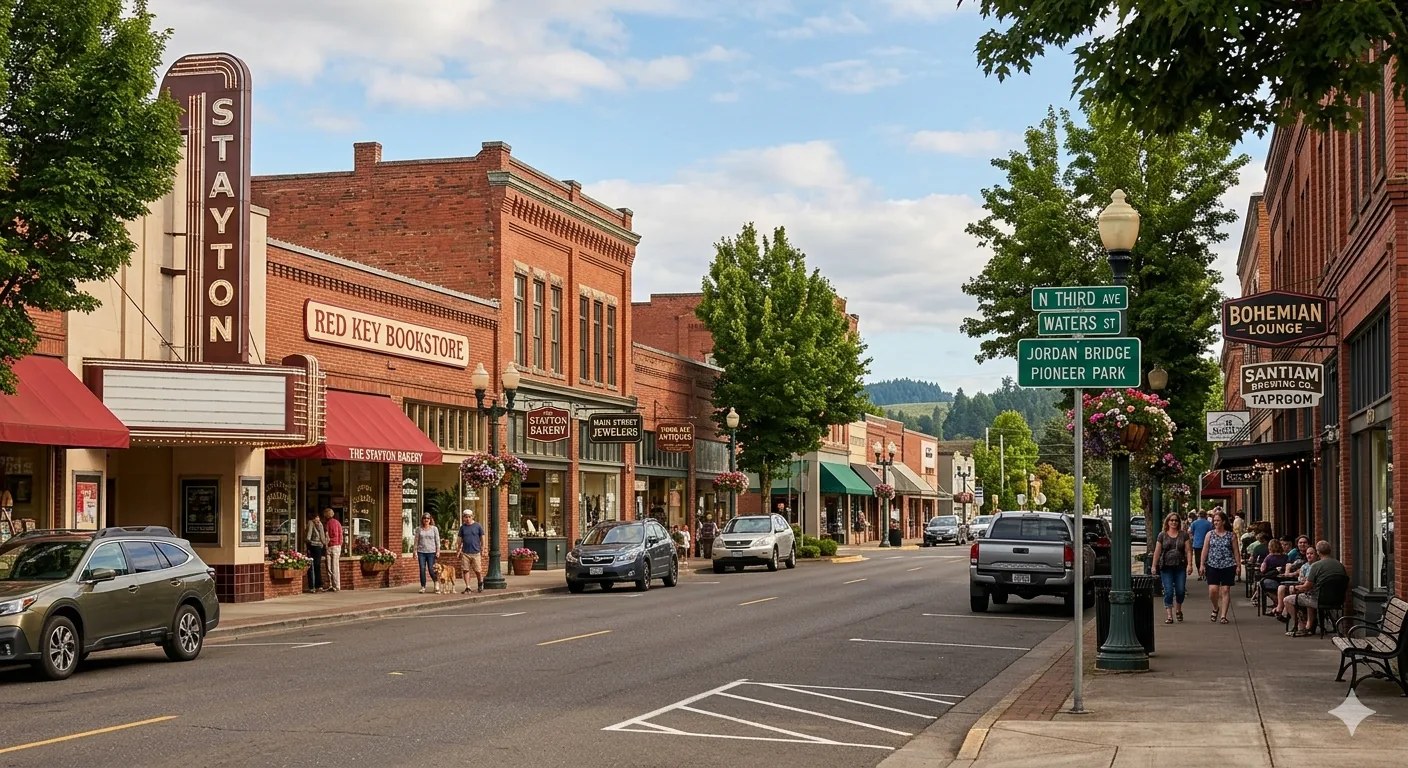
Historic Downtown Stayton is a real downtown — small, functional, and slowly investing in itself. The FY2025–2026 Community Improvement Grant funded new murals celebrating Stayton's history and Kalapuya heritage as part of the 'Flowing Through Time' series downtown, alongside accessibility upgrades at the Spotlight Community Theater. These are modest improvements, but they reflect a community that is actively maintaining and adding to its core rather than watching it deteriorate.
For daily errands and dining, the options are genuinely limited by California standards. A serious shopping run means driving to Salem. There's no major chain grocery infrastructure here beyond what a small town carries, and specialty retail doesn't exist locally — you'll be ordering online for things the local shops don't stock. What exists instead is a tighter commercial core: independent coffee shops, a handful of casual restaurants, and a weekly farmers market that functions as a genuine community gathering point rather than a tourist attraction.
Outdoor Life Is the Real Amenity
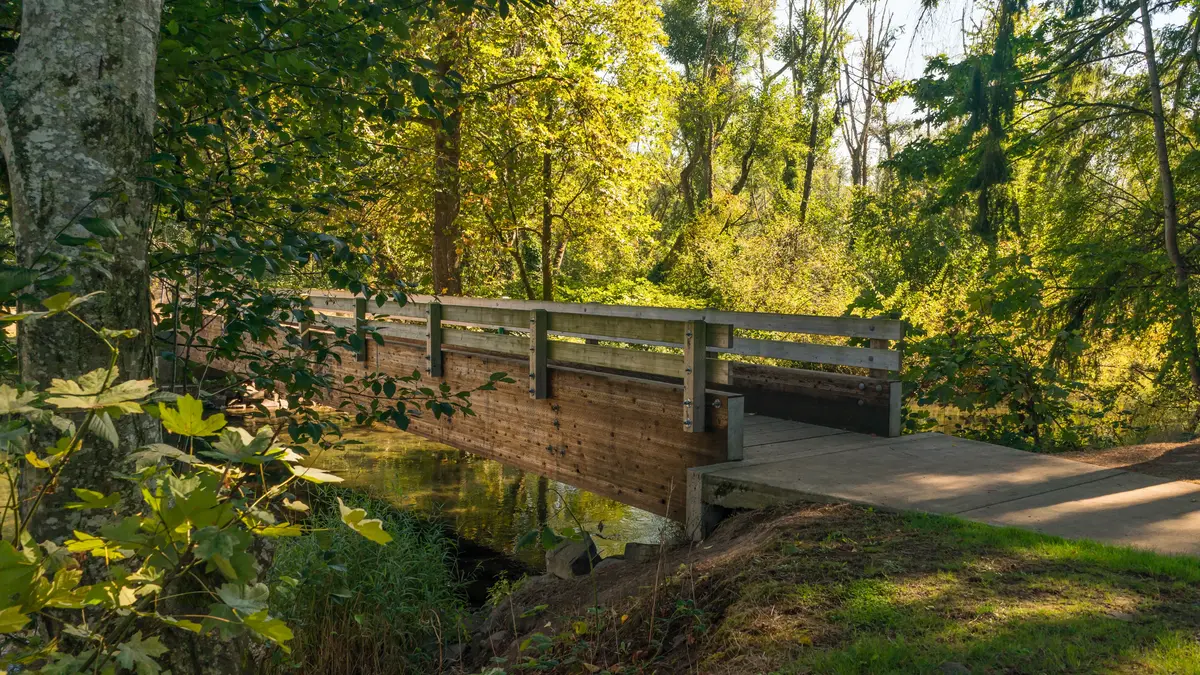
The North Santiam River waterfront is where Stayton residents actually spend time outdoors. Silver Falls State Park sits nearby and functions as the region's marquee outdoor destination — a trail system anchored by multiple waterfalls that draws people from across the Willamette Valley. The Santiam State Forest gives you additional acreage for hiking and recreation without the crowds. For buyers coming from California who priced outdoor access as a premium, Stayton delivers it without the premium.
Where Families Actually Gather
The Stayton Farmers Market is the most reliable community touchpoint, running through the warm months and drawing a cross-section of the town. The North Santiam River waterfront serves as the informal outdoor anchor on warm weekends. The Stayton Public Library anchors the civic center of downtown. The community theater and the school district's active OSAA athletics programs — Friday night football in particular — are where you meet people and become a local rather than a transplant.
Looking to buy in Stayton? Estimate your payment.
Enter your numbers to see an estimated monthly mortgage payment.
Estimate only. Excludes HOA fees and mortgage insurance. The interest rate above is a starting point, not a quoted rate — replace it with your own to see real numbers. Insurance is a flat placeholder, not a Stayton quote.
Schools and Community: What Families Moving from California Should Know
North Santiam School District 29J serves Stayton and the surrounding area. The district holds a B- rating, according to Niche, with 2,078 students enrolled in 2025-26. On 2024-25 state assessments, 28.6% of students reached math proficiency and 40.8% reached reading proficiency — figures that fall below Oregon's state averages and well below what families from high-performing California districts may be accustomed to.
That gap is worth naming honestly. Parents who are relocating from districts in the San Francisco Bay Area, Los Angeles suburbs, or other high-performing California metro areas will notice a difference in academic benchmarks. The district has active OSAA athletics programs, a community-supported school culture, and the Stayton Grizzlies mascot that fills stands on Friday nights. The community investment in its schools is real. But test score benchmarks are what they are, and a family weighing schools as a primary factor should read the full picture on the schools page.
The Community Texture
Stayton's population of 8,292 means you will recognize faces at the grocery store within a few months. That cuts both ways: the community is genuinely tight-knit, newcomers are welcomed but noticed, and the town moves at a pace that is either a relief or a frustration depending on what you're coming from. There is no anonymity here.
California transplants who arrive expecting a scaled-down version of wherever they left tend to struggle. The ones who thrive are those who arrive looking for something genuinely different — a slower gear, a smaller footprint, and access to the outdoors without fighting for it. The community has absorbed enough out-of-state arrivals in recent years that the culture is aware of the dynamic, though how warmly any individual newcomer is received depends considerably on whether they approach the town on its own terms.
Growth Trajectory
Oregon ranked first nationally for inbound migration in the United Van Lines 2025 National Movers Study, with California representing the largest single source at 22% of arrivals. Roughly 31,500 Californians moved to Oregon in 2024 alone. Stayton is not insulated from that trend, and the April 2026 annexation approval for higher-density residential zoning signals that the city is planning for continued growth. For buyers concerned about overbuilding or neighborhood character, this is worth monitoring — though at current scale, Stayton remains well below the point where growth has meaningfully changed its character.
What California Buyers Get Wrong About Stayton
Every California buyer who moves here carries assumptions that don't quite land. Some are pleasantly wrong; others create real friction. The honest version is more useful than the promotional one.
The Income Tax Assumption
The most common misconception: assuming Oregon is categorically lower-tax than California. It isn't — not on income tax, for most earners. Oregon's brackets are compressed and steep, reaching near their maximum rate well below where California's top rate of 13.3% applies. The income-tax savings favor high earners most directly; many middle-income households find they pay about the same or more once they land in Oregon. If you're counting on income tax relief to make the budget work, model your actual Oregon liability before you move, not after.
The Property Tax Windfall
This one actually lands as expected. Stayton's effective property tax rate of 0.79% is structurally lower than what new California buyers pay, and the difference is real money on an annual basis. California's Proposition 13 base rate sounds similar, but new buyers rarely pay anywhere near just 1% once the layers of local bonds and assessments are added. The property tax savings in Stayton are genuine and durable.
Why Some People Leave After Two Years
The most common reason Californians leave Stayton after a short stay is not the taxes or the house prices. It's the limited cultural and retail infrastructure, compounded by the grey season. People who underestimate how much of their daily life in California was built around density — the density of dining, of events, of spontaneous options — find that Stayton's smallness is harder to adapt to than they expected. The drive to Salem handles many practical needs, but it doesn't replace proximity.
What You Would Not Do if Moving Here
You would not skip the radon inspection — a routine step in this part of the Willamette Valley that California buyers routinely underestimate or omit entirely because it simply isn't standard practice in most California markets. Budget for it and treat it as non-negotiable.
You also would not buy assuming you can replicate a California lifestyle at a lower price point. The price point is lower. The lifestyle is different. The buyers who get it right are the ones who move toward Stayton's actual character rather than away from California's cost. For a fuller look at who Stayton suits best and how the neighborhoods compare, the neighborhoods page and the living in Stayton guide fill in the rest.
Local Expert Takeaway: Stayton is a genuine value relative to California — on home price, on property tax, on the absence of any sales tax — but it is not a lifestyle substitute. The buyers who move here successfully are typically bringing California equity into a market where it goes far, carrying a remote income or a retirement budget, and actively choosing a smaller, quieter life along the North Santiam River rather than settling for one. The ones who struggle are those who arrive expecting a scaled-down version of what they left. Run the income tax comparison before you assume you're ahead, get the radon test done, and spend a full grey-season week here before you close — the 155 sunny days a year are real, but so are the other 211.
Quick Takeaways & FAQs
✅ Stayton's typical home price of $471,759 (July 2026) sits substantially below California's statewide typical home value of $773,735, and California equity frequently covers a majority of the purchase price outright.
⚠️ Oregon's income-tax savings favor high earners most directly — the real consumer win for most households is zero sales tax at any level of government, worth thousands annually for typical spending.
📍 The Willamette Valley sits in an elevated radon zone, and California buyers routinely skip the radon inspection because it isn't standard practice in most California markets — don't skip it.
Is Stayton, Oregon cheaper than California to live in overall?
What is the typical home price in Stayton, Oregon?
Does Oregon have a state income tax, and how does it compare to California?
What should California buyers know about the home-buying process in Stayton that's different from California?
How do Stayton's schools compare to what families from California are used to?
Moving to Oregon?
Tell us what you need help with and we'll connect you with local resources.
