
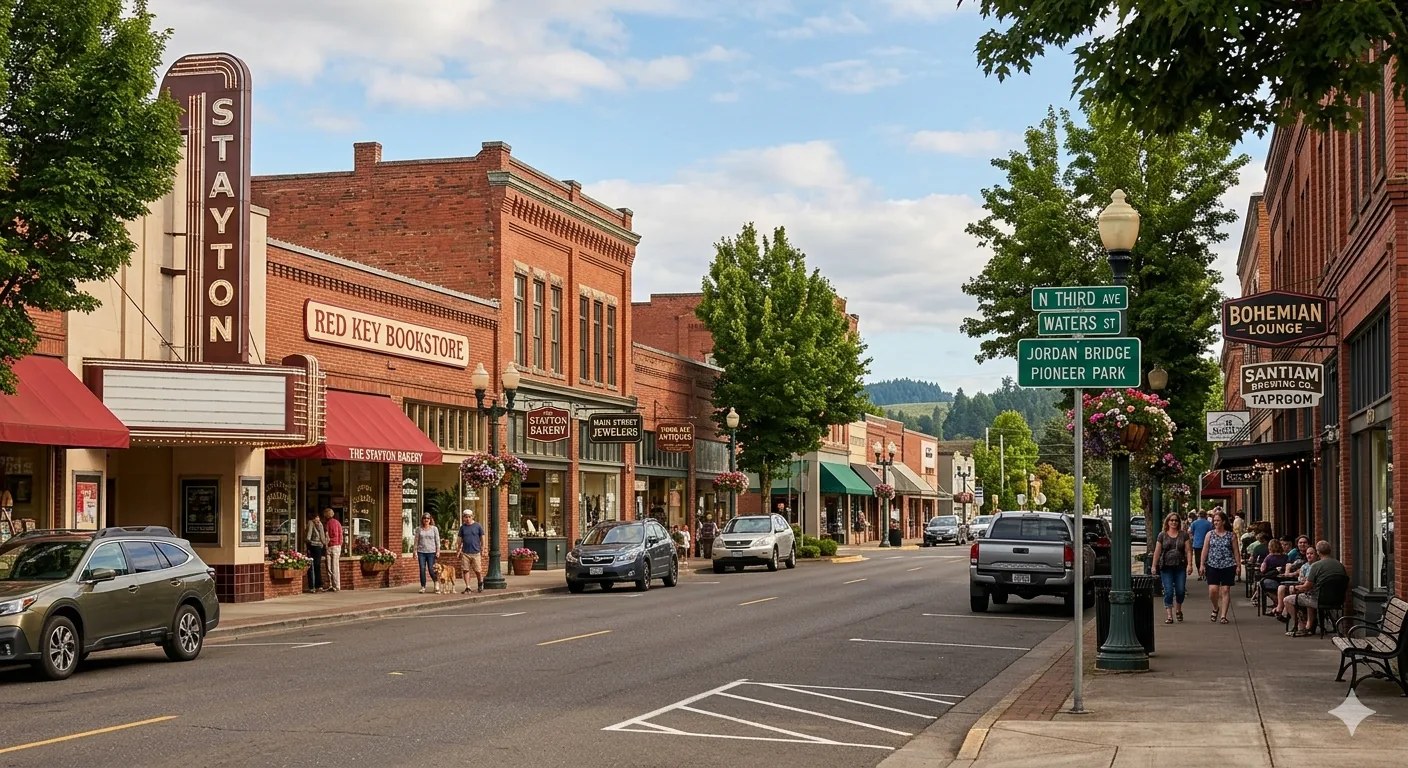
Stayton doesn't advertise itself as a retirement destination, and that may be exactly why it works for some people. A city of 8,292 tucked into the Willamette Valley foothills along OR-22, it sits about 25 minutes to Salem — close enough for a specialist appointment or a Costco run, far enough that the pace of daily life is genuinely different. The North Santiam River runs along its edge, Silver Falls State Park is a short drive up the highway, and the historic downtown is small enough that you'll recognize faces within a few weeks of arriving.
What actually draws retirees here is a combination that's harder to find than it sounds: a hospital inside city limits, home prices noticeably below Salem and Silverton, and a community where the volunteer boards and the farmers market still depend on people showing up. The median household income of $78,268 reflects a working-class and small-business economy — this isn't a place that has been reshaped by an influx of remote-working transplants, and it shows in the texture of daily life. For retirees who want to be part of a town rather than adjacent to one, that matters.
The honest version also includes the limits. Stayton averages 155 sunny days a year, which is a real psychological adjustment for anyone moving from the Southwest or California's interior. Specialty care beyond what Santiam Hospital provides means a drive to Salem or beyond. And the on-foot access — while improving — still requires a car for most errands. These are not deal-breakers for everyone, but they are the real trade-offs worth understanding before you make an offer.
The sections below cover what healthcare actually looks like day-to-day here, how Oregon's tax structure treats retirement income, what downsizing options exist in the current inventory, and how Stayton stacks up against nearby towns that retirees often compare it against.

Why Retirees Are Choosing Stayton
Stayton fits a specific kind of retiree well: someone who has lived in a small city or rural area before, who doesn't need a symphony hall or an upscale restaurant strip, and who genuinely wants a slower pace rather than just tolerating it. The typical home price of $471,759 (July 2026) sits meaningfully below what you'd pay in Silverton or Salem's more desirable neighborhoods, and the cost of living on a fixed income is manageable in a way that the Willamette Valley's larger markets have stopped being. For a buyer coming from the Portland metro or the coast, Stayton still reads as affordable.
The community is also the right size for retirees who want to stay engaged rather than retreat. At 8,292 residents, it's large enough to have real civic infrastructure — a public library, a weekly farmers market, a hospital — but small enough that joining one committee or one volunteer group puts you in the social center of things quickly. Retirees who moved here from Sublimity or Aumsville often say they didn't realize how much they'd missed walkable errands and a recognizable downtown until they had both again.
Who should look elsewhere: if your retirement depends on regular access to advanced cardiac care, oncology, or orthopedic surgery, the distance to a major medical center is a genuine inconvenience that compounds over time. And if you're drawn to the idea of a walkable, cafe-dense downtown where most of your daily life happens on foot, Stayton is heading in that direction but isn't quite there yet. For those priorities, Salem or Silverton are likely better fits.
Healthcare & Medical Access in Stayton
The single biggest practical advantage Stayton has over comparably priced small towns in the valley is Santiam Hospital — a not-for-profit, independent, 40-bed acute-care hospital inside city limits. It has served the area since 1953, and it is one of only three independent acute-care hospitals in Oregon. For a town of this size, having a hospital at all — let alone one that sees more than 40,000 patients annually — is not something to take for granted.
The clinic network is what makes day-to-day healthcare genuinely usable. Santiam Hospital operates 12 clinics, including satellite locations in four surrounding communities. Six of those clinics hold Patient Centered Medical Home certification from the Joint Commission, which in practical terms means coordinated, primary-care-centered treatment rather than the fragmented referral loops that smaller rural systems often produce. The provider roster includes more than 70 dedicated medical providers across primary care and several specialty areas.
The honest distance-to-advanced-care reality is this: for primary care, routine lab work, imaging, and most outpatient procedures, Santiam Hospital handles it. For subspecialty care — complex cardiology, neurosurgery, Level I trauma, major cancer treatment — Salem is the practical destination, and Portland is an option for anything requiring the highest-level tertiary care. Portland International Airport is roughly 60 miles away, and Eugene is roughly 65 miles, which matters if medical travel ever becomes a factor.
Worth noting for long-range planning: in late 2025, Salem Health Hospitals and Clinics and Santiam Hospital entered into a nonbinding letter of intent to explore a potential affiliation. That process was at an early stage as of the time of this writing, and the outcome will shape what integration between the two systems looks like for Stayton patients over the next few years.
Santiam Hospital also participated in more than 50 community health outreach events in 2024, including blood pressure screenings — a practical signal that the hospital functions as a community health presence, not just an acute-care facility.
The Retiree Budget in Stayton
Oregon's tax treatment of retirement income has a clear split that retirees from other states often don't expect. Social Security and Railroad Retirement benefits are fully exempt from Oregon state income tax, with no income limit attached — that exemption applies regardless of how much you receive. That is a genuine advantage for anyone whose retirement income is primarily Social Security.
The other side of that picture is less favorable. Pension distributions, IRA withdrawals, and 401(k) income are taxed at Oregon's regular graduated rates, which start at 4.75% and climb to 9.9% at higher income levels. If a significant portion of your retirement income comes from defined-benefit pensions or tax-deferred accounts, Oregon is not among the most tax-friendly states for your situation. The state has no sales tax, which helps with everyday spending, and property taxes in Stayton run at an effective rate of approximately 0.79% — below the national average and a meaningful factor for anyone planning to own rather than rent. The cost-of-living page has a fuller breakdown of how Stayton's taxes compare across income types.
Oregon homeowners who are 62 or older, or who are disabled, may qualify for the Oregon Department of Revenue's Property Tax Deferral program, which allows eligible owners to borrow from the state to cover their annual property tax bill. Applications are due in April each year — worth knowing before your first tax year if you're on a tight fixed income.
Daily costs in Stayton reflect a small valley city, not a resort or college town. Groceries, fuel, and dining out all run at reasonable levels. The Stayton Farmers Market brings local produce into the picture during the growing season. Retirees who cook at home and don't need frequent urban entertainment find the monthly budget quite manageable relative to what Salem or the Portland suburbs demand. The interactive calculator below can help you model what a mortgage payment looks like at current rates against those property-tax figures.
Looking to buy in Stayton? Estimate your payment.
Enter your numbers to see an estimated monthly mortgage payment.
Estimate only. Excludes HOA fees and mortgage insurance. The interest rate above is a starting point, not a quoted rate — replace it with your own to see real numbers. Insurance is a flat placeholder, not a Stayton quote.
Walkability, Community & Staying Active in Stayton
The flat reality of on-foot access in Stayton is this: the historic downtown core is genuinely walkable once you're in it, but most of the city's residential areas require a car for most errands. The terrain is gentle — the Willamette Valley foothills don't produce the hills that make some Oregon small towns hard to navigate on foot as you age — but the commercial density isn't yet concentrated enough to support a car-free retirement lifestyle. For retirees who can drive and don't need to walk everywhere, this is a minor consideration. For those who are planning ahead to a point where driving becomes difficult, it's worth factoring into your neighborhood choice now.
The social infrastructure is more robust than the city's size might suggest. The Stayton Public Library functions as a genuine community anchor — programming, quiet space, and the kind of librarians-who-know-your-name situation that a small city still sustains. The Stayton Farmers Market draws a loyal weekly crowd during the growing season and is the kind of place where regulars actually stop and talk rather than just shop.
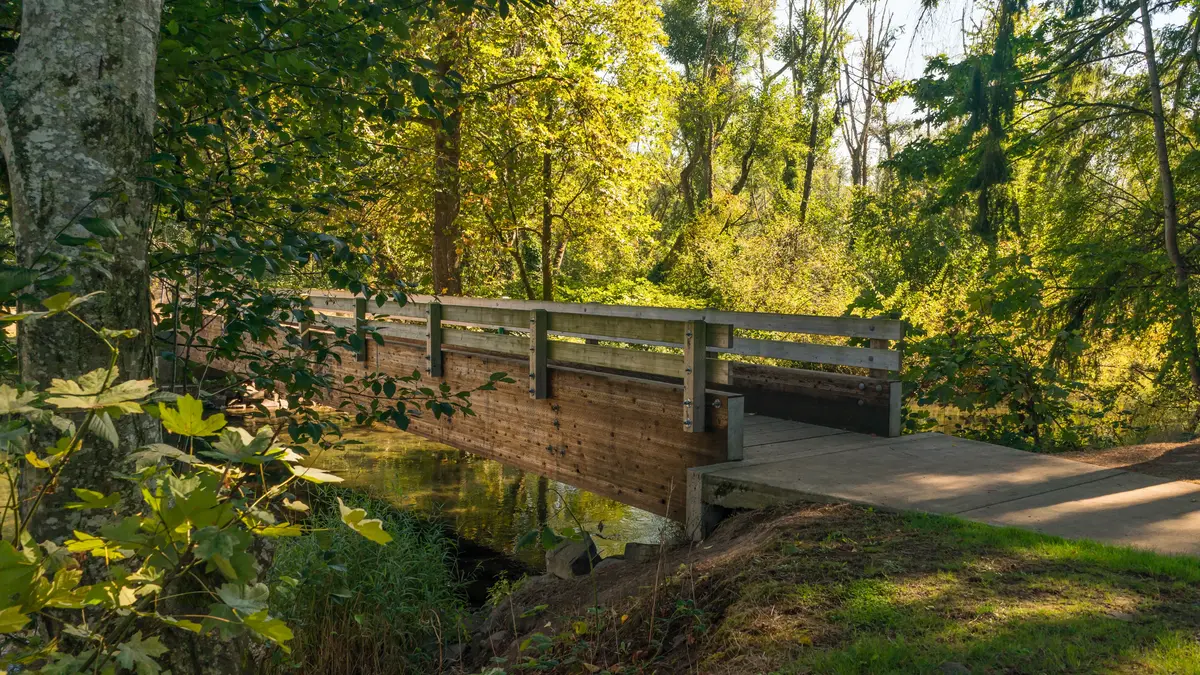
Pioneer Park, the city's signature 10-acre outdoor space, holds the preserved Stayton-Jordan Covered Bridge and connects via paved trails to Riverfront Park and Wilderness Park — a continuous green corridor along the North Santiam River that is accessible and flat enough to be genuinely usable for older adults. Riverfront Park itself encompasses 51 acres of river frontage preserved by a 2004 partnership with the Trust for Public Land. For retirees who want to walk trails without driving to them, this corridor is the best thing Stayton has.
Silver Falls State Park, Oregon's largest at more than 9,000 acres, is roughly 20 to 25 minutes from Stayton and offers more than 24 miles of trails, including the Trail of Ten Falls. It's not a walking-from-your-door amenity, but it is a genuine regional asset that many Stayton retirees describe as one of the reasons they stayed. Santiam State Forest rounds out the options for those who prefer quieter, less-trafficked trails.
Volunteering and civic engagement are the social glue here. City boards, the library, the farmers market, and local service organizations all depend on active participation from residents who have time and inclination — which makes this a city where a retiree with energy can become genuinely embedded in community life within a year or two. That is one of the things Stayton does better than larger markets where the social scene is already formed and harder to enter.
Right-Sizing: Downsizing in Stayton
No 55+ communities were found in Stayton. That is a real gap compared to Salem or Silverton, and it matters for retirees who want a purpose-built, age-restricted community with HOA maintenance, shared amenities, and neighbors in a similar life stage. If that model is a priority, the honest answer is that you'll need to look at neighboring markets.
What Stayton does have is Cascades of Stayton, an independent- and assisted-living community that offers personalized care plans with the specific feature that couples can remain together regardless of the level of assistance each person requires. That is a meaningful distinction for couples navigating different care needs — one of the more common and stressful transitions in retirement. It is not a 55+ community in the age-restricted sense, but for retirees planning ahead for the assisted-living stage, its presence inside city limits is worth knowing.
The single-family housing stock in Stayton skews toward modest ranch-style and one-story homes built during the mid-to-late 20th century, which means single-level living is genuinely available here — more so than in hillside communities or older Victorian-era towns. A buyer specifically searching for a one-story home with a manageable yard in the $400,000 to $500,000 range will find options here that simply don't exist at that price in Salem's established neighborhoods or in Silverton.
Patio homes and low-maintenance condos exist in smaller numbers. Stayton's housing market is not built around the retiree-downsizer as a primary buyer type, and the inventory of smaller, lock-and-leave properties is more limited than in larger retirement-focused markets. Buyers who need that specific format and are flexible on location should see the neighborhoods guide for a closer look at where single-level inventory concentrates. The neighborhoods of Heritage Oaks and Village Creek tend to have the newer residential stock worth examining for this purpose.
One practical note on downsizing timing: the median household income in Stayton sits below the income typically needed to buy the typical home here, which means the local move-up buyer pool is thinner than in higher-income markets. For a retiree selling a larger home here to downsize, that can affect how quickly the larger property moves — something worth discussing with a local agent before listing.
Stayton vs Nearby Retirement Destinations
| City | Cost vs Stayton | Primary Hospital | Walkability | Senior Living Depth | Overall Retirement Fit |
|---|---|---|---|---|---|
| Stayton | The baseline | Santiam Hospital (in-city, independent, 40-bed) | Downtown core walkable; most errands need a car | Cascades of Stayton (assisted/independent living); no 55+ community | Strong value; genuine community; limited senior housing formats |
| Salem | Noticeably pricier | Salem Health (large regional system, multiple campuses) | Much stronger; transit options available | Multiple 55+ communities, CCRCs, and memory care options | Best for retirees who need depth of care and walkable amenities |
| Silverton | Noticeably higher | Dependent on Salem Health for acute care | Charming downtown; most residential areas need a car | Some assisted living; limited 55+ inventory | Beautiful setting; premium price for the lifestyle |
| Sublimity | Noticeably higher | Relies on Santiam Hospital in Stayton | Very limited; fully car-dependent | Minimal senior living options | Best for those who want rural quiet and already own property |
| Aumsville | Somewhat higher | Relies on Santiam Hospital in Stayton | Very limited; fully car-dependent | Very limited senior living options | Affordable rural alternative; fewer services than Stayton |
| Mill City | Noticeably cheaper | Relies on Santiam Hospital for nearest acute care | Small downtown; very limited | Very limited senior living options | Deep rural feel; tradeoff is distance from services |
Salem is the clear choice for retirees who prioritize healthcare depth, walkable daily life, and a wide range of senior housing formats — but you pay for all of it, and the city's scale changes the pace of life significantly. Silverton offers one of the most appealing small-town settings in the valley, but its price premium and limited senior housing inventory mean it works best for retirees who are buying early and have flexibility.
Sublimity and Aumsville sit immediately adjacent to Stayton and share access to Santiam Hospital, but both are more rural, less walkable, and offer even fewer senior services — and both cost more than Stayton. For retirees who want the quietest possible setting and already have roots in the area, that trade-off makes sense; for anyone arriving fresh, Stayton is the better-equipped base. Mill City is genuinely cheaper, but the distance from services, the smaller population, and the lack of a hospital nearby make it a fit for a narrow profile — the retiree who is healthy, self-sufficient, and specifically seeking the upper canyon environment along OR-22.
Stayton's real case is the combination of an in-city hospital, a price point below most of its neighbors, and a small-town social fabric that rewards engagement. That combination is harder to find than any single one of those factors alone.
Local Expert Takeaway: Stayton works best as a retirement destination for people who have done this calculus honestly: you get Santiam Hospital inside city limits, a property-tax rate of approximately 0.79%, and home prices that still make room in the budget for other things — and you accept that specialty care means a drive to Salem, that the winters are gray, and that the senior housing market doesn't offer the purpose-built 55+ formats that larger markets do. The retirees who land well here tend to get involved early — at the Stayton Public Library, the Stayton Farmers Market, or through one of the city's civic boards — and discover that in a city of 8,292, showing up once or twice makes you a regular.
Quick Takeaways & FAQs
✅ Santiam Hospital — a not-for-profit, independent, 40-bed acute-care hospital — sits inside Stayton's city limits, a genuine advantage for a town of 8,292.
⚠️ No 55+ age-restricted communities were found in Stayton, and the single-level and patio-home inventory is more limited than in Salem or retirement-focused suburbs.
📍 Oregon exempts Social Security from state income tax entirely, but pension and IRA withdrawals are taxed at graduated rates up to 9.9% — worth modeling carefully before you move.
Does Stayton have a hospital for retirees, or do you have to drive to Salem?
Are there any 55+ communities in Stayton?
How does Oregon tax retirement income for Stayton residents?
Is Stayton walkable enough for retirement, especially as driving becomes harder?
How does Stayton's retirement value compare to Silverton or Salem?
Moving to Oregon?
Tell us what you need help with and we'll connect you with local resources.
