
Maybe someone told you Stayton was affordable compared to Salem. Maybe you've been watching prices in Silverton and Sublimity and needed somewhere with more room in the budget. Either way, you've landed on a city where the math is genuinely more accessible than most of the Willamette Valley — and where the homebuying process carries some local wrinkles worth understanding before you start scheduling tours. The typical home in Stayton is priced noticeably below what you'd pay in Silverton or Sublimity, and the commute via OR-22 (North Santiam Highway) keeps Salem's job market reachable, at about 25 minutes to Salem.
What the numbers don't tell you upfront: Stayton's median household income of $78,268 sits below the income a buyer typically needs to carry the typical home here — a gap of roughly $31,000. That's not a reason to walk away, but it is a reason to be precise about your budget before you fall in love with a listing. The city's employer base — anchored by the North Santiam School District, Santiam Hospital, the City of Stayton, Marion County, and Wilco — supports steady owner-occupant demand, which means well-priced homes draw real competition. This is a small city of 8,292 people, not a soft market.
The housing stock runs from older craftsman-style homes in Historic Downtown Stayton to newer suburban construction in Heritage Oaks and Village Creek. Entry-level opportunities exist, but they require cash-readiness: Oregon closing costs run 2%–5% of the purchase price on top of your down payment, and buyers who haven't modeled the full cash-at-table number are consistently surprised. The cost-of-living page covers the broader picture; this guide focuses on the mechanics of actually getting into a home here.
The sections below walk through what your budget realistically buys, the step-by-step process from pre-approval to closing, a budget snapshot table with realistic cash scenarios, and the four mistakes that trip up first-timers in this specific market most often.

The Stayton First-Time Buyer Reality
The typical home in Stayton sits at $471,759 (Zillow Home Value Index, July 2026). That figure puts Stayton meaningfully more accessible than Silverton or Sublimity, and within reach for buyers who have their finances organized — but it is not a starter-home market in the way some buyers expect from a city this size.
At that price point, a 3% conventional down payment requires roughly $14,200 upfront, and a 3.5% FHA down payment requires roughly $16,500 — before closing costs. Oregon buyers routinely underestimate the closing-cost line: lender fees, appraisal charges, title insurance, escrow services, and recording fees together can add another $9,400 to $23,600 on a home priced near the city typical. First-timers who plan for the down payment alone and treat closing costs as a secondary concern routinely find themselves short at the table.
Entry-level inventory in Stayton tends to concentrate in older homes in and around Historic Downtown Stayton and the Hollister Addition — properties that offer lower sticker prices but sometimes carry deferred maintenance that shows up in the inspection. Newer construction in Heritage Oaks and Village Creek tends to run above the city typical. The honest picture: if your budget ceiling sits well below $471,759, you can find homes in Stayton, but you're competing for a narrower slice of what's listed, and condition trade-offs come with the territory.
The Homebuying Process in Stayton, Step by Step
Step 1: Get Pre-Approved Before You Tour Anything
In a city with steady owner-occupant demand driven by local employers, sellers routinely expect a pre-approval letter with any offer. Touring without one isn't just inefficient — it puts you a step behind any competing buyer who has done the work. Get pre-approved, not just pre-qualified; the two terms are not interchangeable, and a seller's agent will notice the difference.
Step 2: Define Your Search by Neighborhood and Commute Reality
Stayton's neighborhoods differ in housing age, lot size, and proximity to OR-22. Buyers planning a daily Salem commute should think carefully about which part of town puts them closest to the highway — a few blocks matter less here than in a larger city, but the difference between a neighborhood that flows easily to OR-22 and one that adds friction to the morning is real. The neighborhoods page covers each area's character in detail.
Step 3: Make an Offer — and Know What You're Waiving
Oregon offers are made on standardized OREF forms. As a first-time buyer, the contingencies you include — inspection, financing, appraisal — are your primary protections. Understand what each one does before your agent asks which ones to include or waive. Waiving an inspection contingency on an older home in Downtown Stayton to sharpen your offer is a decision that deserves a real conversation, not a reflex.
Step 4: Inspections and Appraisal
Oregon lenders require an appraisal for any financed purchase. Schedule your general inspection independently and as early as the contract allows — it is the one step first-time buyers most commonly treat as a formality rather than a decision point. Depending on the home's age and condition, your inspector may flag radon testing or a sewer scope as add-ons worth considering; factor those into your timeline.
After you apply, your lender is required by federal law to issue a standardized loan estimate document — read it carefully. It gives you an itemized look at estimated closing costs and identifies which services (title, settlement, etc.) you are permitted to shop independently, sometimes at meaningfully lower cost.
Step 5: Closing
Oregon closings are handled by title and escrow companies, not attorneys. For a financed purchase, you'll receive a federally required closing cost disclosure at least three business days before you sign — compare it line-by-line against your earlier loan estimate and flag any figures that have shifted.
How Much Home Can You Afford in Stayton
Oregon closing costs run approximately 2%–5% of the purchase price. The table below shows estimated cash-at-table requirements across several realistic price points for Stayton buyers. All figures are approximate estimates for budgeting purposes; your actual costs will vary by lender, loan type, and negotiated seller concessions. The interactive calculator below the table lets you model monthly payment scenarios at current rates.
| Scenario | Purchase Price | Down Payment | Est. Closing Costs (2%–5%) | Est. Cash Needed at Table |
|---|---|---|---|---|
| FHA (3.5%) — entry level | $350,000 | $12,250 (3.5%) | $7,000–$17,500 | $19,250–$29,750 |
| Conventional (3%) — entry level | $350,000 | $10,500 (3%) | $7,000–$17,500 | $17,500–$28,000 |
| FHA (3.5%) — near city typical | $425,000 | $14,875 (3.5%) | $8,500–$21,250 | $23,375–$36,125 |
| Conventional (3%) — near city typical | $425,000 | $12,750 (3%) | $8,500–$21,250 | $21,250–$34,000 |
| FHA (3.5%) — at city typical | $471,759 | $16,512 (3.5%) | $9,400–$23,600 | $25,912–$40,112 |
| Conventional (5%) — above typical | $525,000 | $26,250 (5%) | $10,500–$26,250 | $36,750–$52,500 |
The wide closing-cost range reflects genuine variability: lender fees differ, title and escrow costs vary by company, and some sellers will negotiate a credit toward closing costs in the right market conditions. Budget toward the higher end until your loan estimate gives you real numbers to work from.
Looking to buy in Stayton? Estimate your payment.
Enter your numbers to see an estimated monthly mortgage payment.
Estimate only. Excludes HOA fees and mortgage insurance. The interest rate above is a starting point, not a quoted rate — replace it with your own to see real numbers. Insurance is a flat placeholder, not a Stayton quote.
Common First-Time Buyer Mistakes in Stayton
Touring Before Pre-Approval
This is the most common sequence error in any market, but it stings more in Stayton because the city's limited inventory means a desirable listing at the right price can move before a buyer who started late finishes their paperwork. Pre-approval isn't a formality — it's what lets you act when the right home appears.
Treating the Down Payment as the Only Number That Matters
First-timers routinely arrive at closing surprised by the cash gap. On a home priced at the city typical of $471,759 (July 2026), closing costs alone can add $9,400 to $23,600 on top of whatever down payment you've saved. Buyers who treat closing costs as a rounding error routinely find themselves scrambling — or needing to renegotiate seller concessions they didn't plan for.
Waiving the Inspection Contingency Without Understanding the Home's Age
Older homes in Historic Downtown Stayton and the Hollister Addition can carry real deferred-maintenance surprises — aging roofs, older electrical panels, foundation drainage issues common to homes near the river corridor. Waiving an inspection contingency to compete on a tight offer is sometimes the right call on a newer home; it is a much riskier decision on a 1960s craftsman. Know what you're deciding before you decide it.
Ignoring the School-Boundary and Commute Reality Until After the Offer
Buyers relocating from Salem or evaluating Stayton against Aumsville or Sublimity sometimes fall in love with a specific listing without checking which school feeds which neighborhood, or how the daily OR-22 commute actually feels in winter weather. The North Santiam School District 29J holds a B- rating, according to Niche, and serves the whole city — but individual school assignments vary by address. Confirm your children's school placement before you make an offer, not after. The schools page covers the district in full.
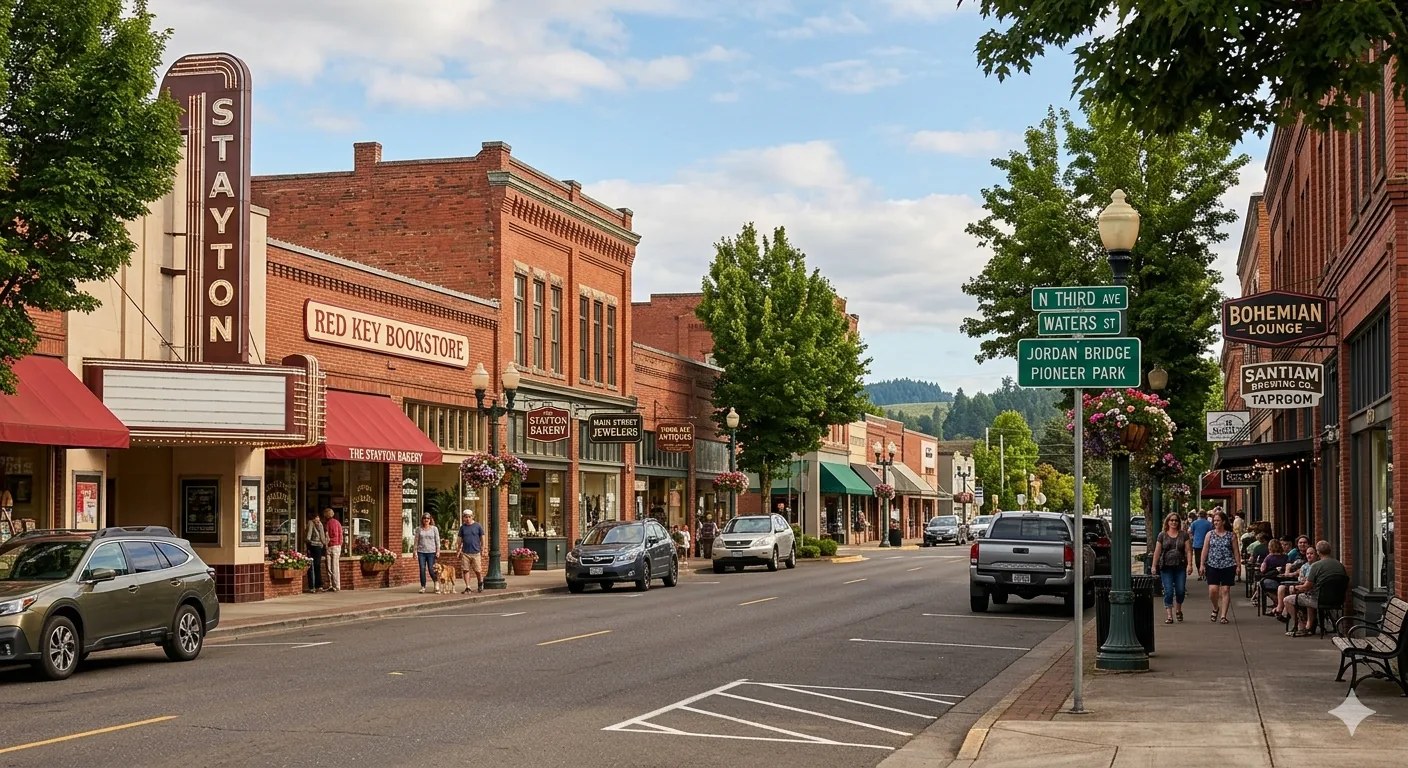
Local Expert Takeaway: Stayton's home prices are genuinely more accessible than most of the surrounding Willamette Valley — but the gap between what median-income households earn here and what the typical home actually costs means first-time buyers need to arrive with their finances tightly organized, not just optimistic. Pre-approval before touring, a realistic closing-cost buffer, and a clear-eyed look at the inspection contingency on older homes near Historic Downtown Stayton are what separate buyers who close smoothly from those who get surprised at the table.
Quick Takeaways & FAQs
✅ Stayton's typical home price of $471,759 (July 2026) is noticeably more accessible than nearby Silverton or Sublimity, giving first-time buyers a realistic entry point into the Willamette Valley.
⚠️ The median household income in Stayton falls short of what's needed to carry the typical home by roughly $31,000 — precise budgeting and pre-approval are not optional steps here.
📍 Oregon closing costs run 2%–5% of the purchase price, meaning buyers near the city typical should plan for $9,400–$23,600 in closing costs on top of their down payment.
What credit score do I need to buy a home in Stayton, Oregon?
How much do I need saved to buy a home in Stayton?
How long does it take to buy a home in Stayton from start to finish?
Is it cheaper to buy in Stayton than in Salem or Silverton?
Should I get pre-approved before looking at homes in Stayton?
Moving to Oregon?
Tell us what you need help with and we'll connect you with local resources.
