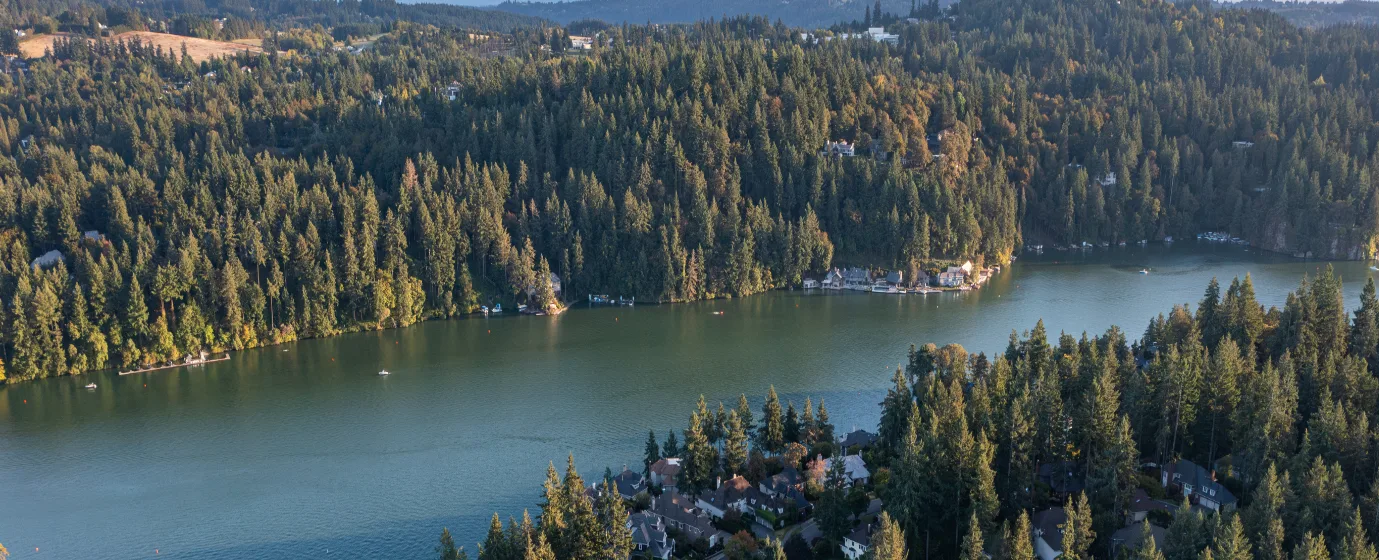
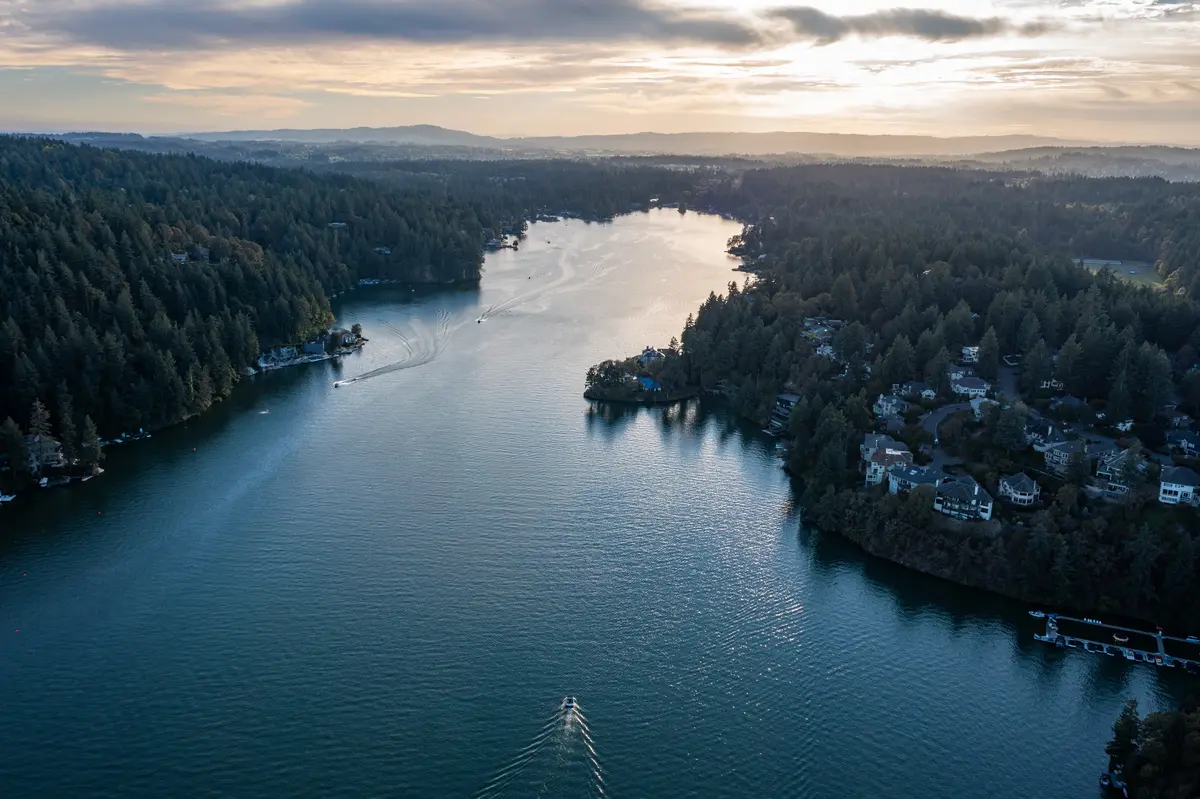
Retire in Lake Oswego and you will spend your first six months wondering why you waited. Oswego Lake sits at the center of a city of 41,474 that genuinely feels like a small town — tree-lined streets, a walkable downtown village, the Lakewood Center for the Arts two minutes from the farmers market — yet Portland is about 20 minutes away when you need a world-class medical center, an international flight, or a museum. The tension for retirees is not whether Lake Oswego is pleasant. It is whether it is worth it: the typical home here was $889,944 as of July 2026 (Zillow Home Value Index), and that figure sets a high floor before you spend a dollar on anything else.
What draws retirees specifically — not just remote workers or families — is a combination of stability and culture that most Portland suburbs cannot match. The Lakewood Center for the Arts, the oldest continually operating nonprofit theater company in the Portland area, puts on a full season of productions each year with no seat farther than 35 feet from the stage. The Lake Oswego Farmers' Market, the Gallery Without Walls outdoor sculpture walk, and the Festival of the Arts each June give the calendar a texture that feels less like a suburb and more like a small Pacific Northwest city that happens to have excellent proximity to a major metro. Residents who moved from coastal California or the Bay Area often say it reminds them of a smaller, greener version of the places they left — but at a fraction of the price they left behind.
Oregon's tax picture is genuinely mixed for retirees: no sales tax anywhere in the state, Social Security fully exempt from state income tax, but pension and IRA distributions taxed at graduated rates that reach 9.9% for higher earners. Property taxes, at an effective rate of approximately 0.98%, run below many comparable West Coast markets. Daily costs on a fixed income are manageable — no sales tax takes the edge off groceries, restaurants, and services — though anyone drawing heavily from a 401(k) or traditional IRA should factor state income tax into their budget before assuming Oregon is cheap.
Whether you are downsizing from a larger home elsewhere in the metro, selling a California property and landing somewhere smaller, or simply deciding whether a Portland suburb at this price point makes sense for your retirement years, the sections below walk through healthcare access, the retiree tax picture, what daily life actually looks like on a fixed income, downsizing options, and how Lake Oswego stacks up against the most realistic nearby alternatives.
Why Retirees Are Choosing Lake Oswego
Lake Oswego fits retirees who are done compromising on aesthetics and culture but are not ready to slow down. The city's scale — the 13th-largest incorporated city in Oregon — is a feature, not a limitation. You can walk from a coffee shop to a gallery to a performing arts center without a plan, and then drive to Portland for a specialist appointment the same afternoon. That combination of self-contained livability and metro proximity is rare in the region.
The retirees who thrive here tend to arrive with equity, often from a larger home sold elsewhere in Oregon, or from California. The typical home price of $889,944 (July 2026) means this is not a downsize-and-pocket-cash market unless you are selling something worth considerably more. For buyers in that position, the trade-off — paying a premium for a city with genuine walkability in its core, strong safety statistics, and a built-in cultural calendar — tends to feel justified within the first year.
Who should look elsewhere? Retirees on a fixed Social Security income with modest savings will find the entry price and the property tax load challenging, even with Oregon's sales tax exemption. Those who want flat terrain throughout the city — not just downtown — will run into Lake Oswego's hilly topography quickly; Mountain Park in particular involves grades that make daily walking difficult for anyone with mobility concerns. And retirees who prioritize proximity to a major hospital over everything else should know the nearest is about 6 miles away in Tualatin — close, but not walkable.
Healthcare & Medical Access in Lake Oswego
Legacy Meridian Park Medical Center in Tualatin — about 6 miles from Lake Oswego — is the nearest hospital. It is an acute care facility operated by Legacy Health, a major nonprofit health system in the region, and has operated since 1973. For most routine and urgent needs, it covers the bases: emergency care, orthopedics, cardiology, neurology, a total joint and spine center, a heart and cancer care center, and advanced imaging, all within a 150-bed facility.
For retirees evaluating day-to-day medical access, the picture is solid. Specialists in primary care, internal medicine, and the disciplines that matter most after 65 — cardiology, orthopedics, oncology — are accessible either at Legacy Meridian Park or through Legacy Health's broader Portland Metro network. The drive from Lake Oswego's downtown to the hospital is short and does not require freeway travel for most residents.
For advanced or highly specialized care — complex cardiac surgery, Level I trauma, major transplant programs — Portland is about 20 minutes away and anchors two major health systems serving the metro. Retirees managing a serious or complex condition should factor that additional leg into their planning, but for the vast majority of medical situations, Legacy Meridian Park handles it locally. The practical reality: Lake Oswego is not a city where healthcare access is a liability, but it is not the same as living next door to a large academic medical center either.
One honest note for retirees: Lake Oswego itself is a smaller city, so most clinic and specialist infrastructure sits in the surrounding metro rather than within city limits. That means a car — or a reliable ride — remains important for medical appointments, even if your day-to-day errands are manageable on foot.
The Retiree Budget in Lake Oswego
Oregon's headline advantage for retirees is real: Social Security benefits are fully exempt from Oregon state income tax, even the portion that is taxable at the federal level. For retirees whose income is primarily Social Security, Oregon's income tax is essentially a non-issue.
The picture changes if you draw from a pension, 401(k), traditional IRA, or annuity. Oregon taxes those distributions at graduated rates starting at 4.75% and reaching 9.9% for income above $125,000 for single filers. A retiree drawing $80,000 a year from a mix of pension and IRA income will feel that rate. A Retirement Income Credit — a 9% credit on eligible pension income for lower-income seniors — was available through tax year 2025 but has since sunset and cannot be claimed for 2026 or later, so factor that out of your projections. Federal retirees with service before October 1, 1991 may still subtract a proportional share of their federal pension; worth verifying with a tax professional.
The effective property tax rate in Lake Oswego runs approximately 0.98% — below the rates in many comparable Pacific Northwest markets, and below much of California. See the full cost-of-living breakdown for how that translates against other local costs. Oregon's complete absence of a statewide sales tax is genuinely meaningful on a fixed income: every restaurant meal, grocery run, and service purchase costs less than it would in Washington, California, or most other states.
One planning note for retirees with significant assets: Oregon levies an estate tax on estates of $1,000,000 or more, with graduated rates from 10% to 16% on the taxable amount above that threshold. That $1 million threshold is low by national standards, and at Lake Oswego home prices, a modest estate can cross it more easily than you might expect. This is worth a conversation with an estate planning attorney before you arrive.
Day-to-day living on a fixed income in Lake Oswego is comfortable by Pacific Northwest standards — independent cafés, a weekly farmers market, arts events, and access to good grocery options keep routine spending predictable — but this is not a budget retirement destination. The entry price of the housing market alone makes that clear.
Looking to buy in Lake Oswego? Estimate your payment.
Enter your numbers to see an estimated monthly mortgage payment.
Estimate only. Excludes HOA fees and mortgage insurance. The interest rate above is a starting point, not a quoted rate — replace it with your own to see real numbers. Insurance is a flat placeholder, not a Lake Oswego quote.
Walkability, Community & Staying Active in Lake Oswego
Lake Oswego's walkability is genuinely two different cities. The downtown core — centered around the lake, Millennium Plaza Park, and the Lakewood Center for the Arts — is very walkable. Errands, dining, coffee, the Lake Oswego Farmers' Market, and the Gallery Without Walls sculpture walk are all reachable on foot if you live in or near First Addition or the downtown corridor. That pocket of the city is where retiring without a car is plausible, at least for daily rhythms.
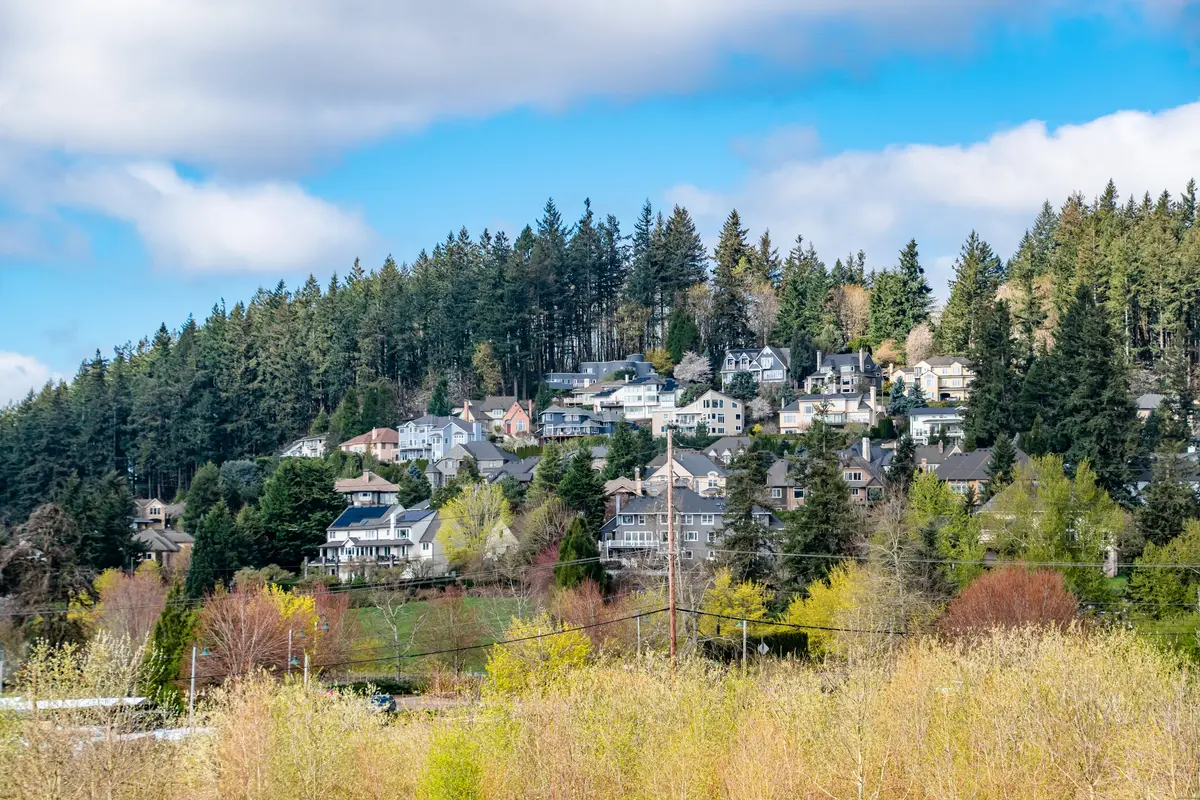
Most of Lake Oswego is a different story. The city's terrain is hilly throughout much of the residential landscape, and neighborhoods like Mountain Park involve sustained grades that make casual walking less practical. Outside the downtown core, most errands mean a car. Retirees who want to sell a car entirely should limit their housing search to the downtown walkable zone and weight that factor heavily in any offer.
Culturally, the active-adult calendar here is one of the strongest in the Portland suburbs. The Lakewood Center for the Arts — the oldest continually operating nonprofit theater company in the Portland area — runs a full season of productions each year, hosts adult arts education classes and comedy nights, and draws audiences from well beyond the city. It is the kind of place that fills its calendar reliably and serves as the largest arts provider in Clackamas County. The Festival of the Arts, held each June at the Lakewood Center and George Rogers Park, has run for over 60 years and draws crowds from across the region — it is genuinely one of those events where parking fills well before the gates open.
George Rogers Park, Tryon Creek State Natural Area, and Iron Mountain Park give active retirees three meaningfully different outdoor options — river access and open lawn at George Rogers, old-growth forest trails at Tryon Creek, and elevated views at Iron Mountain. The Willamette Shore Trolley adds a recreational option that is genuinely one-of-a-kind in the metro. For retirees who gather around food and community, the Lake Oswego Farmers' Market is the social anchor of summer weekends.
Volunteering and civic life are active here. The arts center, the annual festival, and local civic organizations all run on volunteer participation, and a city of this income level and education profile tends to attract the kind of retirees who want that engagement rather than opting out of it.
Right-Sizing: Downsizing in Lake Oswego
Downsizing in Lake Oswego is genuinely possible, but it requires patience and a clear sense of what you are looking for. The city's housing stock leans toward larger single-family homes on hilly lots — which is wonderful scenically and less ideal if you are looking for a flat, single-level ranch-style home that you can age in comfortably.
Single-level homes do exist in Lake Oswego, particularly in Lake Grove, Westlake, and some pockets of the Country Club District, but they compete with buyers of all ages and are not abundant. Condo inventory — which solves the single-level problem and often reduces exterior maintenance — is available in and near the downtown core and is worth prioritizing if on-foot access matters to you. Patio homes and smaller townhomes exist but are not the dominant format in this market.
55+ communities: Condolea is the only age-restricted ownership community within Lake Oswego city limits. It offers a quieter, ownership-based option for buyers who want the age-qualified environment. Condolea is not a large complex, so availability is limited — this is not a community where you can assume a unit is waiting for you when you are ready to move.
Mary's Woods is a different kind of option and worth understanding clearly. It is a Life Plan Community — a Continuing Care Retirement Community — on a 40-acre campus in Lake Oswego. It offers independent living, assisted living, and memory care on a single campus, meaning residents can age in place without relocating as care needs evolve. It was named Best Independent Living and Business of the Year by readers of the Lake Oswego Review and West Linn Tidings for 2026. Mary's Woods is not an age-restricted ownership community in the same sense as Condolea — it operates under a life-plan model with its own contract and fee structure — but for retirees who want the full continuum of care on one campus, it is the most established option in the city.
If you are arriving from a significantly more expensive market and selling a home worth well above the local median, the math of downsizing into a Lake Oswego condo or smaller single-family home can work well. If you are downsizing from elsewhere in the Portland Metro and expecting to free up substantial equity, the calculus is tighter — the neighborhood-level breakdown gives a fuller read on what different parts of the city offer for buyers in this position.
Lake Oswego vs Nearby Retirement Destinations
| City | Cost vs Lake Oswego | Primary Hospital | Walkability | Senior Living Depth | Overall Retirement Fit |
|---|---|---|---|---|---|
| Lake Oswego | Anchor | Legacy Meridian Park (Tualatin, ~6 mi) | Downtown core very walkable; most of city car-dependent | Condolea (55+), Mary's Woods (CCRC) | Strong for culturally engaged, equity-rich retirees |
| West Linn | Somewhat lower | Legacy Meridian Park (Tualatin, nearby) | Hilly and car-dependent throughout; limited walkable core | Moderate; fewer purpose-built senior options than Lake Oswego | Good for retirees who want quiet, space, and slightly lower entry cost |
| Tualatin | Noticeably lower | Legacy Meridian Park (in-city) | Moderate; flatter terrain helps, but not a walkable downtown | Growing; several assisted living and independent living facilities | Best if hospital proximity is the top priority and budget matters |
| Tigard | Noticeably lower | Legacy Meridian Park (very close) | Car-dependent; improving with some new mixed-use development | Solid; range of senior apartment and care options | Practical choice for retirees prioritizing affordability and medical access |
| Milwaukie | Noticeably lower | Legacy Mount Hood (Gresham) or OHSU (Portland) | Improving downtown; mostly car-dependent | Limited dedicated senior communities | Better fit for retirees who want Portland adjacency at a lower cost |
| Portland (inner SW) | Variable; some areas comparable, some higher | OHSU, Legacy Good Samaritan, Providence Portland | Genuinely walkable in the right neighborhoods | Broad; urban senior living options are extensive | Best for retirees who want urban walkability and on-site major medical access |
Tualatin is the strongest alternative if healthcare proximity is your primary criterion — Legacy Meridian Park sits within that city, not 6 miles from it. The catch is that Tualatin's walkability and cultural calendar are thinner than Lake Oswego's, and it lacks a comparable arts anchor.
West Linn offers a quieter, somewhat lower-cost profile that appeals to retirees who want more space and privacy, but it is even more car-dependent than Lake Oswego and has fewer purpose-built retirement living options. Tigard offers practical affordability without much of the cultural texture that makes Lake Oswego distinctive.
Portland's inner southwest neighborhoods — for retirees who want to be genuinely car-free and close to major medical centers — can be the right answer, though the urban environment is a different lifestyle entirely. For retirees who have already decided they want a smaller, residential community with a strong arts scene and good access to the metro, Lake Oswego has no real peer in its price tier among the Portland suburbs.
Local Expert Takeaway: Lake Oswego earns its price for retirees who use what it offers: walk to a café or the farmers market, catch a show at the Lakewood Center for the Arts that evening, hike Tryon Creek on a weekday morning, and drive to Legacy Meridian Park in Tualatin when you need it — all without leaving a city that still feels human-scaled. The honest catch is that this city rewards buyers who arrive with equity and a plan; retirees stretching to afford the entry price often find the property tax and Oregon's income tax on distributions add up faster than expected. Downsize into the downtown core if car-free living matters to you, and talk to an estate planning attorney before closing — Oregon's estate tax threshold is lower than most people assume.
Quick Takeaways & FAQs
✅ Oregon fully exempts Social Security from state income tax, giving Lake Oswego retirees a genuine edge over most West Coast alternatives.
⚠️ Most of Lake Oswego is hilly and car-dependent — retirees who want to walk to daily errands need to focus their search on the downtown core specifically.
📍 Mary's Woods — a Life Plan Community on a 40-acre campus in Lake Oswego — offers independent living through memory care on a single site, named Best Independent Living by local readers in 2026.
Is Lake Oswego a good place to retire?
What hospital serves Lake Oswego retirees?
Does Oregon tax retirement income?
What 55+ communities are available in Lake Oswego?
Is Lake Oswego walkable for retirees?
Moving to Oregon?
Tell us what you need help with and we'll connect you with local resources.
