People moving to the Portland metro from higher-crime cities often assume Lake Oswego is safe the way any wealthy suburb is assumed to be safe — more by feel than by fact. The data is actually more specific and more reassuring than that assumption suggests. Lake Oswego, a city of 41,474 on the southern edge of Portland's metro, consistently ranks among Oregon's safest cities by hard crime counts, not just reputation. The picture holds up when you look at the numbers rather than the neighborhood feel.
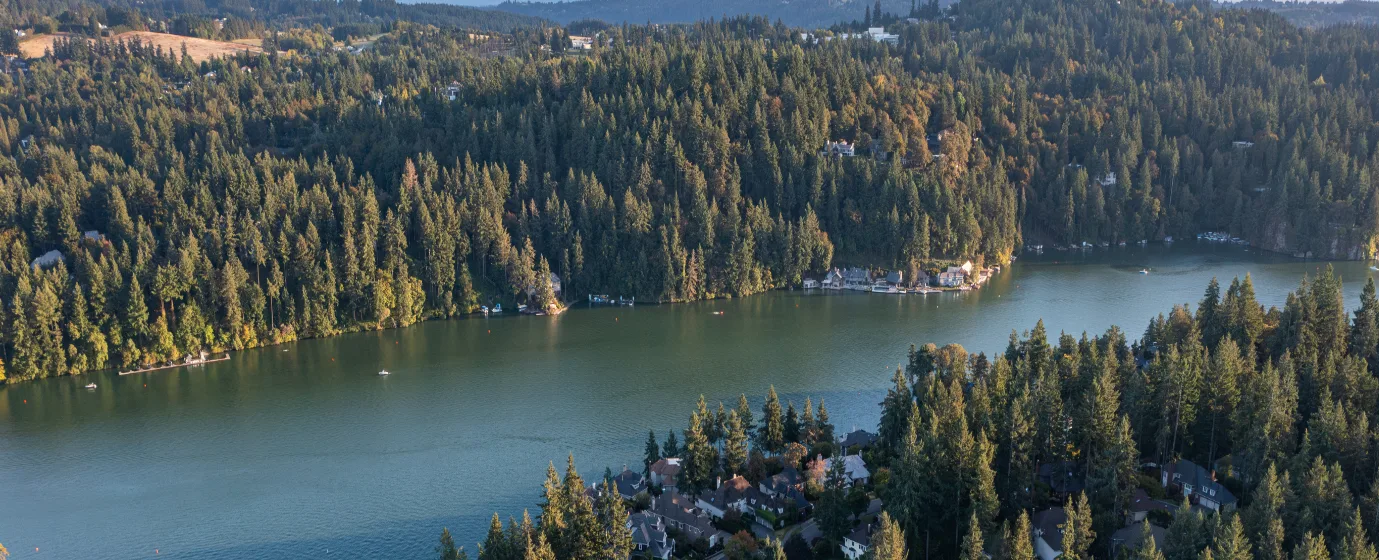
The economy here is anchored by the Lake Oswego School District, the city's own municipal government, and a concentration of professional households with a median income of $141,549. That stable economic foundation matters for safety: low residential turnover, active neighborhood associations, and homeowners who are invested in the long term produce the kind of community fabric that correlates with lower crime independent of police staffing levels. Oswego Lake sits at the center of the city geographically and socially, and the streets around it draw people who walk, gather, and know their neighbors.
The one honest caveat on Lake Oswego's safety picture involves property crime — specifically theft near commercial corridors rather than anything in residential areas. Understanding that distinction separates a buyer who knows the city from one who is reading a blunt aggregate number. The city's typical home price of $889,944 (July 2026) reflects a market where residents vote with their dollars; for a deeper look at what that price buys across the city's neighborhoods, see the cost of living page.
This guide breaks down Lake Oswego's crime statistics against state and national figures, explains where within the city property crime actually concentrates, profiles the safety character of the city's main neighborhoods, and describes the police department structure that backs it all up.

How Lake Oswego's Crime Rates Compare to Oregon and the Nation
The headline figures are straightforward: Lake Oswego has a violent crime rate of 0.7 per 1,000 residents and a property crime rate of 11 per 1,000 residents. Those numbers sit far below what you would find in most Oregon cities or in the country at large.
Oregon's statewide violent crime rate is 3.3 per 1,000 and the national figure is 3.7 per 1,000 — both drawn from Bureau of Justice Statistics, Crime Known to Law Enforcement, 2024 (tables 2 and 3). Lake Oswego's violent crime rate is less than a quarter of either benchmark. On property crime, Lake Oswego carries a property crime rate of 11 per 1,000 residents, which comes in meaningfully below both state and national averages.
Third-party aggregators reach the same conclusion from a different angle, and sites like AreaVibes and NeighborhoodScout are worth checking if you want to look up a specific address — though their estimates run on a different schedule than the figures in this guide. SafeWise's 2026 Oregon safety report found that violent crime in Lake Oswego has decreased for at least three consecutive years, with property crime also declining over the same period.
In resident surveys on Niche.com, 83% of Lake Oswego respondents describe the city as very safe with no safety concerns; the remaining 17% describe it as pretty safe. That is an unusually clean split — most cities show a wider range of responses.
These figures are not a one-year anomaly. The multi-year downward trend means you are not looking at a city that had a quiet year; you are looking at one that has been getting quieter over time.
Understanding Property Crime in Lake Oswego: Where It Actually Happens
A property crime rate of 11 per 1,000 residents is the number most likely to give a careful buyer pause — and it deserves a closer look rather than a dismissal.
Property crime in Lake Oswego concentrates near commercial corridors rather than in residential neighborhoods. The categories driving the aggregate number are shoplifting, vehicle break-ins in parking lots, and package theft near apartment complexes in commercial strips. That pattern means the risk profile of a residential street in Lake Forest or Palisades looks quite different from the aggregate city figure.
The 2024 police department data, presented to the Lake Oswego City Council in April 2025, gives the clearest picture: thefts fell from 347 to 322 in a single year, and burglaries dropped from 83 to 68 over the same period. Out of more than 27,000 total incidents logged by the department in 2024, only 56 involved any use of force — and officers never discharged a firearm. The practical takeaway is that most of what the police are handling is not violent or residential in nature.
If you spend time in the parking areas near larger commercial retail corridors in the city, you will notice the same petty-theft dynamic that affects most Portland-area suburbs. Stay aware of what you leave visible in a parked car; that habit is the primary mitigation for the property crime that does exist here.
The residential experience — walking to George Rogers Park after dinner, leaving a bike unlocked in your driveway for an hour — is meaningfully different from what those aggregate numbers might imply. That distinction matters when you are choosing a neighborhood.
Neighborhood Safety Profiles: What Differs Across Lake Oswego
Lake Oswego's neighborhoods do not have dramatically different crime profiles the way some larger cities do — the floor is already high across the board. But there are real differences in character and exposure worth knowing before you decide on an area. For a full picture of what each neighborhood offers, see the best neighborhoods guide.
Palisades and the Southern Side
Residents and local observers consistently identify Palisades and the southern portion of the city as having the lowest crime exposure. The geography helps: these areas sit farther from commercial strips, with more separation between residential streets and any retail traffic. Palisades runs above the city median on price, which reflects the combination of natural setting and quieter streets.
Mountain Park
Mountain Park's enclosed layout and active homeowners association structure produce a notably quiet safety profile. The neighborhood is essentially self-contained on its hillside above the main city, and that physical separation from commercial corridors keeps it insulated from the retail-adjacent property crime that skews the city's aggregate figures. It runs below the city median on price, which makes it one of the more accessible entry points into a neighborhood with genuinely strong safety characteristics.
First Addition
First Addition is the most walkable part of Lake Oswego, and its strong neighborhood association contributes to a reputation as one of the city's more community-engaged areas. Higher foot traffic and active streets are generally associated with lower opportunistic crime; the neighborhood association here has been active for decades and residents tend to know each other. First Addition runs above the city median on price.
Lake Grove and Westlake
Both Lake Grove and Westlake sit above the city median and occupy the middle of Lake Oswego's safety picture — solidly quiet residential areas without the extreme separation of Palisades or the close community fabric of First Addition. Lake Grove in particular borders commercial areas along a busy retail corridor, which means vehicle-related theft risk is closer, though it does not substantially affect the residential blocks set back from it.
Country Club District, Uplands, and Lake Forest
The Country Club District carries the quiet, established character typical of Lake Oswego's older residential core. Uplands sits above the city median and shares that same low-incident residential reality. Lake Forest runs below the city median and offers a more accessible price point without meaningfully different safety characteristics. All three share the same quiet residential experience as the rest of the city.
The honest summary: no Lake Oswego neighborhood ranks as a safety concern. The variation is between very quiet and extremely quiet, and the primary differentiator is proximity to commercial corridors rather than any residential crime pattern.
Looking to buy in Lake Oswego? Estimate your payment.
Enter your numbers to see an estimated monthly mortgage payment.
Estimate only. Excludes HOA fees and mortgage insurance. The interest rate above is a starting point, not a quoted rate — replace it with your own to see real numbers. Insurance is a flat placeholder, not a Lake Oswego quote.
The Lake Oswego Police Department: Structure and Approach
The Lake Oswego Police Department is accredited through the Oregon Accreditation Alliance — a credential that requires demonstrated compliance with professional standards across policies, training, and operations. The department covers eleven square miles through divisions spanning criminal investigations, traffic enforcement, education programs, and behavioral health.
The Patrol Support Unit gives a sense of how the department is built: two school resource officers embedded in city schools, two motorcycle traffic officers, three Community Service Officers, and a dedicated Behavioral Health Specialist. The department also runs its own 911 dispatch center — LOCOM — rather than contracting it out, which matters for response coordination in a city this size.
Behavioral Health Integration
The Behavioral Health Unit pairs a non-sworn Behavioral Health Specialist with patrol officers to assess situations that have a mental health or substance-use dimension. After on-site de-escalation, the unit can connect individuals to transitional housing, mental health services, or substance-use resources. This model reduces the proportion of calls that escalate and reflects a broader shift in how well-resourced departments are structuring their response capacity.
Adult Resource Officer
A dedicated Adult Resource Officer serves as a liaison for vulnerable adults and residents 65 and older, specializing in elder abuse, domestic violence, and substance abuse resources. The role has been continuously filled since September 2020 — it is a permanent position, not a pilot program. For families with aging parents or retirees considering the city, that is a structural commitment worth knowing about. The full picture of what Lake Oswego offers retirees is on the retiring in Lake Oswego page.
The 2024 performance data tells a consistent story: use-of-force incidents fell 12.5% in a single year, and officers never discharged a firearm across more than 27,000 logged incidents. A department's culture shows up in its use-of-force numbers, and that number is low.
What to Know Before Choosing a Neighborhood — Safety Angle
Six months in, new Lake Oswego residents typically say one of two things surprised them about safety here. The first is how comfortable they feel walking at night — particularly around Millennium Plaza Park, along the Gallery Without Walls sculpture walk, and through the older residential streets near First Addition. The second, which catches more people off guard, is the occasional vehicle break-in near a commercial parking lot. The city's low aggregate crime rate makes that feel jarring when it happens, because it so rarely does.
The practical advice before settling on a specific area: visit the commercial corridors adjacent to any neighborhood you are seriously considering and look at the parking situation. Retail-adjacent streets near larger commercial strips carry more vehicle-break-in exposure than residential blocks set a few streets back. In Mountain Park and Palisades, that proximity question almost never applies. In Lake Grove, it is worth a second look at the specific blocks you are considering relative to the nearest retail corridor.
Parents with young children consistently report that the city's safety profile lets them extend independence to their kids earlier than they expected — walking to school, riding to Tryon Creek State Natural Area or Iron Mountain Park, moving around the neighborhood without an escort. That is the practical expression of a low-crime environment more than any statistic.
One thing you will not find here that some buyers expect from a city at this price point: a gated community structure. Lake Oswego's safety is built on community fabric, an accredited police department, and a stable residential population — not physical gates. The practical consequence is that there is no hard boundary separating a residential street from a commercial one, which is where almost all of the city's property crime occurs.
If neighborhood character and community fit matter as much to you as the safety data — and for most buyers they do — the best neighborhoods guide goes deeper on what each area actually feels like to live in.
Local Expert Takeaway: Lake Oswego is genuinely one of the safer cities in Oregon by the numbers, not just by reputation. The violent crime rate is a fraction of both state and national averages, and property crime — the one area where the city shows any meaningful activity — concentrates in commercial corridors rather than residential streets. Palisades and Mountain Park offer the quietest residential profiles; First Addition pairs safety with walkable streets and an unusually active community association. The police department is accredited, runs its own dispatch center, and has embedded behavioral health capacity that most cities this size do not. The aggregate property crime figure is real but requires context: a vehicle break-in near a retail parking lot is not the same risk as residential crime, and the residential experience here is as low-incident as the city's reputation suggests.
Quick Takeaways & FAQs
✅ Lake Oswego has a violent crime rate of 0.7 per 1,000 residents — less than a quarter of the Oregon state average and well below the national figure.
⚠️ Lake Oswego carries a property crime rate of 11 per 1,000 residents, which is concentrated near commercial corridors, so the risk picture in residential neighborhoods is materially better than the aggregate number implies.
📍 The Lake Oswego Police Department is accredited through the Oregon Accreditation Alliance, operates its own 911 dispatch center (LOCOM), and has a dedicated Behavioral Health Unit paired with patrol — infrastructure that reflects a department built for the long term.
What is the crime rate in Lake Oswego, Oregon?
Is property crime a real concern in Lake Oswego?
Which neighborhoods in Lake Oswego are the safest?
How does the Lake Oswego Police Department operate?
How does Lake Oswego compare to nearby cities on safety?
Moving to Oregon?
Tell us what you need help with and we'll connect you with local resources.
