
The pitch is simple: leave California, stop paying state income tax. For a W-2 earner at $100,000, that's roughly $5,762 back in your pocket every year. At $200,000, a tech worker saves approximately $16,200 annually just by crossing the border into Washington. What the pitch leaves out is that Seattle isn't cheap — the Zillow Home Value Index put the city median at $865,273 in May 2026 — and the rain, the hills, the gray November skies, and the genuinely competitive housing market will require real adjustment. The tax math is real. So is everything else.
Seattle's economy is anchored by Amazon and Microsoft, two employers that have reshaped the city's demographics and income profile over the past two decades. The University of Washington brings research institutions and a steady graduate pipeline; Starbucks keeps its headquarters here. The result is a median household income of $123,860 — well above the national average — and a buyer pool that is younger, more tech-oriented, and more globally mobile than almost any other West Coast city. Seattle Public Schools holds an A- rating, according to Niche, which is strong for an urban district of this size. If you're relocating for a tech role or following a remote-work policy that lets you base anywhere, Seattle is built around people who made exactly that calculation.
On cost of living, the honest answer is: it depends where you're coming from. Californians moving from San Jose or San Francisco will find Seattle broadly comparable — neither dramatically cheaper nor more expensive once housing, taxes, and groceries are factored in together. Those moving from Los Angeles will find Seattle slightly higher on some indices, slightly lower on others. Health insurance premiums for employer-sponsored plans run noticeably below what most Californians pay, though you will drive farther for specialist care depending on your specific condition. What shifts most meaningfully is the tax structure: no state wage tax, a property tax rate of 0.83%, and a sales tax at 10.55% that feels familiar if you were already paying 9–10.75% in the Bay Area or LA.
Whether you're finalizing a job offer, deciding between Seattle and staying in California, or already under contract on a home, the sections below break down Seattle's tax picture for Californians, what the home-buying experience looks like, how daily life compares, what surprises people after six months, and what you actually need to do to make the move legally and financially clean.
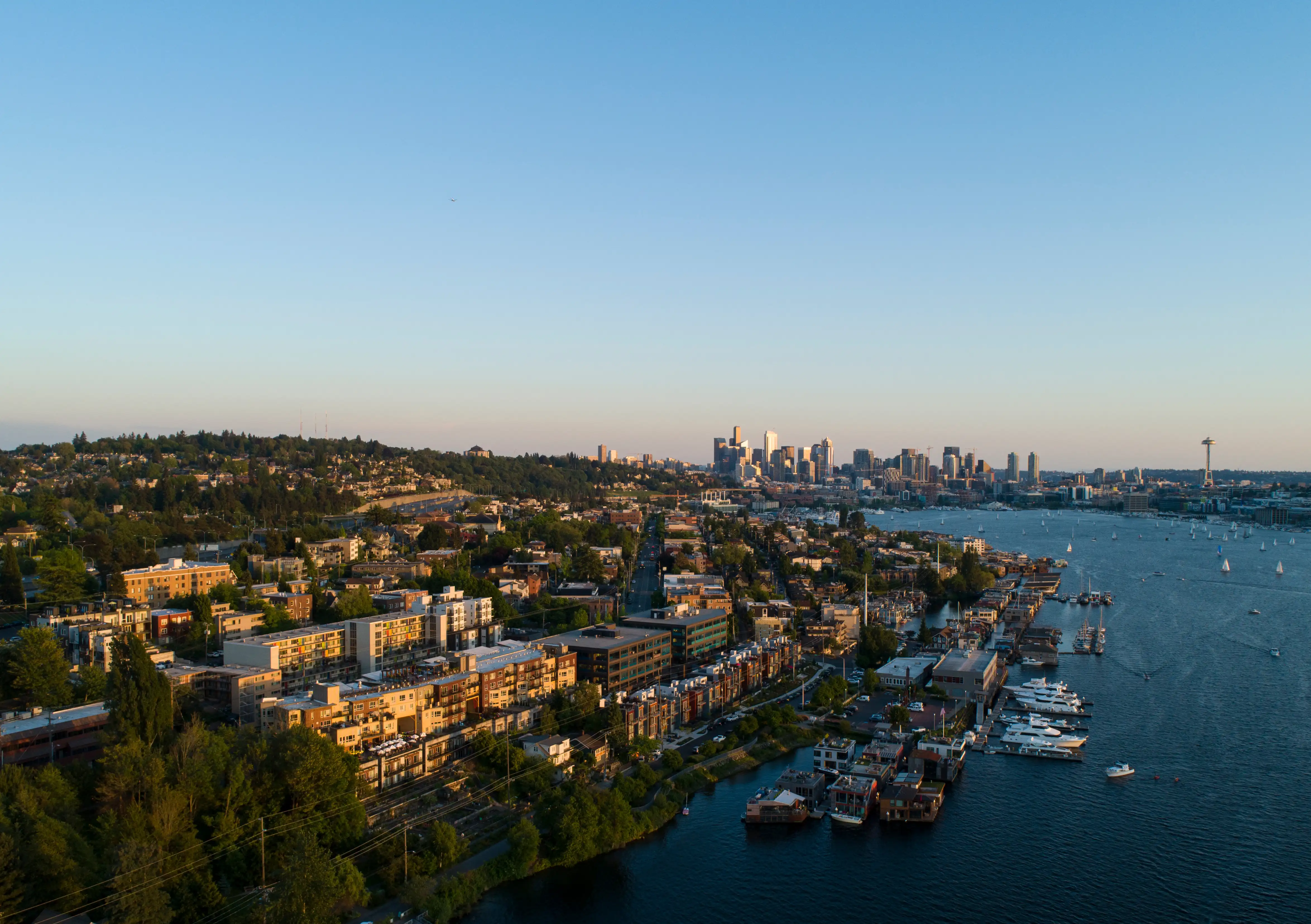
The Tax Comparison Every Californian Needs to See
Washington has no state income tax on wages or salary. California has the highest marginal rate in the country at 13.3%. For most W-2 earners, this is the single largest financial change that comes with moving to Seattle, and it compounds every year you stay.
The Numbers, Straight
| Category | California | Washington / Seattle |
|---|---|---|
| State income tax (wages) | Up to 13.3% marginal rate | $0 through at least 2027 |
| Annual savings at $100K W-2 | — | ~$5,762/yr |
| Annual savings at $200K W-2 | — | ~$16,200/yr |
| Capital gains tax | Up to 13.3% (taxed as ordinary income) | 7% on long-term capital gains above a $278,000 standard deduction for 2025, rising to 9.9% on gains above $1,000,000; real estate sales exempt |
| Sales tax (city rate) | 9–10.75% with local add-ons | 10.55% (groceries exempt) |
| Property tax (effective rate) | ~1% of purchase price (Prop 13 protected) | 0.83% of current market value, reassessed |
| High-income millionaire's tax | Already applies | 9.9% on household income above $1M, starting January 1, 2028 |
Groceries being exempt from Washington's sales tax is a meaningful everyday offset. If you were already paying 10.25% in Los Angeles or 10.75% in parts of the Bay Area, the 10.55% Seattle rate is not the shock it looks like on paper.
The Proposition 13 Trade-Off
This one catches Californians off guard. Under Prop 13, your assessed value in California was locked at purchase price and could only rise a maximum of 2% per year — so a home bought in 2005 might be taxed on a fraction of its current value. Washington has no equivalent protection.
Seattle's 0.83% effective rate applies to current market value, reassessed as the market moves. On a $865,273 purchase, that's roughly in line with what many Californians pay on assessed value — but unlike Prop 13, it can rise as your home appreciates. The longer-term exposure is real if Seattle values continue to climb.
Capital Gains: A Critical Distinction for Sellers
If you're selling a California home with significant appreciation, you face one of two scenarios. California taxes capital gains as ordinary income at up to 13.3%. Washington taxes 7% on long-term capital gains above a $278,000 standard deduction for 2025, rising to 9.9% on gains above $1,000,000, and direct real estate sales are fully exempt.
That exemption matters enormously. Selling your primary California residence before relocating — or timing the sale correctly — can be the difference between owing California tax and owing nothing in Washington on the same transaction. Talk to a tax attorney before you sell.
The FTB Audit Risk — Read This Before You File
California's Franchise Tax Board audits former residents for up to four years after they leave the state. It looks for ongoing ties: days spent in California, a California driver's license, a vehicle still registered there, family members who stayed behind. If the FTB determines your "domicile" never truly changed, it can assess California income tax on Washington earnings.
A clean break means updating your driver's license, re-registering your vehicles, establishing Washington voter registration, and being careful about how much time you spend back in California — especially in year one. This is not hypothetical. High earners making this move specifically for the tax advantage are exactly who the FTB is watching.
Home Prices: What California Buyers Actually Find Here
Seattle's median home price sits at $865,273 (Zillow Home Value Index, May 2026). What that buys — and how competitive the process is — depends significantly on where in the city you're looking and what you're used to.
The Bay Area vs. LA vs. Seattle Read
Coming from San Francisco or San Jose, Seattle prices will feel broadly comparable. The Bay Area median runs meaningfully higher, so the same budget goes further here, and you're less likely to be priced out of a neighborhood you actually want to live in.
Coming from Los Angeles, the comparison is closer. Seattle's median is roughly in the same range as the LA metro — neither city is dramatically cheaper than the other at the median. What shifts is what you get: Seattle tends to offer more green space within neighborhoods, and the mountains are genuinely close, not a two-hour drive in traffic.
What the Buying Process Actually Feels Like
Seattle's market moves fast. Well-priced homes in areas like Ballard, Wallingford, and Queen Anne regularly receive multiple offers within days of listing. Californians used to competitive Bay Area markets will recognize the pattern — inspection waivers, escalation clauses, offers above ask. Those coming from slower Southern California submarkets may be less prepared.
Contingency-waiving is common but not universal. A local buyer's agent who knows specific micro-neighborhoods — the difference between a West Seattle hillside home and a Columbia City bungalow — is not optional if you're buying remotely from California. Seattle's geographic divides are steep enough that buying without understanding them is the most common mistake out-of-state buyers make.
The Entry Point Reality
The $865,273 median covers the full city. Entry-level homes — older construction, smaller lots, neighborhoods farther from light rail — start lower, but in Seattle's market, "entry-level" still means a substantial purchase. Condos in Capitol Hill or Fremont offer lower price points and walkable streets that Californians accustomed to urban living often prefer. First-time buyer programs in Washington include state-level assistance that California buyers won't have encountered before.
One thing Californians underestimate: Seattle's hills are not metaphorical. A home that looks close to downtown on a map can involve a genuine elevation change that affects walkability, parking, and even micro-climate. Drive the routes before you commit to a neighborhood.

Daily Life: The Adjustments California Expats Don't Expect
Six months in, almost every Californian who moves to Seattle says the same thing: the gray is real, and it starts in October. Not dramatic rain — Seattle gets less annual rainfall than Miami — but weeks of low overcast that makes January feel like a long tunnel. People who grew up in coastal California, used to marine layer that burns off by noon, are not prepared for marine layer that simply stays.
The Seasonal Compensation
The trade is a Pacific Northwest summer that is genuinely extraordinary. June through September brings dry, clear days in the mid-70s with almost no humidity, views of Mount Rainier floating above the skyline on clear days, and enough outdoor access — Puget Sound ferry rides, hikes within 45 minutes of the city, kayaking on Lake Union — to understand why people stay. The summer tips the scale for most Californians who make it through their first winter.
Getting Around Without a Car
Sound Transit's Link Light Rail is Seattle's most Californian-friendly feature: it actually works as a commute tool. The 1 Line runs roughly 25 miles from Lynnwood through downtown to Federal Way, connecting to Seattle-Tacoma International Airport in 47 minutes. As of March 28, 2026, the new 2 Line runs one-seat rides between downtown Seattle and the Eastside — including Redmond and Bellevue — which means Microsoft employees can commute to campus from Capitol Hill or Ballard without a car for the first time. A West Seattle Link Extension, approved by the Sound Transit Board in May 2026 with stations at SODO, Delridge, and Alaska Junction, is now advancing. For transit-dependent Californians used to commuter rail or subway systems back home, Seattle's network is expanding faster than most comparable cities.
Driving remains necessary for most people outside of dense neighborhoods. The hills and the bridges create bottlenecks that don't resolve with surface-street rerouting — something to factor into where you choose to live relative to work.
Where People Actually Gather
Pike Place Market is the postcard, but locals treat it as a working farmers market, not a tourist attraction. On a Saturday morning, you will find Wallingford families at Green Lake, Capitol Hill regulars nursing a pour-over at Victrola Coffee Roasters on 15th Ave E, and Ballard regulars queuing early for a table at The Walrus and the Carpenter on Ballard Ave NW. Lowlander, the brewery and beer hall on Occidental Ave S in Pioneer Square's RailSpur development, has become a natural landing spot on weekday evenings. These are the places that tell you what the city actually runs on: seafood, coffee, and enough of a neighborhood-pub culture that the social life doesn't require a car.
The Food and Culture Reset
Californians used to a density of Mexican restaurants, taco trucks on every block, and year-round farmers markets will notice the difference. Seattle has excellent Japanese, Vietnamese, and Asian food — often better than California equivalents at comparable price points. The Mexican food scene is thinner. This is not a minor thing if it's part of your weekly rhythm, and it's worth knowing before you move rather than after.
Looking to buy in Seattle? Estimate your payment.
Enter your numbers to see an estimated monthly mortgage payment.
Estimate only. Excludes HOA fees and mortgage insurance. The interest rate above is a starting point, not a quoted rate — replace it with your own to see real numbers. Insurance is a flat placeholder, not a Seattle quote.
The Honest Trade-Off: What You Give Up and What You Gain
The case for Seattle is strong on paper. No state income tax, a real transit network, Amazon and Microsoft within the city limits, mountains and water visible from residential streets, and summers that people from cold climates would move for on their own. The case against it is shorter but specific enough to matter.
What California Expats Miss Most
Sunshine is the obvious one, but the subtler loss is the year-round outdoor lifestyle. In coastal California, you can run at 7 a.m. in February in a light jacket. In Seattle, February means headlamps, rain gear, and genuine planning. Outdoor culture here shifts — hiking replaces beach days, waterproof layers replace flip-flops — but the adjustment is real for people who built their social life around the outdoors.
The cost-of-living picture is more complicated than the tax savings suggest. Depending on the index, Seattle runs 5–10% above Los Angeles in overall living costs, with housing as the main variable. The income-tax savings are concrete; the cost-of-living adjustment is city-specific. Californians moving from LA should model their full budget rather than assuming Seattle is dramatically cheaper overall.
What You Gain That Isn't on the Spreadsheet
Seattle's pace is slower than the Bay Area's without being sleepy. Neighborhoods feel like neighborhoods — Fremont has an identity, Columbia City has a different one, and Green Lake has yet another, all within a short drive of downtown. The city is large enough to have genuine cultural density: a serious arts scene anchored by institutions near Capitol Hill and Seattle Center, an independent music culture that has outlasted its 1990s fame, and a food scene that rewards exploration rather than just brand-name dining.
The proximity to nature is not marketing copy. Within 45 minutes of Capitol Hill, you can be on a trail with no cell signal. The Cascade Range to the east and the Olympics to the west are visible from Kerry Park on a clear day. For Californians who have been commuting two hours to reach anything resembling wilderness, this is the version of the move that doesn't get old.
The Safety and Schools Context
Property crime in Seattle runs higher than California's larger suburban markets — something to factor in when choosing a neighborhood. The safety picture varies significantly by area, so neighborhood selection matters more here than in many comparable cities. The district's performance is strong for an urban system of its size, but individual school quality varies by attendance boundary in ways that affect where families choose to buy — see the full schools breakdown for boundary-level detail.
Making the Move: What to Do Before, During, and After
A California-to-Seattle move has a legal and financial checklist that most interstate moves don't. Getting it right in the first 90 days protects the tax advantage you moved for.
Before You Leave California
Decide whether to sell your California home before or after establishing Washington residency. If you're sitting on significant appreciation, timing matters — direct real estate sale proceeds are exempt from Washington's capital gains tax, but California will tax those gains if the sale closes while you're still a California resident. A tax attorney, not just a CPA, is worth the cost here.
Begin the documentation trail early. The California Franchise Tax Board will scrutinize your move if your income is high enough to make the no-income-tax benefit material. Every day you can document Washington residency — lease signing date, Washington employer letter, utility account start date — is a day that works in your favor if you're ever audited.
The First 30 Days in Washington
Washington requires new residents to obtain a Washington driver's license within 30 days of establishing residency. Vehicle registration follows. These are not optional steps you can defer: they are the clearest evidence of intent to change domicile, and the FTB treats them as such. Get both done in the first month.
Register to vote in Washington. Update your banking addresses. If you maintain a California P.O. box, a California storage unit, or spend more than a few weeks per year at a California address, document why — the FTB will ask.
The Forward-Looking Tax Note
Washington's no-income-tax status remains fully intact for W-2 earners through at least 2027. Governor Ferguson signed legislation in March 2026 that will impose a 9.9% state income tax on household income above $1 million starting January 1, 2028. If your household income is below that threshold, this does not affect you. If it's above it — or likely to be — the calculus changes at the high end, and the comparison to California's 13.3% top marginal rate narrows significantly. High-income founders, investors, and executives making this move for tax reasons should model the 2028 scenario before committing.
What People Underestimate About the Transition
The social reset takes longer than the paperwork. Seattle has a well-documented reputation for being hard to break into socially — locals have long-established friend groups, are politely busy, and don't always make the first move. Californians, especially those from LA where social spontaneity is more culturally embedded, often find the first year lonelier than expected. Joining something — a running group at Green Lake, a community at a climbing gym, a regular farmers market circuit — accelerates the process more than waiting for coworkers to invite you to things. The city rewards the people who show up rather than those who wait to be invited.
For a full breakdown of who Seattle suits best and what the local economy looks like day-to-day, the living-in-Seattle guide covers the employer landscape and commute patterns in detail.

Local Expert Takeaway: The tax savings are real, the rain is real, and the housing market is competitive enough that showing up without a local buyer's agent and a pre-approval is how you lose your first three offers. Most Californians who thrive here make peace with the winter gray by February and are watching the Cascade Range from Kerry Park by July, wondering why they waited so long. The ones who leave within two years usually cite the social isolation and the property crime more than the weather. Know the difference between what the spreadsheet fixes and what it doesn't — then decide.
Quick Takeaways & FAQs
✅ A W-2 earner at $100,000 saves roughly $5,762 per year in state income taxes the moment they establish Washington residency — no filing tricks required.
⚠️ Seattle's 10.55% sales tax and a property tax that resets with market value (no Prop 13 equivalent) mean the overall cost picture is more nuanced than 'no income tax = cheaper.'
📍 California's Franchise Tax Board audits former residents for up to four years — get your Washington driver's license, vehicle registration, and voter registration done within the first 30 days of your move.
How much do I save on income taxes by moving from California to Seattle?
Is Seattle cheaper than Los Angeles or San Francisco for home buyers?
Does California's Franchise Tax Board come after you if you move to Seattle for the tax benefit?
What is Seattle's sales tax, and how does it compare to California?
Does Seattle have the same Proposition 13 property-tax protection as California?
Moving to Washington?
Tell us what you need help with and we'll connect you with local resources.
