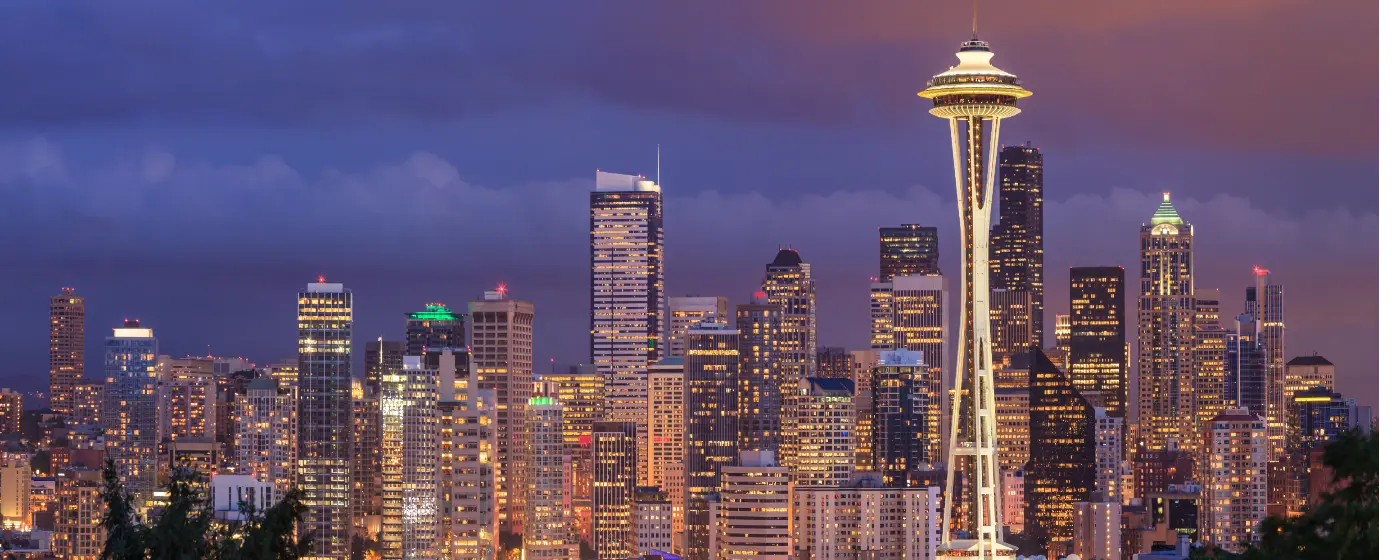
Maybe you've been priced out of Bellevue and someone said Seattle proper is actually the better deal. Maybe Amazon or the University of Washington just relocated you and you have six weekends to figure out which neighborhood makes sense. Whatever brought you here, the first thing to understand is that Seattle is not one real estate market — it's eight or nine markets stacked on hills, separated by water, and connected by bridges that turn a two-mile commute into a twenty-minute one on the wrong day. The city's Zillow Home Value Index sat at $865,273 in May 2026, but that single number describes almost nothing. Homes in Columbia City can trade well below that figure while Queen Anne condos clear seven figures in the same week.
Seattle's economy pulls from multiple directions at once. Amazon's South Lake Union campus and dozens of satellite tech offices make the central and north neighborhoods especially competitive for workers who need to be in-office a few days a week. The University of Washington anchors the northeast edge of the city and shapes the rental market in Wallingford and Green Lake just as strongly as any condo developer. Starbucks' headquarters draws corporate professionals who want quick access to SoDo, and the whole ecosystem supports a cost of living that surprises almost every out-of-state arrival in month two. Seattle Public Schools holds an A- rating, according to Niche, but school boundaries here are specific and consequential — two blocks in the wrong direction can mean a different elementary school entirely, a detail covered in full on the schools page.
Day to day, Seattle's livability leans heavily on geography. If you're on the west side of the hill with a view of Puget Sound, you feel like you're in a different city from someone navigating the flats near I-5. The Burke-Gilman Trail stitches together a significant chunk of the north end. Light Rail now connects the airport to Capitol Hill and the University District, and the coming West Seattle extension is already pushing prices in that peninsula. Outdoor access — from Discovery Park to Seward Park — is woven into daily life in ways that make the rain feel like a reasonable trade-off to most people who stay past year one.
Whether you're considering a move or just researching the area, the sections below break down Seattle's neighborhoods, price bands, buyer types, common mistakes, and the rental market — so you can narrow down the right corner of the city before your first showing.
The Seattle Reality
The Hill-and-Water Divide That Changes Everything
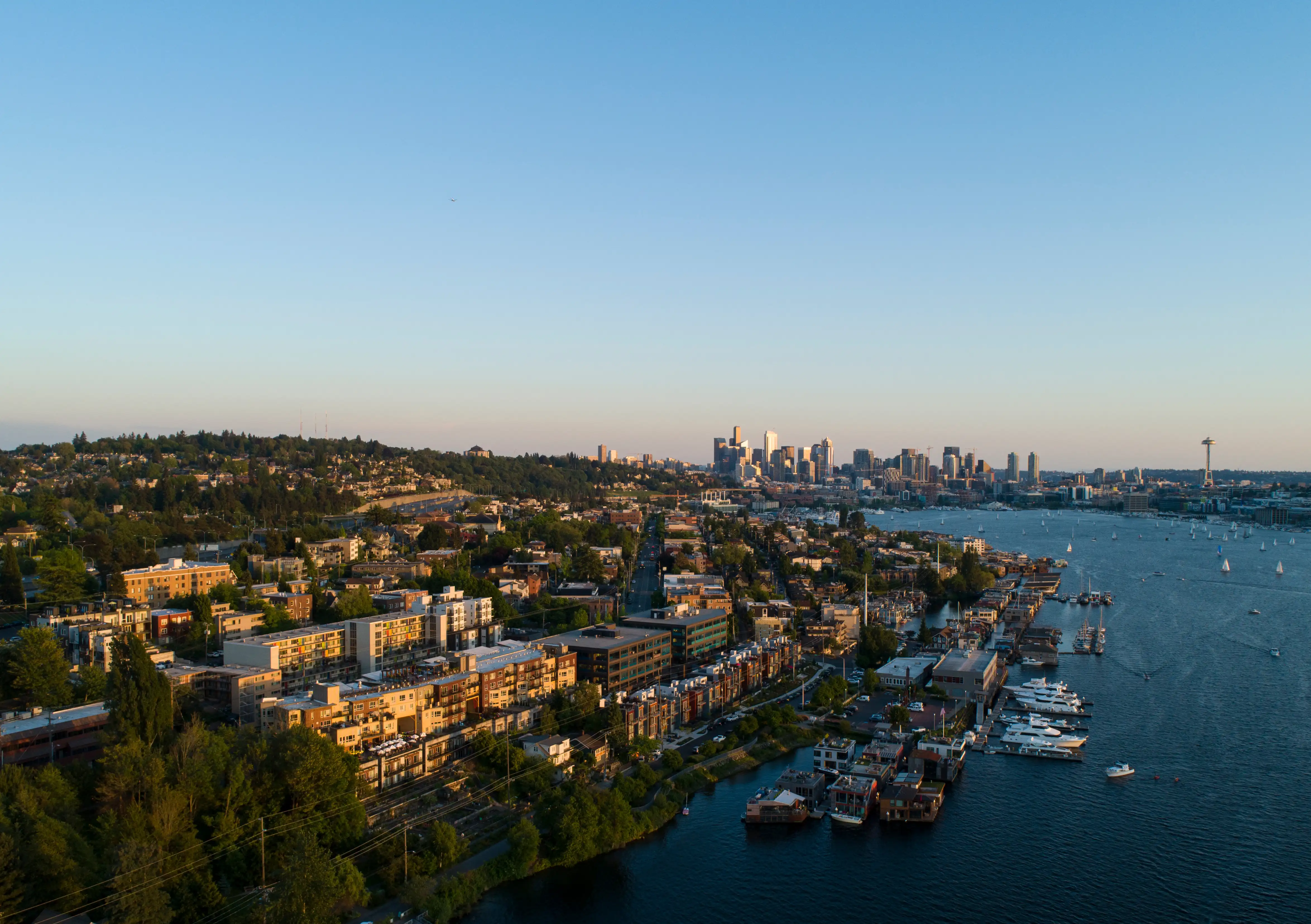
Seattle's geography is not a backdrop — it's the operating system. The city is built on a series of ridges running north-to-south, with Lake Washington to the east, Puget Sound to the west, and Lake Union splitting the middle. That shape means a neighborhood's physical position — hilltop, waterfront, or valley floor — determines its commute options, its flood exposure, its view premium, and in many cases its school assignment. Choosing without understanding this divide is the single most common mistake buyers make here.
The practical dividing line most locals use is Aurora Avenue North (SR 99). North of downtown and on the aurora corridor's west side, you get the dense, walkable neighborhoods — Fremont, Wallingford, Green Lake, and Ballard — that trend toward the city-wide median or above. East of that corridor sits Capitol Hill and the CD, with their own transit infrastructure and price dynamics. Then there's West Seattle, physically cut off by the Duwamish River and accessible only via the West Seattle Bridge or the lower bridge, which genuinely isolates the peninsula during any bridge closure. That isolation happened for two full years after the 2020 crack in the main bridge, and every West Seattle buyer should weigh that memory seriously.
School Boundaries Are Hyper-Local
Seattle Public Schools uses a location-based assignment system, but the boundaries are drawn tightly and updated periodically. Two houses on the same block can feed into different elementary schools. For families with school-age children, the right move is to verify the exact address on the SPS boundary map before making an offer — not after. The schools page has the full breakdown; here, just know that chasing a neighborhood's reputation without checking the specific boundary is a mistake that costs some buyers an entire school re-enrollment process.
Seattle Neighborhoods at a Glance
| Neighborhood | Best For | Price Range | Vibe |
|---|---|---|---|
| Capitol Hill | Walkable Transit | $700K–$1.1M+ | Dense, artsy, LGBTQ+-centered; Volunteer Park as the anchor green space |
| Ballard | Families Walkable | $750K–$1.2M+ | Former Scandinavian fishing village with Craftsmans, craft breweries, and a year-round farmers market |
| Fremont | Commuter Walkable | $800K–$1.3M+ | Self-proclaimed Center of the Universe; increasingly expensive but still the most idiosyncratic |
| Queen Anne | Luxury Views | $900K–$1.5M+ | Split between historic Upper and urban Lower; Kerry Park views, Space Needle proximity |
| West Seattle | Families Value | $650K–$1.1M | Peninsula feel with beach access at Alki; geographically isolated but Light Rail expansion is coming |
| Wallingford | Families Quiet | $800K–$1.2M | Bungalow-lined streets between UW and Green Lake; walkable but lower-key than its neighbors |
| Columbia City | First-Time Transit | $550K–$900K | South Seattle's most diverse commercial strip; Light Rail on MLK Way; fastest-appreciating entry point |
| Green Lake | Nature Families | $850K–$1.3M | Built around a 2.8-mile lakeside loop; bungalows, good schools, and almost no vacancy |
Best Seattle Neighborhood by Buyer Type
| Buyer Type | Best Neighborhood | Why |
|---|---|---|
| First-Time Buyer | Columbia City | Entry points starting in the mid-$500Ks give first-time buyers a foothold inside city limits with a Light Rail stop on MLK Way already in place. |
| Luxury Buyer | Queen Anne | Upper Queen Anne's historic Victorians and territorial views command the city's most consistent price premiums, with a directional median near $1,050,000 (February 2026). |
| Walkability Seeker | Capitol Hill | Seattle's most densely populated neighborhood offers excellent on-foot access — grocery stores, restaurants, and Link Light Rail all reachable without a car from almost any address. |
| Families with Kids | Green Lake | The lakeside loop, strong elementary school assignments, and a neighborhood where the default weekend activity is a bike ride rather than a drive make Green Lake the perennial family shortlist. |
| Commuter | Fremont | Fremont sits directly between South Lake Union and the University District, making it the rare Seattle neighborhood where Amazon and UW employees can both bike to work. |
| Large-Lot Buyer | West Seattle | West Seattle's older single-family stock — particularly on the hillside above Alki — offers larger lots and more breathing room than anywhere else at this price range inside city limits. |
| Renter | Capitol Hill | The highest density of apartment and condo supply means the most rental competition and therefore more unit choice, with transit to every major employment hub. |
Looking to buy in Seattle? Estimate your payment.
Enter your numbers to see an estimated monthly mortgage payment.
Estimate only. Excludes HOA fees and mortgage insurance. The interest rate above is a starting point, not a quoted rate — replace it with your own to see real numbers. Insurance is a flat placeholder, not a Seattle quote.
Most Popular Seattle Neighborhoods
Capitol Hill
Capitol Hill is where Seattle's density experiment works best — and most loudly. Broadway and Pike/Pine corridors are lined with independent restaurants, indie record shops, and bars that stay busy on Tuesday nights, anchored by the strong LGBTQ+ community that has shaped the neighborhood for decades. The trade-off is noise, density, and prices that start around $700K for a modest condo and climb past $1.1M for a single-family home on a quiet side street near Volunteer Park.
Best for: Renters transitioning to buyers, transit-dependent households, and anyone who wants urban density without leaving Seattle proper.
Ballard
Ballard's Craftsman bungalows and the Ballard Locks give it a physical identity that newer neighborhoods can't replicate, and a cluster of craft breweries along 14th Avenue NW and NW 52nd Street have made it a legitimate destination for the city's craft beer scene. Prices in the mid-to-high $800,000s for the neighborhood overall, with single-family homes pushing into the $1M–$1.2M range on the blocks closest to Golden Gardens and the Ship Canal. The Sunday farmers market on Ballard Avenue is the unofficial social hub, and Syttende Mai each May brings the neighborhood's Scandinavian history back to the surface — a seasonal quirk that genuinely surprises newcomers who didn't know a Norwegian constitution day parade was part of the deal.
Best for: Families and working professionals who want walkable streets, maritime history, and weekend-market culture without paying Queen Anne prices.
Fremont
Fremont earned its "Center of the Universe" motto honestly — the Fremont Troll under the Aurora Bridge, the Lenin statue on 36th Street, and a summer solstice parade with body-painted cyclists are not tourist inventions but neighborhood institutions that locals genuinely defend. Access to South Lake Union along Westlake Avenue makes it one of the strongest commuter positions in the city for tech workers, which has pushed single-family prices well into the $800K–$1.3M range and squeezed out the quirk-over-cost crowd. Buyers who loved Fremont in 2015 and are now returning from the suburbs often find the character intact but the entry price substantially higher than they remember.
Best for: South Lake Union commuters who want neighborhood character and don't need a large yard.
Queen Anne
Upper and Lower Queen Anne function almost as separate neighborhoods: Upper Queen Anne has the Kerry Park overlook, the historic Victorians, and a quiet strip of local shops along Queen Anne Avenue N, while Lower Queen Anne (increasingly called Uptown) sits at the foot of Seattle Center next to the Space Needle and Chihuly Garden and Glass, with a denser, more transient feel. The directional median sale price was around $1,050,000 in February 2026, making it consistently the most expensive of Seattle's residential neighborhoods — and the hill itself creates real accessibility challenges for households without reliable cars or strong legs.
Best for: Luxury buyers, view-obsessed buyers, and households where Seattle Center proximity is a genuine lifestyle priority.
West Seattle
West Seattle's Alki Beach gives it something no other Seattle neighborhood can claim: a place to watch the sunset over Puget Sound and the Olympic Mountains from a flat, sandy beach within city limits. Prices run $650K–$1.1M with more single-family inventory and larger lots than comparable spending buys in Ballard or Wallingford. The catch — and it's a real one — is the West Seattle Bridge: when the main span cracked in 2020 and closed for two years, peninsula residents faced significantly longer commutes with no easy alternative, and that vulnerability hasn't disappeared just because the bridge reopened. Light Rail expansion is approaching, which is already pulling prices upward, but anyone buying here before service opens is buying on the promise, not the reality.
Best for: Families who want more space, beach access, and a slightly slower pace — and who can tolerate the bridge dependency.
Wallingford
Wallingford sits in one of Seattle's most geographically ideal positions — north of Lake Union, south of Green Lake, and bisected by 45th Street, which connects the University District to Fremont in under ten minutes by bike. The housing stock is dominated by early-20th-century bungalows that have been maintained, renovated, and now priced between $800K and $1.2M for most single-family homes. It's quieter than either of its neighbors, which is genuinely a feature for some buyers and a con for others who move here expecting Fremont energy and find block after block of well-kept front yards and early bedtimes.
Best for: Parents with school-age children, UW faculty and staff, and buyers who want walkable streets without nightlife noise.
Columbia City
Columbia City's commercial strip along Rainier Avenue S is Seattle's most genuinely diverse main street — Ethiopian, Vietnamese, and Mexican restaurants alongside a Light Rail station on MLK Way that connects directly to downtown and SeaTac. Entry-level prices starting in the mid-$500Ks make it the only neighborhood on this list where first-time buyers can get a house — not just a condo — inside Seattle city limits without stretching dramatically beyond the city-wide median. The honest caveat: buyers who purchased here primarily for price appreciation are now in a neighborhood that has attracted significant attention, and prices have moved accordingly.
Best for: First-time buyers, transit-dependent households, and anyone who wants Seattle's best international food corridor at the end of the block.
Green Lake
Green Lake's 2.8-mile paved loop around the lake is not just a park — it's the organizing principle of the neighborhood. On a dry Saturday morning, the path is packed by 8 a.m., and the streets radiating outward from it are full of parents pushing strollers, dogs, and residents who chose the neighborhood specifically because the loop is the weekend. Single-family homes on the blocks closest to the water consistently push into the $1M–$1.3M range, and inventory is perpetually tight — homes here go to pending faster than almost anywhere else in Seattle. The trade-off is that Green Lake has almost no nightlife and limited retail compared to Ballard or Capitol Hill; it's a neighborhood that rewards buyers who genuinely want the lake as their social center.
Best for: Outdoor-oriented families, buyers prioritizing elementary school assignments, and anyone whose ideal Sunday starts with a lakeside run.
Common Mistakes Buyers Make in Seattle
Treating the City-Wide Median as a Neighborhood Price
The city-wide Zillow Home Value Index of $865,273 (May 2026) is a useful orientation number and almost useless as a shopping benchmark. Columbia City and West Seattle have meaningful inventory below it; Green Lake and Queen Anne regularly trade well above it. Buyers who arrive with that figure as their ceiling without checking neighborhood-level comps frequently find themselves eliminated from every offer in Ballard before they've looked at their second house.
Underestimating the West Seattle Bridge Risk
Every West Seattle buyer should read about the 2020 bridge closure before making an offer. The main span of the West Seattle Bridge cracked and closed in March 2020, rerouting all peninsula traffic through the lower Spokane Street Bridge for over two years. There is no alternative crossing — the Duwamish is not walkable or cyclable at that point. If you're buying in Alki, the Junction, or Fauntleroy, you are buying the bridge dependency alongside the ocean views, and that's a trade worth pricing consciously.
Chasing Square Footage Over School Boundary
Seattle buyers regularly discover — after going under contract — that the house with the bigger backyard in Wallingford is assigned to a different elementary school than the smaller house three blocks north. Seattle Public Schools' assignment boundaries are drawn at the parcel level, not the neighborhood level. The extra 200 square feet is rarely worth being assigned to a school you didn't want; verify the SPS boundary map before your inspection period, not after your offer is accepted.
Assuming All of Capitol Hill Is Walkable and Quiet
Capitol Hill's on-foot access is genuinely excellent, but Pike Street and Broadway between Pike and Pike/Pine are entertainment corridors with late-night bar noise, street activity, and the acoustic reality of density. Buyers who want that access but also quiet should look at the blocks east of 15th Avenue E near Volunteer Park, where the neighborhood calms considerably. Buying on the assumption that "Capitol Hill" means one consistent experience — without walking the specific block at 10 p.m. on a Friday — is a mistake that tends to produce early regret.
Best Areas to Rent in Seattle
| Area | Ideal For | Typical Rent Range | Trade-off |
|---|---|---|---|
| Capitol Hill | Transit Walkable | $1,800–$3,200/mo | Highest supply and best transit access, but street noise and density are real at lower price points |
| Ballard | Families Walkable | $1,900–$3,400/mo | Strong neighborhood feel and good transit options, but rents have climbed steadily with buyer demand |
| Fremont / South Lake Union | Commuter Tech | $2,000–$3,600/mo | Walking distance to Amazon campus means high demand and very low vacancy; two-bedroom apartments rent quickly |
| Columbia City | First-Time Value | $1,400–$2,400/mo | The most accessible rents within Seattle city limits, but fewer high-rise amenities than north-end options |
| West Seattle (The Junction) | Families Quiet | $1,600–$2,800/mo | More space per dollar than north Seattle, but bridge dependency remains the defining inconvenience |
Seattle's rental market moves faster than most newcomers expect — a well-priced two-bedroom in Ballard or Capitol Hill typically goes to applications within days of listing, and same-day or next-day decisions are normal. Renters relocating from smaller markets should have their income documentation and references ready before they start touring, not after.
Local Expert Takeaway: The buyers who make the fewest mistakes in Seattle are the ones who pick a neighborhood before they pick a house. If you're a South Lake Union commuter, Fremont or Wallingford will serve you better than West Seattle no matter how appealing the Alki Beach views look on a sunny Sunday. If Columbia City's price range is what makes homeownership possible for you, understand that the Light Rail stop on MLK Way is already doing the work — you don't need to wait for the neighborhood to arrive. And if you're buying in Ballard, walk the specific block at night: the streets near the craft breweries along 14th Avenue NW stay lively into the evening, which is a feature for some buyers and a dealbreaker for others.
Quick Takeaways & FAQs
✅ Columbia City's Light Rail connection and entry prices in the mid-$500Ks make it the clearest path to homeownership inside Seattle city limits for first-time buyers.
⚠️ West Seattle's Alki Beach views come with a genuine infrastructure risk — the 2020 bridge closure lasted over two years and left peninsula residents with no viable alternative commute route.
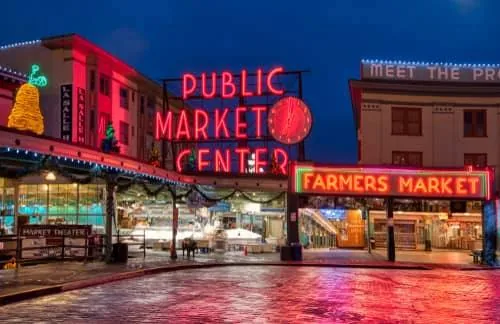
📍 Ballard's year-round Sunday farmers market on Ballard Avenue is where the neighborhood actually gathers — not the bars, not the Locks — and it's the single best way to test whether the neighborhood fits your lifestyle before you make an offer.
What is the most affordable neighborhood in Seattle to buy a home?
Which Seattle neighborhood is best for families with young children?
Is West Seattle worth buying in before the Light Rail extension opens?
How competitive is the Seattle real estate market right now?
Which Seattle neighborhood has the best walkability and transit access?
Moving to Washington?
Tell us what you need help with and we'll connect you with local resources.
