
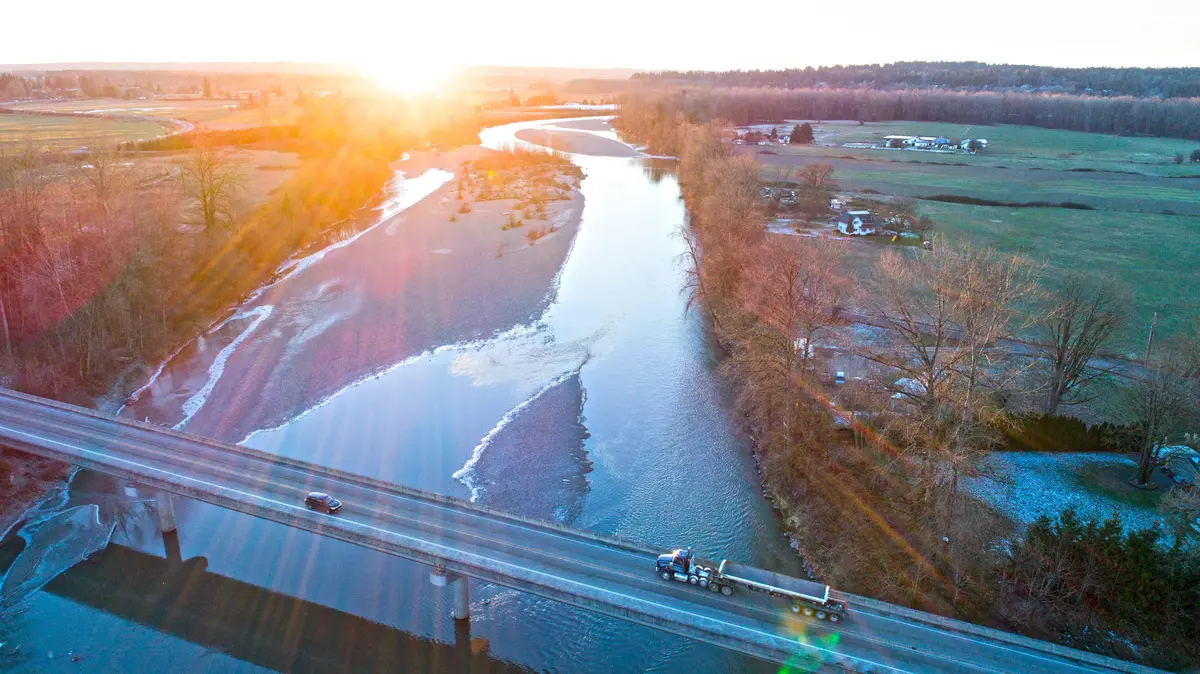
You've done the spreadsheet. Arlington, WA checks the boxes on paper — no state income tax, home prices well below what you left behind, and a commute to Everett that runs about 20 minutes on a good day. But spreadsheets don't tell you that this is a small city of roughly 22,000 people on the Stillaguamish River, bracketed by I-5 to the west and the Cascade foothills to the east, where your neighbors are as likely to work on a Boeing production line in Everett as they are to run a small business on Olympic Avenue. That geographic and economic reality shapes everything from where you'll buy to how you'll spend a Saturday afternoon.
Arlington sits in Snohomish County, about 40 miles north of Seattle and 10 miles north of Everett, the county seat. The major employment anchors drawing people here — aerospace manufacturing at Boeing's Everett campus, the Arlington School District, Angel of the Winds Casino Resort, and Zenix Aerospace — reflect a community rooted in blue-collar industry and public-sector work, not the tech corridors that define the southern end of the county. That distinction matters: Arlington's median household income of $86,581 is solid, but the social fabric feels decidedly different from Bellevue or Kirkland. Arlington Public Schools holds a B rating, according to Niche, and for many California families leaving overcrowded suburban districts, that steady, mid-sized district is a meaningful draw.
The cost difference compared to California's coastal metros is not subtle. Arlington's Zillow Home Value Index stood at $598,417 in 2026 — a figure that reads as entry-level in San Francisco or coastal Los Angeles. Salary.com's 2025 cost-of-living index puts Arlington's overall expenses approximately 45% below San Francisco's. You'll give something back at the register — the combined sales tax rate runs approximately 9.3%–9.4%, and groceries are exempt — but the math on housing and income taxes tends to overwhelm that trade-off for most California transplants. Health insurance premiums typically run noticeably below what you were paying in California, though you will drive farther for specialist care than you would from a major metro.
Whether you're being relocated by an employer, priced out of the Bay Area, or simply ready for a different pace, the sections below break down the California-to-Arlington financial comparison, the tax picture on both sides, what to expect from everyday life, the honest trade-offs, and how to think about the move before you make an offer.
The Home Price Reality: What Your California Budget Buys Here
The single biggest shock for California transplants is how far a dollar stretches in Arlington — and how quickly that advantage resets expectations about what "normal" looks like.
Arlington's Zillow Home Value Index sits at $598,417 as of 2026. That figure represents a genuinely different housing market from the one most Californians are leaving. In the Bay Area, the typical home value runs well into the seven figures; in San Diego and Los Angeles, even modest single-family homes routinely clear $800,000 to $900,000. In Sacramento — one of California's more affordable metros — values have pushed well past $500,000 and continue climbing. Arlington's number, by contrast, buys you a real house on a real lot, not a condo with HOA fees that rival a car payment.
For a cleaner picture of what changes when you cross the state line, the table below compares Arlington against several California markets California transplants most commonly arrive from.
| Market | Approximate Typical Home Value (2026) | Relative to Arlington | State Income Tax (Top Rate) |
|---|---|---|---|
| Arlington, WA | $598,417 | — | 0% (no broad-based income tax) |
| Sacramento, CA | Noticeably above Arlington | Higher | Up to 13.3% |
| San Diego, CA | Substantially above Arlington | Much higher | Up to 13.3% |
| Los Angeles, CA | Substantially above Arlington | Much higher | Up to 13.3% |
| Bay Area, CA | Dramatically above Arlington | Far higher | Up to 13.3% |
| San Francisco, CA | Dramatically above Arlington | Far higher (overall cost ~45% more) | Up to 13.3% |
The qualitative gap is real and consistent: across every major California metro, Arlington comes in meaningfully lower — in some cases, dramatically so.
One thing to understand before you get too comfortable: Arlington's property tax rate of 0.79% applies to the full current market value of whatever you purchase, from day one. There is no Washington equivalent of California's Proposition 13. In California, long-term owners often pay effective rates on a decades-old assessed value — a legacy buyer in a $1.2 million home might pay taxes on a 1998 assessed value of $280,000. In Arlington, you buy at $598,417, you pay on $598,417. That 0.79% is a reasonable rate in absolute terms, but the reset-at-purchase mechanic is a structural difference worth building into your budget from the start. For more detail on property and other local taxes, see the Arlington cost of living page.
Washington's Tax Structure: What You Stop Paying and What You Start
The income tax situation is the clearest win for California transplants, and it is worth being precise about what it means.
Washington levies no broad-based personal income tax on wages, salary, or self-employment income. If you earned $150,000 in California and paid at the upper end of the state's bracket structure, you faced a marginal rate of 9.3% on that income — and California's top marginal rate reaches 13.3%. That liability disappears the day you establish Washington residency. For a dual-income household relocating from the Bay Area, the annual savings can be substantial enough to offset several months of mortgage payments.
The One Exception Worth Knowing
Washington taxes 7% on long-term capital gains above a $278,000 standard deduction for 2025, rising to 9.9% on gains above $1,000,000. This matters primarily if you're selling a California home and realizing a large gain, or if you hold significant investment assets and take gains in the same year you move. It is not a tax on your paycheck — it is a tax on investment gains above that threshold in a given year. Plan the timing of any large asset sales with a tax professional who understands both California's exit tax rules and Washington's capital gains structure.
The Sales Tax Trade-Off
Washington funds its public services through sales taxes, property taxes, and excise taxes rather than income taxes. The combined sales tax rate in Arlington runs approximately 9.3%–9.4%, which is higher than California's 7.25% state base rate — though many California counties and cities layer local additions on top of that base, sometimes reaching 9%–10.75% in high-cost areas. Groceries are fully exempt from Washington's sales tax, which takes a real edge off the rate for day-to-day household spending. Prepared food, clothing, electronics, and most retail purchases are taxed at the full combined rate.
| Tax Type | California | Arlington, WA | Net Change for Most Transplants |
|---|---|---|---|
| State income tax (wages) | 1%–13.3% marginal | None | Eliminated |
| Capital gains (state) | Taxed as ordinary income (up to 13.3%) | 7% on gains above $278K standard deduction (2025); 9.9% above $1M | Lower for most; watch timing |
| Effective property tax rate | ~0.68%–1.1% (Prop 13 compressed) | 0.79% on full current market value | Similar rate, no acquisition-cap |
| Sales tax (combined) | 7.25%–10.75% depending on locality | ~9.3%–9.4% | Roughly similar; groceries exempt in WA |
| Grocery tax | Exempt (most items) | Exempt | No change |
| Estate / inheritance tax | None | WA estate tax applies above $2.193M | Relevant for higher-net-worth estates |
For most California wage earners, the income tax elimination more than offsets the slightly higher sales tax rate. The property tax nuance — no Prop 13 reset protection — is the one structural item that catches transplants off guard, particularly those who owned California property for many years at a suppressed assessed value.
Everyday Cost of Living: Where Arlington Wins and Where It Doesn't
Housing and taxes get the headlines, but the texture of daily spending is where the California-to-Arlington shift really shows up in your bank account.
Groceries and Dining
Grocery prices in Arlington track closer to national averages than to California coastal pricing, where markups on everything from produce to dairy run well above the norm. The grocery tax exemption in Washington means the sales tax rate at the checkout line is zero on food staples — a meaningful difference for a family doing a weekly shop. For dining out, independent options along Olympic Avenue and in the Old Town core tend to run at price points that would feel reasonable compared to what you were paying in a California coastal metro. Skookum Brewery on 59th Ave NE is a verified local taproom where an evening out doesn't require a reservation made three weeks in advance.
Transportation and Utilities
Gas prices in Washington generally track below California's — the state's gas tax is lower and the regulatory environment adds less to the pump price. Electricity costs depend on your provider and usage, but the Pacific Northwest's hydropower base has historically kept rates competitive. Utility and transportation cost details live on the Arlington cost of living page, where the full breakdown lives.
What You Give Up
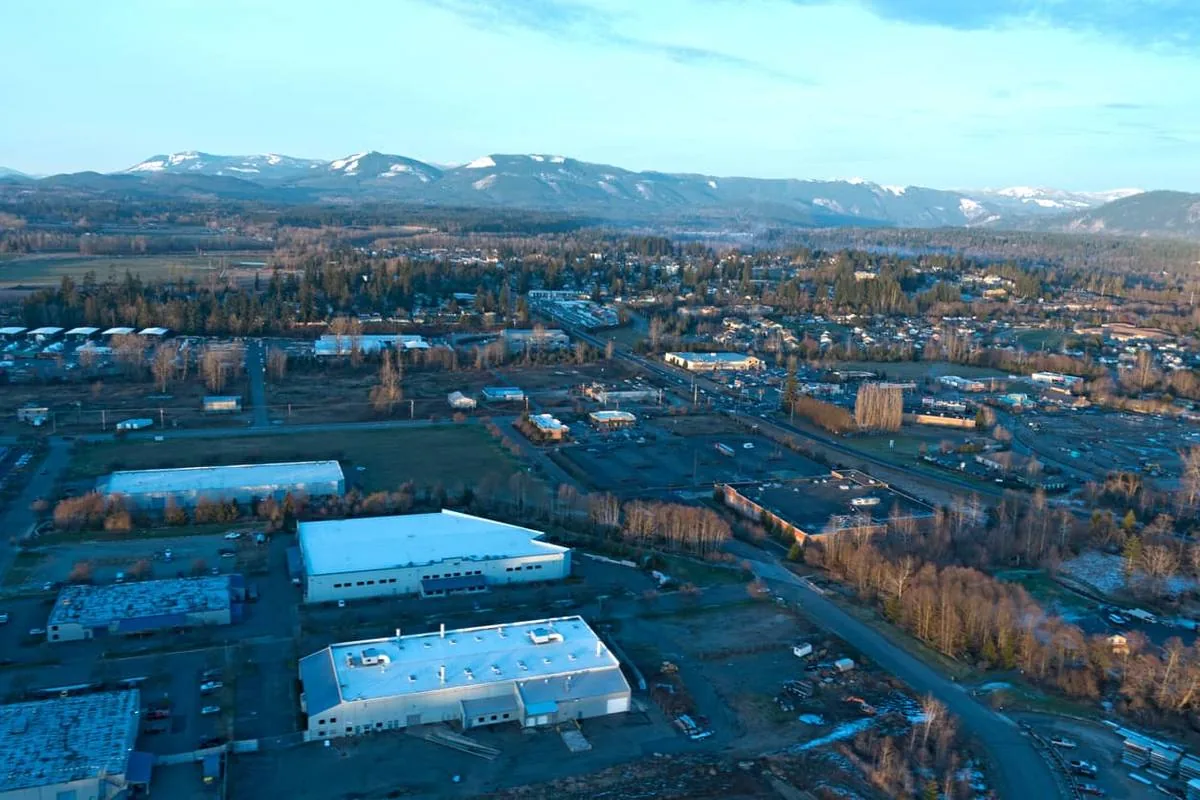
Arlington does not have the retail density of a larger city. There is no Trader Joe's within the city limits — the nearest is in the Everett area. The same applies to certain specialty grocery options and high-end retail that California transplants from urban cores take for granted. You adapt quickly, or you build a once-a-month run to the south into your routine. Most people adapt quickly.
Six months after moving here, the most common surprise is not what things cost — it's how much more space you have for the money, and how little traffic you encounter getting anywhere within Arlington itself. The I-5 corridor south toward Everett and Seattle is a different story during peak hours, and that commute reality is covered in detail on the living in Arlington page.
Looking to buy in Arlington? Estimate your payment.
Enter your numbers to see an estimated monthly mortgage payment.
Estimate only. Excludes HOA fees and mortgage insurance. The interest rate above is a starting point, not a quoted rate — replace it with your own to see real numbers. Insurance is a flat placeholder, not a Arlington quote.
Lifestyle Shift: From California to the Stillaguamish Valley
The practical financial comparison is only half the picture. The other half is whether Arlington's daily life actually fits the way you want to live.
Outdoor Access Is Immediate
The Centennial Trail — a 30-mile paved multi-use path — passes directly through Arlington, connecting south toward Snohomish and north toward the Skagit County line, drawing more than 500,000 users annually for cycling, walking, and equestrian use. At Legion Memorial Park, the Centennial Trail connects to the Whitehorse Trail, a 27-mile compacted-gravel route running east to Darrington through the northern Snohomish County foothills. This is not a bike path that ends at a parking lot — it is a trail system that puts genuine backcountry access within reach without driving to a trailhead. For families coming from California suburbs where outdoor access meant fighting traffic to a crowded state park, this alone resets expectations about what a weekend looks like.
The Pace Is Different — Specifically Different
Arlington is a working city, not a lifestyle suburb. The presence of Boeing's Everett operations about 20 minutes south shapes the culture in real ways: shift workers, aerospace engineers, and small-business owners all share the same streets. The Angel of the Winds Casino Resort brings hospitality employment and a distinct entertainment draw. This is not a city where the farmers market is the social center — though the Stillaguamish River corridor and Legion Memorial Park are where families actually congregate on warm weekends.
The Weather Adjustment
No section on moving here from California would be honest without this: the Pacific Northwest gray is real. Arlington averages significantly more overcast days than any California coastal market, and the rain is not dramatic — it is persistent and low-key from October through April. Californians from dry inland valleys often find the adjustment harder than those from the Bay Area, which at least has marine-layer mornings. By month three, most transplants have either bought a good rain jacket and stopped thinking about it, or started quietly questioning the move. This is the specific seasonal quirk no one warns you about — not the cold, but the weeks of flat gray sky in January when the mountains are hidden and the light doesn't change between 7 a.m. and 4 p.m.
Parks, trails, and outdoor recreation options are covered fully on the Arlington parks and recreation page.
What Californians Get Right — and Get Wrong — About This Move
Most California transplants arrive with an accurate picture of the financial upside and an incomplete picture of everything else. Here is what experience separates from expectation.
What You Get Right
The income tax elimination is real and immediate. The home price gap is real. The outdoor access — Cascades, trail systems, Stillaguamish River — genuinely delivers on what Pacific Northwest marketing promises. Arlington Public Schools is a functional, mid-sized district that most families from overcrowded California suburban districts find refreshingly navigable; the full school picture is on the Arlington schools page.
What People Get Wrong
The assumption that Washington is tax-free. It is income-tax-free for wages — that is specific and important. But the sales tax is real, the property tax resets at purchase with no Prop 13 protection, and Washington taxes 7% on long-term capital gains above a $278,000 standard deduction for 2025, rising to 9.9% on gains above $1,000,000 — which applies to high-earners liquidating California real estate or investment accounts in their move year. Run the full tax picture with a professional before you close, not after.
The other common misjudgment is treating Arlington as an outer suburb of Seattle. At 40 miles north of Seattle, it functions more like a self-contained small city with its own employment base and culture. People who move here expecting the amenity density of a Seattle neighborhood within 20 minutes tend to be disappointed. People who move here expecting a quieter, more affordable city with genuine outdoor access and a short commute to Everett tend to stay.
Why People Leave
The transplants who eventually move back to California or push further into Snohomish County's larger cities typically cite two things: the retail and dining gap — particularly the absence of the specialty grocery and restaurant variety they built their California life around — and the weather. Those who stay almost universally name the same two things in reverse: the financial breathing room is life-changing, and they learned to love the gray. The Arlington neighborhoods page can help you think through which part of the city fits your specific situation before you start making offers.
| Factor | California (Typical Coastal) | Arlington, WA | Honest Assessment |
|---|---|---|---|
| Home price entry point | High to very high | $598,417 typical (2026 ZHVI) | Strong advantage for Arlington |
| State income tax | Up to 13.3% marginal | None on wages | Strong advantage for Arlington |
| Sales tax | 7.25%–10.75% | ~9.3%–9.4% (groceries exempt) | Roughly comparable |
| Property tax mechanic | Prop 13 cap on assessed value | Full market value, reset at sale | Watch this if you owned CA property long-term |
| Outdoor access | Varies; often congested trailheads | Centennial Trail, Whitehorse Trail, river access | Advantage Arlington |
| Retail / dining density | High in most metros | Limited; Everett 20 min south | Trade-off; plan ahead |
| Weather | Sunny; dry summers | Overcast Oct–Apr; mild; wet | Significant adjustment for many |
| Commute to major employment | Varies; often severe | ~20 min to Everett; 40 mi to Seattle | Advantage Arlington vs. major CA metros |
* ZHVI = Zillow Home Value Index.
The buyers who thrive here are the ones who moved toward something specific — the trail system, the financial reset, the Everett aerospace job — rather than simply away from California prices. That distinction tends to predict who stays.

Local Expert Takeaway: The financial case for leaving California and landing in Arlington is genuinely strong: no state income tax on wages, a typical home value of $598,417 against California's coastal figures, and a Centennial Trail that runs 30 miles through your backyard. The honest local advice is to run your full tax picture — including the capital gains levy on investment accounts — before you close, understand that the 0.79% property tax applies to your full purchase price from day one (there is no Prop 13 here), and be clear-eyed about the retail gap and the November-through-March gray. Grab a pint at Skookum Brewery on 59th Ave NE and talk to someone who moved here three years ago. They will tell you the same thing: the financial breathing room changes the texture of your life, and the weather is manageable once you stop fighting it.
Quick Takeaways & FAQs
✅ Washington's zero income tax on wages means most California transplants eliminate their largest state tax liability the day they establish residency — a meaningful annual gain for dual-income households.
⚠️ Arlington's approximately 9.3%–9.4% sales tax is higher than California's state base rate, and the property tax resets fully to your purchase price at closing — there is no Proposition 13 equivalent here.
📍 The Centennial Trail connects directly through Arlington at Legion Memorial Park to the 27-mile Whitehorse Trail east toward Darrington — a trail network that would take 45 minutes of California freeway driving to reach from most Bay Area suburbs.
Do I really pay zero state income tax if I move from California to Arlington, WA?
How does Arlington's home price compare to what I'm leaving in California?
What happens to my California property taxes versus what I'll pay in Arlington?
Is the sales tax in Washington really higher than California's?
What do California transplants most commonly wish they had known before moving to Arlington?
Moving to Washington?
Tell us what you need help with and we'll connect you with local resources.
