
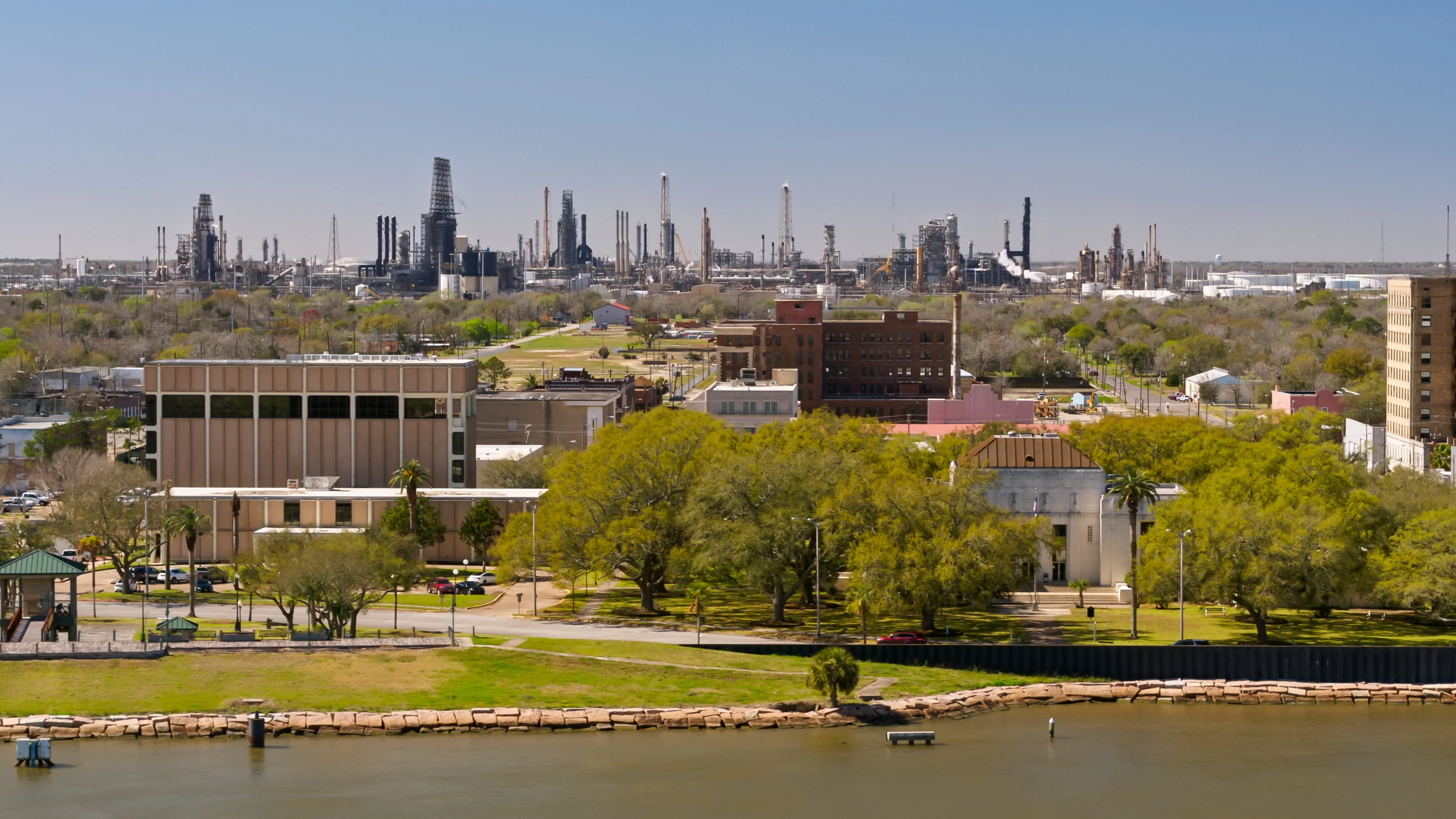
Port Arthur sits at the tip of the Golden Triangle, wedged between Sabine Lake, the Gulf Coast humidity, and one of the heaviest concentrations of petrochemical refining capacity in North America. That industrial identity — Motiva, Valero, TotalEnergies, Chevron Phillips — is the single biggest factor shaping who lives here, what they earn, and what it costs to stay. If you've been priced out of other Texas metros or you're relocating for refinery work, the numbers here will genuinely surprise you in the right direction.
Port Arthur's overall cost of living runs roughly 12–14% below the national average, making it one of the more affordable mid-sized cities in Southeast Texas. The median household income of $46,354 sits modestly below the state norm, but at these price levels, that income stretches further than it would in Houston, Beaumont, or virtually anywhere on the Texas coast. The city of 55,804 people isn't growing the way Austin or Dallas suburbs are, and that restraint shows up directly in what buyers and renters pay.
The honest trade-off here is structural: Port Arthur delivers genuinely low housing costs and a below-average overall price level, but utility bills — especially summer electricity — run above the national baseline. The Gulf Coast climate is real. From May through October, air conditioning isn't optional, and bills reflect that. Water costs also moved upward after the City Council approved a rate increase in late 2025. So the savings are real, but they come with a seasonal asterisk on the utility line.
Whether you're weighing a move here or comparing Port Arthur against Groves, Nederland, or Port Neches, the sections below break down housing costs, rent figures, everyday expenses, how this city stacks up against its neighbors, and what the Texas tax structure means for your bottom line.
What It Really Costs to Live in Port Arthur
The clearest way to understand Port Arthur's cost posture is this: multiple independent cost-of-living indices place it at roughly 86.5% of the national average. Housing drives that number almost entirely. When you strip housing out, the rest of the city's costs — groceries, transportation, everyday goods — track closer to the national norm, with utilities running modestly above it.
Compared to the Texas metros most people benchmark against, Port Arthur is noticeably cheaper. Houston's market runs well above this city's price level, and even Beaumont — just about 25 minutes up the highway — carries higher typical home prices. The cities buyers most often compare Port Arthur to directly are its immediate neighbors: Nederland, Groves, and Port Neches, all of which come in noticeably higher on typical home price. For a buyer who wants to stay in Jefferson County and keep costs down, Port Arthur is generally the entry point.
What drives affordability here isn't some suburban growth story — it's the city's older housing stock, its industrial rather than residential identity, and decades of population stability rather than the rapid appreciation pressure that reshapes coastal Texas markets. That makes Port Arthur genuinely affordable in a way that tends to hold, rather than the brief affordability window that closes when a market heats up. For the full picture on how neighborhoods within the city differ in character and housing type, see the best neighborhoods guide.
Housing: Rent vs Buy in Port Arthur
The typical home price in Port Arthur is $125,021 (Zillow Home Value Index, July 2026). That figure places Port Arthur among the most affordable ownership markets not just in Southeast Texas, but in the state. Entry-level homes — older construction, smaller footprints — start well below the city-wide figure, putting ownership within reach for buyers who might be locked out of almost any other Texas metro.
The effective property tax rate is approximately 1.57%, which is worth understanding clearly. Texas has no state income tax, so property taxes carry more of the government-services load than in most states. At Port Arthur's price levels, that rate is manageable in absolute terms — and owners who file for the homestead exemption through the Jefferson County Appraisal District can reduce their taxable assessed value, which is worth doing as soon as you close. The engine's mortgage calculator below will let you run current-rate payment estimates against the actual home price; the figures will be more accurate than any estimate written into this article.
The city-wide typical rent is $1,270 per month (Zillow Rent Index, July 2026). That figure makes the rent-vs-buy math genuinely interesting here: at Port Arthur's price levels, the monthly cost of ownership at current rates can compare favorably to renting, which is not a common condition in most Texas markets right now. Renting still makes sense if you're uncertain about the region, new to a refinery contract position, or want flexibility while you learn the different parts of the city. But for anyone planning a stay of more than two or three years, the ownership math is worth running. The median household income here is at or above the income needed to qualify for the typical home price, which is a meaningful affordability signal — it means Port Arthur isn't a market where locals are priced out of their own city.
One practical note: buyers who want the lowest entry price will find it in the city's older residential areas rather than in the newer pockets closer to the western boundaries. For specifics on which neighborhoods fit which buyer profile, the neighborhoods guide covers that in detail.

Everyday Costs Beyond Housing in Port Arthur
| Category | Typical Monthly Cost | Notes |
|---|---|---|
| Housing (typical rent) | $1,270/mo | City-wide typical rent. Buying? Use the calculator above for a mortgage estimate. |
| Utilities | $170–$260/mo | Electricity, gas, water, sewer, trash |
| Groceries | $520–$700/mo | Food at home, household of 2–3 |
| Transportation & Gas | $160–$280/mo | Fuel, and transit where it is a real option |
| Phone & Internet | $110–$185/mo | Mobile plan plus home broadband |
| Misc / Discretionary | $200–$420/mo | Dining out, entertainment, subscriptions |
Non-housing figures are estimates for a household of two to three, not a sourced index; housing is the city-wide typical rent (Zillow ZORI, July 2026). Refreshed with the rest of the city data.
Port Arthur's location on the Gulf Coast is the defining factor for non-housing costs. The climate — humid subtropical, with summers that stretch from May well into October — means air conditioning runs hard and long. Port Arthur is served by Entergy Texas, a regulated utility, which means residents cannot shop among competing retail electric providers the way Texans in deregulated markets can. Electricity costs run above the national average, and summer bills spike considerably as cooling demand takes over for months at a stretch. The utilities cost index for the city sits around 110 against a national baseline of 100, so budget for above-average energy costs even in a year when electricity prices hold steady.
Water bills also moved up after the City Council approved a 20% rate increase effective October 1, 2025 — a change that adds to a typical household's monthly costs at average usage. On the grocery side, Port Arthur actually runs slightly below the national average, with a grocery cost index near 96. Transportation costs are below average as well: the city sits at the convergence of US-69, US-96, US-287, TX-87, TX-73, TX-82, and TX-347, giving drivers straightforward highway access to regional employers, and most commutes within the Golden Triangle don't require the long drives that inflate transportation budgets in sprawling metros. Port Arthur Transit operates fixed-route bus service and demand-response options for those who prefer not to drive, though the car-dependent reality of Southeast Texas means most households budget for at least one vehicle.
Looking to buy in Port Arthur? Estimate your payment.
Enter your numbers to see an estimated monthly mortgage payment.
Estimate only. Excludes HOA fees and mortgage insurance. The interest rate above is a starting point, not a quoted rate — replace it with your own to see real numbers. Insurance is a flat placeholder, not a Port Arthur quote.
Port Arthur vs Nearby Cities: How the Costs Compare
| City | Typical Home Price | Typical Rent | Cost vs Port Arthur |
|---|---|---|---|
| Port Arthur (this city) | $125,021 | $1,270/mo | — |
| Nederland | $195,000 | $1,350/mo | 56% higher |
| Groves | $163,000 | $1,250/mo | 30% higher |
| Port Neches | $247,291 | $1,388/mo | 98% higher |
Source — home prices: Zillow ZHVI, July 2026; rent: Zillow ZORI, July 2026. Nearby-city figures are the same series, refreshed together.
Port Arthur consistently comes in as the most affordable ownership option among its immediate Golden Triangle neighbors. Nederland, Groves, and Port Neches all carry noticeably higher typical home prices — the gap is meaningful enough that buyers who have flexibility on which city they land in often end up in Port Arthur precisely because the entry price is lower by a real margin, not a rounding difference.
Beaumont runs higher still on typical home price, and Houston is in a different category entirely — well above anything in the Golden Triangle on both home price and rent. What that means practically is that Port Arthur's affordability isn't just a local story. It holds up even when you zoom out to the broader Southeast Texas region.
The rent comparison follows a similar pattern. Port Arthur's city-wide typical rent is among the lowest in the immediate area, which matters for households that aren't ready to buy or are working through a contract employment situation. This page shows a full side-by-side comparison with current figures under the nearby cities section of this page — that table pulls directly from refreshed data and will reflect the most current numbers.
The one honest caveat in any Port Arthur vs. neighbor comparison: lower housing costs come alongside a utility cost structure that runs above average. A household that saves substantially on a mortgage or rent relative to Nederland or Groves will still face the same Gulf Coast summer cooling bills that everyone in this region deals with. The net savings are real, but they're not the full spread between the two home prices.
Taxes & the Bottom Line for Port Arthur
Texas has no personal state income tax — zero percent, for all income types and all income levels, including wages, retirement distributions, and Social Security. That's a meaningful advantage for anyone relocating from a state with a meaningful income tax rate, and it's part of why the overall cost picture in Southeast Texas looks different from what many out-of-state buyers expect.
The sales tax structure in Texas starts at a 6.25% state base rate, with local additions pushing the combined rate up to a maximum of 8.25% depending on where you're buying. Most purchases in Port Arthur will hit close to the combined cap, which is standard across urban and suburban Texas. Sales tax applies to most goods but not to most groceries, which moderates the impact for everyday household spending.
Property taxes carry more weight in Texas than in most states — they're how the state funds schools, city services, and county government without an income tax. The effective rate in Port Arthur is approximately 1.57%. At the home-price levels described earlier in this guide, that rate is workable, and the homestead exemption through the Jefferson County Appraisal District is the first thing a new owner should file for. It reduces the taxable assessed value on a primary residence and is not automatic — you have to apply.
The honest bottom line on Port Arthur: this is a city whose cost structure works best for households that value low ownership costs and a reasonable commute to industrial employment, and who are prepared for above-average utility bills during a long Gulf Coast summer. Buyers coming from high-cost metros will find the housing price almost disorienting — in a good way. Households that want a walkable, amenity-dense urban experience or are drawn primarily by job diversity may find the trade-offs harder to absorb. But for working families anchored to the refining economy, or anyone whose budget requires a low entry point into Texas homeownership, the numbers in Port Arthur are genuinely hard to beat in this region. For a closer look at how Port Arthur fits different life stages, the retiring guide covers the retiree budget angle, and the first-time homebuyer guide walks through the buying process step by step.

Local Expert Takeaway: Port Arthur's cost of living is real affordability, not a rounding error. The typical home price of $125,021 (July 2026) puts ownership within reach of a household earning the local median — a condition you won't find in Nederland, Groves, or Port Neches, all of which run noticeably higher. The catch is the utility bill: Entergy Texas serves this regulated market, summer cooling runs from May through October, and there's no rate-shopping option. Budget for energy costs that track above the national average every summer, factor in the 2025 water rate increase, and the picture becomes honest rather than just cheap.
Quick Takeaways & FAQs
✅ Port Arthur's typical home price of $125,021 (July 2026) makes it the most affordable ownership market among its immediate Golden Triangle neighbors — and one of the lowest entry points into Texas homeownership anywhere on the Gulf Coast.
⚠️ Utility bills run above the national average thanks to a long Gulf Coast summer cooling season and a regulated electricity market where you cannot shop competing providers — budget for meaningful summer spikes.
📍 Texas charges zero state income tax, but the effective property tax rate of approximately 1.57% means owners should file immediately for the homestead exemption through the Jefferson County Appraisal District to reduce their taxable assessed value.
Is Port Arthur, TX affordable compared to the rest of Texas?
What are utility costs like in Port Arthur?
What is the property tax rate in Port Arthur, Texas?
Is it cheaper to rent or buy in Port Arthur?
Does Texas's no-income-tax policy benefit Port Arthur residents?
Moving to Texas?
Tell us what you need help with and we'll connect you with local resources.
