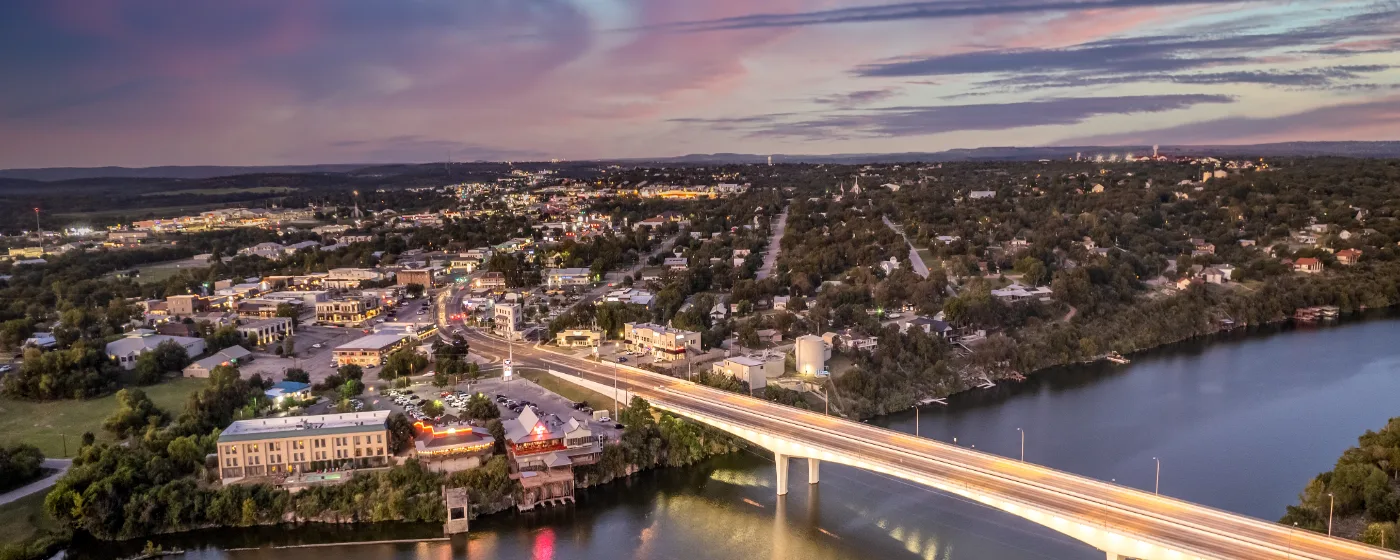
Most people who retire to the Texas Hill Country have done the math on Austin — and flinched. Marble Falls is what happens when you want the lakes, the limestone ridgelines, and the warm winters without paying the capital-city premium. At a typical home price of $403,309 (Zillow ZHVI, July 2026) and a population of 9,633, it is small enough to feel like a town and large enough to have a real hospital inside city limits. That combination is rare at this price point in Central Texas, and it explains why so many retirees from Dallas, Houston, and the coasts keep landing here.
The economic backbone of Marble Falls is modest and deliberately so. Baylor Scott & White Medical Center – Marble Falls is both the city's most consequential employer and its most reassuring amenity for anyone over 60. The Marble Falls Independent School District anchors the community calendar even for residents without grandchildren enrolled — Friday night football at Mustang Stadium is genuinely a civic event. The city sits at the junction of US-281 and TX-71, which means Austin is about 55 minutes away on a good day, an important reality for anyone who needs specialist care or simply wants a major airport within reach of Austin-Bergstrom International Airport (AUS), 54 miles out.
Texas's tax posture is the other reason retirees keep showing up. No state income tax means Social Security, pensions, and IRA withdrawals stay whole. The effective property tax rate of approximately 1.30% is real and worth budgeting carefully — this is not a low-tax state on property — but the senior exemptions and school-tax freeze that apply at age 65 change the picture meaningfully for long-term owners. Daily costs on a fixed income are manageable: groceries, dining, and gas run close to the Texas average, and the Hill Country's outdoor amenities — the Highland Lakes, the trails, the cedar-scented air — cost nothing.
Whether you are weighing Marble Falls against Burnet, Horseshoe Bay, or somewhere entirely outside the Hill Country, the sections below break down the healthcare access, the retiree budget math, the walkability reality, downsizing options, and an honest comparison with the towns most often on the same shortlist.

Why Retirees Are Choosing Marble Falls
The case for Marble Falls in retirement starts with what it has that most comparably priced small Texas towns do not: a full-service hospital on the city's own footprint. For retirees, that distinction is not a minor amenity — it is often the deciding factor between staying in a place long-term and eventually being forced to move closer to care. Marble Falls clears that bar, and the price of entry is well below what a lakefront town with this level of medical access would cost almost anywhere else in Texas.
The fit is best for retirees who genuinely want small-town life — not as a trade-off, but as the actual goal. Historic Downtown Main Street has the kind of walkable, unhurried character that brings people back from the farmer's market to the coffee shop to the gallery in a single morning without getting back in the car. Lake Marble Falls is downtown, not a drive away. The pace is slow in the way that requires intentional slowing down, not in the way that signals neglect.
The honest limits are real too. Marble Falls is a city of 9,633, and that number defines what it can and cannot offer. Performing arts, a wide range of specialty dining, or the kind of urban stimulation that some retirees need to stay engaged — those require a drive. Anyone who moved from a city expecting the Hill Country to eventually develop into one will be disappointed. The typical home price of $403,309 (Zillow ZHVI, July 2026) also means the median household income of $57,925 does not stretch comfortably to buy here without a meaningful down payment or equity from a prior home — see the full cost-of-living breakdown for context on what a fixed-income budget actually covers.
Healthcare & Medical Access in Marble Falls
Baylor Scott & White Medical Center – Marble Falls is the anchor of the city's healthcare picture, and it sits within city limits — not in the next county, not a thirty-minute drive down US-281. That matters enormously for older adults whose calculus about where to live is inseparable from how quickly they can reach emergency care. The hospital runs a 24-hour emergency room alongside a Heart and Vascular Institute, a NeuroHealth Institute, cancer care, orthopedics, urology, and wound care — a breadth of service that most towns this size cannot sustain.
The same campus also includes a specialty clinic with a broad specialist bench for a city this size. Cardiovascular disease, orthopedic surgery, internal medicine, and neurology are among the services available. Urgent care is available seven days a week, which matters on a Sunday afternoon when a visit to an ER feels like overkill. The outpatient rehabilitation center on the same campus handles physical, occupational and hand, and speech therapy — practical for anyone managing a hip replacement recovery or age-related musculoskeletal issues without wanting to drive to Austin for every appointment.
The honest caveat is what is not here. Marble Falls does not have a major academic medical center, a Level I trauma center, or the subspecialty depth you would find at a large urban system. Complex oncology, advanced cardiac intervention, or rare neurological conditions will require going to Austin — about 55 minutes away — or to San Antonio, farther still. For most routine and semi-complex care, the Baylor Scott & White campus handles it well. For the highest-acuity situations, you need to have a plan and a driver.
Austin-Bergstrom International Airport (AUS) is 54 miles out, which becomes relevant if travel for specialized medical care at a major academic health center is ever on the table. That kind of contingency planning is worth doing before you move, not after.
The Retiree Budget in Marble Falls
Texas has no state income tax, and that is not a talking point — it is constitutionally protected. Social Security benefits, pension payments, 401(k) and IRA withdrawals, and investment income all arrive in Marble Falls without a state tax haircut. For retirees drawing from multiple income streams, the savings over a decade can be substantial compared with states that tax retirement income at even a modest rate.
On property taxes, the picture is more nuanced. The effective rate runs approximately 1.30%, which on a $403,309 home is a real annual line item. The more important number for retirees is what happens at age 65: Texas homeowners who qualify for the over-65 homestead exemption get their school-district taxable value frozen — it cannot increase as long as they remain in the home. Texas voters also approved Proposition 13 in November 2025, raising the standard school-district homestead exemption to $140,000. Combined with the additional senior exemption, qualifying homeowners aged 65 and older could shelter up to $200,000 of their home's value from school-district taxes. For a home priced near the city median, that exemption structure can eliminate the school-district portion of the tax bill entirely. Verify the current exemption amounts with the Burnet County Appraisal District before making financial decisions — this is fast-moving legislation and the details matter.
Texas also passed a 2025 constitutional amendment prohibiting estate, inheritance, and gift taxes, which matters for retirees thinking about asset transfer to heirs. Combined with no income tax, the state's overall tax posture for retirees is among the more favorable in the country — even accounting for property taxes that run higher than the national average.
Day-to-day costs on a fixed income in Marble Falls are manageable without being cheap. Groceries and dining run close to the Texas average. The Hill Country's outdoor offerings — boating on Lake Lyndon B. Johnson, fishing, hiking near Inks Lake State Park — add quality of life without adding to the monthly budget. Where costs creep up is in the car-dependency outside downtown: fuel and vehicle maintenance are real line items here in a way they would not be in a walkable urban neighborhood. The engine's mortgage calculator below gives a starting point for housing costs at current rates.
Looking to buy in Marble Falls? Estimate your payment.
Enter your numbers to see an estimated monthly mortgage payment.
Estimate only. Excludes HOA fees and mortgage insurance. The interest rate above is a starting point, not a quoted rate — replace it with your own to see real numbers. Insurance is a flat placeholder, not a Marble Falls quote.
Walkability, Community & Staying Active in Marble Falls
The Walkability Reality
Historic Downtown Main Street is genuinely walkable — independent shops, a handful of well-regarded restaurants, coffee spots, and galleries within a few blocks of each other and of Lake Marble Falls. For retirees who settle near or in the downtown core, a morning that includes coffee, errands, lunch, and a lakeside walk without touching a car is a realistic daily routine, not an aspirational one.
Outside the downtown core, the picture changes. The city's own 2024 comprehensive plan acknowledges that expanded pedestrian connections to grocery stores and parks are a goal, not yet a reality for most of the city's footprint. Neighborhoods like Gregg Ranch, Thunder Rock, and Flatrock Crossing are suburban in character — comfortable, but car-dependent for anything beyond a walk around the block. Retirees who prioritize errands on foot should weight their neighborhood choice accordingly and look closely at the neighborhood breakdown before deciding where to land.
The terrain is worth knowing: this is Hill Country, which means limestone rises and drops are part of the landscape. The area around the lake and downtown is relatively flat and accessible. Some of the newer residential developments sit on more varied ground, which matters if mobility is a consideration now or might be in coming years.
Community and Active Life
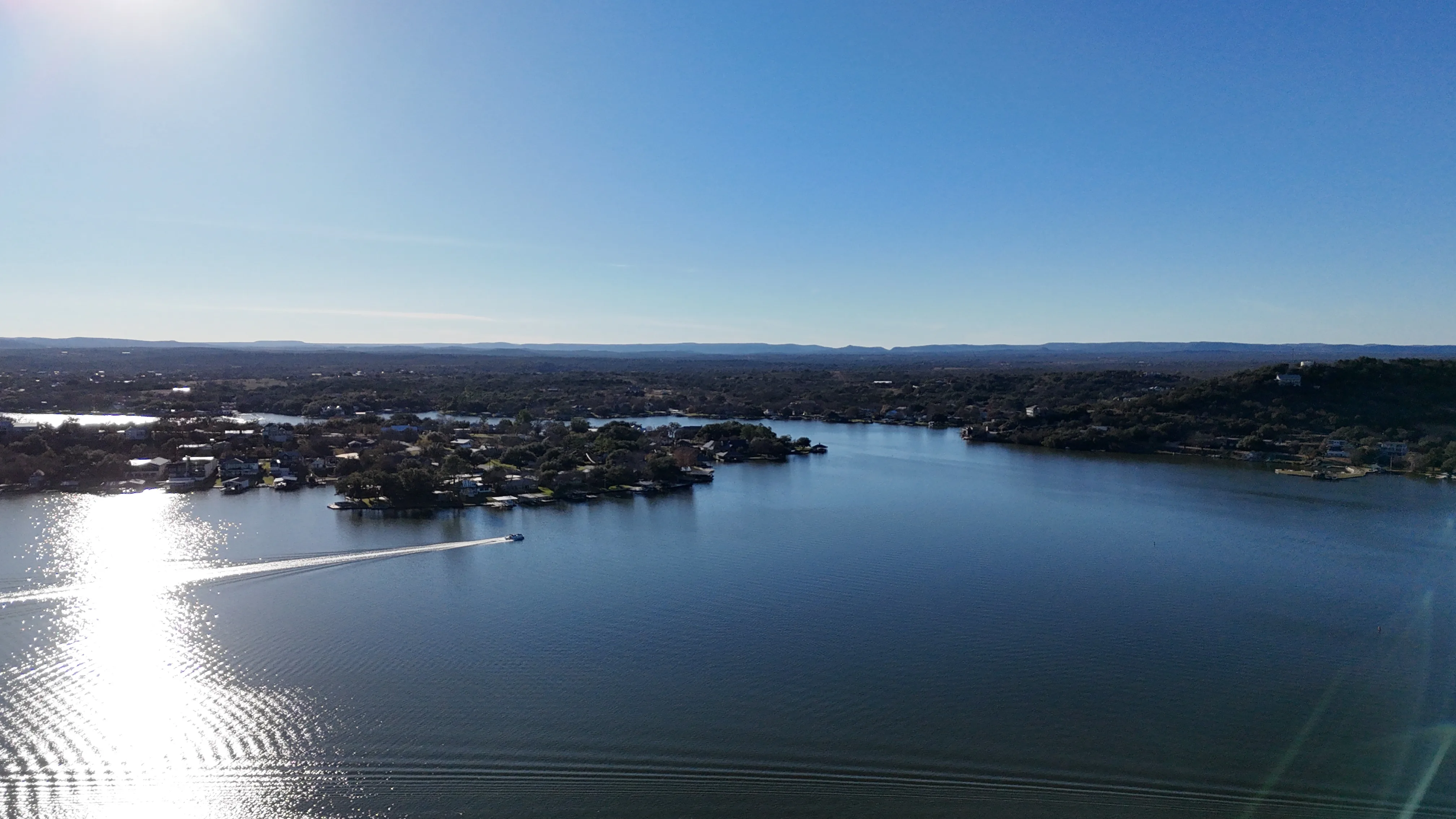
For a city of 9,633, Marble Falls punches above its weight on community texture. Johnson Park and Camp Creek Park anchor the outdoor social life, and the Highland Lakes chain — Lake Marble Falls and Lake Lyndon B. Johnson — means boating and fishing are genuinely woven into daily life for residents who want them, not just weekend visitors.
Civic clubs, church communities, and volunteer networks are the connective tissue of social life here in the way they are in most small Texas towns — and that tends to work well for retirees who show up ready to participate. The Marble Falls Area Chamber of Commerce and the city's parks programming provide organized entry points. The Falls on the Colorado Museum offers both a cultural anchor and a place where volunteers are genuinely welcomed. For retirees accustomed to a dense calendar of ticketed cultural events, the honest answer is that most of that programming requires a drive to Austin — about 55 minutes away — or to the Highland Lakes area resort communities nearby.
Right-Sizing: Downsizing in Marble Falls
No 55+ communities were found in Marble Falls. That is the short answer, and it is an honest one. Retirees who want a purpose-built active-adult community with a clubhouse, pickleball courts, and a social director built into the HOA will need to look at neighboring communities or widen the search radius.
What Marble Falls does have is a more varied housing stock than many Hill Country towns its size. The city's 2024 comprehensive plan documents a 2022 mix of roughly half single-family detached homes, about a third multifamily, and meaningful shares of duplexes and single-family attached homes. That last category — townhomes, cottages, attached units — is exactly what many downsizing retirees are looking for: less square footage, less maintenance, single-level living without the isolation of a large lot. The city's own zoning permits these forms in and around the downtown core, which is also where walkability is strongest.
Single-level homes exist throughout the city but require deliberate searching. Much of the newer construction in developments like Gregg Ranch and Legacy Crossing skews toward two-story floor plans. Buyers specifically seeking single-level living should filter for it early — it is available, but it is not the default in most new construction here.
For retirees who need care rather than independence, assisted living and memory care are available in Marble Falls. Gateway Villas and Gateway Gardens, a Discovery Senior Living campus, and Arbor House Marble Falls are among the local options. Assisted living here runs in line with Texas averages — not cheap, but not an outlier either — and memory care is among the larger line items to plan for in any long-range budget. These are not 55+ communities; they are care facilities, and that distinction matters for planning purposes.
The neighborhood guide has more detail on which areas skew toward the housing types that suit right-sizing buyers.
Marble Falls vs Nearby Retirement Destinations
| City | Cost vs Marble Falls | Primary Hospital | Walkability | Senior Living Depth | Overall Retirement Fit |
|---|---|---|---|---|---|
| Marble Falls | Anchor | Baylor Scott & White Medical Center – in-city, full service | Downtown core walkable; car needed elsewhere | Assisted living available; no 55+ communities found | Strong for active, outdoors-oriented retirees |
| Horseshoe Bay | Noticeably higher | Relies on Marble Falls BSW for acute care | Very limited; resort-community layout | Some resort-style senior options; no dedicated 55+ campus found | Best for affluent retirees prioritizing lake and golf lifestyle |
| Burnet | About the same | Regional hospital nearby; less comprehensive than BSW Marble Falls | Small walkable downtown; car needed for most errands | Limited senior-specific inventory | Quieter pace; good value but less medical infrastructure |
| Granite Shoals | Somewhat lower | Relies on Marble Falls BSW for acute care | Minimal; residential in character | Very limited | Entry-level lakeside living; best as a budget option near Marble Falls services |
| Kingsland | About the same | Relies on Marble Falls BSW or regional hospital for acute care | Minimal walkable infrastructure | Limited | Lakefront character appeals; healthcare access requires planning |
| Georgetown | Pricier | Larger regional health system closer to Austin | Stronger; genuine walkable square and mixed-use development | Sun City Texas is the region's largest 55+ community | Best for retirees who want a purpose-built active-adult community |
The clearest alternative for retirees who want a dedicated 55+ lifestyle is Georgetown, where Sun City Texas offers the full active-adult campus experience — but at a noticeably higher price point and without the Hill Country lake character that draws most people to Marble Falls in the first place.
Burnet is the closest competitor on price and feel, but its medical infrastructure is thinner. Granite Shoals is genuinely less expensive and sits right on the lake, but it outsources nearly all its services — including acute care — to Marble Falls, which makes it a reasonable choice only if you are comfortable with that dependency.
Horseshoe Bay appeals to a different buyer: the resort-community lifestyle, the golf, and the higher-end real estate are the draw, and retirees there also lean on the Baylor Scott & White campus in Marble Falls for serious care. For most retirees balancing cost, healthcare access, and genuine small-town community, Marble Falls sits at a more practical intersection than any of its immediate neighbors.
Local Expert Takeaway: Marble Falls is genuinely one of the better-positioned small Texas cities for retirement — not because it has everything, but because it has the one thing most comparable towns lack: a full-service hospital inside city limits. Baylor Scott & White Medical Center handles most of what retirees need day-to-day, from cardiology to rehab. The Texas tax structure — no income tax, the over-65 school-tax freeze, and now expanded homestead exemptions for seniors — meaningfully improves the fixed-income math for long-term owners. The catch is that no 55+ communities exist here, so retirees who want a purpose-built active-adult campus need to look at Georgetown or beyond. If you can live without that infrastructure and want a lakeside downtown you can actually walk, Marble Falls rewards the trade-off.
Quick Takeaways & FAQs
✅ Baylor Scott & White Medical Center sits inside Marble Falls city limits, making it one of the few small Hill Country towns with genuine acute-care access for retirees.
⚠️ No 55+ communities were found in Marble Falls — retirees who want a purpose-built active-adult campus will need to look at Georgetown or other nearby cities.
📍 Texas's over-65 homestead exemption freezes school-district taxes for qualifying seniors; verify current amounts with the Burnet County Appraisal District before buying.
Is Marble Falls a good place to retire?
What hospital serves retirees in Marble Falls?
Does Texas freeze property taxes for seniors in Marble Falls?
Are there 55+ or active-adult communities in Marble Falls?
How walkable is Marble Falls for retirees?
Moving to Texas?
Tell us what you need help with and we'll connect you with local resources.
