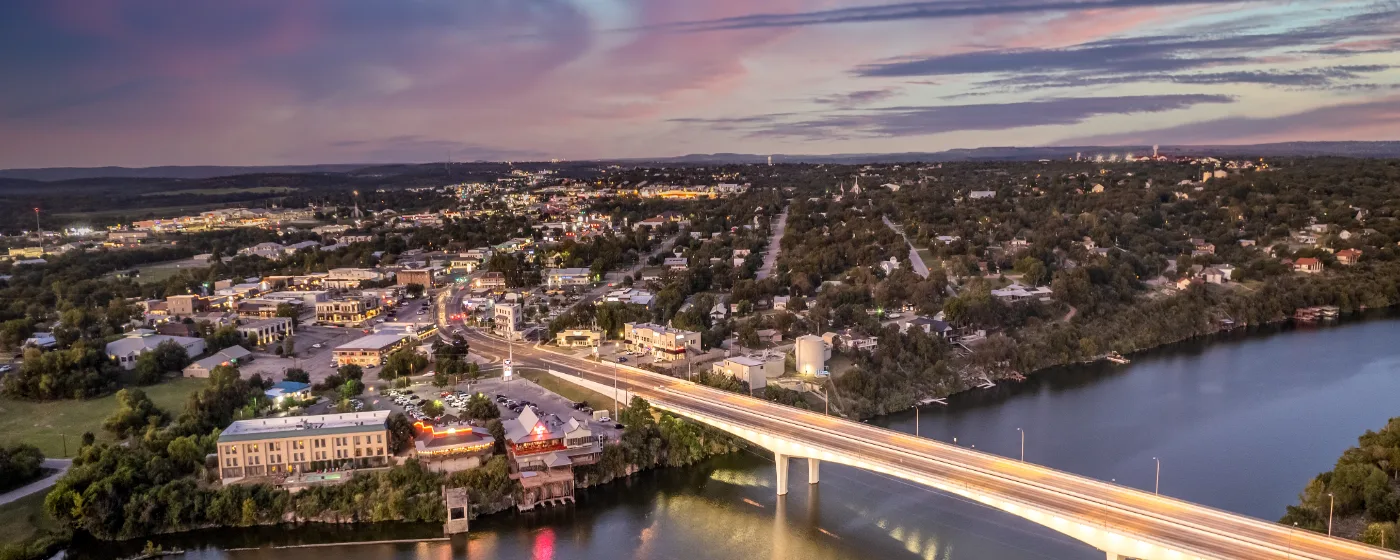
Most Californians who end up in Marble Falls didn't plan on a city this small. They ran the numbers on Austin, maybe drove through the Hill Country on a weekend trip, and kept thinking about the lake. Marble Falls sits on the Highland Lakes chain of the Colorado River, about 55 minutes from Austin, and it operates on a scale that genuinely surprises people: a population of 9,633, a downtown you can walk end to end in ten minutes, and a pace of life that has very little in common with anywhere in coastal California. The city's off-highway position — served by US-281, TX-71, FM-1431, and FM-2147 — keeps the through-traffic character of a larger corridor town from taking over. That geography is a big part of why people stay.
The economic comparison between what you're leaving and what you're arriving at is sharp and cuts in both directions. The income-tax picture alone is a reason Californians keep shortlisting Texas: California's top state income tax rate of 13.3% has no equivalent in Texas, where the state constitution prohibits income tax entirely. Against that, Marble Falls carries a 1.30% effective property tax rate — nearly double California's effective property tax rate of 0.71%, which has been held artificially low by Proposition 13 since 1978. Neither state taxes groceries. Gas is meaningfully cheaper in Texas. The overall picture is genuinely favorable for most California households making the move, but the property tax jump surprises buyers who only looked at the headline income-tax comparison.
The home price shift is the main event. The typical Marble Falls home was priced at $403,309 as of July 2026 (Zillow Home Value Index), well below California's statewide typical home value of $773,735 (Zillow Home Value Index). That gap funds a lot of life decisions — a larger lot, a boat slip, a shorter mortgage. The honest counterpoint is that Marble Falls's median household income of $57,925 is below what it takes to comfortably carry the typical home here, so the affordability math that looks obvious from California isn't friction-free once you're living it. If your California income travels with you — remote work, a pension, equity from a sale — the numbers tilt strongly in your favor. For full details on the cost-of-living breakdown, see the cost of living in Marble Falls page.
Whether you're doing preliminary research or ready to make a decision, the sections below break down the home price and tax comparison in detail, what the lifestyle shift actually looks like, what Californians consistently get wrong about this move, the local culture and community texture, and the practical questions worth answering before you commit.

The Home Price Comparison: What Your California Equity Actually Buys Here
California's statewide typical home value of $773,735 is the number Marble Falls is competing with — and at a typical price of $403,309 (July 2026), the gap is substantial. For a buyer converting California equity into a Hill Country purchase, that difference can mean buying outright, buying without a mortgage, or simply banking the remainder. Those scenarios are common enough here that the real estate market has absorbed a wave of California cash buyers over the past several years.
What that price point gets you in Marble Falls is categorically different from California in ways beyond square footage. Master-planned communities like Gregg Ranch and Thunder Rock offer newer construction with Hill Country views, larger lots, and amenities that would carry a significant premium in any California market. Neighborhoods like Flatrock Crossing and Legacy Crossing have attracted buyers who want newer builds at prices that felt unimaginable back home. Older stock in Old Town and the Historic Downtown Main Street corridor tends to sit at the lower end of the market. For a detailed look at what each area offers, the Marble Falls neighborhoods guide covers them in full.
One thing the comparison table cannot capture: Marble Falls's affordability is relative. The median household income here is meaningfully below what a buyer would need to purchase the typical home without straining. If your California income relocates with you — remote work, consulting, Social Security, or a pension — you are in a structurally different position than a buyer dependent on local wages. That distinction matters when you're evaluating how sustainable the cost picture is after the move.
The rental market is expanding. As of late 2024, more than 1,600 apartment and multi-family units were under development, which signals that the city is adding capacity for the people who want to try Marble Falls before buying. The typical rent citywide was $1,551 per month as of July 2026 (Zillow Observed Rent Index) — a figure most Californians read twice before believing.
| Metric | Marble Falls, TX | California (Statewide) |
|---|---|---|
| Typical home value | $403,309 (Zillow ZHVI, July 2026) | $773,735 (Zillow ZHVI) |
| State income tax | None (constitutionally prohibited) | Top rate 13.3% |
| Effective property tax rate | 1.30% | 0.71% |
| State sales tax base rate | 6.25% (capped combined at 8.25%) | 7.25% statewide base |
| Grocery sales tax | None | None |
| Typical citywide rent | $1,551/mo (Zillow ZORI, July 2026) | Noticeably higher statewide |
* ZHVI = Zillow Home Value Index. ZORI = Zillow Observed Rent Index.
The sales tax comparison is close enough that it rarely drives decisions, but the gasoline tax gap does add up: Texas levies roughly 20 cents per gallon versus California's roughly 53.9 cents, and in a city where every errand involves a drive, that difference shows up in real numbers over a year.
The Tax Picture: Where Texas Gives and Where It Takes Back
The headline everyone leads with is correct: Texas has no state income tax, and California's top state income tax rate of 13.3% applies to the highest earners under the California Franchise Tax Board's bracket structure. But the more useful number for most relocating households is what happens at ordinary income levels. A single filer earning $100,000 in California pays roughly $5,000 to $5,200 in state income tax after the standard deduction. In Texas, that bill is zero. That savings exists at every income level, not just at the top of the bracket.
Property tax is where Texas collects what the income tax does not. Marble Falls's effective rate of 1.30% is nearly double California's effective property tax rate of 0.71%. California's rate has been compressed by Proposition 13's assessment limits for decades — a California homeowner who bought in 2005 is taxed on a fraction of today's market value. Texas has no equivalent cap. Your assessed value in Marble Falls tracks market value, and the bill reflects it. On a home at the typical price, the annual property tax is a real line item in your budget, not an afterthought.
The net result for most California movers is still strongly positive — the income-tax savings tend to outpace the property-tax increase for anyone earning above the local median. But the math is most favorable if your income travels with you. A retiree living on a fixed California pension or Social Security, or a remote worker whose salary does not reset to Texas wages, captures the full income-tax benefit against a property-tax rate that is higher but applied to a much lower purchase price.
Sales Tax: Closer Than You Think
California's statewide base sales tax rate of 7.25% is the highest state-level rate in the country, per the Tax Foundation, and local add-ons push the average above that. Texas's base rate is 6.25%, with a combined state-and-local cap of 8.25%. The practical difference in everyday purchasing is modest. Neither state taxes groceries, so that line item is neutral in the comparison.
The Bottom Line
Californians who do well in this comparison are those whose income does not reset downward when they move. If your paycheck, pension, or investment income stays at California levels while your housing cost drops and your income-tax bill disappears, Marble Falls is an objectively better financial position. If you're moving and also taking a local job at Marble Falls wages, the arithmetic is tighter and worth modeling carefully before you close.
What the Lifestyle Shift Actually Looks Like
Marble Falls is a city of 9,633 people. If you are coming from any part of coastal California — the Bay Area, Los Angeles, San Diego, Sacramento — that number is not an abstraction. It means one grocery store anchors the weekly run. It means the nearest commercial airport is about 54 miles away. It means a serious shopping trip means driving out of town. People who have done this move describe the first six months as a recalibration of what "convenient" means.
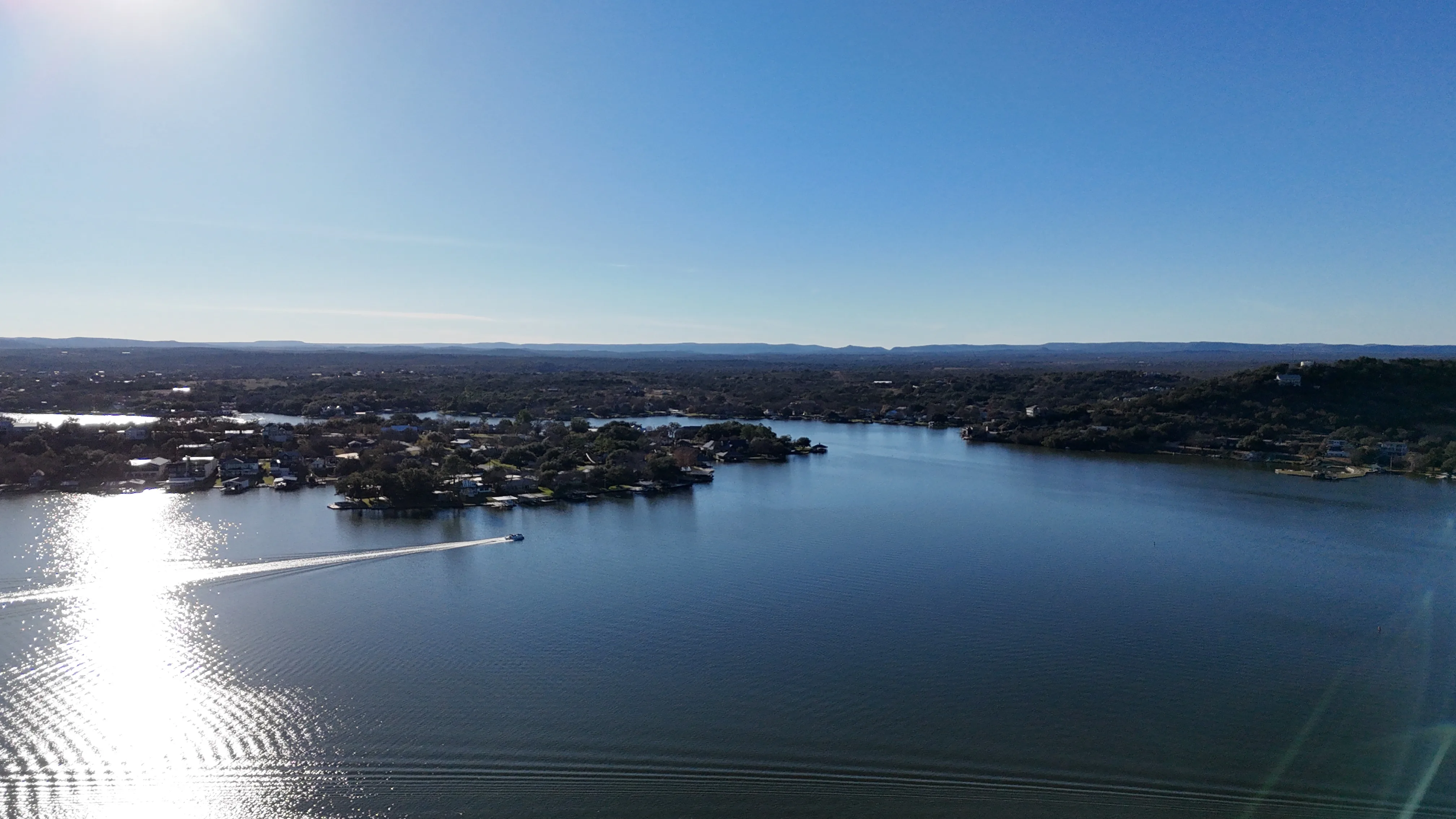
The lake changes the quality-of-life calculation significantly. Lake Marble Falls and Lake LBJ give residents something that most Texas cities of this size do not have: water. Johnson Park and Camp Creek Park provide everyday outdoor access without requiring a drive to state land. For Californians who built their identity around outdoor access — trails, water, open space — this is the feature that makes Marble Falls different from a random small Texas town. The Highland Lakes chain is the largest lake chain in Texas on the Colorado River, and it runs right through the city's front yard.
What Surprises People After Six Months
The heat is the thing nobody fully prepares for. Marble Falls averages 226 sunny days a year, and a significant portion of those days involve temperatures that make outdoor activity a morning-only proposition from June through early September. Californians from the Bay Area, accustomed to summers that rarely exceed 75 degrees, find the adjustment more significant than expected. This is not a dealbreaker for most people — it's an adjustment — but it changes how you use the outdoor amenities that drew you here in the first place.
The other surprise is how quickly the community feels like community. Marble Falls is growing fast — the Census Bureau documented a population jump of nearly 24% in a single year between 2023 and 2024 — but the city's position off the main I-35 corridor has helped it avoid the anonymous sprawl character of faster-growing Texas suburbs. The Historic Downtown Main Street, the Old Highway 281 Bridge over the Colorado, and the Falls on the Colorado Museum give the city a sense of place that newer Texas suburbs often lack.
The Auto-Dependence Reality
Marble Falls is a car city. Its 2024 comprehensive plan acknowledges this directly and calls for better pedestrian connectivity, but the infrastructure today requires a vehicle for essentially every errand. Californians from walkable urban neighborhoods — parts of San Francisco, Silver Lake, Pasadena — will feel this most acutely. Residents who work locally average about a 15-minute commute. Those commuting to Austin face a drive of about 55 minutes on a typical day, which is manageable a few times a week but significant as a daily habit. Health insurance premiums generally run noticeably below what California residents are used to paying, though you will drive farther for specialist care than you would in a major California metro.
Looking to buy in Marble Falls? Estimate your payment.
Enter your numbers to see an estimated monthly mortgage payment.
Estimate only. Excludes HOA fees and mortgage insurance. The interest rate above is a starting point, not a quoted rate — replace it with your own to see real numbers. Insurance is a flat placeholder, not a Marble Falls quote.
What Californians Get Wrong About This Move
The most consistent mistake is treating the home price gap as pure savings. The sticker difference between California's statewide typical home value of $773,735 and Marble Falls's $403,309 (July 2026) is real, but the property tax rate, the auto costs in a car-dependent city, and the reduced income ceiling for local jobs all need to factor into what the move actually saves. Buyers who ran the numbers only on purchase price and income tax and skipped the property tax math have had an unpleasant first escrow closing.
The second mistake is underestimating how different the school district picture is. Marble Falls ISD holds a C rating, according to the Texas Education Agency, and on 2024-25 state assessments, 33% of students reached math proficiency and 45% reached reading proficiency. For families leaving high-performing California districts, particularly in wealthier suburban markets, this is a meaningful difference. The district has active UIL athletics programs and the community culture around Friday night football is genuinely strong — but academic performance metrics should not be assumed to transfer. The full picture is on the Marble Falls schools page.
Why People Move Back Out
The most common reasons Marble Falls doesn't stick for California transplants are specific and honest: the heat from June through September limits outdoor life in ways that erode the lake-and-trails appeal that drove the move; the distance from Austin becomes a friction point for anyone who needs frequent access to urban services, a major airport, or a dense professional network; and the size of the city — genuinely small, not Texas-suburb small — eventually conflicts with expectations shaped by years of living somewhere larger. None of these are surprises if you've spent real time here before buying. They are surprises if you moved on the strength of one or two visits during October or March, which is when the Hill Country is at its most persuasive.
What You Would Not Do
Moving here without a test period is the clearest risk. The city has rental inventory — and more coming — which makes a 6-to-12-month rental before buying a real option rather than a theoretical one. The neighborhoods that look quietest on a map are worth experiencing across seasons. Lydia Parke and Homestead at Mormon Mill, for example, feel genuinely removed from the commercial spine, and whether that distance reads as peace or isolation depends entirely on the household. Renting in the area you plan to buy is the single most useful thing a California transplant can do before committing.
Weekends and Local Favorites: What the Community Actually Looks Like
Marble Falls punches above its population of 9,633 in the density of its food and coffee scene, largely because it serves as the commercial hub for Burnet County and draws weekend traffic from Horseshoe Bay and the surrounding lake communities. The result is a dining and coffee culture that would be unremarkable in a California coastal town but is genuinely surprising in a Hill Country city this size.
The Blue Bonnet Cafe is the long-standing anchor of the local breakfast scene, the kind of institution that appears in conversations about Marble Falls regardless of what you originally asked. River City Grille covers the lakeside casual end of the dining spectrum. The Real New Orleans Style Restaurant brings a flavor profile that is decidedly not Hill Country Texas, and it has a following for exactly that reason. Bella Sera Marble Falls handles the occasions that call for something more deliberate, and Jardin Corona Marble Falls fills the everyday Mexican food role that is a functional necessity in any Texas community.
The coffee situation is more developed than most California transplants expect. Mojo Coffee Marble Falls and Numinous Coffee Roasters serve the specialty-coffee end of the market. HTeaO handles the Texas-specific tea culture that Californians encounter for the first time here. Lost Roads Baking Co. is worth knowing about for pastry and bread. The Ragtime Oriole rounds out the independent café options for people who want a place to work or read without a chain soundtrack behind them.
The outdoor calendar is genuinely central to social life here. Lake Marble Falls and Lake LBJ anchor the warm-weather routine for a large share of residents, with Johnson Park and Camp Creek Park handling the land-based version of that impulse. The Falls on the Colorado Museum and Historic Downtown Main Street give the city a cultural reference point that is rooted in the Colorado River's history rather than imported from Austin. For people moving from California, the absence of a large urban arts and entertainment infrastructure is real — but the outdoor and community-scale social life that fills that gap is also real, and it works for the households that came here specifically for it.
The growth is visible and ongoing. New residential development is evident on the approaches from Austin — master-planned communities, townhomes, new commercial. Marble Falls is not frozen in amber. The question for a California buyer is whether the pace of change is adding the amenities they want, or eroding the small-town character that drew them in the first place. That answer varies by neighborhood and, more honestly, by temperament.
Local Expert Takeaway: The California-to-Marble-Falls move works best for households whose income travels with them. The income-tax savings are real, the home price gap is real, and the lake access is real — but the property tax rate is nearly double what Californians are used to paying, the school district's performance metrics are significantly below what most California suburban districts post, and the city's size (9,633 people) is not a rounding error. Spend a week here in July, not March, before you sign anything. If the heat is manageable and the scale suits you, the financial case is hard to argue with.
Quick Takeaways & FAQs
✅ Texas has no state income tax, and at typical California income levels that represents thousands of dollars per year that simply don't leave your paycheck — one of the clearest financial benefits of the move.
⚠️ Marble Falls's effective property tax rate of 1.30% is nearly double California's effective rate of 0.71%, and unlike California's Proposition 13, Texas assessments track market value — a real budget line that surprises buyers who only looked at the income-tax headline.
📍 The city's population jumped nearly 24% in a single census year, which means new construction is visible everywhere — but the Blue Bonnet Cafe, the lake, and the Historic Downtown Main Street remain the anchors that tell you this is still a specific place with its own identity.
How much cheaper are homes in Marble Falls compared to California?
Do I really pay zero state income tax in Texas?
How far is Marble Falls from Austin, and is the commute realistic?
How are the schools in Marble Falls compared to California?
What do Californians most commonly regret about moving to Marble Falls?
Moving to Texas?
Tell us what you need help with and we'll connect you with local resources.
