What Is Living in San Angelo, Texas Like?
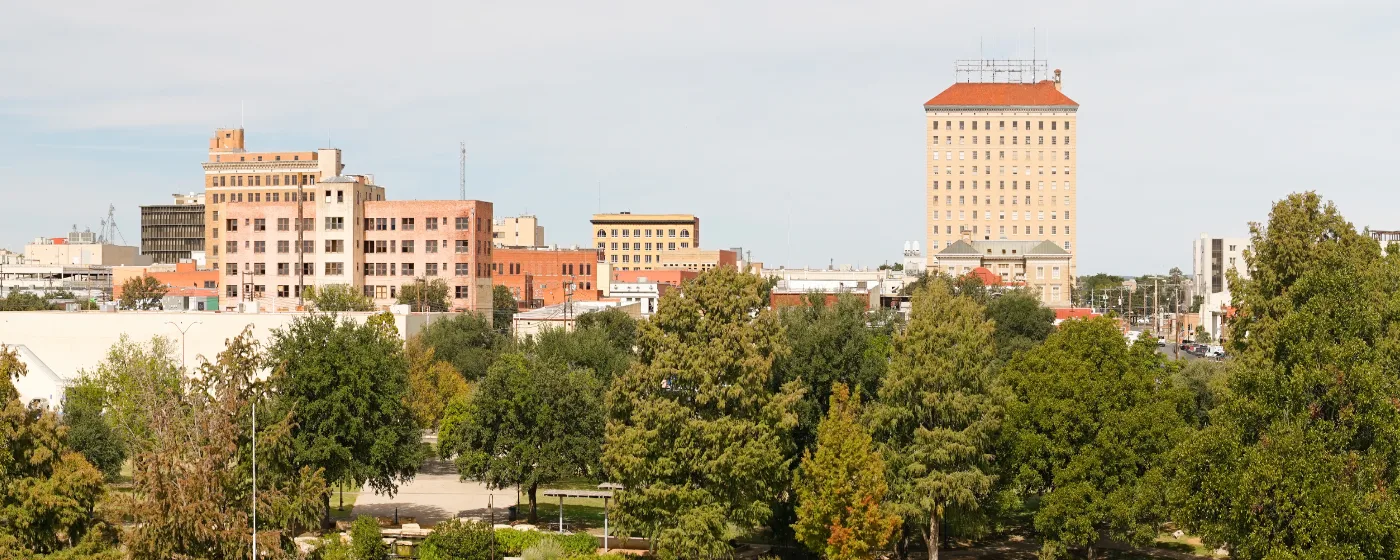
Most people moving to San Angelo from out of state expect a small, dusty West Texas outpost. What they find instead is a city of 100,640 with a legitimate arts scene, a 4-mile river walk recognized nationally for its design, and a cost of living that undercuts the U.S. average in ways that take a few paychecks to fully appreciate. San Angelo sits at 1,900 feet in Tom Green County, geographically suspended between the Texas Hill Country and the Rolling Plains, with US-87, US-277, and the Houston Harte Expressway (US-67) stitching it into the broader region. It is not a suburb of anything — the nearest major metro is about 90 minutes to Midland-Odessa, TX — and that self-contained quality is precisely what draws people once they understand it.
The economic spine of San Angelo is military and medical. Goodfellow Air Force Base — home of the 17th Training Wing, specializing in intelligence, surveillance, reconnaissance, and fire-protection training — is one of the city's defining institutions, graduating trainees from every branch of the U.S. military, and the base supports more than a thousand direct and indirect jobs across the region. Alongside the base, the healthcare sector is the top employment category in the city, with a major regional health system anchoring the medical community. Angelo State University keeps the population young — the median age is 35.5 — and the San Angelo Independent School District, with 12,507 students enrolled in 2025-26, is among the largest civic employers. Ethicon Inc. brings medical device manufacturing into the mix, rounding out a local job market that is more diversified than its geography might suggest.
Housing here is genuinely affordable relative to what most relocating buyers are leaving behind. The typical home price is $214,811 (Zillow Home Value Index, July 2026), and the median household income of $65,864 is at or above what it takes to buy at that level — a combination that is increasingly rare in Texas. Day-to-day costs run well below the national average across groceries, utilities, and housing, which is a meaningful quality-of-life factor for anyone moving from a coastal market or even from Dallas or Austin. The Concho River Walk, San Angelo State Park's 7,677 acres, and Lake Nasworthy give outdoor life real texture without requiring a long drive. The city has more than 250 sunny days a year, and low afternoon humidity keeps even the summer heat more bearable than the thermometer suggests.
Whether you are being relocated to Goodfellow, drawn by affordable homeownership, or simply priced out of larger Texas cities and looking for somewhere with actual character, the sections below break down San Angelo's neighborhoods, cost of living, schools, local favorites, commute patterns, and what daily life here is really like.
San Angelo at a Glance
Looking to buy in San Angelo? Estimate your payment.
Enter your numbers to see an estimated monthly mortgage payment.
Estimate only. Excludes HOA fees and mortgage insurance. The interest rate above is a starting point, not a quoted rate — replace it with your own to see real numbers. Insurance is a flat placeholder, not a San Angelo quote.
Why Are People Moving to San Angelo?
The case for San Angelo is easy to make. Affordable homes, a stable job market anchored by federal military spending, a surprisingly active arts and outdoor scene, and a commute that averages around 14 to 15 minutes door to door. The case against it is shorter but worth reading: it is genuinely remote, the school district holds a C rating, according to the Texas Education Agency, and anyone accustomed to big-city retail and dining density will need time to recalibrate expectations.
The Military Engine
Goodfellow Air Force Base is the single largest driver of population stability in San Angelo. The 17th Training Wing graduates trainees from every branch of the U.S. military and supports a significant number of direct and indirect jobs across the region. For the city, that means a steady stream of incoming families, a rental market with consistent demand, and a local economy that does not rise and fall with oil prices the way much of West Texas does.
The flip side is real: military families rotate in and out on predictable cycles, which shapes the social fabric of certain neighborhoods. Longtime residents tend to cluster in the more established parts of the city; newer arrivals often land near the base or in areas with higher rental supply.
Healthcare and Higher Education
A major regional health system is among the largest private employers in San Angelo. Angelo State University — a Texas Tech University System school — brings a large student population into the city and contributes to a research, education, and athletics community that keeps the city from feeling purely transient. Ethicon Inc., a Johnson & Johnson subsidiary focused on medical device manufacturing, adds a private-sector layer that most cities this size don't have.
Who Actually Moves Here
| Buyer Type | What Draws Them | Best For |
|---|---|---|
| Military families | Proximity to Goodfellow AFB, strong rental supply | Families Commuter |
| First-time buyers | Typical home price well below Texas averages | First-Time Value |
| Remote workers | Low cost of living, outdoor access, no commute pressure | Nature Value |
| Healthcare professionals | Demand for medical staff, affordable lifestyle | Commuter Value |
| Retirees from coastal cities | Home prices far below what they're leaving, slower pace | Quiet Value |
| Angelo State University faculty and staff | Campus proximity, stable employment, walkable areas nearby | School Walkable |
The city has a violent crime rate of 2.18 per 1,000 residents, which reassures buyers who run the numbers before visiting. A property crime rate of 24.86 per 1,000 residents runs above both state and national benchmarks — something worth understanding by neighborhood before you commit. The safety page breaks this down in more geographic detail.
What Daily Life Feels Like in San Angelo
After six months, the thing newcomers most often say they didn't expect is how much there is to do within the city limits. San Angelo is the Visual Arts Capital of Texas — a designation that sounds like a chamber of commerce invention until you walk Paintbrush Alley, see the murals threading through the historic core, or visit the San Angelo Museum of Fine Arts on the riverbank. Fort Concho National Historic Landmark, with 23 original and restored structures dating to 1867, anchors the south end of the city and draws enough traffic to matter as a cultural anchor, not just a historical footnote.
The River as a Living Room
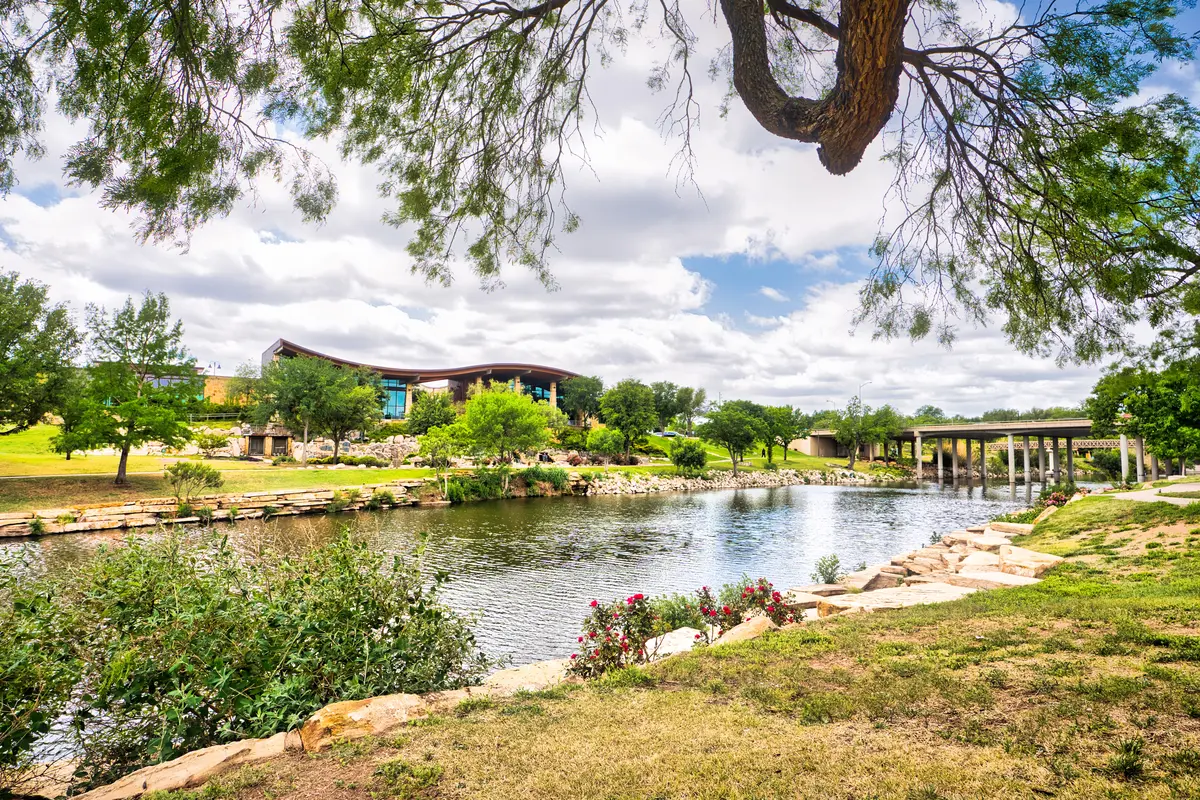
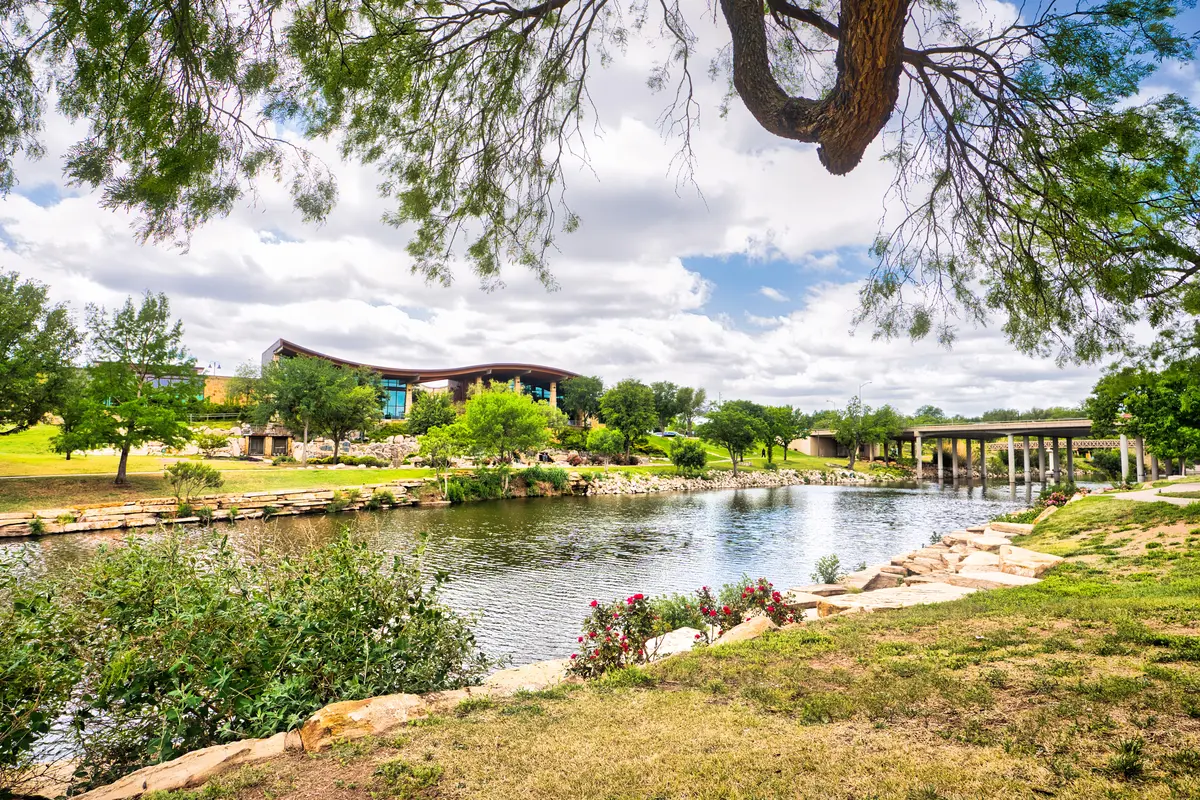
The Concho River Walk is 4 miles of path that the American Planning Association named one of its Great Places in America. It is not a tourist attraction in the Riverwalk-San Antonio sense — it is where people run, walk dogs, meet after work, and gather for the annual River Fest. The Celebration Bridge connects the two banks and is one of the more photographed spots in the city, particularly at dusk. This is genuinely where the city gathers on a weekday evening.
What You Give Up
San Angelo is not walkable in the way a dense city is. About 88% of residents drive to work, and most daily errands — grocery runs, hardware store, a serious shopping trip — require getting in a car. The downtown and river corridor work reasonably well on foot once you're in them, but most of the city is laid out for driving. A serious shopping run beyond what local stores carry means driving out of town.
Winters here are mild by national standards but still include occasional hard freezes — the February 2021 storm hit San Angelo hard, and longtime residents keep generators and water supplies as a matter of habit now. Summer temperatures regularly reach triple digits, though the low afternoon humidity (averaging 44%) and 1,900-foot elevation make it more livable than Houston or Dallas at the same temperature. The 250 sunny days a year is real, not marketing.
The Wool and Rodeo Heritage
San Angelo was built on wool and mohair — it was once one of the largest wool markets in the world — and that heritage is still visible in the livestock shows, the annual stock show and rodeo, and the social calendar that fills around agriculture. This is a place where UIL athletics matter at a community level and where Friday night football fills the stands at the high school level. If that culture is unfamiliar, it takes some getting used to. If it's your background, it feels like landing somewhere that hasn't erased itself to appeal to newcomers.
The San Angelo Housing Market Right Now
The typical home price in San Angelo is $214,811 (Zillow Home Value Index, July 2026). For context, that figure sits well below most Texas metros and dramatically below major coastal markets. The median household income here is aligned with what it actually takes to carry a home at that price — a combination the cost-of-living page breaks down in full.
The city's effective property tax rate of approximately 1.20% is relevant to the monthly cost calculation, even if the base price feels manageable. Texas has no state income tax, which offsets the property tax burden for most buyers — but the rate is worth factoring in explicitly when comparing San Angelo to states that do tax income.
What the Market Looks Like by Area
The Bluffs and Southland carry home prices above the city median, reflecting newer construction and established residential character. Lake View and the east side of the city offer entry points below the median — useful for first-time buyers or anyone stretching a budget. Santa Rita and the College Hills area near Angelo State University tend to sit right at the median. The neighborhoods page explains what each of these areas actually feels like to live in, which matters as much as the price tier.
Typical city-wide rent runs $1,332 per month (Zillow ZORI, July 2026), reflecting steady demand from the military and university populations. Some parts of the city carry higher rental supply than others, particularly in areas where Goodfellow-affiliated families concentrate. The rental and ownership picture together paint a city where buying is accessible for a wide range of incomes — not just those at the top of the local wage scale.
One honest note for buyers moving from a larger market: well-priced homes at this price point move. San Angelo is not a slow, sleepy market where you can take three months to decide. That said, the city does not have the frenzied multiple-offer conditions that defined Texas metros in 2021 and 2022 — there is room to be thoughtful without losing every property you look at.
San Angelo Neighborhoods
San Angelo has several distinct areas — each with its own character and appeal. Here’s a breakdown to help you narrow down where to focus your home search.
🏡 Lake View
Lake View sits on the north side of San Angelo and offers a mix of modest single-family homes and established streets that suit buyers looking for an affordable entry into the city. The area has a settled, residential feel with easy access to Loop 306 for cross-town errands.
🏠 Santa Rita
Santa Rita is one of the city's more centrally situated neighborhoods, with a mix of mid-century and more recent construction that puts it right at the city-wide price level. It suits buyers who want a convenient location without paying a premium for newer development.
🌳 College Hills (ASU–College Hills)
The College Hills area wraps around Angelo State University and draws faculty, staff, and families who want to be within reach of campus life. The housing stock is a mix of older established homes and some rental-heavy blocks, with a walkable pocket near the university itself.
🏘 Bentwood
Bentwood is an established residential area known for its mature trees and larger lots, appealing to buyers who want more space and a quieter setting within the city. It has a neighborhood association feel and attracts families and longtime San Angelo residents.
🏔 The Bluffs
The Bluffs carries home prices above the city median and is known for newer construction and elevated views that give it a distinct character from the city's older residential areas. It attracts buyers looking for move-in-ready homes with contemporary finishes.
🌆 Southland
Southland is one of San Angelo's more established higher-tier areas, with a mix of well-maintained single-family homes on generous lots. It suits buyers who want a quieter, residential feel with proximity to the south side's amenities and shorter drives to key employers.
Pros & Cons of Living in San Angelo
The Pros
- Affordable cost of living relative to national averages
- Stable job base anchored by Goodfellow AFB and healthcare
- Abundant sunshine and river/lake recreation
- Strong small-town community feel
The Cons
- Very hot, sunny summers with intense heat
- Higher property crime rate than national average
- Relatively isolated, with long drives to major metro areas
Getting Around & Commuting in San Angelo
The commute situation in San Angelo is one of its least-discussed advantages. The average one-way commute runs approximately 14 to 15 minutes, which puts it well below the national average and well below what most people moving from a Texas metro are used to. The city covers 58.61 square miles, and because most major employers — Goodfellow AFB, the regional health system, Angelo State University, the school district, the city itself — are distributed across it rather than concentrated in one corridor, traffic rarely stacks up the way it does in larger cities.
The Road Network
Loop 306 is the outer loop that most residents use to cross town efficiently. The Houston Harte Expressway (US-67) cuts through the city and is the main route for those heading east. US-87 and US-277 carry the north-south and regional traffic. For daily errands, most San Angelo residents learn within a few weeks which combination of these routes gets them to work and back in under 20 minutes.
There is no regional rail or light rail serving San Angelo. Driving is how the city works — roughly 88% of residents commute by car, and about 3.4% walk, which is notable for a Texas city of this size and reflects the walkable pockets near Angelo State and the river district.
Regional Travel
San Angelo Regional Airport (SJT) is 8 miles from the city center and handles regional connections. The drive to Midland-Odessa is about 90 minutes — the nearest larger market for specialty medical care, larger retail, or connecting through a busier airport. Abilene is a comparable drive to the northeast. Most San Angelo residents plan one or two regional trips per month and consider it a normal feature of West Texas life rather than an inconvenience.
Who This Commute Profile Suits
| Situation | How San Angelo Works |
|---|---|
| Goodfellow AFB assignment | Base is within the city; most personnel live 10–15 minutes away |
| Healthcare sector | Medical campus is centrally located; cross-town drives are short |
| Angelo State University | Campus sits in the College Hills area; surrounding neighborhoods are accessible on foot or by short drive |
| Remote workers | No commute pressure; city size means errands are fast |
| Midland-Odessa commuters | About 90 minutes each way; not a practical daily commute — most who work there relocate closer |
| Retirees | Short drives to medical, shopping, and recreation; low traffic stress |
The catch for anyone considering San Angelo as a base for frequent regional work travel: commercial flight options at SJT are limited, and most departures require connections. Buyers who fly regularly for work weigh this carefully.
Schools in San Angelo
Families relocating to San Angelo have public, private, and higher-education options nearby. Here’s a quick overview.
🎓 School District
San Angelo Independent School District serves K–12 students across San Angelo and the surrounding area. Rated C (source: Texas Education Agency, 2025 A-F accountability rating (2024-25 school year)).
🏆 Graduation Rate
The 4-year high-school graduation rate here is approximately 91%.
📚 Higher Education
Texas’s public universities — the University of Texas at Austin, Texas A&M University, and the University of Houston — offer four-year degrees statewide, with one of the largest community college systems in the country (50+ public community college districts) providing two-year and workforce programs.
🌐 Online Learning
UT Austin Online and Texas A&M University Online offer fully accredited online degrees for remote learners across the state.
Safety in San Angelo
A quick look at how San Angelo compares on the numbers that matter most when weighing a neighborhood or a move.
🛡 Violent Crime
Approximately 2.18 per 1,000 residents.
🔒 Property Crime
Approximately 24.86 per 1,000 residents.
Compared to the most recent national figures from the Bureau of Justice Statistics (2024), San Angelo’s violent crime is below the national average (about 3.7 per 1,000), and property crime is above the national average (about 18.4 per 1,000).
Against Texas as a whole, San Angelo’s violent crime is roughly half the state average, and property crime is somewhat above the state average (Bureau of Justice Statistics, Crime Known to Law Enforcement, 2024 (tables 2 and 3)).
Crime rates can vary a lot within a single city, so the citywide numbers above are only a starting point. Some neighborhoods in San Angelo run well below these averages, while others run higher — the kind of block-by-block detail that matters most when you’re actually choosing where to live. The full guide below breaks it down neighborhood by neighborhood.
Working in San Angelo
San Angelo’s largest employers span several industries — here are some of the anchors of the local job market.
🏛 Goodfellow Air Force Base
Military
🏥 Shannon Health
Healthcare
🎓 San Angelo Independent School District
Education
🎓 Angelo State University
Higher education
🏛 City of San Angelo
Municipal government
🏥 Ethicon Inc.
Medical device manufacturing
Parks & Recreation in San Angelo
Some of the outdoor spaces that shape everyday life in San Angelo.
🌱 Concho River Walk
🌱 San Angelo State Park
San Angelo residents don’t have to go far for green space — spots like Concho River Walk and San Angelo State Park are part of everyday life here, whether that’s a morning walk, a weekend hike, or just somewhere to unwind outside. The full guide below covers more of what San Angelo has to offer for parks and outdoor recreation.
Retiring in San Angelo
San Angelo draws retirees for its balance of amenities, outdoor access, and cost. Here’s what to weigh.
🌤 Climate
San Angelo averages 64.9°F annually with more than 250 sunny days a year. Summers reach triple digits but afternoon humidity averages just 44%, which takes the edge off considerably. Winters are mild most years, though hard freezes do occur and residents prepare accordingly.
🍴 Lifestyle
The Concho River Walk, San Angelo State Park, and the San Angelo Museum of Fine Arts give retirees a daily texture that goes well beyond what most cities this size offer. A working arts community, a weekly farmers market, and a historic downtown with independent dining options mean there is consistent programming without having to drive far for it.
🏚 55+ Communities
No 55+ communities were found in San Angelo. Retirees here typically buy in established neighborhoods like Southland or the Lake Nasworthy area, where single-level homes and proximity to medical services make the most practical sense.
✈ Getting Around
A car is necessary for daily life in San Angelo, but the reward is a city where most drives take under 15 minutes. San Angelo Regional Airport (SJT) is 8 miles from the city center and handles regional connections for longer travel. Medical care is accessible within the city limits through the regional health system.
🏛 Texas Taxes for Retirees — What to Know
- No state income tax — Texas has no personal income tax — constitutionally protected under Article VIII, Section 24. Social Security, pensions, 401(k)/IRA withdrawals, and annuity payments are all untaxed at the state level, with no state return to file.
- Sales tax is the tradeoff — The state sales tax is 6.25%, and local add-ons bring the combined rate in San Angelo to 8.25% (Texas Comptroller of Public Accounts, city sales and use tax rates, July 2026). Groceries and prescription drugs are exempt.
- Property taxes — the real tradeoff — Texas’s effective property tax rate averages about 1.40%, among the highest in the country, since property tax (not income tax) funds most local government and schools.
- Over-65 homestead exemption and school-tax freeze — Homeowners 65+ (or disabled) get an additional $60,000 exemption from their home’s value for school district taxes, on top of the general homestead exemption — $200,000 off school taxable value combined, following November 2025’s Proposition 11 (SB 23), which raised the over-65 exemption to $60,000, and Proposition 13 (SB 4), which raised the general homestead exemption to $140,000. Once claimed, your school district tax bill is frozen at that year’s amount and cannot increase as home values rise, and the ceiling can transfer if you move to a new home within Texas.
- Deferral option if cash is tight — Homeowners 65+ can defer property tax payment entirely for as long as they live in the home, rather than paying it currently — interest accrues, but no forced sale.
- No estate or inheritance tax — Texas has no estate tax, no inheritance tax, and no gift tax.
- No separate capital gains tax — Because Texas has no state income tax, capital gains — including on investments and home sales — are not taxed at the state level at all, unlike states such as Washington that tax capital gains separately from income.
Tax laws change frequently and individual situations vary. This is general information, not tax advice — always consult a qualified Texas tax professional or CPA for personalized retirement tax planning.
Weekends & Local Favorites in San Angelo
San Angelo's weekend life is anchored by water, art, and the outdoors — in a part of Texas where those three things coexist in the same city, that combination is genuinely unusual. The Concho River Walk draws walkers and cyclists on most mornings, and the International Waterlily Collection near the river is one of the few places in the world where you can see this many species in one spot — an oddly spectacular detail for a West Texas city.
Outdoor Life
San Angelo State Park stretches across 7,677 acres along O.C. Fisher Reservoir and draws a consistent crowd of hikers, mountain bikers, and anglers throughout the year. The trails through the park include some of the better mountain biking terrain in the region, and the reservoir gives the park a lakeside character that the surrounding landscape doesn't. Lake Nasworthy, closer to the city's edge, is where locals go for fishing, paddleboarding, and summer afternoons. Spring Creek Park ties the south side of the city to the trail network. The combination of these places means a Saturday in San Angelo has genuine outdoor options without a long drive.
Arts and Culture
The San Angelo Museum of Fine Arts sits on the riverbank and punches above its weight for a city this size. Fort Concho National Historic Landmark is not just a preserved site — it hosts living history events and festivals that draw the city together seasonally. The Chicken Farm Art Center is a working art colony in repurposed farm buildings, and Paintbrush Alley runs through a stretch of the city where murals and gallery studios sit side by side. For a city of 100,640, the arts infrastructure here is substantive.
Food, Coffee, and the Farmers Market
The food scene is modest by Austin or Dallas standards but has genuine anchors worth knowing. Twisted Root Burger Co. is a reliable Texas-regional chain stop. The Original Henry's and Angry Cactus represent the local end of the casual dining scene. Cork & Pig Tavern is the go-to for a more relaxed evening out, and Western Sky Steakhouse handles the traditional West Texas steakhouse expectation. On the coffee side, Buttercup all day café, The Bearded Barista Coffee & Stuff, The Grind Coffee & Cafe, Free Rein Coffee - San Angelo, and Elohim Grounds collectively give the city an independent coffee culture that feels real rather than manufactured. The San Angelo Farmers Market is where locals pick up produce and connect with the agricultural community that still defines this part of Texas.
What surprises people after a year here is not that they found something to do — it's that they stopped having to work to find it. The city's social life is compact enough that you run into the same people at the river walk, the farmers market, and the art openings, and that familiarity starts to feel like exactly what they moved here for.
Local favorites in San Angelo
Restaurants
- Twisted Root Burger Co.
- The Original Henry's
- Angry Cactus
- Cork & Pig Tavern
- Western Sky Steakhouse
Outdoors
- Concho River Walk
- Lake Nasworthy
- San Angelo State Park
- International Waterlily Collection
- Spring Creek Park
Coffee
- Buttercup all day cafe´
- The Bearded Barista Coffee & Stuff
- The Grind Coffee & Cafe
- Free Rein Coffee - San Angelo
- Elohim Grounds
Farmers Markets
- San Angelo Farmers Market
Top Things Locals Say About San Angelo
The best intel about a city comes from the people who actually live there. Here’s what San Angelo residents say when newcomers ask the questions everyone’s thinking.
“I kept waiting for the novelty to wear off, but it didn't. I can get anywhere in town in under 15 minutes, I bought a house I actually own at a price that would be laughable back home, and the river walk on a weeknight is legitimately one of the nicer things I've done in a city this size.”
— Recent San Angelo home buyer
“What's the most surprising thing about living in San Angelo?”
The arts scene catches most people off guard. San Angelo is the Visual Arts Capital of Texas, and once you've spent a weekend walking Paintbrush Alley, visiting the museum on the river, and catching something at Fort Concho, you stop thinking of it as a West Texas oil-and-cattle town. That, and how fast you can get anywhere — the commute numbers are real, and you feel them immediately.
“What do locals love most about San Angelo?”
The Concho River Walk is the honest answer. It's not a tourist attraction — it's where people run in the morning, meet after work, and gather for River Fest. Lake Nasworthy on a summer weekend feels like the whole city migrates there. And the pace of the place: it has real amenities without the density and cost that usually comes with them.
“What should newcomers to San Angelo know?”
February can surprise you. The 2021 winter storm hit San Angelo hard, and locals have learned to keep supplies on hand. Summer triple-digit days are real, but the low humidity makes them more tolerable than the temperature suggests — most people adjust faster than they expect. And Loop 306 is your friend for getting across town without touching the slower surface streets.
“How much do you need a car in San Angelo?”
A car is essential for nearly all of daily life in San Angelo. Most errands — grocery runs, getting to work, picking up kids — require driving. The exception is the river corridor and the area around Angelo State, where some things are genuinely accessible on foot. About 3.4% of residents walk to work, which is higher than most Texas cities of this size, but that reflects a small walkable pocket rather than the city overall.
Cities Near San Angelo
Other communities near San Angelo worth a look — each with its own character and price point.
| City | Distance | Best For | Vibe | Median Rent | Median Buy |
|---|---|---|---|---|---|
| Christoval | 16 mi | Rural acreage, privacy seekers | Small, quiet, river country | $1,000 | $260,000 |
| Wall | 12 mi | Families, top-rated rural schools | Tight-knit, agricultural, spacious | $1,050 | $275,000 |
| Mertzon | 25 mi | Remote living, ranching lifestyle | Very small, unhurried, West Texas | $950 | $220,000 |
More Helpful Guides for San Angelo
Going deeper on San Angelo? Our blog series covers everything from first-time buying to retiring here — explore the guides below.
Local Expert Takeaway: San Angelo is a city where the numbers make sense in a way they haven't in most of Texas for years — a typical home at $214,811 (July 2026), a commute under 15 minutes, and a job market anchored by Goodfellow AFB and a major regional health system that doesn't depend on a single industry. The trade-off is real: you are genuinely far from a major metro, the school district holds a C rating according to the Texas Education Agency, and daily life requires a car for almost everything. But the Concho River Walk, the arts community, Lake Nasworthy, and San Angelo State Park give the city a livability that its price tag doesn't fully advertise. Buyers who visit once expecting a sleepy oil-country town tend to recalibrate quickly.
Quick Takeaways & FAQs
✅ San Angelo's typical home price of $214,811 (July 2026) is one of the most accessible entry points of any Texas city above 100,000 people.
⚠️ The San Angelo ISD holds a C rating according to the Texas Education Agency — a real consideration for families with school-age children who are weighing the move.
📍 Goodfellow Air Force Base is the city's economic anchor, which means steady population and rental demand — and a social fabric shaped by military rotation cycles.
Is San Angelo a good place to live?
What is the cost of living in San Angelo, TX?
How is the job market in San Angelo?
What are the best neighborhoods in San Angelo?
How far is San Angelo from major Texas cities?
Helpful Links for Moving to San Angelo
Moving to Texas?
Tell us what you need help with and we'll connect you with local resources.
