You've done the math, and it probably shocked you. A home in Allen, Texas — a well-ranked suburb in the Dallas-Fort Worth Metroplex with a highly rated school district and a population of 113,447 — typically costs a fraction of what you'd pay in coastal California. The city sits in Collin County, one of the fastest-growing counties in the country, connected to Dallas by US-75 and within reach of the broader metro via SH-121 (Sam Rayburn Tollway). What drives people here isn't just the price gap; it's the combination of a professional-class community, top-tier public schools, and a tax structure that puts thousands of dollars back in your pocket every year.
Allen Independent School District holds an A rating, according to the Texas Education Agency, with 20,117 students enrolled in 2025-26. More than 60% of Allen's adult residents hold a bachelor's degree or higher, which tells you something about who moves here: engineers, finance professionals, tech workers, and families making deliberate, spreadsheet-driven decisions. Major employers include Experian and the city itself, and residents within commuting range of Plano benefit from JPMorgan Chase's large presence there. The community has the feel of a place where people planned to stay — well-maintained subdivisions, active youth sports programs, and a Friday night football culture that Californians sometimes find genuinely surprising.
Allen's overall cost of living sits roughly 6% below the national average. Groceries run about 10% cheaper than the national average, and entertainment and personal services run about 16% cheaper — though utilities run roughly 20% above the national average, a detail worth building into your budget before you sign anything. The city-wide typical rent stands at $1,703/mo (Zillow ZORI, July 2026), and the typical home price is $493,450 as of July 2026 — a number that will register as almost implausibly low if you're coming from a Bay Area or Southern California market. The full cost-of-living breakdown has the detailed figures.
Whether you're being relocated by your employer, priced out of your current market, or simply recalculating where your dollar goes farthest, this guide breaks down what the California-to-Allen comparison actually looks like — home prices, the tax structure, what changes in daily life, how the domicile transition works, and the honest trade-offs that don't show up in the spreadsheet.
The Home Price Reality: What Your Money Actually Buys Here
California's statewide typical home value of $773,735 is itself an abstraction — it averages coastal markets that regularly exceed a million dollars with inland areas that pull the number down. What matters is that Allen's typical home price of $493,450 (Zillow ZHVI, July 2026) represents a genuinely different purchasing experience, not just a lower number on the same kind of property.
* ZHVI = Zillow Home Value Index.
In Allen, that price range gets you a detached single-family home in a planned subdivision, typically with a two- or three-car garage, a backyard, and access to neighborhood amenities. The housing stock skews newer and larger than what most California buyers are used to at comparable price points. Entry-level options exist, primarily in areas like Lost Creek Ranch, which runs below the city median. Neighborhoods like Twin Creeks, Watters Crossing, and Starcreek all sit above the city median — these are the established, amenity-rich areas that California buyers tend to gravitate toward, and they price accordingly. Montgomery Farm is another well-regarded community in this tier of the market.
The honest caveat: Allen is not cheap by Texas standards. Nearby McKinney and Plano both come in at roughly the same price point, and Frisco runs noticeably higher. If you're choosing Allen specifically, you're paying for the school district and the community infrastructure — not for a bargain relative to the rest of the DFW metro.
One thing that trips up California buyers is the affordability math. The median household income in Allen is $130,901, which is a genuinely high figure — but it still falls short of what's needed to comfortably carry the typical home here. That gap is smaller than what California buyers are used to navigating, but it means even in Allen, stretching is a real possibility. Factor that into your down payment planning before you start touring homes.
What the Price Comparison Looks Like in Practice
| Factor | California (Statewide) | Allen, TX |
|---|---|---|
| Typical home value | $773,735 (statewide) | $493,450 (Zillow ZHVI, July 2026) |
| Property tax rate (effective) | 0.71% (statewide effective rate) | 1.30% effective rate |
| Annual tax on typical home (approx.) | Much lower on long-held homes under Prop 13 | Assessed annually at market value |
| Entry-level tier | Varies widely; inland markets more accessible | Lost Creek Ranch and similar areas |
| Above-median neighborhoods | Most coastal submarkets | Twin Creeks, Watters Crossing, Starcreek, Suncreek, Shaddock Park |
| Typical city-wide rent | Substantially higher in major metros | $1,703/mo (Zillow ZORI, July 2026) |
The property tax picture deserves its own attention, and the section below goes into it directly.
The Tax Shift: Income, Property, and Sales
Income Tax: The Headline Number
Texas has no state income tax — it is constitutionally prohibited. California's top state income tax rate of 13.3% applies only to the highest earners, but the rates are progressive and affect most professional-income households meaningfully. At $100,000 of household income, a California resident pays an effective state income tax rate in the range of 5.1% to 5.8%. A Texas resident at the same income pays zero.
The gap is actually wider than the headline suggests. California also levies a State Disability Insurance payroll deduction of 1.3% with no wage ceiling under current law (SB 951). Texas has no equivalent charge. For a household earning $150,000 or $200,000, that SDI line alone adds up to a real annual figure that disappears entirely on moving day.
Property Tax: The Trade-Off California Buyers Need to Understand
This is where the math gets complicated, and where California buyers most often get a surprise they didn't anticipate. California's effective property tax rate of 0.71% sounds like a reasonable number — but it's held artificially low by Proposition 13, which caps assessment at the purchase price and limits increases to 2% annually. A neighbor who bought in 1995 may be paying taxes on a value a fraction of today's market price. You, buying today, are assessed on the full current price from day one.
Texas reassesses annually at market value, and Allen's effective property tax rate is 1.30%. On a $493,450 home, that's a meaningful annual obligation — the cost-of-living page has the full breakdown. The critical offset is Texas's homestead exemption. In November 2025, Texas voters approved raising the school-district homestead exemption from $100,000 to $140,000 (SB 4). Homeowners 65 or older or disabled receive an additional $60,000 exemption, bringing their total school-district exemption to $200,000. Filing Form 50-114 with the Collin County Appraisal District by April 30 is free and simultaneously activates a 10% annual cap on how much your appraised value can increase — Texas's answer to Prop 13, though it works differently and kicks in only after you file.
The honest summary: your property tax bill in Allen will be noticeably higher than what you were paying in California if you'd held that home for more than a few years. If you bought in California recently, the gap narrows considerably. Either way, build the Texas number into your monthly budget as a real line item, not an afterthought.
Sales Tax: A Modest Win
California's statewide base sales tax rate of 7.25% is the floor — many California cities push their combined rate above 9% or even 10% once local add-ons are included. Texas's base state rate is 6.25%, with local jurisdictions allowed to add up to 2%, capping the combined rate at 8.25%. Allen sits within that cap. For everyday purchases, you'll notice the difference at the register, though it's the smallest of the three tax categories in terms of annual impact for most households.
| Tax Category | California | Texas / Allen | Direction for Movers |
|---|---|---|---|
| State income tax | Top rate 13.3%; effective ~5–6% at $100K income | 0% — constitutionally prohibited | Major gain for TX |
| SDI payroll deduction | 1.3%, no wage ceiling (SB 951) | None | Gain for TX |
| Effective property tax | 0.71% (Prop 13 suppressed) | 1.30% in Allen, assessed annually | Higher in TX for new buyers |
| Homestead exemption | Prop 13 purchase-price cap; no annual filing needed | $140,000 school-district exemption; Form 50-114 required | TX requires action to activate |
| Annual appraisal cap | 2% under Prop 13 | 10% once homestead exemption is filed | CA more protective long-term |
| Base sales tax rate | 7.25% statewide (local add-ons common) | 6.25% base; max 8.25% combined | Modest gain for TX |
The net effect for most professional households moving from California to Allen is a substantial increase in take-home pay, partially offset by a higher annual property tax bill — and the property tax gap closes quickly as California assessments catch up to market value for recent buyers.

What Changes in Daily Life — and What Doesn't
The first thing most California transplants notice isn't the tax bill or the home price — it's the space. Houses sit on larger lots, garages are standard, and there's no competition for a parking spot at the grocery store. Allen is a car-dependent suburb; most errands require driving, and the street grid is built around that assumption. If you were living in a walkable urban neighborhood in California, this is the adjustment that takes the longest.
Climate: More Sun, Different Heat
Allen gets 232 sunny days a year — more than most of California's coastal cities, though the character of that sun is different. North Texas summers are genuinely hot and humid in a way that coastal California simply isn't. July and August will require an adjustment period. Winters are mild by most standards, with occasional ice events that shut the region down more thoroughly than the temperature would suggest, simply because the infrastructure isn't built for it. Californians moving from the inland empire or Central Valley adapt faster; those from San Francisco or San Diego should budget a full summer before they feel settled.
The Professional and Social Scene
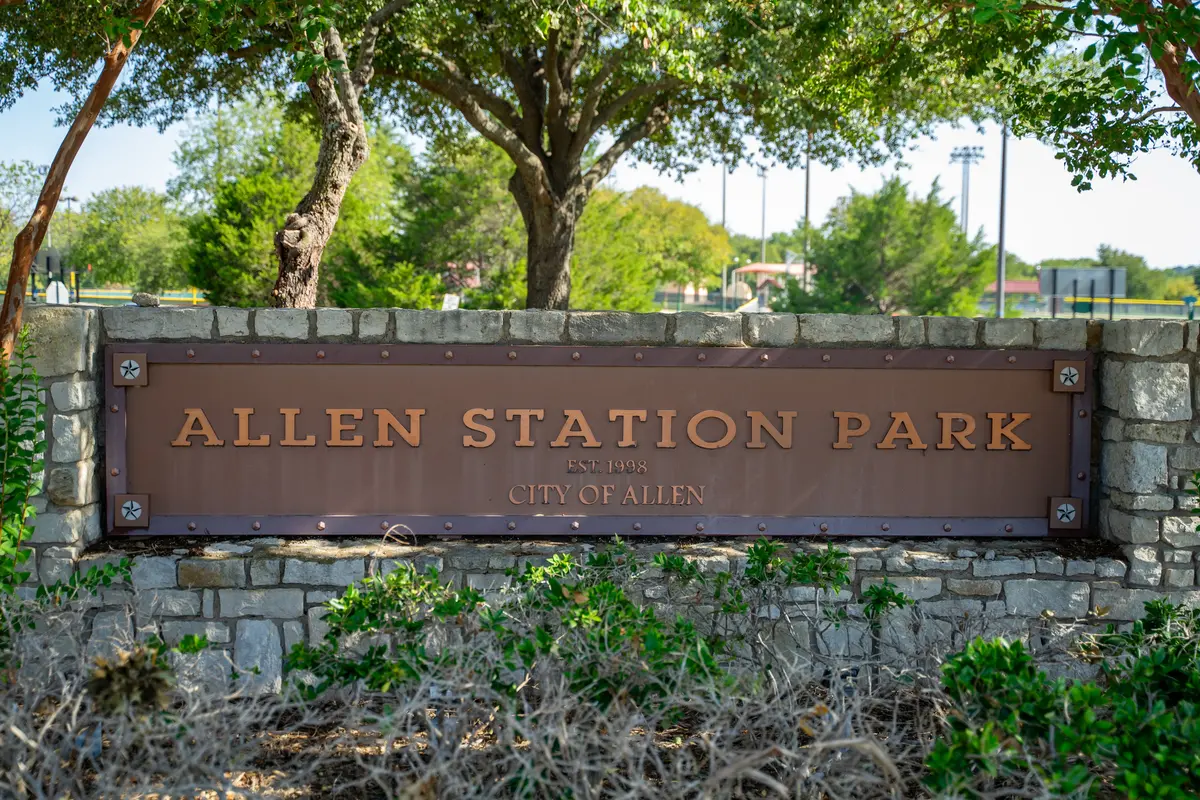
Allen's community skews toward dual-income households with school-age children, which means the social infrastructure is organized accordingly. The parks system — Celebration Park, Bethany Lakes Park, and Allen Station Park among the anchors — is genuinely well-funded and heavily used. UIL athletics programs draw consistent community investment, and Friday night football at Allen High School fills the stands in a way that surprises people who didn't grow up in Texas.
The dining and coffee scene is more suburban than what many California transplants expect. What Allen has is real: a handful of independent coffee shops, a mix of local and regional restaurants, and walkable retail at a planned outdoor shopping district. What it doesn't have is the density of a walkable urban neighborhood. A serious shopping trip sometimes means driving, and a specialty grocer or niche retailer may not be within a quick drive. This is the compromise that most people either accept quickly or find harder to shake.
Cost of Routine Life
Groceries run about 10% cheaper than the national average, and entertainment and personal services run about 16% cheaper. The offset is utilities, which run roughly 20% above the national average — Texas summers drive air conditioning costs that Californians from coastal climates haven't budgeted for. Health insurance premiums generally run noticeably below what most California professionals were paying, though you may drive farther for certain specialist care than you were accustomed to. Factor both into your first-year budget before assuming the tax savings translate directly into monthly surplus.
Six months in, the thing that surprises California transplants most often is how quickly the financial picture normalizes. The larger house stops feeling like a novelty and starts feeling like the baseline. The paycheck, without a state income tax line, adjusts your sense of what's possible. The utility bill in August is the persistent reminder that nothing here is entirely free.
Looking to buy in Allen? Estimate your payment.
Enter your numbers to see an estimated monthly mortgage payment.
Estimate only. Excludes HOA fees and mortgage insurance. The interest rate above is a starting point, not a quoted rate — replace it with your own to see real numbers. Insurance is a flat placeholder, not a Allen quote.
Cutting Ties with California: What the Franchise Tax Board Expects
This is the step most people underestimate, and it's the one with the most financial consequence if you get it wrong. Establishing Texas domicile isn't just a matter of buying a house — the California Franchise Tax Board actively audits former residents who maintain significant California connections, and the definition of "significant" is broader than most people expect.
The Documentation Checklist
To establish a clean break, you need to spend at least 183 days outside California in the tax year you claim the move, obtain a Texas driver's license, register your vehicles in Texas, and register to vote in Texas. Each of these is documented and auditable. The Franchise Tax Board looks at phone records, credit card statements, social media check-ins, and professional licensing records. A California real estate license you've kept active, a country club membership you haven't cancelled, or a California-registered vehicle still sitting in your driveway all become evidence of continued California ties.
The practical friction moment: many California transplants assume that buying a Texas home and filing a Texas return is sufficient. It isn't. The FTB's standard is domicile — where you intend to make your permanent home — not merely where you happened to be on a given number of days. If your spouse, children, or close professional relationships remain in California while you're in Allen, expect scrutiny.
What to Do Before You Leave
Get a Texas driver's license within 90 days of establishing Texas residency. Re-register your vehicles with the Texas Department of Motor Vehicles. Update your voter registration. Notify your employer's HR and payroll departments of the change. If you hold professional licenses in California, determine whether transferring or surrendering them is appropriate for your situation. Keep a contemporaneous log of where you spend each night during the first year — not because you expect to need it, but because having it ready makes an audit short.
The higher your California income was, the more motivated the Franchise Tax Board is to audit the transition. High earners — particularly those with California-source income from equity, partnerships, or S-corps — should work with a tax professional who specializes in multistate residency changes before the move, not after. The savings are real; protecting them requires paperwork.
Weekends and Local Favorites in Allen
One thing that catches California transplants off guard is how quickly Allen develops its own rhythm. The city is large enough to have real amenities and cohesive enough that regulars recognize each other at the places they return to.
Where Locals Actually Spend Time
Watters Creek at Montgomery Farm is the closest thing Allen has to a walkable outdoor district — retail, restaurants, and the walking trails that wind through the development make it a genuine gathering spot rather than a standard strip center. On a weekend morning, the trails draw a steady crowd of runners and families with strollers. Celebration Park and Allen Station Park anchor the recreational infrastructure for families with kids.
Twin Creeks Golf Course draws residents from across the city, and the surrounding neighborhood's trail system connects to a broader network that makes it possible to cover real ground on foot or by bike without touching a major road.
The Coffee and Dining Scene
For coffee, Frogg Coffee Bar & Crêperie draws a loyal following for its combination of espresso drinks and made-to-order crêpes — a format that doesn't exist everywhere and makes it a weekend-morning destination. Armor Coffee Co - Allen appeals to the more serious espresso crowd. Caffe Promenade, Sweet Bear Cafe, and Sweetwaters Coffee & Tea round out the independent options for those who want to rotate.
For meals, Mi Cocina is the regional Tex-Mex anchor that longtime locals have been going to for years. TwoRows Classic Grill handles the sports-bar-with-actual-food niche. Talia's Cafe is the neighborhood spot that regulars treat as a standing appointment. Kelly's at the Village and Roman Cucina offer a step up in occasion — the kind of places that end up hosting birthdays, milestone dinners, and the welcome-to-the-neighborhood invitations that come early in a suburb like Allen.
Allen Premium Outlets serves as both a practical shopping destination and an informal gathering point on weekday afternoons. The Credit Union of Texas Event Center brings concerts and touring acts to the city — the kind of anchor that means you don't always have to drive to Dallas for a show. And Allen Heritage Village gives the city a historical anchor that newcomers often discover late and end up returning to.
The honest California comparison: Allen's dining and coffee scene is good, not great, by coastal urban standards. What it lacks in density and experimentation it makes up for in consistency and ease. Most of the places worth going to are genuinely worth going to — and getting a table on a Friday is rarely the ordeal it would be in a comparable California suburb.
Local Expert Takeaway: Most California transplants land in Allen expecting to feel the financial relief immediately and spend the first summer recalibrating everything else. The income tax disappears from your paycheck on day one — that part is as real as advertised. The property tax bill arrives later and is larger than what a California long-timer expects. The homestead exemption (Form 50-114, Collin County Appraisal District, filed by April 30) is free money that activates a 10% appraisal cap, and most new owners wait too long to file it. Get that done in month one, put the Allen ISD school calendar on your wall, and give yourself one full Texas summer before you decide whether the trade was worth it. Almost everyone who lasts past August says yes.
Quick Takeaways & FAQs
✅ Texas has no state income tax, and the difference shows up in every paycheck from your first day in Allen.
⚠️ Allen's effective property tax rate of 1.30% is nearly double California's statewide rate, and new buyers are assessed at full market value from day one — not a legacy figure held down by Prop 13.
📍 Filing the Texas homestead exemption (Form 50-114) with the Collin County Appraisal District by April 30 is free, raises your school-district exemption to $140,000, and caps how fast your assessed value can grow — most new owners miss the first deadline.
Is Allen, Texas significantly cheaper than California for homebuyers?
How much will I save on state income tax by moving from California to Texas?
Will my property taxes be higher in Allen than in California?
What does the California Franchise Tax Board look for when someone moves to Texas?
How does Allen's sales tax compare to California's?
Moving to Texas?
Tell us what you need help with and we'll connect you with local resources.
