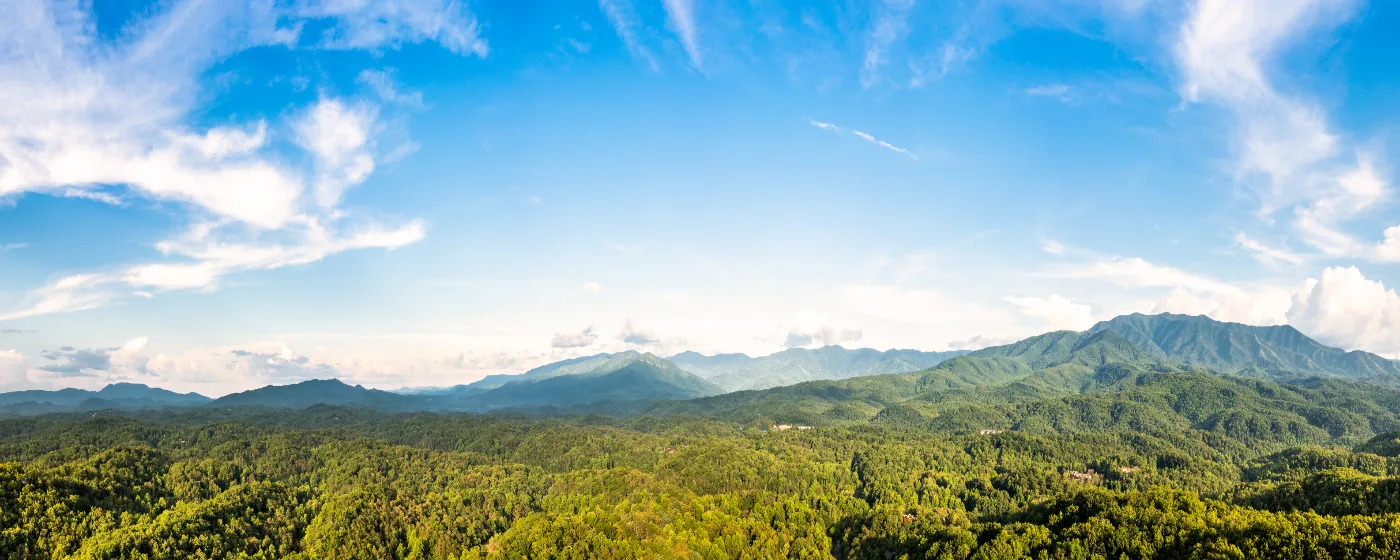
You've done the California math — and it no longer works. Maybe your employer went remote and the Bay Area lease renewal landed on your desk looking like a prank. Maybe you sold a home in the Central Valley and want the proceeds to actually buy something livable on the other end. Whatever the trigger, a small city at the entrance to the most-visited national park in America has started showing up in your research, and you're trying to figure out whether it's real. Gatlinburg, Tennessee sits where the Great Smoky Mountains begin, at the end of US-441 as it descends from the park. It is a city of 3,715 permanent residents surrounded by an extraordinary volume of annual park visitors — and that tension between quiet mountain town and relentless tourist corridor is the central reality any relocating Californian needs to understand before making an offer.
The local economy runs almost entirely on tourism. Ripley's Aquarium of the Smokies, Ober Gatlinburg ski resort and amusement park, and Anakeesta adventure park are the city's largest private employers alongside the City of Gatlinburg itself. The Sevier County school district — which serves Gatlinburg's school-age residents — holds a B rating, according to Niche, with 14,054 students enrolled in 2024-25. Most people who move here permanently are either remote workers who chose the mountains deliberately, retirees exiting higher-cost states, or owners of short-term rental properties who decided to live where their investment already was. The commute picture is honest but limited: Knoxville is about 45 minutes to the west, and that's where you'll find most of the professional job market.
The cost comparison with California is stark in the best possible way. Gatlinburg's typical home price sits at $406,899 as of August 2026 — meaningfully below California's statewide typical home value of $764,158. Tennessee collects no state income tax on wages, retirement distributions, or Social Security, which is a structural shift that compounds every year you live here. The overall cost of living runs roughly 9% below the U.S. national average, with housing costs tracking approximately 20% below that average. Health insurance premiums generally run noticeably below what you were paying in California, though the honest trade-off is that specialist care requires a longer drive than most Californians are accustomed to.
Whether you're weighing a permanent move, a semi-retirement base, or a primary residence that doubles as a vacation rental, the sections below break down what the California-to-Gatlinburg financial shift actually looks like, how the two states compare on every major tax line, what life feels like once the tourists go home, and what surprises people six months in.
The Home Price Comparison: What Your California Equity Buys Here
The single most disorienting part of moving from California to Gatlinburg is opening Zillow for the first time and assuming the listings are missing a digit. They're not. The typical home price in Gatlinburg is $406,899 as of August 2026. For context, California's statewide typical home value of $764,158 means you are crossing into a market that costs roughly half as much — and that gap represents real, spendable equity if you're arriving with California sale proceeds.
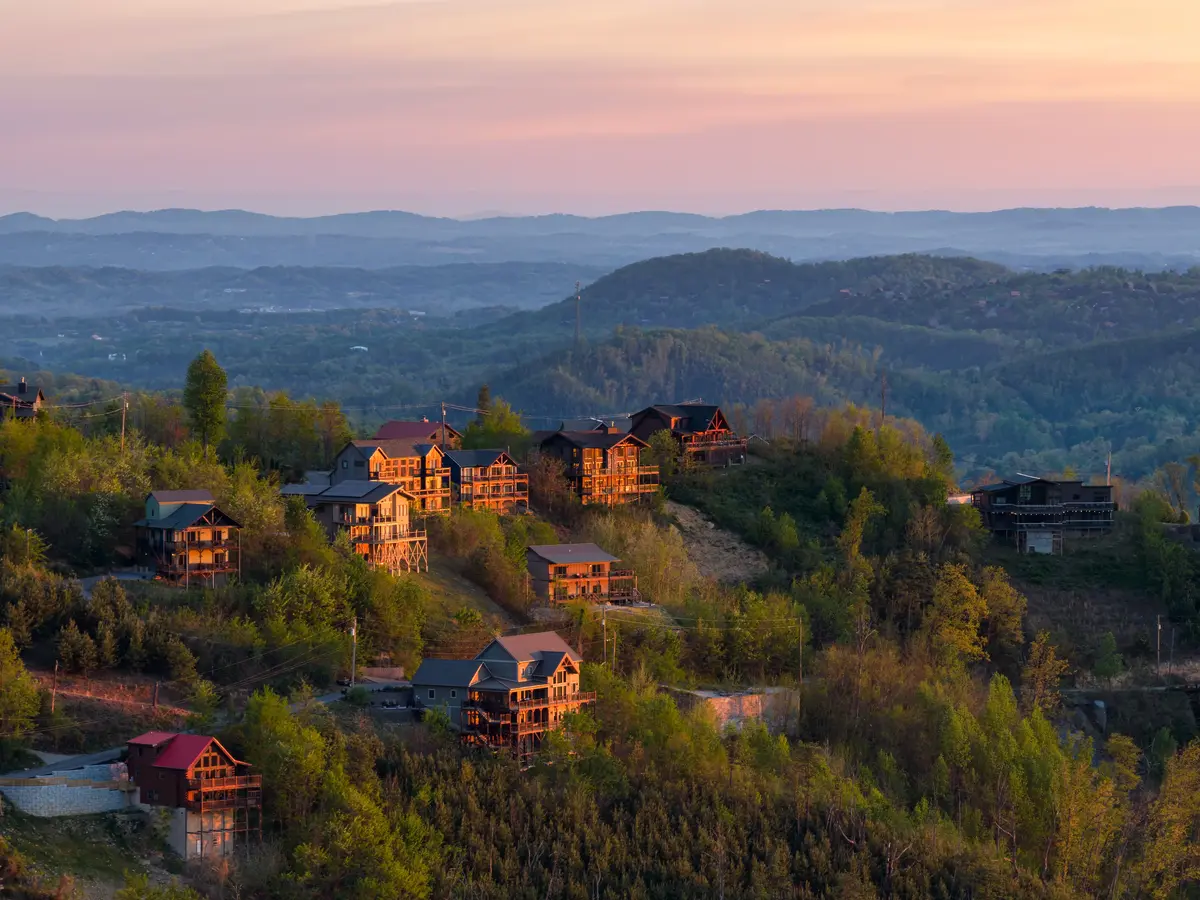
What that price buys is worth understanding clearly. Entry-level options in Gatlinburg tend to be older construction on the flatter land near the Parkway or down toward Mynatt Park. Mid-range and above gets you into the mountain neighborhoods — Chalet Village and Chalet Village North sit on wooded ridgelines with Smoky Mountain views, Cobbly Nob offers larger lots and more seclusion, and Ski Mountain puts you within walking distance of Ober Gatlinburg. The Arts & Crafts Community out toward The Glades has a quieter character — studios, galleries, and craftspeople — that draws buyers who want distance from the tourist strip. For a fuller breakdown of what each area feels like on the ground, see the best neighborhoods guide.
There is one affordability note worth stating plainly: the median household income in Gatlinburg is $57,760, and the typical home price sits well above what that income alone can carry. If your budget depends on local wages rather than California equity or remote income, the numbers require honest attention. Most successful buyers arriving from California are either bringing substantial equity to close the gap or maintaining income streams that don't depend on the local job market.
One category of buyer changes the calculus entirely: those interested in short-term rentals. Gatlinburg sits inside what is consistently described as Tennessee's most active short-term rental market, and the investment math draws Californians who can put California equity to work in a tourism-driven economy. That comes with its own rules — covered in the section below — but the underlying dynamic explains why you'll find a meaningful number of California transplants who chose Gatlinburg specifically because their purchase could generate income while they lived there.
Nearby City Price Comparison
| City | Price vs. Gatlinburg | Character |
|---|---|---|
| Pigeon Forge | Somewhat higher | More commercial, closer to Dollywood corridor |
| Sevierville | About the same | County seat, more suburban services |
| Pittman Center | Noticeably higher | Rural, larger parcels, fewer tourists |
The Tax Shift: What Tennessee Means for Your Bottom Line
No state in the contiguous U.S. offers a more dramatic tax contrast with California than Tennessee. California's top state income tax rate of 13.3% is the highest in the nation. Tennessee levies no state individual income tax — not on wages, not on pensions, not on Social Security, not on IRA or 401(k) withdrawals. That is not a small distinction. It is the foundational reason the state consistently appears at the top of California-exit destination lists.
For a practical illustration: a single filer earning $100,000 who relocates from California to Tennessee saves roughly $5,762 per year in state income taxes alone, based on CountryTaxCalc's May 2026 California-versus-Tennessee analysis. That figure is illustrative — your actual savings depend on your income level and deductions — but the direction is not illustrative. It is structural and permanent for as long as Tennessee's tax code holds. California's top state income tax rate of 13.3% applies only to the highest earners, but the rate climbs steeply through the middle brackets well before it reaches that ceiling.
The capital gains piece matters separately for Californians arriving with home-sale proceeds. Tennessee levies no state capital gains tax. California imposes capital gains taxes at rates up to 13.3%. If you are selling appreciated California real estate to fund this move, the state tax you do not owe Tennessee is a real number.
Property Tax: Lower Here, But Not for the Reason Californians Expect
Californians often assume their property taxes are low because of Proposition 13 — and compared to many states, they are. California's effective property tax rate of 0.71% reflects decades of Prop 13 assessment caps. Gatlinburg's effective property tax rate is 0.37%, roughly half of California's. Sevier County as a whole carries one of the lowest effective rates in Tennessee. For a home at the city's typical price level, the annual property tax difference is meaningful and compounds over a long hold.
The Sales Tax Trade-Off
Tennessee's income-tax advantage comes with one genuine offset. Gatlinburg's combined sales tax rate is 9.75% — 7% state base plus a 2.75% local component — among the highest combined rates in the country. California's statewide base sales tax rate of 7.25% is actually lower on its face, though most California cities push the effective rate higher through local additions. Depending on your spending patterns, the sales tax gap reduces the income-tax advantage by an estimated $1,000 to $2,000 per year. It is a real cost, worth building into your mental budget, but it does not come close to erasing the income-tax benefit for most earners.
Tennessee also carries no state estate or inheritance tax — a detail that matters more to Californians arriving in or near retirement than to younger buyers, but worth knowing regardless. For a full breakdown of Gatlinburg's cost-of-living picture including utilities and groceries, see the cost of living page.
| Tax Category | California | Tennessee / Gatlinburg |
|---|---|---|
| State income tax (wages) | Up to 13.3% | 0% — none |
| State income tax (retirement / SS) | Taxed as ordinary income | 0% — fully exempt |
| Capital gains (state) | Up to 13.3% | 0% — none |
| Effective property tax rate | 0.71% | 0.37% (city); Sevier County among TN's lowest |
| Combined sales tax | 7.25% base plus local add-ons | 9.75% combined (7% state + 2.75% local) |
| Estate / inheritance tax | None (but income tax applies to some retirement distributions) | None |

What Life Actually Looks Like Once You've Moved Here
The single thing most Californians are not prepared for is the tourist volume. Great Smoky Mountains National Park draws more visitors than any other national park in the country, and a substantial share of them pass through Gatlinburg. On a warm October weekend, US-441 through town can slow to a standstill that would feel familiar to anyone who commuted on the 405. The difference is it has a season. Summer and fall are the peaks. Winter drops significantly, and the city feels like a genuinely different place — quieter, local, and honest about its small size.
Permanent residents learn quickly which rhythms to work with and which to route around. The grocery run happens on a weekday morning, not Saturday afternoon. The hike on Chimney Tops Trail or Laurel Falls Trail gets done before 9 a.m. in summer, or saved for late October when the crowds thin and the color peaks. Gatlinburg Trail, which follows the river right from town, is walkable from the Parkway neighborhoods and draws far fewer people than the park's higher-elevation routes. This is a city of 3,715 permanent residents, and the social scale of it — the actual neighbor-to-neighbor texture — is nothing like California urban life.
The Morning and the Weekend
Daily life for residents centers on a few practical rhythms. Coffee before the tourists arrive is a real and specific habit: Coffee & Company, Painted Bear Coffee Co, Smoky Mountain Coffee & Creamery, Cuppa Gatlin Cafe, and Gatlinburg Grind are all options spread through the city, each with its own character. The Gatlinburg Farmers Market draws residents for local produce through the warmer months — the kind of weekly anchor that matters more when the rest of your shopping requires planning.
The dining scene splits cleanly between tourist-facing and local-facing. Howard's Restaurant, Gatlinburg's oldest restaurant, is the marker for the latter. Crockett's Breakfast Camp draws long lines for good reason. Ole Red brings a livelier, honky-tonk energy. The Peddler Steakhouse and Alamo Steakhouse are the serious-dinner options. For full coverage of where to spend a Saturday, the parks and recreation page covers the outdoor side of the calendar in detail.
What Surprises People at Six Months
The humidity catches California transplants off guard every time. Summers in the Smokies are warm and genuinely humid — not the dry heat of Southern California's interior valleys or the coastal marine layer. Gatlinburg averages 205 sunny days a year, which is reasonable but not the relentless sunshine many Californians are used to. The mountains generate their own weather, and afternoon storms roll in fast through July and August.
The second surprise is how much driving becomes necessary for anything beyond the immediate corridor. Knoxville is about 45 minutes away, and that's where most of the city-scale services, professional offices, and larger retail live. Most serious shopping trips mean driving out of town. For Californians used to dense suburban retail, this is an adjustment — not a dealbreaker, but an honest one worth naming before the move rather than after.
Looking to buy in Gatlinburg? Estimate your payment.
Enter your numbers to see an estimated monthly mortgage payment.
Estimate only. Excludes HOA fees and mortgage insurance. The interest rate above is a starting point, not a quoted rate — replace it with your own to see real numbers. Insurance is a flat placeholder, not a Gatlinburg quote.
Beyond the Monthly Mortgage Payment — What to Factor In
- The property tax rate above — The 0.37% used in the estimate is the median effective rate — tax actually paid as a share of market value — published by Ownwell, 2026. Half of local homes pay more and half pay less: your own bill depends on that property's assessed value and any exemptions it qualifies for, which can differ a lot from its market price. Confirm with the Sevier County assessor before you budget.
- Total cost of ownership — Your monthly mortgage payment is just the baseline. Depending on the specific city, county, and service district, homeownership costs also include local utility fees, municipal surcharges, and special assessments (such as water, sewer, storm drainage, or local energy taxes) that vary by location.
- Independent due diligence — Because these recurring local costs and municipal fees change depending on the exact property address, buyers must research them independently during their transaction process.
Tax laws, local municipal fees, and utility costs change frequently and individual situations vary. This page is general information, not tax or legal advice — always consult a qualified tax professional, CPA, or local municipal offices for personalized guidance.
Short-Term Rentals: What California Buyers Are Really Asking About
A specific and recurring conversation among California transplants here is whether to buy a property that generates short-term rental income while they live nearby or in it. The appeal is understandable: California equity dropped into a market that costs roughly half as much, in a corridor that draws more park visitors than anywhere else in the country, in a state with no income tax on rental proceeds at the state level.
The mechanics require careful due diligence before any offer. Short-term rental rules vary by zoning district in Gatlinburg and operating one requires a city-issued Tourist Residency Permit plus city and county business licenses. Short-term rental income in Gatlinburg is subject to lodging and sales taxes — confirm the current rates and requirements with the city directly before making any projections. The regulatory environment here has historically been described as tourism-friendly, but confirm the current ordinance with the city before you count on a specific property's eligibility, because zoning and permitting rules can change at the council level.
Tennessee state law limits a municipality's ability to ban short-term rentals outright, which provides a degree of structural protection that California markets — where STR ordinances have tightened sharply in many cities — do not offer. That said, the parcel-level zoning check is not optional and not something to do after you've fallen in love with a property.
The investment math here is genuinely different from California's. Sevier County and its municipalities maintain well-established, tourism-friendly regulatory frameworks — the infrastructure for short-term rental ownership is mature, the demand is proven, and the tax burden at the state level is dramatically lower than what a California-based rental owner was paying. Whether that translates into the right purchase for your situation depends on the specific property, the specific zoning, and your willingness to manage an active tourism market rather than a quiet residential one.
The Honest Trade-Offs: What You're Giving Up and What You're Gaining
Moving from California to Gatlinburg is not a lateral move with better taxes. It is a genuine lifestyle shift, and the buyers who adjust most smoothly are the ones who walked in clear-eyed about both sides of the ledger.
What You're Gaining
The financial case is real and compounding. No state income tax means more of every paycheck, every pension distribution, and every Social Security check stays in your pocket — permanently, not as a one-year break. The property tax rate at 0.37% is among the lowest you'll find anywhere in Tennessee, itself a low-tax state. The overall cost of living running roughly 9% below the national average is not a rounding error; it shows up in groceries, services, and day-to-day spending in ways that compound over years.
The environment itself is a legitimate gain for people who chose it intentionally. The entrance to Great Smoky Mountains National Park — the most-visited in the country — is at the edge of downtown. Chimney Tops Trail, Laurel Falls Trail, Cataract Falls, and the Gatlinburg Trail are not amenities in the marketing-brochure sense; they are the reason a specific kind of Californian chooses this place over every other low-tax state on the list. The Sevier County school district holds a B rating, according to Niche, which is a reasonable outcome for a community this size. For a detailed look at schools, see the schools page.
What You're Giving Up
Scale, primarily. Gatlinburg is a genuinely small town of 3,715 permanent residents. The professional services, cultural infrastructure, and retail density that Californians often take for granted require a drive to Knoxville. No 55+ communities were found in Gatlinburg, which matters to some buyers and not at all to others, but it's worth knowing before you start the search.
The tourist corridor is not background noise — it is the economic engine the entire city runs on, and living inside it means navigating it. Some buyers discover they underestimated this. People move out of Gatlinburg most often for one of two reasons: the seasonal traffic becomes genuinely disruptive to daily life, or the limited local job market makes it unsustainable without remote income or significant savings. If your income depends on local employment, the job market here is real but narrow, centered on tourism and city government. The commute to Knoxville for professional work — about 45 minutes — is manageable for some and not for others. Be honest with yourself about which category you're in before you close.
The buyers who thrive here tend to share a profile: remote workers or retirees with income not tied to the local economy, people who actively wanted the mountains rather than settled for them, and owners who see the tourism traffic as opportunity rather than inconvenience. If that's you, the financial shift from California to Gatlinburg is among the most favorable you can make. If it's not, the numbers alone won't be enough.

Local Expert Takeaway: Most Californians who move to Gatlinburg and stay do so because they made a deliberate choice about the mountains — not because they stumbled into a cheaper version of what they left. The tax shift is real: no state income tax, a property tax rate at 0.37%, and overall living costs running well below the national average add up to a structural financial improvement that compounds every year. But Gatlinburg is a city of 3,715 permanent residents inside a tourist corridor seeing more annual park visitors than any other national park in the country. The buyers who get this right are the ones who figured out whether they could live happily inside that tension before they made an offer — not after. Walk Laurel Falls Trail on a Tuesday morning in November and then walk the Parkway on a Saturday in October. If both versions of this place feel like home, you've done your homework.
Quick Takeaways & FAQs
✅ Tennessee collects no state income tax on wages, retirement income, or Social Security — a permanent structural advantage over California's top rate of 13.3%.
⚠️ The tourist volume on the Parkway during peak season is not a minor inconvenience — it shapes daily life for permanent residents and is the most common reason people leave.
📍 Short-term rental zoning in Gatlinburg is specific and consequential: verify eligibility at the parcel level before making any offer on a property you plan to rent.
Is Gatlinburg actually affordable compared to California?
Does Tennessee really have no state income tax?
Can I buy a short-term rental property in Gatlinburg?
What's the property tax rate in Gatlinburg compared to California?
What do people from California find hardest about living in Gatlinburg?
Moving to Tennessee?
Tell us what you need help with and we'll connect you with local resources.
