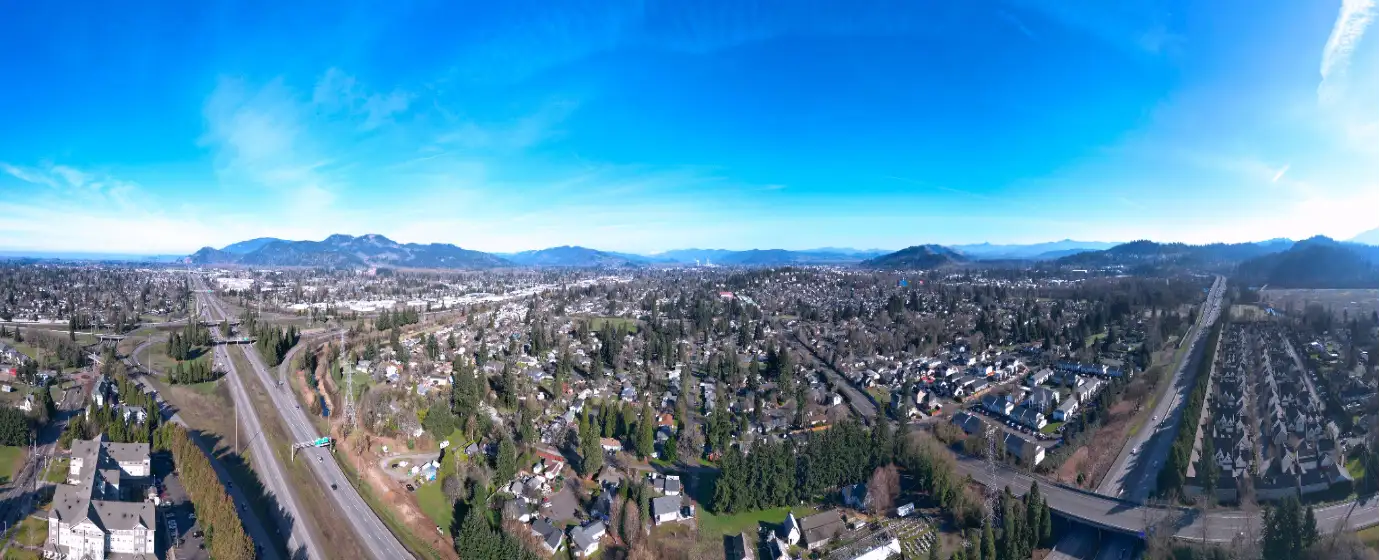
You've done the math on Oregon, read about Eugene, and then noticed that the city right next door — Springfield — comes in noticeably below Eugene on home prices while sharing the same hospital campus, the same river trails, and the same quick drive to the airport. That gap is real, and it's the central reason a growing number of retirees are signing papers in Springfield rather than Eugene. The typical Springfield home price stood at $421,652 as of July 2026 — a meaningful difference from Eugene — while sitting just about 12 minutes to Eugene by car, close enough to draw on every cultural and medical resource the larger city offers.
Springfield is Oregon's 10th-largest incorporated city, with a population of 61,182 spread across neighborhoods that range from the historic Washburne district downtown to the newer construction in Jasper Meadows and Mountaingate. The local economy anchors on PeaceHealth Sacred Heart Medical Center at RiverBend — a 388-bed regional hospital that is one of the largest employers in the metro — alongside Springfield Public Schools and Lane County government. For retirees, that employer mix matters less than what it signals: a city with stable civic infrastructure and a hospital that is genuinely within the city limits, not a drive away.
Oregon's tax picture for retirees is a study in contrasts. Social Security goes completely untaxed at every income level. Everything else — pensions, IRA withdrawals, 401(k) distributions — gets taxed at graduated rates that climb as high as 9.9%. The no-sales-tax state means daily living costs run lower than most West Coast comparisons. Springfield's 158 sunny days a year won't satisfy transplants from the Southwest, but the Willamette Valley's mild winters rarely push below freezing, and the outdoor access along the McKenzie and Willamette rivers is genuinely year-round.
Whether you're weighing a move from California, considering downsizing from a larger Oregon city, or comparing Springfield head-to-head with Eugene or Creswell, the sections below walk through healthcare access, the retiree budget, walkability and community, downsizing inventory, and how Springfield stacks up against nearby retirement alternatives.

Why Retirees Are Choosing Springfield
The honest case for retiring in Springfield starts with a single question: do you actually need to pay Eugene prices when Springfield gives you the same hospital, the same river, and the same access to the Oregon coast and Cascade foothills? For retirees who are buying with equity from a prior home — especially equity built in California or the Pacific Northwest's pricier markets — Springfield at a typical price of $421,652 (July 2026) allows for a paid-off purchase or a dramatically smaller mortgage than a comparable Eugene address. That financial breathing room is real on a fixed income.
Springfield also suits retirees who prefer a quieter, less polished city over Eugene's more active restaurant and arts scene. The Washburne Historic District has genuine architectural character without the foot traffic. Willamalane Park and Recreation District's adult programming is serious and well-funded — this is not a token senior center, it's a full-service district with its own dedicated facility and daily programs for adults 60 and older. Proximity to Eugene means concerts, the Oregon Bach Festival, the University of Oregon's museums, and a full range of dining are all reachable for an evening out.
Who should look elsewhere? Retirees who want to walk to coffee shops and a farmers market without a car will find Springfield's citywide car-dependent reality frustrating — the walkable pockets near downtown and Gateway are real but limited. Retirees with very large taxable retirement accounts should consult a tax professional before committing: Oregon's top rate of 9.9% on pension and IRA income is the fourth-highest in the nation and can take a meaningful bite. And anyone whose retirement plan requires a large estate passing to heirs should note that Oregon's estate tax kicks in at $1 million — far below the 2026 federal threshold — a structural fact worth addressing with an estate attorney well before the move.
Healthcare & Medical Access in Springfield
The single most important healthcare fact for retirees weighing Springfield: PeaceHealth Sacred Heart Medical Center at RiverBend sits inside Springfield's city limits. This is not a regional hospital you drive to in an emergency — it is here, fully within the city, operating a 24-hour Level II Trauma Center. That distinction matters enormously when the call goes to 911 at 2 a.m.
RiverBend is a 388-bed campus with genuine specialty depth. Advanced cardiac care runs through the Oregon Heart & Vascular Institute; neurosciences operate under the Oregon Neurosciences Institute. Cancer surgery, women's and children's services, outpatient physical therapy — including osteoporosis care and balance and vestibular training, two services that loom large for adults in their 70s and beyond — all sit on the same campus. Home health, hospice, and palliative care round out the continuum. For retirees who have watched family members cobble together care across multiple disconnected facilities, a single integrated campus is not a small thing.
For a smaller city, Springfield's hospital situation is unusually strong. The depth of specialty care at RiverBend means that most of what an aging adult needs — cardiac monitoring, orthopedic rehab, neurological follow-up, cancer surveillance — can be handled locally rather than requiring a trip to Portland. The Eugene–Springfield metro is about a 2.5-hour drive from Portland's Oregon Health & Science University, the state's academic medical center, for cases that genuinely require subspecialty intervention that RiverBend doesn't carry.
On the outpatient side, Willamalane's Adult Activity Center offers nurse-led foot care clinics and free Medicare counseling through the SHIBA program — Oregon's State Health Insurance Benefits Assistance network. These are practical, unglamorous services that save real money and catch real problems, and they're available to Springfield adults 60 and older without cost barriers.

The Retiree Budget in Springfield
Oregon's tax treatment of retirement income has one clear winner and several catches. Social Security — at every income level, with no means-testing — is completely exempt from Oregon income tax. That is a genuine advantage over states that tax Social Security, and it disproportionately benefits retirees whose income is primarily Social Security-based.
The catches begin with everything else. Pensions, traditional IRA and 401(k) distributions, and most other retirement income are taxed at graduated rates starting at 4.75% and climbing to 9.9%. There is no general retirement-income exclusion in Oregon. The small pension credit under Oregon law that had been available sunset for tax years beginning January 1, 2026 — confirm the current status with a tax professional, as legislation in this space moves. In practical terms, a retired couple drawing $80,000 per year from a 401(k) faces a meaningful Oregon tax bill regardless of how low their Social Security keeps their federal tax.
The property tax picture is more favorable. Springfield's effective rate runs approximately 0.77%, which is low by national standards and very low compared to most Western states with comparable home prices. Oregon also offers a property tax deferral program for homeowners age 62 or older whose household income does not exceed $60,000 — the state pays the county taxes, with a lien at 6% simple interest repaid at sale or transfer. For income-constrained retirees sitting on home equity, this can be a meaningful cash-flow tool; for those above the income threshold, it is not available. See the full cost breakdown at the cost-of-living page.
Oregon's lack of a sales tax shows up quietly but consistently in the grocery line, the hardware store, and every other daily purchase. On a fixed income, that steady relief compounds across a year. Oregon does levy its own estate tax with a $1 million exemption — far below the 2026 federal threshold — so retirees with estates in that range should work with an estate attorney rather than assuming federal planning covers the Oregon exposure. In odd-numbered tax years, Oregon's constitutional kicker credit can deliver a one-time offset; for tax year 2025, it equaled 9.863% of a filer's 2024 Oregon income tax before credits. It is not a planning tool, but it is real money when it arrives.
Looking to buy in Springfield? Estimate your payment.
Enter your numbers to see an estimated monthly mortgage payment.
Estimate only. Excludes HOA fees and mortgage insurance. The interest rate above is a starting point, not a quoted rate — replace it with your own to see real numbers. Insurance is a flat placeholder, not a Springfield quote.
Walkability, Community & Staying Active in Springfield
Springfield's walkability is the honest trade-off in this city. Most of Springfield requires a car for daily errands — the citywide baseline reflects a mid-century street grid built around the automobile. The downtown core and the Gateway district are the exceptions, where a retiree living nearby can reach coffee, a few restaurants, and the weekly Lane County Farmers Market without driving. If walkable streets are a non-negotiable condition of retirement, the specific neighborhood matters as much as the city choice.
The terrain itself is forgiving. Springfield sits flat along the Willamette River valley floor; the hills begin only as you move toward Mountaingate and Thurston. For retirees with joint or mobility concerns, the level streets around downtown, Island Park, and the Middle Fork Path corridor are genuinely accessible without elevation challenges.
The Willamalane Adult Activity Center
The Willamalane Park and Recreation District operates a dedicated Adult Activity Center that functions as the city's real senior hub. Daily fitness and recreation classes, water fitness, free lectures for adults 60 and older, weekday senior meals, a food pantry, nurse-led foot care clinics, free Medicare counseling through the SHIBA program, and energy-assistance enrollment support are all available through the center. The programming depth here is unusual for a city of Springfield's size — Willamalane is a well-funded special district with its own tax base, not a city department stretched thin across competing priorities.
Outside the center, the district maintains parks, trails, pools, and natural areas throughout the city, with adaptive recreation for adults with disabilities and scholarship programs that remove financial barriers. Seasonal community events — including a Haunted Hayride at Dorris Ranch Living History Farm — give the calendar a local texture that newer transplants genuinely appreciate after the first Oregon fall. The Wildish Community Theater and the Emerald Art Center offer arts engagement without driving to Eugene, though Eugene's much larger cultural calendar is only about 12 minutes away.
Volunteering and social connection are easier here than in many comparably sized Oregon cities, partly because the Willamalane district actively recruits volunteers and partly because the Eugene–Springfield metro's university culture creates a steady stream of lectures, events, and continuing-education options. Retirees who moved here from more anonymous suburbs often describe the community as unexpectedly engaged — one of those things nobody warned them about, in the good direction.
Right-Sizing: Downsizing in Springfield
No 55+ communities were found in Springfield. That's the honest starting point for anyone expecting the structured, amenity-heavy active-adult community model common in Arizona or parts of Florida. Springfield's downsizing market is a more conventional one: single-level ranch homes, some patio homes, a limited condo inventory, and a handful of assisted living and memory care facilities for later-stage care needs.
The upside of the conventional market is price. Single-level ranch construction from the 1960s through the 1990s — Springfield built a lot of it — trades at prices meaningfully below what comparable square footage costs in Eugene. For a retiree selling a larger home and buying a manageable single-level property outright, the math can work cleanly. The Washburne Historic District has some smaller bungalows that suit a downsized footprint, though single-level options are more plentiful in North Springfield and the Hayden Bridge area. See the full neighborhood breakdown at the best neighborhoods page.
Assisted Living and Memory Care
When independent living is no longer the right fit, Springfield has a real range of licensed options. Spring Valley Assisted Living offers assisted living and respite care. Bayberry Commons provides assisted living and memory care. Timber Pointe Senior Living covers independent and assisted living in a smaller, residential setting. The Esther at RiverBend and The Rawlin at RiverBend Memory Care, operated by ONELIFE Senior Living, sit near the PeaceHealth campus — proximity to the hospital is a deliberate design choice that matters when residents need frequent medical appointments or inpatient stays. None of these facilities are 55+ communities; they are licensed care communities for adults needing support services.
For retirees who want to age in place in a purchased home rather than transition to a care facility, Springfield's outdoor access helps. The McKenzie River corridor east of the city and the Willamette River frontage via Clearwater Park, Island Park, and the Middle Fork Path offer low-impact hiking, fishing, cycling, and birdwatching — activities that sustain physical health and mental engagement without requiring high-elevation trailheads or long drives.
Springfield vs Nearby Retirement Destinations
| City | Cost vs Springfield | Primary Hospital | Walkability | Senior Living Depth | Overall Retirement Fit |
|---|---|---|---|---|---|
| Springfield | Anchor | PeaceHealth RiverBend (in-city, Level II Trauma) | Car-dependent citywide; walkable downtown core | Multiple assisted living and memory care options; no 55+ communities | Strong for healthcare-first, budget-conscious retirees |
| Eugene | Somewhat higher | Shares PeaceHealth RiverBend; additional outpatient clinics | More walkable than Springfield; stronger urban core | Broader independent-living and 55+ options | Better fit for retirees who prioritize walkability and arts access |
| Creswell | About the same | None in-city; relies on Eugene–Springfield for hospital care | Very limited; small-town errands require a car | Minimal; few senior-specific facilities | Works for self-sufficient retirees wanting small-town quiet; healthcare distance is the real risk |
| Coburg | Somewhat higher | None in-city; Eugene–Springfield access via short drive | Minimal; tiny historic core, otherwise car-dependent | Very limited | Niche fit for buyers wanting a small historic community with rural character |
| Cottage Grove | Noticeably cheaper | Small critical-access hospital in-city; complex care goes to Eugene | Compact downtown with some on-foot access | Limited assisted living options | Budget-first retirees who don't need regular specialist access and are comfortable with a longer drive for advanced care |
| Oakridge | Noticeably cheaper | No hospital in-city; emergency care is a significant drive | Very limited | Minimal | Outdoor-focused, healthy retirees who prioritize scenery and solitude over medical access |
Eugene beats Springfield on walkability and senior housing variety, and for retirees whose retirement plan centers on an active urban lifestyle, the somewhat higher price point is likely worth it. Springfield's edge is straightforward: the same flagship hospital, a lower purchase price, and Willamalane's genuinely strong adult programming — all without sacrificing Eugene's cultural calendar, which remains just about 12 minutes to Eugene by car.
Creswell and Coburg appeal to buyers who want a quieter address and are comfortable driving to Springfield or Eugene for everything medical, social, and commercial. That trade-off is manageable when you are 65 and healthy; it becomes a different calculation at 80. Cottage Grove is the genuine budget alternative for retirees prioritizing home price over specialist access, with the honest caveat that complex medical care requires a 30-plus-minute drive to the Eugene–Springfield metro. Oakridge is a legitimate answer for a specific kind of retiree — one for whom daily outdoor access outweighs everything else — but it is the most medically exposed option on this list.
For most retirees making a practical, long-term decision, Springfield sits in the most defensible position: affordable enough to buy without financial stress, medically equipped for the full arc of aging, and close enough to Eugene that the trade-offs in walkability and cultural density are easy to offset with a short drive.

Local Expert Takeaway: Springfield's strongest retirement argument isn't the price — it's that PeaceHealth Sacred Heart Medical Center at RiverBend sits inside the city limits, giving you Level II Trauma access and deep specialty care without leaving town, while Willamalane's Adult Activity Center delivers real programming — senior meals, Medicare counseling, fitness classes, free lectures — at a scale that surprises people who assumed this was a smaller community. Layer in the flat terrain along Island Park and the Middle Fork Path, Eugene's full cultural calendar about 12 minutes away, and a home price that lets equity from a prior sale go far, and Springfield earns serious consideration from retirees who want medical security and livability without paying Eugene prices to get it.
Quick Takeaways & FAQs
✅ PeaceHealth Sacred Heart Medical Center at RiverBend — a 388-bed hospital with a Level II Trauma Center, cardiac, and neurosciences institutes — sits inside Springfield's city limits, making it one of the most medically well-served smaller cities in Oregon for retirees.
⚠️ Oregon taxes pensions, IRA, and 401(k) distributions at rates up to 9.9%, and levies its own estate tax starting at $1 million — retirees with significant taxable retirement income or sizable estates should model the Oregon tax picture carefully before committing.
📍 No 55+ age-restricted communities exist in Springfield; retirees wanting that model will need to look to Eugene or other nearby cities, though Springfield does have several assisted living and memory care facilities for later-stage needs.
Is Springfield, Oregon a good place to retire?
Does Oregon tax retirement income for retirees in Springfield?
What is the nearest hospital to Springfield, Oregon for retirees?
Are there 55+ communities or active-adult communities in Springfield, Oregon?
What senior programs and activities are available in Springfield?
Moving to Oregon?
Tell us what you need help with and we'll connect you with local resources.
