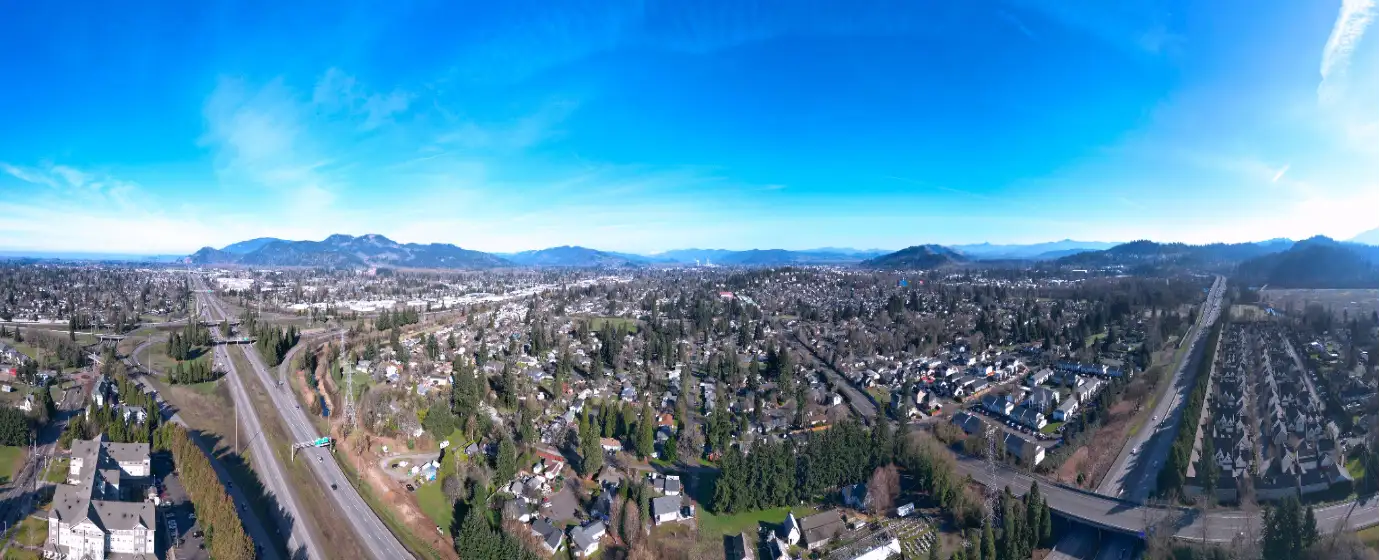
Maybe you've been priced out of your corner of the Bay Area, or your company shifted remote and the math on your current mortgage stopped making sense. Maybe you drove through the Willamette Valley on a camping trip and something clicked. California accounts for roughly 22% of all inbound moves to Oregon — the single largest source of new residents — and Springfield is the quiet destination many of those transplants end up choosing over its better-known neighbor Eugene. It sits at the eastern edge of the metro, where I-105 connects it to Eugene in about 12 minutes, with the McKenzie River corridor at its back and a downtown that is working hard to catch up to the ambition of its residents.
Springfield is a city of 61,182 people — the 10th-largest incorporated city in Oregon — built around a real working-class economy rather than a university identity. The major employers include a large regional healthcare anchor, Springfield Public Schools, Lane County government, and International Paper, which has been part of the city's industrial backbone for generations. That mix attracts Californians who want a city with actual infrastructure but not the price tag that comes with Austin or Denver. Springfield Public Schools holds a C rating, according to Niche, which is an honest data point to weigh if schools are driving your decision.
The number that stops most Californians mid-sentence is the home price. The typical home value in Springfield sits at $421,652 as of July 2026 — a figure that needs no asterisk or creative framing when you are comparing it with California's statewide typical home value of $773,735. The overall cost of living runs substantially below San Francisco and most major California metros, though it sits modestly above the U.S. national average. Groceries, utilities, and transportation all contribute to that gap, as does the absence of a state sales tax — Oregon charges none, at any level.
What follows is a practical guide for California households seriously considering Springfield: how the home-price and tax math actually works, what surprises people after a few months, where the genuine trade-offs sit, and what daily life looks like once the moving truck leaves.

The Home Price Reality for California Buyers
The headline figure deserves a full examination, not just a comparison. Springfield's typical home value of $421,652 (July 2026) is not a distressed-market bargain or a reflection of poor amenities — it is what a solid working-class city in the Willamette Valley looks like when it has not been fully discovered yet.
Compare that directly with California's statewide typical home value of $773,735, and the gap is immediately legible. A household selling a California home near that statewide figure and buying in Springfield at the typical price could emerge with equity left over after the purchase — enough to absorb moving costs, establish an emergency fund, or reduce the loan size substantially.
What the Springfield Market Actually Offers
Entry-level homes — older ranch-style construction in North Springfield or Hayden Bridge — start noticeably below the citywide typical. Thurston and Mountaingate, the city's more established residential corridors, run above the typical, though still well below comparable neighborhoods in Eugene. The neighborhood breakdown covers character and trade-offs in detail.
One thing California buyers are not prepared for: Oregon does not reset a home's assessed value at the time of sale. Under Oregon's Measure 50, assessed value can only increase by 3% per year regardless of what you paid. California's Proposition 13 works similarly in principle — but Prop 13 resets on every sale, starting your tax bill fresh at the new purchase price. In Oregon, you may buy a home whose assessed value has been capped for decades and pay taxes on a number meaningfully below what you paid.
Springfield's effective property tax rate sits at 0.77% — below the Lane County average of approximately 1.03% and well below what most California buyers were paying on a recently purchased home. The combination of a lower purchase price AND a lower rate compounds quickly.
| Factor | Springfield, OR | California (Statewide) |
|---|---|---|
| Typical home value | $421,652 (July 2026, Zillow ZHVI) | $773,735 (Zillow ZHVI) |
| Effective property tax rate | 0.77% | California's effective property tax rate of 0.71% — but resets to ~1% at purchase under Prop 13 |
| Assessed value behavior | Capped at 3%/year increase under Measure 50; does NOT reset on sale | Resets to purchase price on every sale under Prop 13 |
| State sales tax | 0% — Oregon charges none | California's statewide base sales tax rate of 7.25%; local rates push averages above 8.98% |
| Nearby city comparison | Eugene somewhat higher; Coburg somewhat higher; Creswell about the same | — |
| Median household income | $68,761 | — |
* ZHVI = Zillow Home Value Index.
One honest note on affordability: Springfield's median household income is below the income needed to buy the typical home here by about $42,000. That gap is smaller than in most California markets, but it is real, and it means financing strategy still matters.
The Tax Picture: Where Oregon Helps and Where It Doesn't
The tax comparison between California and Oregon is not as simple as the moving blogs make it sound. There is a genuine win, a genuine surprise, and a nuance that catches six-figure earners off guard.
The Clear Win: No Sales Tax
Oregon is one of only five states with no sales tax at any level — state, county, or city. California's statewide base sales tax rate of 7.25% is just the floor; local add-ons push the statewide average toward 8.98%, and some California cities exceed 10.75%. For a household spending roughly $40,000 a year on taxable goods, that elimination represents real annual savings — money that does not show up on a pay stub but accumulates steadily at the register.
The Surprise: Income Tax Is Not a Simple Win
Oregon's top state income tax rate of 9.9% kicks in at $125,000 of taxable income for single filers — a far lower threshold than California's top rate. California's top state income tax rate of 13.3% applies only to the highest earners, those above $1 million in taxable income. For earners in the $80,000–$150,000 range, Oregon's compressed brackets can produce a higher effective state income tax rate than California's graduated structure does at the same income level.
That is not a reason to stay in California — but it is a reason to run the numbers before assuming the move is a tax windfall. A CPA experienced in state-to-state moves is worth the cost in your first year, especially given the partial-year residency rules that govern the year you move.
The Offsetting Benefit: The Federal Tax Deduction
Oregon offers something California does not: residents can deduct a portion of their federal income taxes paid from Oregon taxable income. That deduction meaningfully lowers the effective burden for low- and moderate-income households. It phases out at higher incomes and disappears entirely for joint filers with federal AGI above $290,000, so high earners do not benefit — but for the median Springfield household, it softens the bracket compression considerably.
| Tax Type | Oregon / Springfield | California |
|---|---|---|
| Sales tax | 0% — none at any level | California's statewide base sales tax rate of 7.25%; local averages above 8.98% |
| Top state income tax rate | 9.9% (kicks in at $125K single / $250K joint) | California's top state income tax rate of 13.3% (above $1M single) |
| Middle-income effective rate | Can exceed California's at $80K–$150K income | Lower effective rate at mid-income levels |
| Federal tax deduction | Partial deduction allowed; phases out above $290K AGI (joint) | Not available |
| Property tax behavior | 0.77% effective rate; assessed value capped 3%/year, no sale reset | California's effective property tax rate of 0.71%; resets to purchase price on sale |
| Part-year return complexity | High — recommend CPA for move year | High — California is aggressive about part-year residency rules |
The move-year tax return is almost always complicated on both the California and Oregon sides. Both states are assertive about part-year residency, and double-taxation avoidance provisions require careful documentation of when you changed domicile.

What Daily Life Actually Costs Here
Home prices and tax rates are the big levers, but the texture of everyday spending is what shapes how a move actually feels six months in. Springfield runs substantially below San Francisco and most major California metro areas on overall cost of living — and well below the Bay Area and Southern California on almost every line item — though it sits modestly above the U.S. national average.
The No-Sales-Tax Effect in Practice
The absence of any sales tax recalibrates how you shop in ways that are hard to predict from inside California. Furniture purchases, appliances, clothing, electronics, a new car — none of it carries a tax line at checkout. That psychological shift takes a few months to stop feeling like a mistake was made.
Rent If You Are Not Buying Immediately
The typical two-bedroom apartment runs $1,540–$1,880 per month, with a citywide typical rent of $1,678 as of July 2026 — a figure covered in full on the cost of living page. That range reflects real inventory across Gateway, Thurston, and the apartment corridors near downtown, not cherry-picked units.
Healthcare Costs
Health insurance premiums in Oregon run noticeably below what most California residents pay, particularly for individual market plans. The honest trade-off is that Springfield sits in a regional market: routine and primary care are readily available, but for complex specialist care, you will drive farther than residents of a major California metro are accustomed to.
What Californians Underestimate
The rain. Springfield sees 158 sunny days a year — less than half the year, and noticeably fewer than even coastal California's overcast stretches. Residents describe the stretch from November through March as persistent grey rather than dramatic storms, which is its own kind of weather to adapt to. Californians who planned for "Oregon rain" often did not plan for that specific shade of drizzle, six days out of seven, for five months straight.
Groceries and utilities track roughly at or just above national averages, which means they feel lower than California prices on most items but are not dramatically cheaper. The savings are real but not shocking — the housing delta is where the actual financial relief lives.
Looking to buy in Springfield? Estimate your payment.
Enter your numbers to see an estimated monthly mortgage payment.
Estimate only. Excludes HOA fees and mortgage insurance. The interest rate above is a starting point, not a quoted rate — replace it with your own to see real numbers. Insurance is a flat placeholder, not a Springfield quote.
Jobs, Remote Work, and the Employment Picture
If you are relocating with a job already in hand — especially a California remote salary — Springfield's economics are straightforward. If you are planning to find work after the move, the picture requires more honesty.
The Local Employer Base
Springfield's largest employers anchor the healthcare, education, and manufacturing sectors. International Paper has been part of the city's industrial backbone for generations. Lane County government and the City of Springfield provide a stable public-sector base, and the regional healthcare sector has been a consistent source of employment across the metro. The living in Springfield page covers the full employer picture.
Eugene as the Job Market
In practical terms, Springfield residents treat Eugene as a single labor market. The University of Oregon, state agencies, and a more diverse service sector are all accessible in about 12 minutes to Eugene via I-105. For most professional-sector roles, that is the relevant job pool.
Remote Workers
A significant share of California transplants here work remotely. That is not a consolation framing — it is the actual reason many of them moved. A California tech or media salary calibrated to Bay Area or Los Angeles costs of living stretches considerably in Springfield. The fiber internet infrastructure in the metro area is adequate for video-heavy remote work, and the combination of lower housing costs and no sales tax makes the numbers work in a way they no longer did at the origin point.
The honest caution: the Eugene-Springfield metro is not a growth market in the way the Pacific Northwest's tech corridors are. If remote work ends, the fallback job market is regional rather than deep. That trade-off is worth pricing in before the move.
Weekends, Local Favorites, and the Adjustment Period
The practical stuff — taxes, home prices, commutes — is what drives the spreadsheet. What determines whether you stay after two years is harder to quantify.
Where People Actually Spend Time
The Willamalane Park and Splash Pad is the city's civic gathering point for families with school-age children. Island Park and Clearwater Park pull residents to the river corridor on warm days. The Middle Fork Path connects the eastern reaches of the city to a genuine outdoor commuter and recreation trail — not a glorified sidewalk, but a route that feels like the Willamette Valley it runs through. Dorris Ranch Living History Farm is the kind of place that surprises California arrivals who expected Oregon to be all alpine and no pastoral.
The local food and coffee scene is small but specific. Plank Town Brewing Company, PublicHouse, Hawaiian Island Grill, Hole in the Wall BBQ Springfield, and Prime Time Sports Bar & Grill give the city a real anchor set rather than a chain-dependent strip. Coffee runs at Lovely All Day Café, The Washburne Café, Native Coffee Company, Crema and Bloom, and Fast Lane Coffee Co — a concentration that punches above what the city's size might suggest. The Lane County Farmers Market (Springfield) and Herrick Farm Store connect residents to Willamette Valley produce in a way that California arrivals often find genuinely comparable to what they left behind.
The Six-Month Reality
What Californians say after six months, consistently: they underestimated how much they would miss year-round sunshine, and they overestimated how much they would miss urban density. Springfield is not Portland. The nightlife and cultural programming are modest. The Wildish Community Theater and the Emerald Art Center carry cultural weight for a city this size, but a household that ran on a packed social calendar of events, openings, and concerts will feel the gap.
The practical adjustment that catches people is the DMV: new Oregon residents must obtain an Oregon driver's license and register their vehicle within 30 days of establishing residency. That clock starts the day you move in, not the day you think to check on it. Build that errand into week one rather than month two.
What stays true for most transplants: the space, the quiet, and the river access replace what they gave up in ways they did not anticipate. The Washburne Historic District has a neighborhood texture that takes years to build and cannot be manufactured. The parks and trails are the reason many people stop looking at other cities once they visit.
Best for: Value Nature Commuters to Eugene
Local Expert Takeaway: Springfield is not the city California transplants imagined — it is more industrial, more working-class, and more rain-soaked than the Oregon of Pacific Northwest marketing. But the home price gap is real, the no-sales-tax relief is immediate, and the McKenzie River corridor at the city's edge is the kind of everyday access that costs $2 million in Marin. The households who land here and stay are the ones who came for the math and discovered they actually liked the place.
Quick Takeaways & FAQs
✅ Springfield's typical home value of $421,652 (July 2026) is meaningfully below California's statewide typical home value of $773,735 — the gap is real and not a distressed-market artifact.
⚠️ Oregon's income tax brackets compress steeply, and middle-income earners can face a higher effective state rate than they paid in California — the sales-tax elimination is the clearest broad relief, not the income tax.
📍 Oregon's Measure 50 caps assessed value increases at 3% per year and does not reset on sale — California buyers accustomed to Prop 13 reassessment will find this a meaningful long-term property tax advantage.
Is Springfield, Oregon actually cheaper than living in California?
How does Oregon's property tax compare to California's for a home buyer?
Will I pay less in income taxes if I move from California to Oregon?
What is the job market like in Springfield for someone moving from California?
What do people wish they had known before moving to Springfield from California?
Moving to Oregon?
Tell us what you need help with and we'll connect you with local resources.
