
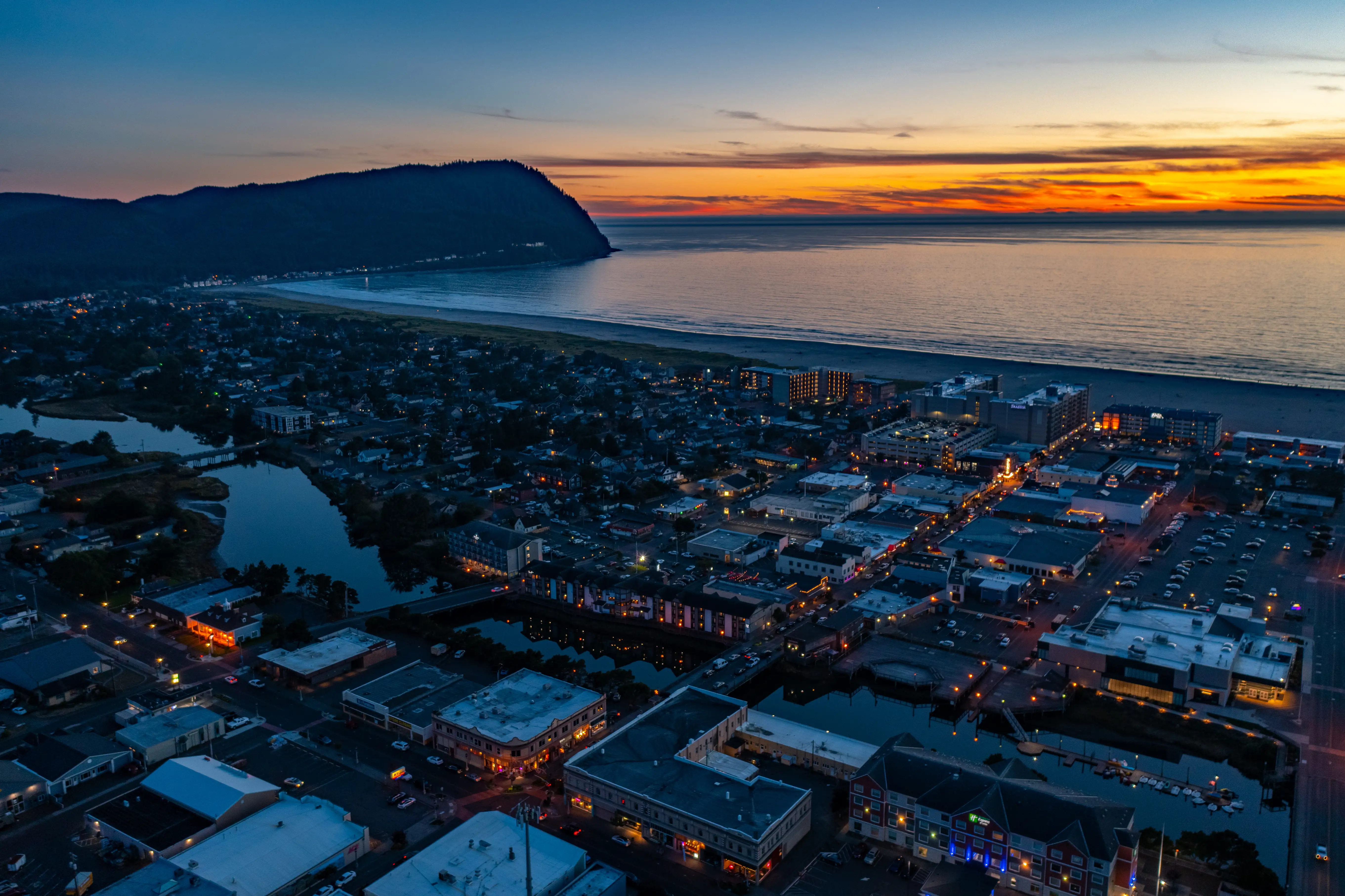
You've done the math, or someone told you to, and the numbers landed somewhere around "that's a lot less house for a lot more money" — except in reverse. Californians who land in Seaside, Oregon often describe the same moment: standing at the Turnaround where Broadway Street meets the water, watching the fog roll off Tillamook Head, and realizing the town costs a fraction of what they left behind. Seaside sits on the northern Oregon coast along US-101, about 90 minutes to Portland, a city of 7,192 full-time residents squeezed between the Necanicum River and the ocean. What drives daily life here is not a tech campus or a suburban master plan — it is the coast itself, the seasonal rhythm of tourism, and a small-town infrastructure that rewards people who came to slow down.
The economic backbone is modest by California standards. The Seaside School District, the city government, and the tourism and hospitality sector together employ most of the workforce. Californians who move here often bring remote income with them, which is the more honest answer to how many people afford the lifestyle without a local job. The Seaside School District 10 holds a C+ rating, according to Niche, with 1,425 students enrolled in 2025-26 — a district small enough that every parent quickly knows the principal by name. Who moves here? Mostly people who spent a weekend and couldn't stop thinking about it: remote workers, early retirees, and families trading square footage and commute time for a place where kids can walk to the beach.
The cost picture is the central reason Californians keep landing here. The typical Seaside home value sits at $473,271 (Zillow Home Value Index, July 2026) — meaningfully below California's statewide typical home value of $773,735, and a world apart from the coastal California markets most movers are leaving. Oregon charges no sales tax at any level, which matters every time you buy a car or furnish a house. The tradeoffs are real: the median household income of $47,361 reflects a local economy built on service work, and the rain is not a rumor — Seaside sees only 128 sunny days a year, which catches most arrivals off guard after a California upbringing.
Whether you're comparing tax bills, thinking through what your California equity buys here, or trying to understand what February on the Oregon coast actually feels like, the sections below break down the home price comparison, the real tax picture, what daily life looks like for California transplants, the rental market, and the honest tradeoffs before you make an offer.

The Home Price Reality: What California Equity Buys in Seaside
The housing comparison is the sharpest number in this entire conversation. California's statewide typical home value of $773,735 buys you a median Zillow Home Value Index figure — the same index that puts Seaside's typical home at $473,271 (July 2026). That gap represents a real difference in what your equity can do when you arrive.
For buyers coming from coastal or metro California, the practical effect is often arriving with a substantial down payment — sometimes enough to buy outright, or close to it. That changes the monthly calculus entirely. A buyer who carried significant equity out of a Bay Area or Los Angeles home frequently finds that Seaside's price point is within reach without stretching.
What the Price Buys in Seaside
The mix of housing in Seaside is older and more varied than most California suburbs. Bungalows from the mid-century era sit alongside newer construction in areas like Blue Heron Pointe and Thompson Falls Estates. The Promenade-adjacent neighborhoods command a premium for ocean proximity, while East Hills and Stanley Acres offer more modest entry points. For the full breakdown of which neighborhoods suit which buyer, the best neighborhoods page covers the character of each area.
The Affordability Gap Californians Should Understand
The honest caveat: Seaside's local income base does not keep pace with its home prices. The median household income of $47,361 sits well below what it takes to carry the typical home here. It is a town where people move to — often with outside capital — not a town where people climb the ladder from renter to owner on a local salary alone.
For comparison within the Oregon coast: Gearhart and Cannon Beach both run noticeably higher than Seaside's price point. Astoria, a short drive up US-101, sits at about the same level. If your California equity lands you in Seaside's range, you're buying at the accessible end of this stretch of coastline.
Oregon's Measure 50, passed in 1997, works similarly to California's Proposition 13: it caps annual increases in assessed value at 3% unless you make significant improvements. Californians who understand Prop 13 will recognize the mechanic. Long-term owners often see their assessed value drift well below market value over time — a genuine financial advantage for anyone planning to stay put.
The effective property tax rate in Clatsop County is 0.63%, below the national median of around 1%. Seaside's annual tax bills are more manageable than comparable coastal markets in California. For the full cost-of-living breakdown including utilities and groceries, see the cost of living page.
The Tax Picture: What Changes and What Doesn't
The most common mistake California transplants make is assuming Oregon's lower top income tax rate means a lower overall tax bill. It usually doesn't, and it's worth understanding why before you file your first Oregon return.
Income Tax: The Counter-Intuitive Reality
California's top state income tax rate of 13.3% applies only to the highest earners — and while that rate is genuinely punishing at the very top, most California earners never reach it. Oregon's top rate of 9.9% sounds like a meaningful step down. But Oregon's brackets compress sooner, meaning many middle-income households pay about the same or more in state income tax here than they did in California. The income-tax savings tend to favor very high earners; for most of the income range the difference is modest or runs against you.
That surprises nearly every Californian who moves here expecting relief. The net tax difference between the two states is modest for most income levels — far smaller than a move to Texas, Nevada, or Washington would deliver. Oregon also imposes a statewide transit tax on wages at 0.1%, withheld by employers.
Sales Tax: The One Area Where Oregon Wins Cleanly
Oregon has no sales tax — not statewide, not locally. The state prohibits local governments from imposing one, which makes it completely sales-tax-free on all retail purchases. California's statewide base sales tax rate of 7.25% is the highest in the nation at the state level, and local additions push many California counties well above that base.
The practical effect: every car purchase, appliance, piece of furniture, and building material you buy in Oregon costs you nothing in sales tax. For buyers furnishing a new home or outfitting a life from scratch after a move, the no-sales-tax rule is the single most immediate financial change. Households that spend heavily on durable goods can save meaningfully year over year, partially or fully offsetting the higher income tax burden for those in the middle of the earnings range.
Property Tax: A Genuine Advantage
California's effective property tax rate of 0.71% and Seaside's 0.63% are close enough that property tax alone won't make or break a decision. The more important variable is the price the rate applies to — and at $473,271 (July 2026) versus California's statewide typical home value of $773,735, Seaside's dollar-for-dollar tax obligation is lower in absolute terms. Seaside's Measure 50 assessment cap means that advantage typically compounds the longer you own.
The honest summary: Californians moving to Seaside are not moving for the tax savings. They're moving for what the housing price and the lifestyle deliver. The taxes are roughly a wash for most income levels, and anyone who tells you otherwise is probably selling something.

Daily Life as a California Transplant
The migration numbers tell you something real: Oregon led the nation in inbound moves in 2025, with California accounting for 22% of arrivals. People who make this move have thought it through — or they haven't, and they find out quickly what they missed.
What Surprises People in Month Six
The sun. Or the lack of it. Seaside gets 128 sunny days a year. Coming from almost anywhere in California, that number lands differently once you're living it. The Oregon coast's fog and rain are not a Portland thing — they are heavier and more persistent here, right on the water. Many transplants underestimate how much this affects mood, outdoor habits, and the general texture of winter. People who move here and thrive are usually the ones who build a relationship with rain gear early and stop waiting for good weather to go outside.
The town itself is small — 7,192 residents — and the infrastructure reflects that. The Seaside Promenade and the Turnaround give the city an outsized landmark for its size, and the Broadway Street arcades give it a seasonal boardwalk energy. But the dining and services footprint is modest. A serious shopping run means driving out of town. The Seaside Farmer's Market runs through the warm months and is a genuine community gathering point, but it is not a substitute for grocery infrastructure.
Where Californians Actually Land
Remote workers tend to find the East Hills and Stanley Acres areas first — quieter, more residential, and less subject to tourist traffic than the Prom-adjacent blocks. Families with kids who want walkable access to the beach often look at The Cove, the quieter southern end of the city, while buyers who want to be in the middle of the action gravitate toward Downtown Seaside. The geographic divides here matter more than the street-level map suggests — see the neighborhoods guide for the real picture.
The Weekends and the Local Scene
The coast is the organizing principle of the weekend. Tillamook Head Trail offers a genuinely demanding hike above the ocean. The Necanicum River and The Cove draw people out of the house when the weather cooperates. Seaside Beach is the town's front yard, and in summer it is everyone's front yard at once — the tourist volume in July and August surprises people who moved here for quiet. Saddle Mountain State Natural Area is a short drive inland for a higher-elevation escape.
For eating and coffee, the local scene punches above its size. Dooger's Seafood & Grill and Norma's Seafood & Steak are the kind of places where locals and tourists end up in the same room and nobody minds. Finn's Fish House and Mo's Seafood & Chowder round out the seafood-heavy dining that the coast makes inevitable. Camp 18, a few miles outside of town, is worth knowing about for its scale and setting. On the coffee side, Seaside Coffee Roasters, Osprey Café, CHALKBOARD Cafe, Brew 22 Coffee, and Controversial Coffee give you enough independent options that you won't feel the absence of a national chain — though you will feel it for other things.
The Seaside Aquarium and the Seaside Civic and Convention Center anchor the civic calendar. The Butterfield Cottage Museum gives the town an anchored sense of its own history, which matters more once you've been here long enough to care about it.
Looking to buy in Seaside? Estimate your payment.
Enter your numbers to see an estimated monthly mortgage payment.
Estimate only. Excludes HOA fees and mortgage insurance. The interest rate above is a starting point, not a quoted rate — replace it with your own to see real numbers. Insurance is a flat placeholder, not a Seaside quote.
Renting vs. Buying: What the Market Looks Like for California Arrivals
Not every California transplant arrives ready to buy. Some want to rent for a year, learn the neighborhoods, and decide where to put down roots. Seaside makes that harder than it looks.
The Rental Constraint
The short-term vacation rental market has pulled a significant share of housing stock out of the long-term rental pool — particularly in oceanfront and downtown-adjacent neighborhoods where tourist demand is highest. What that means in practice: the rental inventory listed as available for a year-long lease is genuinely constrained, and competition for those units is real. Renters seeking long-term stability tend to find better options in inland residential areas away from the tourist corridors.
Rent levels are low by California standards. One-bedroom units average around $949 per month (Apartments.com/CoStar, May 2025), with two-bedrooms around $1,110 and three-bedrooms at $1,455 or more. Those figures are well below the national average and dramatically below comparable California coastal markets. The catch is availability, not price.
Buying as a California Arrival
Most Californians who arrive with equity from a sold home find themselves in a strong position to buy immediately. The typical home value of $473,271 (Zillow Home Value Index, July 2026) is reachable with a meaningful California down payment, and the no-sales-tax rule means the transaction costs of furnishing and equipping a home are lower than they were in California.
The affordability gap is the local reality check: this is not a market where local wages support local prices easily. If your income is tied to the local economy rather than a remote salary or retirement savings, the math is harder. The first-time homebuyer page covers the buying process mechanics in detail for anyone navigating a purchase here for the first time.
The STR Question
Some California buyers arrive with the idea of running a short-term vacation rental. Seaside's tourism traffic makes the idea feel obvious. The honest advice: understand the local regulations before you close, because the STR market that pulled inventory away from long-term renters is the same market you'd be competing in — and city rules governing short-term rentals can shift. Treat any STR income projection as a secondary consideration, not a primary financing strategy.
Honest Tradeoffs: What You Give Up and What You Gain
The case for leaving California for Seaside is easy to make. The case against it is shorter, but worth sitting with before you make an offer.
What You Gain
| Category | California | Seaside, Oregon |
|---|---|---|
| Typical home value | $773,735 (Zillow Home Value Index) | $473,271 (Zillow Home Value Index, July 2026) |
| Sales tax | 7.25% statewide base (plus local additions) | 0% — no sales tax at any level |
| Top income tax rate | 13.3% (California Franchise Tax Board) | 9.9% — but brackets hit sooner |
| Property tax rate | 0.71% effective rate | 0.63% effective rate |
| Assessment cap | Proposition 13 (3% annual cap) | Measure 50 (3% annual cap) |
| Coastal access | Often limited, expensive, or developed | Open beach, Prom, Tillamook Head, year-round |
The no-sales-tax savings matter most in the first year after a move, when you're buying cars, appliances, and furniture. The assessment cap matters most if you plan to stay a long time.
What You Give Up
Income tax is the primary financial downside for many earners. At typical Oregon income levels, many households will pay more to Salem than they paid to Sacramento — not dramatically more, but more. The sun is the lifestyle downside that hits hardest. 128 sunny days a year is a fact that lives in your body differently than it does on a spreadsheet.
The job market is the structural constraint. Seaside's local employers — the school district, the city government, the tourism sector — do not support California-equivalent salaries. People who move here and feel financially comfortable are, in most cases, either remote workers who kept their out-of-state income, retirees drawing pensions or investment income, or buyers who arrived with enough California equity to reduce their monthly costs substantially. If you're planning to find work locally, read the living in Seaside guide for the honest employer picture before you arrive.
The Reason People Leave
Why do people move out of Seaside after trying it? The most common honest answers: the winter isolation, which is real and cumulative on a foggy coast far from a major city; the limited professional job market; and the schools, which the Seaside School District's C+ rating on Niche reflects. Families with school-age children who prioritize academic outcomes tend to find the district's test scores — on 2024-25 state assessments, 27.6% of students reached math proficiency and 44% reached reading proficiency — a difficult adjustment from higher-performing California districts. The schools page covers this in full.
The people who stay are the ones who moved for the right reasons: the coast, the quiet, the pace, and the ability to own something outright on an income that wouldn't touch California real estate. That's a real trade. Just go in knowing what both sides of it actually look like.
Local Expert Takeaway: Most California transplants who land in Seaside did it for the housing cost — and the housing cost delivers. At $473,271 (Zillow Home Value Index, July 2026), the typical Seaside home is meaningfully below what they sold, and the no-sales-tax rule makes every purchase after the move cheaper than it was. What they didn't fully price in is the income tax, which at mid-range earnings often runs higher than California, and the 128 sunny days a year, which is the number that changes a decision for some people once they've actually lived through a coast winter. The buyers who thrive here are the ones who came for the Promenade, the Tillamook Head hike, the Necanicum River, and the slow pace — and who had the financial flexibility to make the numbers work regardless of what the local job market pays.
Quick Takeaways & FAQs
✅ Seaside's typical home value of $473,271 (July 2026) is meaningfully below California's statewide typical home value of $773,735, and Oregon charges zero sales tax — two genuine financial wins for California arrivals.
⚠️ Oregon's income tax brackets compress sooner than California's, meaning many middle-income households will actually pay more in state income tax here than they did in California — the lower top rate is not the full picture.
📍 Seaside sees only 128 sunny days a year — a figure that surprises nearly every California transplant and shapes whether they stay past their first winter.
Is it cheaper to live in Seaside, Oregon than in California?
Does Oregon really have no sales tax?
How do Seaside's property taxes compare to California?
What is the rental market like for someone moving from California who wants to rent first?
How far is Seaside from Portland, and does the commute work?
Moving to Oregon?
Tell us what you need help with and we'll connect you with local resources.
