
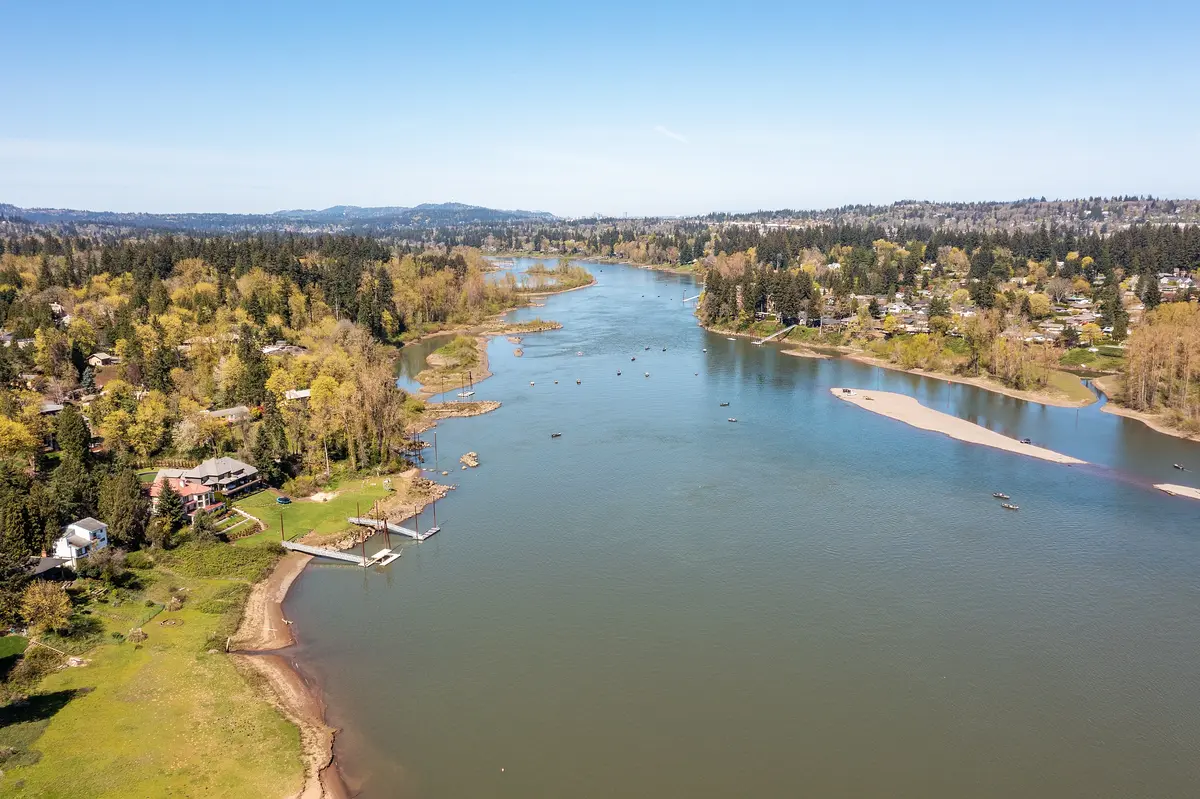
You have probably run the comparison: Oregon City versus West Linn to the north, or somewhere in the broader Portland Metro. West Linn is noticeably higher in price, and the city just south of it — Oregon City — sits at a median that still requires real money, but gives you something West Linn increasingly cannot: a genuine entry point into Clackamas County homeownership, with canyon trails minutes from downtown and a drive that is about 25 minutes to Portland on most days. The city of 37,755 sits where two rivers meet, on a pair of plateaus separated by a 90-foot basalt bluff, and that unusual geography shapes everything about the housing stock here.
The economic backbone is anchored by Clackamas County government, Clackamas Community College, the Oregon City School District, and a regional health system — employers that have historically kept the local economy stable rather than volatile. The Oregon City School District holds a B- rating, according to Niche, which is worth factoring into your long-term calculus if you have kids or plan to. The buyers who land here and stay tend to be people who want access to Portland without paying Portland-adjacent prices in every direction, and who are willing to trade a flat, walkable grid for a city that climbs, terraces, and surprises.
On the cost side, the cost of living in Oregon City is lower than West Linn and roughly in line with Milwaukie for most categories, but the typical home price at $605,330 (Zillow Home Value Index, July 2026) puts ownership well out of reach for the median household income without careful planning. Oregon has no sales tax, and the effective property tax rate here runs approximately 0.96% — that arithmetic matters when you are building a first-year budget. Day-to-day life mixes river access, a genuine historic downtown, and 26 park sites across the city's two plateaus.
Whether you are already touring open houses or still running numbers on a spreadsheet, the sections below break down what your budget actually buys here, how the buying process works in this market, a realistic cash-to-close snapshot, and the specific mistakes that cost first-time buyers the most in Oregon City.

The Oregon City First-Time Buyer Reality
The typical home price in Oregon City is $605,330 (Zillow Home Value Index, July 2026). That figure sits above what the median household income here can comfortably carry — a gap of roughly $64,000 between what a median-income household earns and what lenders typically want to see for a purchase at this price. That is the first honest thing a first-timer needs to hear: buying here requires either meaningful savings, a household income above the local median, or both.
What does that price actually buy? At or below the city median, you are looking at older construction — homes built in the 1970s through the 1990s on the lower plateau near McLoughlin Boulevard, or modest ranches tucked into the hillside neighborhoods. Areas like McLoughlin, Caufield, Hillendale, and Canemah tend to be where first-time budgets land most often; the neighborhood guide breaks down each area's character and housing stock in detail.
The competitive reality here is more forgiving than it was two years ago, but well-priced homes in the lower ranges still attract multiple buyers. First-timers who show up without a pre-approval letter are routinely passed over — sellers in this price band have enough demand that they do not need to wait. Patience and a willingness to take on cosmetic or mechanical updates open more doors than most buyers expect when they start the search.
The Homebuying Process in Oregon City, Step by Step
Step 1: Get Pre-Approved Before You Do Anything Else
This is not a formality in Oregon City — it is the price of entry. Listing agents here expect to see a current pre-approval letter attached to any offer. A pre-qualification (a softer, often unverified estimate of what you might borrow) is not the same thing and will not carry the same weight. Go to a lender, hand over your tax returns, pay stubs, bank statements, and W-2s, and get the hard credit pull done before you tour a single home.
First-time buyers most often get this step wrong in one of two ways: they get pre-approved for the maximum their lender will give them, or they wait until they find a house they love. Both are expensive mistakes. The maximum you can borrow and the amount that makes your monthly life comfortable are rarely the same number. Pre-approve for the ceiling, but shop with a target price you have thought through honestly.
Step 2: Find a Local Buyer's Agent
Oregon City's market has enough specific quirks — the two-plateau geography, school boundary lines that do not follow obvious neighborhood borders, and older homes with deferred maintenance that is common in the lower price bands — that having a buyer's agent who knows the city matters more than it might in a more homogenous suburb. A buyer's agent costs you nothing directly; their commission is typically paid by the seller. Interview two or three before committing.
Step 3: Shop Within Your Range and Make Offers Quickly
Homes priced correctly in the under-$575,000 range here move without sitting long. When you find a property that fits, the expectation in this market is that you will move within days, not weeks. Your agent will help you read the listing history — if a home has sat longer than average, there is usually a reason worth investigating before you waive anything to win it.
Step 4: Inspections Are Non-Negotiable
This is where first-timers most often get hurt in Oregon City specifically. The lower price bands here skew toward homes built before 1990, many of which have not been systematically updated. Expect to budget for a general home inspection, and strongly consider adding a sewer scope — older neighborhoods here sit on aging lateral lines, and a sewer repair after closing is one of the most expensive surprises a first buyer can face. The inspection period is your only real window to understand what you are buying; use it fully.
Step 5: Appraisal, Clear to Close, and Closing Day
Once your offer is accepted, your lender orders an appraisal. If the home appraises below your purchase price, you will need to negotiate, make up the difference in cash, or walk away (if you have an appraisal contingency — and you should). From appraisal to clear-to-close typically takes three to four weeks in a standard transaction. Oregon closings are handled by a title company or escrow officer, not an attorney — your agent and lender will coordinate the timeline, but you will sign a significant stack of documents on closing day and bring your verified funds to the table.
How Much Home Can You Afford in Oregon City
The table below gives you a concrete starting point for the cash you will need at closing under different scenarios. Closing costs in Oregon typically run 2–3% of the purchase price and include lender fees, title insurance, prepaid interest, and homeowners insurance escrow. These are estimates — your actual figures depend on your lender, your rate, and the specific property.
| Scenario | Purchase Price | Down Payment | Est. Closing Costs (2–3%) | Est. Cash Needed at Table |
|---|---|---|---|---|
| FHA (3.5% down) — entry-level | $450,000 | ~$15,750 (3.5%) | ~$9,000–$13,500 | ~$24,750–$29,250 |
| Conventional (3% down) — entry-level | $450,000 | ~$13,500 (3%) | ~$9,000–$13,500 | ~$22,500–$27,000 |
| FHA (3.5% down) — near median | $550,000 | ~$19,250 (3.5%) | ~$11,000–$16,500 | ~$30,250–$35,750 |
| Conventional (3% down) — near median | $550,000 | ~$16,500 (3%) | ~$11,000–$16,500 | ~$27,500–$33,000 |
| Conventional (5% down) — at city median | $605,000 | ~$30,250 (5%) | ~$12,100–$18,150 | ~$42,350–$48,400 |
| Conventional (10% down) — at city median | $605,000 | ~$60,500 (10%) | ~$12,100–$18,150 | ~$72,600–$78,650 |
FHA loans require mortgage insurance for the life of the loan unless you refinance; conventional loans with less than 20% down require private mortgage insurance, which drops off once you reach 20% equity. Use the mortgage calculator below to model your specific monthly payment at current rates.
One number many first-timers undercount: prepaid items. Your lender will collect several months of homeowners insurance and property taxes upfront into an escrow account at closing — this is on top of the closing costs shown above, and it is real cash you need in hand on closing day. Build that into your savings target early, and confirm the full closing disclosure with your lender at least three days before closing day, when your lender is legally required to deliver it.
Looking to buy in Oregon City? Estimate your payment.
Enter your numbers to see an estimated monthly mortgage payment.
Estimate only. Excludes HOA fees and mortgage insurance. The interest rate above is a starting point, not a quoted rate — replace it with your own to see real numbers. Insurance is a flat placeholder, not a Oregon City quote.
Common First-Time Buyer Mistakes in Oregon City
Skipping Pre-Approval and Losing the House
The single most common story a buyer's agent tells about Oregon City first-timers is this: someone falls in love with a home in Caufield or Hillendale, calls their agent to submit an offer, and learns the seller accepted another offer that morning — from a buyer who was already pre-approved. In a market where well-priced homes at the entry level attract serious buyers, showing up without a lender letter is simply starting the race a lap behind. Get pre-approved first, even if you are still six months away from seriously shopping.
Waiving the Sewer Scope to Win a Bid
Oregon City's lower-priced neighborhoods are full of homes built in the 1960s, 1970s, and 1980s. The sewer laterals running from those homes to the city main are often original cast-iron or Orangeburg pipe — materials that fail. A sewer scope during the inspection period costs far less than a failed lateral after closing, which can run into the tens of thousands. First-time buyers in competitive situations are sometimes pressured — by sellers, by circumstances, or by their own eagerness — to skip it. Do not. The inspection contingency is your protection, and the sewer scope is the most Oregon City-specific piece of it.
Not Understanding the Two-Plateau Geography Before You Commit to a Neighborhood
Oregon City's upper and lower plateaus are separated by a bluff with limited cross-connections, and that physical reality shapes daily life in ways that do not show up on a listing photo. Neighborhoods on the lower level — along OR-99E near McLoughlin Boulevard — have fast access to Clackamette Park and the river, but commuting uphill or to the freeway at rush hour adds real time. Buyers who choose a neighborhood without driving it on a weekday morning, or without checking where the school boundaries actually fall, sometimes find that the trade-off does not work for their daily life. The living in Oregon City guide covers the commute reality in more detail.
Underestimating the Total Cash Required at Closing
The down payment number is the one that gets all the attention, and buyers often show up to closing surprised by how much more cash the table requires. Closing costs, prepaid homeowners insurance, property tax escrow, and any rate-buydown points add up to a meaningful sum on top of the down payment. On a $550,000 purchase with 3.5% down, the total cash you need at the table — not just the down payment — can be $10,000 to $15,000 more than buyers expect. Build that into your savings target early, and confirm the full closing disclosure with your lender at least three days before closing day, when your lender is legally required to deliver it.

Local Expert Takeaway: Oregon City rewards first-time buyers who do their homework before they fall in love with a house. Entry-level homes do exist here, but they tend to be older, and the inspection process is not a formality in this market. Get pre-approved, budget honestly for cash to close beyond just your down payment, and drive the neighborhoods on a weekday before you decide which plateau fits your life. The history and the geography here are genuinely compelling, and buyers who go in prepared tend to feel good about the trade-offs Oregon City asks them to make.
Quick Takeaways & FAQs
✅ Oregon City offers some of the most accessible entry points in Clackamas County, with the city-wide typical home price of $605,330 (July 2026) sitting noticeably below West Linn while still giving access to Clackamas County schools, trails, and the Portland commute corridor.
⚠️ The median household income here falls short of what a typical purchase requires by roughly $64,000 — this market genuinely demands savings discipline and a realistic budget ceiling.
📍 Older housing stock in the lower price bands makes a sewer scope during the inspection period especially important — it is the one step Oregon City buyers most often skip and most often regret.
What credit score do I need to buy a home in Oregon City?
How much should I save before buying a home in Oregon City?
Is Oregon City a buyer's or seller's market right now?
What is the property tax rate in Oregon City?
Does it make sense to buy in Oregon City rather than renting?
Moving to Oregon?
Tell us what you need help with and we'll connect you with local resources.
