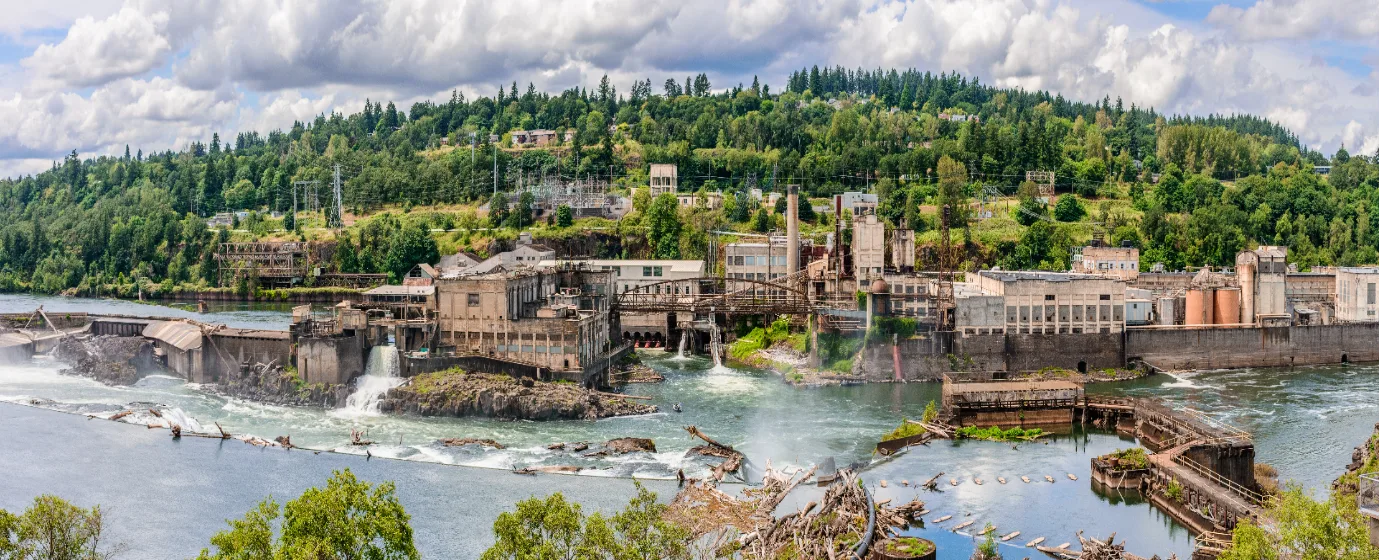
Oregon City surprises people who look at it only on a map. It sits about 25 minutes to Portland on I-205, carries some of the lowest prices in the Portland Metro for a city with a genuine historic downtown, and still has neighborhoods where lots are generous and the street is quiet by eight o'clock. The catch is that the city's topography — a series of basalt cliffs and river benches stacked on top of each other — means two houses a quarter-mile apart can feel like different towns entirely. The Municipal Elevator is not a novelty; it is what people actually use to move between levels of the city, and that vertical geography shapes everything from commute patterns to which grocery run makes sense.
Oregon City's 37,755 residents are served by a handful of institutions that anchor daily life: Clackamas Community College, Clackamas County government, the Oregon City School District, and a regional health system. The Oregon City School District, with 6,988 students enrolled in 2025-26, holds a B- rating, according to Niche. The median household income of $97,829 reflects a largely working-professional and trade population — many residents commute to Portland or to the wider Clackamas County employment corridor rather than working in-city. That commuter identity shapes which neighborhoods matter most and which trade-offs buyers are willing to make.
The typical home price in Oregon City sits at $605,330 (Zillow Home Value Index, July 2026) — noticeably below neighboring West Linn and somewhat above Gladstone and Milwaukie. For a city with a working waterfall visible from downtown, a National Historic Site, and a bluff trail system, that pricing still surprises buyers coming from elsewhere in the metro. The effective property tax rate of approximately 0.96% adds to the relative affordability, though it is worth noting that the median household income here falls below what it takes to comfortably carry the typical home — a real constraint for buyers at the entry level. For a full breakdown, see the Oregon City cost-of-living page.
Whether you are relocating from California, moving out of a Portland rental, or upsizing from a smaller Clackamas County town, the sections below break down Oregon City's eight core neighborhoods by character, buyer type, and honest trade-offs — so you can match a zip code to your actual life rather than a listing photo.

The Oregon City Reality
The single most important thing to understand about Oregon City's geography is that it is not flat, and that is not a detail — it is the whole decision. The city sits on three distinct topographic levels separated by basalt cliffs: the historic downtown and river edge at the bottom, a broad middle bench where McLoughlin and several residential neighborhoods spread out, and the higher plateau where most of the newer suburban growth has happened. What level you are on affects your commute route, your walkability, your relationship to the river, and how much of the city you interact with on a daily basis.
The second major divide is the OR-213 corridor. Neighborhoods that sit close to OR-213 — Hillendale, Caufield, Tower Vista — have easy on-ramp access and shorter drive times, but the trade-off is corridor noise and a more suburban feel. Neighborhoods further removed from the highway, like Canemah or Elyville / Barclay Hills, feel quieter and more self-contained, but every errand is a deliberate car trip. Buyers who assume Oregon City is uniform end up surprised six months in — particularly those who buy on the lower river level expecting walkable access to the upper-city shops and services, only to discover the elevator is charming but the walk up the cliff is not.
School boundaries within the Oregon City School District are drawn largely along these geographic and street-level lines, so a move of a few blocks can shift which elementary school a family is assigned to. The district serves the whole city, but individual school quality and programming vary — and a buyer who assumes all schools are equivalent because they share a district name is making one of the costlier assumptions in this market. Know the boundary before you make an offer, not after.
Neighborhoods at a Glance
| Neighborhood | Best For | Vibe |
|---|---|---|
| Park Place | Families Commuters | Owner-occupied, well-kept, community-oriented; mix of mid-century and newer infill on a planned suburban grid with trail connections in progress |
| McLoughlin / McLoughlin Historic District | Views Walkable | WPA-era promenade, 305 historic properties, riverfront character, and a basalt-bench setting that feels unlike anywhere else in the Portland Metro |
| Caufield | Families Quiet | Newer suburban subdivisions on the southeastern edge, engaged neighborhood association, semi-rural surroundings with strong commuter access |
| Tower Vista | Commuters Value | Central and car-dependent; proximity to Hillendale Park and a mid-city location without a strong defining identity |
| Hillendale | First-Time Commuters | Established central neighborhood with family-oriented housing stock; practical rather than scenic, but one of the city's most accessible entry points |
| Elyville / Barclay Hills | Privacy Nature | Craftsman bungalows and newer construction tucked into wooded lots; urban-suburban blend with a genuine historic character |
| Canemah | Privacy Views | Tiny riverfront hamlet with one of the most intact historic streetscapes in Oregon; deeply quiet, deeply car-dependent |
| Hazel Grove / Westling Farm | Families Quiet | Spacious lots on a former hazelnut farm in the south end; 1990s–2000s construction, a new neighborhood park, and an unhurried suburban pace |
Oregon City typical home price: $605,330 (Zillow ZHVI, July 2026). Typical rent: $1,955/mo (Zillow ZORI, July 2026). Neighborhood tiers on this page are relative to these figures.
Best Neighborhood by Buyer Type
| Buyer Type | Best Neighborhood | Why |
|---|---|---|
| First-Time Buyer | Hillendale | Prices run below the city median with solid single-family housing stock and practical OR-213 access — a realistic entry point without sacrificing space. |
| Luxury Buyer | Park Place | The neighborhood's above-median pricing reflects its owner-occupied stability, newer infill, and a city-backed concept plan shaping its long-term trajectory. |
| Walkability Seeker | McLoughlin / McLoughlin Historic District | The McLoughlin Promenade and proximity to the historic downtown core give this neighborhood the closest thing to on-foot daily life Oregon City offers. |
| Families with Kids | Park Place | High owner-occupancy, a planned trail system, community parks, and strong neighborhood bonds make it the most consistently family-oriented area in the city. |
| Commuters | Caufield | Direct access to OR-213 and I-205, newer homes, and an active neighborhood association combine to make Caufield one of the most commuter-ready addresses in the city. |
| Large-Lot Buyers | Hazel Grove / Westling Farm | Spacious lots from the 1990s–2000s build-out era, a southern location away from through-traffic, and a neighborhood built on farmland that still breathes. |
| Renters | McLoughlin / McLoughlin Historic District | Below-median pricing and a dense mix of housing types near downtown give renters more options in this neighborhood than most other parts of the city. |
Looking to buy in Oregon City? Estimate your payment.
Enter your numbers to see an estimated monthly mortgage payment.
Estimate only. Excludes HOA fees and mortgage insurance. The interest rate above is a starting point, not a quoted rate — replace it with your own to see real numbers. Insurance is a flat placeholder, not a Oregon City quote.
Most Popular Neighborhoods
1. Park Place
Park Place is the neighborhood Oregon City families tend to stay in once they find it. The housing stock runs from solid mid-century ranches to newer infill, with around 75% owner-occupied homes and an average household of nearly three people — which tells you something about who lives there. The 2024 update to the Park Place Concept Plan commits the city to mixed-use village nodes, off-street trail connections, and a large community park, which is encouraging for long-term value — though that future park is still in the planning stage, not yet built. Access to both I-205 and OR-213 makes the Portland commute manageable.
Best for: Families with kids, commuters who want a stable, owner-occupied neighborhood with room to grow.
2. McLoughlin / McLoughlin Historic District
McLoughlin sits on a broad basalt bench above downtown — what locals call the city's "second level" — and contains 305 historically significant properties shaped by a building boom that ran from the 1870s through the early 1900s. The McLoughlin Promenade, a WPA-era walkway on Singer Hill Bluff overlooking the Willamette River listed on the National Register of Historic Places in 2014, is the neighborhood's defining public amenity. Prices run below the city median, which makes the historic character here a genuine bargain — the trade-off is that older homes carry older-home maintenance costs, and the bluff topography means not everything is within walking distance the way it looks on a map.
Best for: Buyers drawn to historic character and river views who can work with an older housing stock and a more vertical daily life.
3. Caufield
Caufield is Oregon City's most classically suburban neighborhood — medium-to-large single-family homes, many built after 2000, laid out where the city's subdivisions meet the Clackamas County countryside. The Caufield Neighborhood Association is among the most active in the city, with some of the highest meeting attendance of any neighborhood group, which signals a community that actually shows up. The vacancy rate is effectively near zero, meaning homes here rarely sit available for long. Prices run below the city median, but the trade-off is that Caufield lacks walkable retail and errand-running means driving.
Best for: Families and commuters who want newer construction, a quiet edge-of-city feel, and genuine neighbor engagement.
4. Tower Vista
Tower Vista is the city's most practical mid-central address — adjacent to Hillendale, Hazel Grove / Westling Farm, and several other established neighborhoods, with pricing at roughly the city median. Hillendale Park, with its lake, basketball courts, and picnic areas, is the nearest significant green space. The neighborhood is car-dependent and lacks a strong defining identity of its own, which means it tends to attract buyers who are prioritizing proximity and price over character — not a criticism, just the honest read on what Tower Vista is.
Best for: Buyers who want mid-city location at the median price point without paying a premium for a neighborhood name.
5. Hillendale
Hillendale is where a lot of first-time buyers in Oregon City actually land, and for good reason: prices run below the city median, the housing stock is solid and family-oriented, and OR-213 access is real without the neighborhood sitting directly on the corridor. What Hillendale trades away is distinctiveness — there is nothing wrong with it, but there is also nothing about it that makes people stay for the neighborhood itself rather than for the convenience. For buyers stretched by Oregon City's income-to-price gap, that compromise is usually the right one.
Best for: First-time buyers and commuters who need practical access and below-median pricing more than neighborhood personality.
6. Elyville / Barclay Hills
Elyville was annexed into Oregon City in 1893 as a working-class neighborhood, renamed Barclay Hills, and has since reclaimed its original name — a history that shows up in the housing stock, where Craftsman bungalows share blocks with newer construction tucked into wooded lots on the edge of farmland. Residents describe it as having both an urban and suburban character, and that reads as accurate: it sits between the historic downtown core and the newer southwestern subdivisions, which means it draws buyers who want a historic feel without committing fully to the preservation obligations of the McLoughlin district. The data does not place this neighborhood against the city median, so say nothing about its price relative to others — shop it on its own terms.
Best for: Buyers who want historic character with a wooded, semi-rural edge and more flexibility than a formal historic district provides.
7. Canemah
Canemah is one of the most genuinely unusual places to live in the Portland Metro — a former riverboat-building town established in 1845, now a tiny community tucked along the Willamette River above Willamette Falls, with a historic district listed on the National Register of Historic Places since 1978. The neighborhood has fewer than 200 residents, and Canemah Bluff Nature Park preserves the original bluff landscape above the falls with walking trails and river views. The honest downside: most errands mean a drive, the tight historic street grid makes the neighborhood difficult to navigate on foot between levels, and the small scale means you will know your neighbors whether you want to or not. Prices run below the city median, but the trade-off is real isolation.
Best for: Buyers who specifically want the rarest address in Oregon City — historic, small-scale, riverfront — and can fully commit to a car-dependent daily routine.
8. Hazel Grove / Westling Farm
Hazel Grove / Westling Farm sits on what was a working hazelnut farm before the city grew south around it, and the neighborhood still carries that legacy in its spacious lots and unhurried pace. Most homes were built in the 1990s and 2000s, with some mid-century residences mixed in; the 3.5-acre Hazel Grove Park, completed in 2022, adds trails, a playground, and mature trees to what is otherwise a quiet suburban fabric. Prices sit at the city median. The trade-off is distance from downtown and the upper-city commercial areas — this is a neighborhood you drive out of, not one you walk around in.
Best for: Families and downsizers who want spacious lots, newer-era construction, and a genuinely quiet southern address.
Common Mistakes Buyers Make in Oregon City
Assuming the city is flat and uniform. Oregon City's basalt cliff system creates real daily-life differences between the river level, the McLoughlin bench, and the upper plateau. Buyers who tour a home on Singer Hill and assume the walk to downtown is a five-minute stroll discover the Municipal Elevator is the actual route — and it closes at night. Before you make an offer on anything on the lower or middle levels, walk the actual route between your front door and the places you go daily.
Underestimating downtown-area surface congestion. The primary north-south surface route through the city near downtown can back up significantly during morning and afternoon commutes. Buyers focused on I-205 access from Caufield or Park Place often underestimate how different the commute experience is for someone living on the lower downtown level who needs to reach that arterial first. Understand which road your address actually feeds before signing.
Chasing square footage over school-boundary awareness. The Oregon City School District covers the whole city, but elementary assignments follow geographic boundaries — and those boundaries do not always track neighborhood lines. A buyer stretching into Hillendale or Tower Vista for the extra bedroom without checking the specific school boundary may end up in a different elementary zone than expected. The schools page has the full breakdown; confirm the boundary with the district before you remove inspection contingencies.
Underestimating what below-median pricing means for older housing stock. Several of Oregon City's most appealing neighborhoods — McLoughlin and Canemah among them — carry below-median prices precisely because the homes are older. Late-19th- and early-20th-century construction means potential costs for foundations, electrical, plumbing, and windows that newer Caufield or Hazel Grove homes do not carry. Buyers who compare the sticker price without budgeting for a thorough inspection of an older home are making a math error that usually shows up in year two.
Best Areas to Rent in Oregon City
| Area | Ideal For | Trade-off |
|---|---|---|
| McLoughlin / Downtown Adjacent | Renters who want walkable access to the Oregon City Farmers Market, the historic downtown, and the river-level amenities | Older housing stock means more variable unit quality; the bluff topography limits how much you can actually reach on foot |
| Hillendale | Commuters and first-time renters who want a practical central address at a relatively accessible price point | The neighborhood is functional rather than scenic — little in the way of walkable retail or neighborhood gathering spots |
| Tower Vista | Renters who want a mid-city location close to Hillendale Park without paying a premium for a neighborhood name | Fully car-dependent; most daily errands require a drive regardless of where you are headed |
| Park Place | Families and long-term renters who want a stable, owner-occupied neighborhood feel with good commuter access | Rental inventory is limited — this is a predominantly owner-occupied area and vacancy is low |
| Caufield | Renters who want newer construction and a quieter, edge-of-city setting with strong OR-213 and I-205 access | Essentially no walkable retail; a serious shopping trip means driving, and the rental supply is tighter than in more central areas |
Oregon City's typical two-bedroom rent runs in the $1,800–$2,190 range, which is noticeably lower than comparable Portland neighborhoods but still a meaningful stretch given local wage levels. Rental inventory across the city is thin — especially in owner-heavy neighborhoods like Park Place and Caufield — so renters who find a well-priced unit tend to stay. For context on how that rent figure sits against household incomes in the city, the cost-of-living page has the full picture.

Local Expert Takeaway: Oregon City's neighborhoods are sorted by elevation as much as by price — and that topographic reality is something a lot of buyers from flat cities do not internalize until they are living it. The McLoughlin Promenade and Canemah Bluff Nature Park are genuinely worth building your neighborhood search around if you care about the river. If you care about commute efficiency, Caufield and Park Place are where I-205 access is cleanest. And if you are working with a budget below the city median, Hillendale and Canemah give you the most honest entry points without sacrificing structural quality — just understand the maintenance realities that come with Canemah's 19th-century housing stock before you fall for the views.
Quick Takeaways & FAQs
✅ Canemah is one of the only intact former riverboat towns in Oregon — a genuinely rare historic address at a below-median price, steps from Canemah Bluff Nature Park and Willamette Falls views.
⚠️ The city's basalt cliff system creates real daily-life divides between neighborhoods that look close on a map but require the Municipal Elevator or a significant drive to connect.
📍 Park Place has a city-approved concept plan updated in 2024 that commits to new community parks and off-street trails — making it one of the few Oregon City neighborhoods with mapped, funded future green space.
Which Oregon City neighborhood is best for families with young children?
What is the most affordable neighborhood to buy in Oregon City?
Is Canemah a good place to live in Oregon City?
How does Oregon City's topography affect which neighborhood you should buy in?
What should renters know before looking for apartments in Oregon City?
Moving to Oregon?
Tell us what you need help with and we'll connect you with local resources.
