About Ali
Keizer's Neighborhoods: What Each One Is Really Like
Keizer has 39,082 residents and a surprising amount of neighborhood diversity for a city that size. Knowing which pocket fits your life is the most important thing I can help a buyer figure out.
Greater Gubser and Northgate
Greater Gubser is consistently one of the most active buyer neighborhoods I work in. Families with kids and first-time buyers gravitate here — the housing stock leans toward ranches and split-levels on modest lots, the layout is walkable in the sense that neighbors actually know each other, and Greater Gubser sits right at the city median price. Northgate has a similar feel: established, accessible, and popular with buyers who want a move-in-ready home without stretching their budget.
West Keizer and Wilark Park
West Keizer runs closer to the Salem boundary, and that's both its draw and its quirk. Mid-century ranch homes on quarter-acre lots are common here, and the neighborhood has a more established, less HOA-managed character than some of the newer communities. Wilark Park sits adjacent to the greenway that connects through to Hidden Creek Estates — it's a genuine selling point for buyers who prioritize outdoor access on a daily basis, not just on weekends.
McNary Estates and Inland Shores
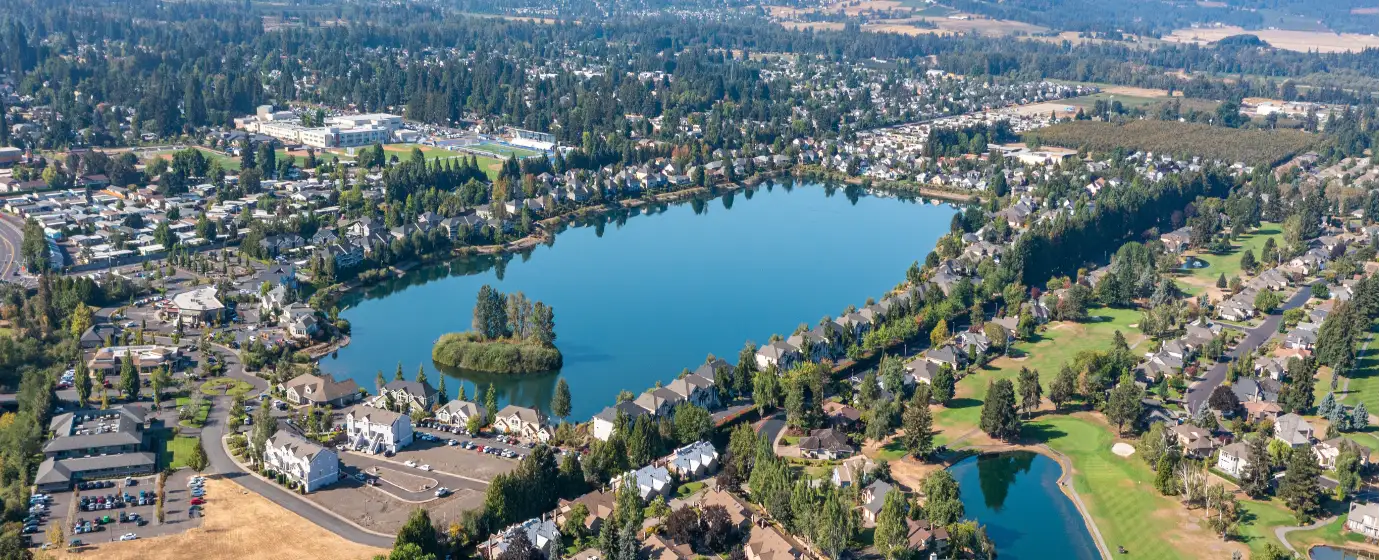
These are the two neighborhoods I show to buyers who want a more amenity-rich setting. McNary Estates wraps around the public McNary Golf Club — manicured lots, HOA governance, and a relaxed pace that appeals strongly to buyers coming out of higher-density areas. Inland Shores is its own thing entirely: the community surrounds Staats Lake, a lake that was formerly a rock quarry, with green spaces, fountains, and a mix of single-family homes and condos. Both carry HOA considerations worth reviewing carefully before an offer.
Hidden Creek Estates and Northeast Keizer
Hidden Creek Estates was built mostly between the mid-1990s and mid-2000s, has walking paths, no through-traffic, and connects directly to Wilark Park — the kind of quiet neighborhood where buyers who've been burned by busy arterials finally exhale. Northeast Keizer, anchored by the Keizer Station shopping complex near the I-5 and Chemawa interchange, is the part of town with the most recent commercial growth. New apartments have gone up here, and a 17-acre mixed-use project along River Road — described by Keizer's planning director as significant for the community — had its plans finalized in April 2025. If you want to be close to retail and are comfortable with a neighborhood that's still filling in around you, this corridor is worth a close look.
Best for: First-Time Buyers Families — Greater Gubser and Northgate. Move-Up Quiet — McNary Estates, Inland Shores, Hidden Creek Estates.
Keizer vs Nearby Cities
| City | Typical Home Price | Typical Rent | Cost vs Keizer |
|---|---|---|---|
| Keizer (this city) | $453,552 | $1,563/mo | — |
| Salem | $440,726 | $1,584/mo | 3% lower |
| Woodburn | $429,908 | $1,733/mo | 5% lower |
| West Salem | $430,000 | $1,500/mo | 5% lower |
Source — home prices: Zillow ZHVI, July 2026; rent: Zillow ZORI, July 2026. Nearby-city figures are the same series, refreshed together.
This is the comparison I walk through most often — because most buyers landing in Keizer have already looked at Salem, and some are wondering whether Woodburn or West Salem makes more sense.
Salem is the obvious reference point, and honestly, the price picture between the two is close enough that price alone shouldn't be the deciding factor. What tips buyers toward Keizer instead of Salem is usually the character of the city itself: Keizer incorporated separately in 1982, has its own civic identity, its own parks system with 19 parks, and a community that — for its size — punches above its weight in local events. The Iris Festival, the Summer Concerts in the Park, and the Salem-Keizer Volcanoes minor league baseball season give the city a sense of rhythm that some Salem neighborhoods simply don't have. That civic texture matters more than people expect, and I've had buyers choose Keizer over Salem specifically because of it.
West Salem sits across the Willamette River and runs somewhat lower on typical price than Keizer. It's a real option for buyers who want more of a hillside feel and don't mind that the river crossing is part of every commute. I tell buyers to drive that route at rush hour before they commit.
Woodburn, about fifteen miles to the north, runs somewhat lower in price and has a different economic character — more manufacturing and agricultural employment in the mix. Some buyers find it appealing for the lower entry point; others find the commute to Salem or Portland more than they bargained for once they're actually living it.
Brooks is small enough that I rarely compare it directly to Keizer — it's not a like-for-like choice. If a buyer mentions Brooks, I usually want to understand whether they're drawn to rural character or whether they've simply been outpriced everywhere else and are casting a wide net.
The engine has put a data table directly above this text showing the figures side by side. What those numbers can't show is the day-to-day texture of each city — and that's the part I help buyers work through in person.
Schools: What the Numbers Say and What They Don't
Keizer sits entirely within Salem-Keizer School District 24J, one of the largest districts in Oregon. Every home in the city feeds into it — which simplifies the picture in some ways and complicates it in others.
The district serves 36,837 students enrolled in 2025-26, according to the Oregon Department of Education. On 2024-25 state assessments, 20.9% of students reached math proficiency and 32.2% reached reading proficiency — figures the Oregon Department of Education publishes and updates annually. Those numbers are below state averages, and I think it's important to say that plainly rather than soften it. A large urban-suburban district serving a diverse, high-need population is going to produce outcomes that vary considerably from school to school and from year to year.
What the district-wide figure doesn't tell you is which school a specific address feeds into. I've worked with buyers who assumed proximity to a school meant assignment to it, and that's not always how boundary lines work in a district this size. The individual school picture within Salem-Keizer 24J is genuinely varied.
The district does have active OSAA athletics programs, and community involvement in school activities runs high — Friday night football is a real event in this town, not just a figurative one. That community texture matters to a lot of the families I work with, even when the academic metrics are more complicated.
My honest advice: anyone seriously considering a move to Keizer should confirm the assigned school for a specific address directly with the district and review the data the Oregon Department of Education publishes themselves. Don't rely on a map, a neighbor's assumption, or anything I tell you in general terms — the boundary confirmation is a five-minute call to the district and it's worth every second of it.
Looking to buy in Keizer? Estimate your payment.
Enter your numbers to see an estimated monthly mortgage payment.
Estimate only. Excludes HOA fees and mortgage insurance. The interest rate above is a starting point, not a quoted rate — replace it with your own to see real numbers. Insurance is a flat placeholder, not a Keizer quote.
Commute and Daily Life
The commute question is almost always the first practical thing buyers want answered, and Keizer's answer is genuinely straightforward for the Willamette Valley: it's about 12 minutes to Salem, with I-5 and OR-99E both available depending on where in Keizer you're starting from and where in Salem you're headed.
For buyers commuting to Portland, the math is different. Portland International Airport is roughly 55 miles out, and Eugene is roughly 65 miles. A daily Portland commute from Keizer is a real commitment — not impossible, but the buyers who choose to do it are either working remotely most days or have very specific reasons the Keizer price point justifies the drive. I always tell buyers to run that commute at least once during their actual work-week hours, not on a Sunday afternoon, before they're locked in.
Day-to-day errands are comfortably handled within the city for most buyers. Keizer Station anchors the northeast end of town with retail and services, and the River Road corridor handles a lot of the everyday shopping. Salem's downtown and additional retail are about 12 minutes away.
What Surprises People After Six Months
The thing that catches newcomers off guard most often is the grey. Keizer gets 153 sunny days a year, and while that's the Willamette Valley reality rather than a Keizer-specific one, buyers arriving from sunnier climates underestimate it. The November-through-February stretch in particular is genuinely grey and damp, and it changes how people feel about the outdoor amenities they were excited about in August. Keizer Rapids Park and the Claggett Creek Wetlands are legitimately beautiful — the disc golf course, the boat ramp on the Willamette, the multi-use trails — but the buyers who stay happiest here are the ones who've already made peace with Oregon winters.
The other thing people don't anticipate is how civic the city is. The Iris Festival — Keizer bills itself as the Iris Capital of the World — draws the kind of turnout that makes newcomers realize they've landed somewhere with a real community identity, not just a suburb that happens to have a name.
What the Money Actually Buys
The typical home price in Keizer sits at $453,552 (Zillow Home Value Index, July 2026), and the effective property tax rate runs approximately 0.88%. What that buys varies considerably by neighborhood, which is why I push back gently when buyers come in with a single price point and no sense of where in the city they want to be.
Greater Gubser sits right at the city median — buyers at that price point find solid ranch or split-level homes on quarter-acre lots, typically with three bedrooms, an established yard, and a neighborhood that's been stable for decades. Northgate has a similar housing character: established ranches and split-levels that represent good value for lot size and neighborhood stability, without the HOA layers that newer communities carry.
McNary Estates and Inland Shores are distinct enough from each other that I treat them as different conversations entirely. McNary is golf-course suburban in the best sense — you're buying a lifestyle as much as a house. Inland Shores is more unusual: a lake community inside a Willamette Valley suburb, with views and an HOA that maintains a level of upkeep that buyers either appreciate or find constraining. Both carry HOA fees and CC&Rs worth reading before an offer goes in.
Hidden Creek Estates makes its case quietly — walking paths, no cut-through traffic, and a connection to Wilark Park that makes it feel more spacious than the lot sizes alone would suggest. West Keizer brings mid-century character on quarter-acre lots, with a less HOA-managed feel than the newer communities.
One thing I want to name directly: the median household income in Keizer, at $84,813, falls meaningfully below what's needed to comfortably carry the typical home here. That gap is real, and it's why I have a lot of conversations about dual-income households, down payment sources, and realistic expectations before we ever start touring. It's not a dealbreaker for the right buyer, but it's not a number to ignore either.
Weekends and Local Favorites
This is where I'll name the places buyers ask me about directly, because the question of what a city is actually like to live in matters as much as the price and the commute.
Keizer Rapids Park is the outdoor anchor — 18-hole disc golf course, multi-use trails, and a boat ramp onto the Willamette. On a clear Willamette Valley Saturday, it's busy in the best way. Claggett Creek Wetlands gives the city a second nature corridor that's quieter and more contemplative, and it's the kind of place that outdoor-oriented buyers mention repeatedly once they've found it. Keizer Community Park and Wallace House Park fill out the neighborhood-level park system across the city's 19 parks.
For food and coffee, the local scene is more developed than first-time visitors expect. La Hacienda Real Keizer and Casa Los Dos Amigos handle the Mexican food conversation in a city where that conversation comes up often. The Margarita Factory Keizer has a strong following. Hops n Drops is the spot for casual food and local beer. In-N-Out Burger is there for the buyers who want to know.
For coffee, Bentley's Coffee, Java Crew Keizer, The REC: Grange, and Courthouse Coffeebar - Keizer give you real independent options rather than a choice between chains. The REC in particular has a community feel that fits the city's overall civic character.
The Salem-Keizer Volcanoes minor league baseball season runs through summer at Volcanoes Stadium, and it's genuinely one of the best inexpensive evenings out in the Willamette Valley. The Iris Festival draws the whole city every year. The Festival of Lights Holiday Parade and the Summer Concerts in the Park fill out the calendar in ways that make the civic identity of the city tangible rather than theoretical.
None of this replaces Portland's dining scene or Bend's outdoor access — and buyers should go in with clear eyes about that. But as a place to actually live day-to-day, Keizer has more going on than its market position suggests.
Final Advice From Ali
Quick Takeaways & FAQs
✅ Keizer's public-sector employment base — schools, city, county, and state — gives the housing market a stability that pure private-sector towns don't always have.
⚠️ The typical household income in Keizer falls meaningfully below what's needed to carry the typical home here, so buyers should run the numbers honestly before touring.
📍 Keizer is Oregon's 15th-largest incorporated city and calls itself the Iris Capital of the World — the Iris Festival each year is when that identity shows up in full force.
What is the commute from Keizer to Salem really like on a workday?
How do Salem-Keizer schools actually perform, and what should I know before choosing a home?
Which Keizer neighborhood is right for me?
How does Keizer compare to Salem for a buyer choosing between the two?
What does $453,552 actually buy in Keizer right now?
What surprises buyers most after they've lived in Keizer for six months?
Is Keizer a good fit for someone who works remotely?
What would you tell someone who is on the fence about Keizer versus just buying in Portland or waiting for prices to drop?
Moving to Oregon?
Tell us what you need help with and we'll connect you with local resources.
