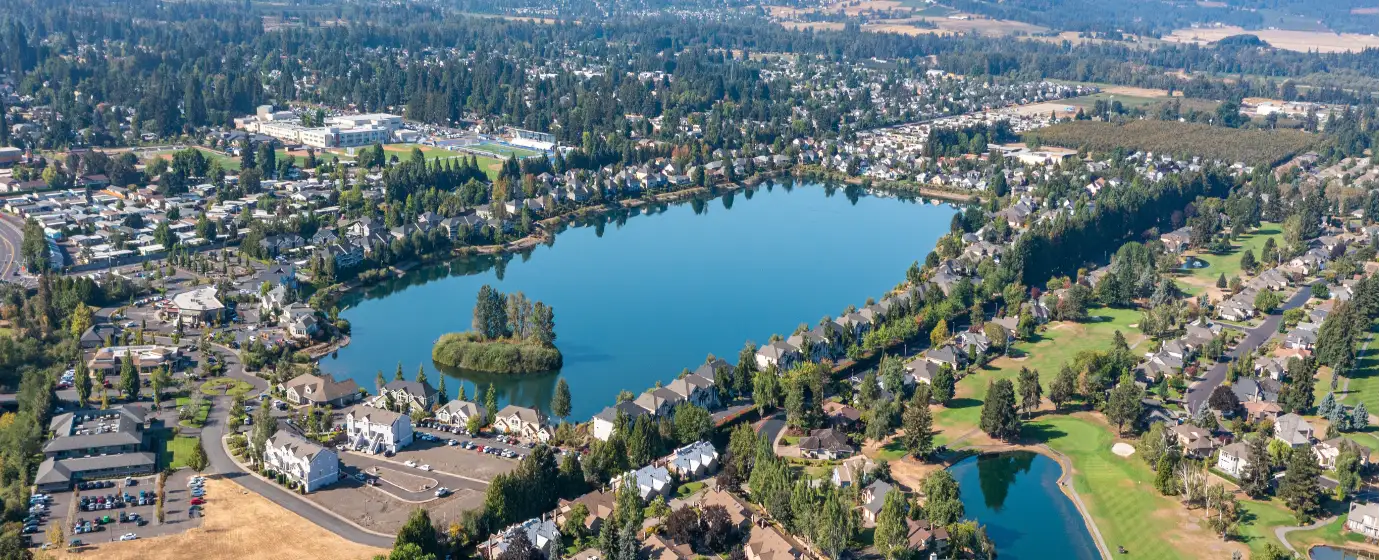
You've done the math on home prices and it looks almost too good to be true. A city of 39,082 people tucked into the Willamette Valley just north of Salem, Keizer sits along I-5 and OR-99E with a suburban layout that California transplants tend to recognize immediately — walkable neighborhoods, local parks on most blocks, and a density that reads as comfortable rather than crowded. What most people moving from California don't fully calculate until month three is how many separate line items change at once: the mortgage, the tax withholding, the receipt at the checkout counter, and the cost of covering a family's routine care.
The economic backbone here is public-sector employment — Salem-Keizer Public Schools, the City of Keizer, Marion County, and the State of Oregon anchor the job base, which means the community is built around stability rather than boom cycles. The Salem-Keizer School District 24J serves the area, with McNary High School as Keizer's home campus and active OSAA athletics programs that fill stands on Friday nights. Many residents commute about 12 minutes to Salem for work or services, and the city's position between Portland and Eugene makes it genuinely useful as a home base without requiring a Portland price tag.
Keizer's typical home price stands at $453,552 as of July 2026 — noticeably below what most California buyers left behind. Oregon's complete absence of a statewide sales tax is the most immediate daily difference for anyone arriving from a California county where the combined rate runs well above the statewide base. The catch on the tax picture is real and worth understanding before you assume the savings are simple. And Keizer's 153 sunny days a year — well below what most California coastal cities get — is the weather adjustment that catches people off guard more than any dollar figure.
Whether you're weighing a specific neighborhood, trying to model what your monthly picture looks like without California's tax structure, or just trying to understand what kind of city Keizer actually is, the sections below break down the home price comparison, the full tax landscape, what daily life costs, the lifestyle shift, and the honest trade-offs that come with leaving California for the Willamette Valley.

The Home Price Reality: What Your California Equity Buys Here
The headline figure is hard to argue with. Keizer's typical home price stands at $453,552 as of July 2026 — measured against California's statewide typical home value of $773,735 (Zillow Home Value Index), that is a gap most California buyers find genuinely startling when they see it on paper for the first time.
What that gap means in practice depends on where in California you're coming from. If you're arriving from a coastal metro, your equity position after a sale can cover a Keizer purchase with room left over. If you're coming from an inland California market that was already more affordable, the jump is smaller but still meaningful — Keizer's prices run noticeably below what most of those markets have reached in the last several years.
What the Entry Level Looks Like
Older ranch-style homes in established neighborhoods like Greater Gubser tend to sit at or near the city median. Newer construction in areas like Northeast Keizer near Keizer Station or the larger lots in McNary Estates and Hidden Creek Estates runs above it. The full neighborhood breakdown lives on the best neighborhoods page, but the practical point for a California buyer is that the city's entry-level inventory is real — you are not competing for a small slice of affordable stock the way you were at home.
Oregon's Measure 50: The Property Tax Structure That Matters
Keizer's effective property tax rate of 0.88% is governed by Oregon's Measure 50, which caps annual growth in a property's assessed value at no more than 3% per year. That means the bill you get in year one is essentially the bill you plan around for years two, three, and four — it does not spike with the market.
California's Proposition 13 worked similarly for long-term owners, but it resets entirely when a property sells. When you buy in Keizer, you exit Prop 13 protection and enter Oregon's Measure 50 cap at the new purchase price and Keizer's 0.88% rate. The comparison with California's effective property tax rate of 0.71% (Tax Foundation) is closer than many buyers expect — California's rate looks lower, but that figure reflects decades of Prop 13 compression across a base that includes many long-held properties. As a new buyer, Keizer's rate is not dramatically different, and the predictability of the 3% annual cap is the feature that actually matters over a 10-year hold.
For the full property and income tax breakdown, see the cost-of-living page.
Affordability: The Honest Caveat
Keizer's median household income of $84,813 sits below the income needed to comfortably carry the typical home at current prices. That gap is smaller than what California buyers typically face in their home markets, but it is still a gap. Remote workers arriving with California salaries are often in a different position entirely, and that mismatch between local wages and local prices is part of why transplants with out-of-state income have changed the buyer pool here over the last several years.
The Tax Picture: Where California Transplants Actually Save (and Where They Don't)
Oregon's tax structure looks friendlier than California's at first glance, and in several meaningful ways it is. But the picture is more complicated than a single headline rate, and walking into it without understanding the nuance leads to some genuine surprises.
Sales Tax: The Clearest Win
Oregon has no statewide sales tax — one of only five states with a 0% rate. For anyone arriving from California, where California's statewide base sales tax rate of 7.25% is only the floor and combined local rates in most counties push well above that, the difference is immediate and visible. Every grocery run, every appliance purchase, every car bought here carries no sales tax line on the receipt. For a household doing significant discretionary spending, this is the most tangible daily savings and the one that registers fastest.
The sales tax difference is most visible on large purchases: a car, a major appliance, home furnishings for a new house. Coming from a California county where the combined rate runs well above the statewide base, the absence of any tax on a vehicle purchase or a full home furnishing run is the kind of savings that actually shows up in a bank statement rather than just a qualitative comparison.
Income Tax: Read This Before You Assume It's Lower
California's top state income tax rate of 13.3% applies only to the highest earners — the nine-bracket system means most middle-income Californians are paying effective rates well below the top. Oregon's four brackets run from 4.75% to 9.9%, which sounds simpler and more favorable. The income-tax savings genuinely favor high earners who were paying at or near California's top rate; many middle-income households pay about the same or modestly more on the income tax line alone.
The sales tax elimination is what closes that gap for typical households — it is not the headline income tax rate that saves you money, it is the combination of no sales tax alongside lower housing costs. For very high earners, Oregon's 9.9% ceiling is a genuine reduction worth planning around. For everyone else, the honest framing is that you are trading a comparable income tax environment for a zero-sales-tax environment.
What the Table Shows
| Tax Category | California | Keizer / Oregon | Practical Note for Transplants |
|---|---|---|---|
| Sales Tax | California's statewide base sales tax rate of 7.25% (local rates often higher) | 0% | Immediate, visible savings on every purchase |
| Top Income Tax Rate | California's top state income tax rate of 13.3% | 9.9% | A clear win for very high earners; middle-income households often pay about the same or more |
| Property Tax Rate | California's effective property tax rate of 0.71% | 0.88% effective rate | Rates are close; OR's Measure 50 cap adds predictability |
| Prop 13 / Measure 50 | Resets on sale — Prop 13 protection ends when you sell | 3% annual assessed-value cap after purchase | New buyers in both states face similar protection going forward |
| Social Security Tax | Not taxed at state level | Not taxed at state level | Even; both states exempt it |
| Income Tax Brackets | Nine brackets, 1%–12.3% | Four brackets, 4.75%–9.9% | Oregon is simpler; not automatically lower for most earners |
The bottom line for most California transplants: the home price gap and the sales tax elimination are the two largest financial advantages. Income tax is roughly a wash or a slight disadvantage for typical earners, and property tax rates are close enough that predictability matters more than the rate itself.
Daily Life Costs: What the Monthly Picture Looks Like
Day-to-day expenses in Keizer run below what most California metros carry, and the difference shows up across multiple categories rather than just in housing. Most California markets index well above the national average on routine costs — Keizer does not.
Housing as the Anchor
The largest monthly change for most California transplants is the housing payment itself. Oregon's housing costs run noticeably below California's statewide average, and Keizer specifically sits below Oregon's broader average. A typical two-bedroom rental in Keizer runs $1,440 to $1,750 per month — a range that covers most of the city's apartment and rental-home stock. What that figure will feel like depends entirely on what you were paying before, and for anyone leaving a coastal California market, the adjustment is significant.
Groceries, Utilities, and Everyday Spending
Groceries in Keizer run modestly below what most California markets carry, and Oregon utilities come in slightly below California's average as well. Neither difference is dramatic on any single bill, but they compound alongside the sales tax elimination: a household that was spending meaningful money in California sales tax across all categories now spends zero, and the grocery and utility lines both run slightly below what they were used to. The cumulative effect on a monthly budget is more than the individual line items suggest.
Transportation costs are broadly similar to mid-size California metros — Keizer is a car-dependent city, and fuel and insurance costs are the primary variables. Phone and internet service runs close to national average rates. For a full breakdown of utilities, grocery costs, and transportation expenses by category, the cost-of-living page covers each line in detail.
Healthcare Costs
Health insurance premiums in Oregon generally run noticeably below what California residents pay, which matters for anyone buying individual or family coverage outside an employer plan. The honest trade-off is that the Willamette Valley has fewer specialists and less density of advanced care options than a major California metro — routine care is accessible, but you may drive farther for subspecialty appointments.
Looking to buy in Keizer? Estimate your payment.
Enter your numbers to see an estimated monthly mortgage payment.
Estimate only. Excludes HOA fees and mortgage insurance. The interest rate above is a starting point, not a quoted rate — replace it with your own to see real numbers. Insurance is a flat placeholder, not a Keizer quote.
The Lifestyle Shift: What California Transplants Find Familiar and What Surprises Them
Keizer reads as suburban in the way that a well-established California suburb from the 1980s and 1990s reads as suburban — owner-occupied single-family homes, sidewalks, parks within a short walk of most neighborhoods, and a commercial strip along OR-99E that handles most daily errands. California transplants tend to find the physical layout familiar within a few weeks. The adjustments tend to come from different directions.
The Weather Adjustment Nobody Fully Anticipates
Keizer gets 153 sunny days a year. That number sits well below what most California coastal cities average, and it is significantly below what inland California markets see. The Willamette Valley's fall and winter are genuinely gray — not bitterly cold, not heavy with snow, but overcast for stretches that can run weeks at a time between November and March. People who move from the Central Valley or Southern California and assume Oregon means the Pacific coast postcard version of Oregon weather tend to recalibrate that expectation by January of their first year.
What the City Actually Offers
Keizer Rapids Park anchors the city's recreational identity — the turf field upgrades authorized by the city council and funded jointly by Marion County through American Rescue Plan Act dollars make it a genuinely well-maintained destination, not just a neighborhood green. Claggett Creek Wetlands offers a quieter, nature-corridor experience that regulars treat as a different kind of escape. The ballpark on the city's east side — now operating as Roto-Rooter Park after a 2025 naming-rights deal and a reported $2.5 million upgrade — hosts the Salem-Keizer Volcanoes and delivers the kind of low-cost, community-feel summer evening that is genuinely hard to find in a California metro at any price.
The parks and recreation page goes deeper on the outdoor options.
The Trade-Off That Takes Longest to Make Peace With
Keizer is not a city with a traditional walkable downtown. Errands, dining, and most services require a car, and a serious shopping trip — anything requiring a wider retail selection — means driving. The commercial fabric is strip-mall suburban rather than main-street walkable, and that is true regardless of which neighborhood you land in. People who moved expecting the vibe of a California beach town's main street tend to be the ones who find themselves reconsidering after six months. People who moved to get more space for less money and didn't have a strong attachment to walkable urban amenities tend to settle in fast.
The community character leans toward families with school-age children and long-term homeowners. The living in Keizer hub covers the commuter picture and who the city tends to suit.
Weekends and Local Favorites: What Californians Discover After the Move
The places Keizer residents actually spend time are not the ones that show up in a relocation brochure. After a few months, the rhythm of the city becomes clearer, and it tends to center on a handful of anchors.
Where Locals Eat and Drink
La Hacienda Real Keizer and Casa Los Dos Amigos draw regulars who take the Mexican food seriously — these are not chain approximations. Margarita Factory Keizer fits the Friday-evening slot for a lot of people who work in Salem and want a drink without a drive back into the city. Hops n Drops handles the sports-bar end of the dining week. In-N-Out Burger exists here, which matters more to California transplants than to anyone who didn't grow up with it — finding it in Keizer is the kind of small continuity that makes a move feel slightly less disorienting in the first few months.
Coffee as a Social Anchor
Bentley's Coffee and Java Crew Keizer both have regulars who treat them as a second office. The REC: Grange and Courthouse Coffeebar - Keizer cover a slightly different register — more third-space than quick-stop. California transplants who were used to a dense independent coffee scene find Keizer's version smaller but genuinely local.
Parks as Community Infrastructure
Keizer Rapids Park, Claggett Creek Wetlands, Keizer Community Park, and Wallace House Park cover most of what families and residents need from the outdoor side of daily life. The parks are the reason Keizer's suburban density doesn't feel airless — there is enough green space distributed across the city that most neighborhoods have something within a short walk.
What People Miss From California
The most common honest answer from transplants is the food diversity. Keizer's dining scene is solid within its lane but narrower in range than what most California metros offer. The coast is reachable — roughly an hour and a half to two hours depending on conditions — but it is not the kind of afternoon-drive relationship that California coastal residents have with the water. Portland International Airport (PDX) sits about 55 miles out, and Eugene's airport (EUG) about 65 miles, which covers most travel needs without being particularly convenient for frequent flyers.
The city is actively pursuing middle-housing zoning and urban growth boundary expansion, which suggests the housing supply picture will shift over the next several years — an important signal for buyers thinking about long-term appreciation and neighborhood character, not just today's entry price. For the full schools picture, the schools page covers the district rating and named schools in detail.
Local Expert Takeaway: The case for Keizer as a California landing spot is real, but the savings are more precisely located than the headline numbers suggest. The home price gap versus California's statewide typical home value of $773,735 is where the money actually is. Oregon's zero sales tax is the second genuine win that shows up in daily life immediately. The income tax picture is more nuanced — the savings genuinely favor high earners, while many middle-income households pay about the same or modestly more on that line alone. Measure 50's 3% annual cap on assessed value growth means the property tax bill you start with is roughly the one you plan around for years, which is a different kind of value than the rate alone conveys. The adjustment that catches most California transplants off guard is the weather — 153 sunny days a year is not the Pacific Northwest fantasy, it is the Willamette Valley reality, and knowing that before January of your first year is worth more than any tax comparison.
Quick Takeaways & FAQs
✅ Oregon's complete absence of a statewide sales tax is the most immediate and tangible financial win for Californians arriving from counties where the combined rate runs well above the statewide base.
⚠️ Oregon's income tax savings genuinely favor high earners; many middle-income households pay about the same or modestly more on that line, making the sales tax elimination and lower home prices the real drivers of the household cost advantage.
📍 Keizer's ballpark, now operating as Roto-Rooter Park after a 2025 naming-rights deal and upgrade, hosts the Salem-Keizer Volcanoes and delivers the kind of affordable, community-feel summer evening that is genuinely hard to replicate in most California metros at any price point.
Is it actually cheaper to live in Keizer than in California?
How does Oregon's income tax compare to California's for someone earning a typical salary?
What happens to my property tax when I move from California to Keizer?
What should California transplants expect from the weather in Keizer?
How far is Keizer from Portland and what are the airport options?
Moving to Oregon?
Tell us what you need help with and we'll connect you with local resources.
