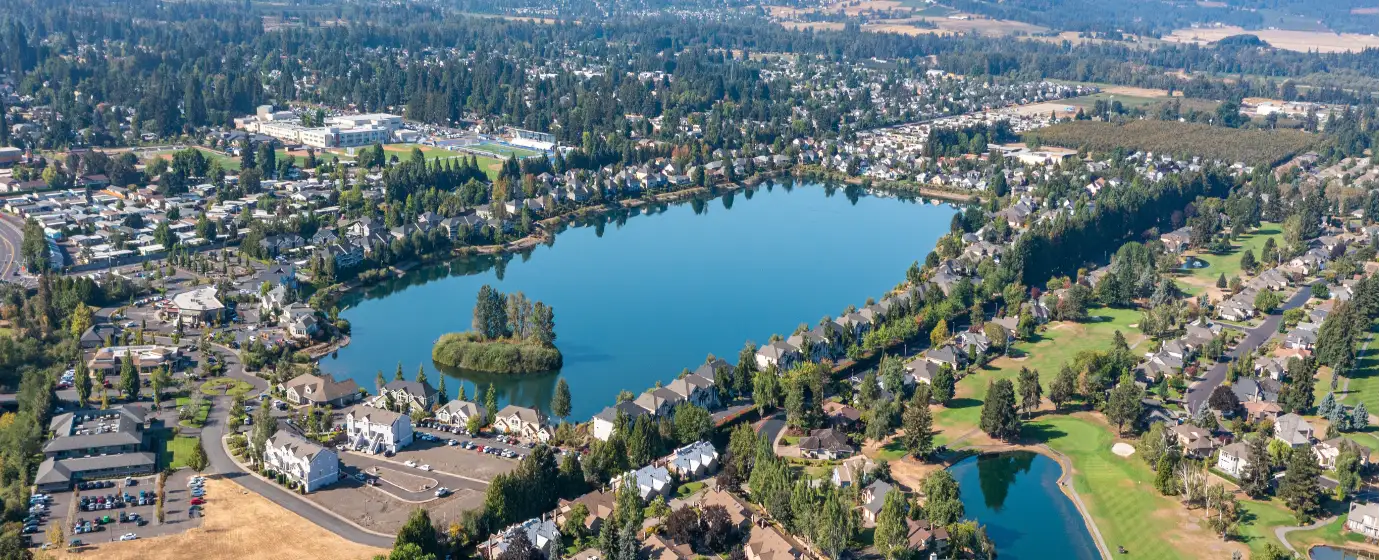
Plenty of retirees moving to the Willamette Valley aim for Salem and end up discovering Keizer — the smaller city directly north, running alongside the Willamette River, where the pace is noticeably quieter and the price point lands a step below what Salem's most desirable neighborhoods ask. At 39,082 residents, Keizer is large enough to feel like a real community but compact enough that you're not navigating the sprawl that defines much of western Oregon's growth corridor. I-5 and OR-99E both run through the city, which matters more in retirement than many people expect: those routes are your connection to Salem Hospital five miles away, to Portland International Airport (PDX) about 55 miles north, and to Eugene Airport (EUG) roughly 65 miles south when family visits require a flight.
The city's economic backbone is public-sector employment — Salem-Keizer Public Schools, the City of Keizer, Marion County, and the State of Oregon collectively make up the major employer base here. That means the community skews toward the stable, civic-minded households that typically make a neighborhood feel rooted rather than transient. Retirees here are often former state employees or educators whose pension income, combined with Oregon's complete exemption of Social Security from state income tax, gives them a workable fixed-income picture — though Oregon's treatment of other retirement income carries a real tax bite worth understanding before you commit.
The typical home price in Keizer sits at $453,552 (Zillow Home Value Index, July 2026), which puts it well below what Portland-area suburbs have been asking for years and makes a paid-off or low-mortgage retirement home genuinely achievable for households arriving with equity from a higher-cost market. The effective property tax rate runs approximately 0.88%, among the more manageable rates in the Willamette Valley. Oregon's complete absence of a statewide sales tax means your grocery runs, hardware store trips, and everyday purchases aren't quietly nickeled-and-dimed the way they are in neighboring states. The trade-off — and it's a real one — is the Willamette Valley's notorious gray-sky winters. Keizer averages 153 sunny days a year, which takes adjustment if you're arriving from California or the Southwest.
Whether you're weighing Keizer seriously or just beginning to map the region, this guide covers the healthcare picture, the retiree tax reality, what daily life actually looks like on a fixed income here, the question of walkability and senior community, your downsizing options, and how Keizer compares to other nearby retirement destinations in the valley.

Why Retirees Are Choosing Keizer
The case for Keizer in retirement starts with proximity without the price. Salem is the state capital, five miles south, with its own hospitals, arts venues, and services — and Keizer residents access all of it while paying for a quieter, slower city. The typical home price of $453,552 (Zillow Home Value Index, July 2026) is a threshold many retiring couples can clear with the equity from a sold family home, leaving room to land without a mortgage or with a modest one. For those moving from California, the delta is significant enough to change retirement math entirely.
Keizer fits retirees who want a real neighborhood, not a resort community. You'll find established streets, longtime neighbors who wave, and a city that runs its parks and services without the dramatic budget swings of fast-growing exurbs. Keizer Rapids Park anchors the western edge along the Willamette River, and Claggett Creek Wetlands gives the city a genuine natural corridor that draws walkers year-round. For retirees who want to stay active without driving to a gym, the park system is one of Keizer's strongest arguments.
Who should look elsewhere? If walkable access to a dense downtown — restaurants, galleries, transit — is non-negotiable, Keizer will frustrate you. Most errands require a car. The dining and nightlife scene is modest; if you're arriving from a city with a rich cultural calendar, the adjustment is real. Retirees who need specialized medical care beyond what a regional hospital provides — rare subspecialties, academic medical centers — will find that Portland's options are an hour away on a good day, more on a bad one. And if you prize winter sunshine, 153 sunny days a year is an honest number that won't meet that need.
Healthcare & Medical Access in Keizer
Salem Hospital sits about 5 miles from Keizer and is the closest hospital to the city. It is a comprehensive regional health system with a Level II trauma center and a full emergency room — meaning serious injuries and acute cardiac events don't require a transfer out of the region in most cases. That Level II designation matters for retirees in a practical way: it signals a surgical team available around the clock, neurosurgery capability, and intensive care, which are the services that tend to matter most as people age.
The specialty depth at Salem Hospital is substantial for a regional system. The hospital covers cancer care, cardiac services including a cardiac rehabilitation program, orthopedics and joint replacement, neurosciences, spine and pain management, imaging, sleep disorders, and diabetes care — a list that maps closely onto what most people over 65 actually use. The anticoagulation clinic alone serves more than 90 patients daily, managing conditions like atrial fibrillation, heart valve replacement complications, deep-vein thrombosis, and stroke recovery. For retirees managing chronic conditions, that kind of on-the-ground depth matters more than a headline ranking.
Salem Hospital also hosts Mended Hearts, the peer-to-peer cardiac patient support network, with monthly meetings — a meaningful resource for anyone recovering from heart surgery or supporting a spouse through it. The community dimension of healthcare is easy to overlook, but it's the kind of thing retirees who've lived through a cardiac event tend to mention first.
The honest limitation: if you need a subspecialty that only Oregon Health & Science University in Portland carries — certain complex cancers, rare neurological conditions, organ transplant — you're looking at roughly an hour's drive on I-5 on a clear day. That gap is real, and it's worth factoring into your decision if a complex diagnosis is already in the picture. For most retirees in good-to-moderate health, the coverage Salem Hospital provides is sufficient for day-to-day and emergency needs without leaving the area.
The Retiree Budget in Keizer
Oregon's tax posture for retirees is genuinely mixed, and the marketing version — "no sales tax!" — is only part of the picture. The full picture: Oregon fully exempts Social Security and Railroad Retirement benefits from state income tax, which is a meaningful break for retirees whose income leans on those sources. But pensions, 401(k) withdrawals, annuities, and IRA distributions are taxed as ordinary income under Oregon's graduated rate structure, which runs from 4.75% to 9.9%. A retiree drawing significantly from a pension and traditional retirement accounts will feel that.
One credit worth knowing about is now gone. Oregon's Retirement Income Credit — which gave lower-income seniors age 62 and up a credit of up to 9% on eligible pension income — sunsets after tax year 2025 and cannot be claimed going forward. A 2025 legislative effort to extend it did not pass. If you were counting on it, it's no longer part of the calculation.
There is a meaningful property tax option for seniors here. Oregon homeowners age 62 or older may defer property tax payments entirely until the home is sold, provided household income stays under $60,000 and the home has been owned and occupied for at least five years before applying. At an effective rate of approximately 0.88%, Keizer's property tax burden is already moderate — and for retirees who qualify for the deferral program, it becomes a cash-flow tool worth discussing with a tax advisor.
The absence of a statewide sales tax is the real daily-life benefit. Groceries, household supplies, prescriptions not covered by insurance — none of those transactions carry an additional state tax at the register, which adds up quietly over a year on a fixed income. Day-to-day costs in Keizer are in line with what you'd expect from a mid-size Oregon city, without the premium baked into Portland's immediate suburbs. For a full breakdown of Keizer's cost of living, including utilities and typical rent figures, the cost-of-living page has the detail.
Looking to buy in Keizer? Estimate your payment.
Enter your numbers to see an estimated monthly mortgage payment.
Estimate only. Excludes HOA fees and mortgage insurance. The interest rate above is a starting point, not a quoted rate — replace it with your own to see real numbers. Insurance is a flat placeholder, not a Keizer quote.
Walkability, Community & Staying Active in Keizer
Walkability in Keizer is honest rather than impressive. The city was built around car ownership, and most errands — grocery runs, pharmacy trips, medical appointments — will require driving. That said, the park system is genuinely walkable once you're in it. The City of Keizer maintains 19 parks, and Keizer Rapids Park in particular offers paved paths along the Willamette River that are flat, wide, and accessible for retirees who want a daily walk without navigating hills or traffic. Claggett Creek Wetlands adds another natural corridor that many residents use year-round.
The Keizer Station area, near the northeastern edge of the city, has a more walkable commercial character than most of the city — a cluster of shops, services, and dining options close enough together that a retiree living nearby can reach them without a car trip. It's not a downtown in the traditional sense, but it functions as one for practical purposes.
What Keizer lacks is an organized senior center with a strong programming calendar — that kind of hub tends to draw retirees into community in a way that informal parks and commercial strips don't. Retirees who've built social lives around a senior center in a previous city often find they need to be more intentional about building community here. The flip side is that the city's proximity to Salem, about 12 minutes to Salem by car, gives access to Marion County's broader senior services, volunteering opportunities, and community programming that Salem's larger population base supports.
Active retirees who care about outdoor life will find the Willamette Valley setting rewarding. Silver Falls State Park — Oregon's largest — lies about 26 miles east of Salem, making it a comfortable day trip. The region's Willamette Valley wine country is accessible in all directions. The Oregon Garden near Silverton draws gardeners and walkers through the warm months. These aren't substitutes for a local senior center, but they're a real part of daily life quality here that shouldn't be undersold.
Volcanoes Stadium, home of the Salem-Keizer Volcanoes, gives the community a summer gathering rhythm that many retirees appreciate — affordable, low-stakes, genuinely local. Summers in the valley are warm and dry, and the ballpark is the kind of place where you run into the same people every week.
Right-Sizing: Downsizing in Keizer
No 55+ communities were found in Keizer. That's an honest constraint worth naming early, because it rules out the gated, amenity-rich active-adult community model that some retirees are specifically looking for. What Keizer does have is a general housing stock that includes a reasonable number of single-story ranch homes — the kind of practical, low-maintenance option that makes up most of the city's older residential neighborhoods like Greater Gubser and Northgate.
For retirees who want single-level living without age-restricted covenants, Keizer's ranch-home inventory is worth exploring. These homes tend to run at or near the city-wide typical price, and the lots are generally manageable in size — enough yard to enjoy without becoming a maintenance burden. The neighborhoods page has more detail on the character of specific areas and how they compare on price.
Assisted living and memory care options do exist in Keizer for those navigating that transition or planning ahead. Bonaventure at Keizer Station offers retirement, assisted living, and memory care under one roof, with onsite amenities that include a bowling alley and movie theater — an unusual depth of programming for a community this size. The Village at Keizer Ridge provides assisted living and memory care as well, focused on residents who need support with daily activities or who are living with Alzheimer's or other forms of dementia. Neither of these is a 55+ independent community, but they are in-city options that families researching the next stage of care don't have to leave Keizer to find.
Retirees who want to rent rather than own will find the typical 2-bedroom rent in Keizer running $1,440–$1,750 per month, which is noticeably below what comparable units in Portland's suburbs command. That spread makes renting a genuinely viable transitional strategy — useful for retirees arriving from out of state who want to learn the city before committing to a purchase.
Keizer vs Nearby Retirement Destinations
| City | Cost vs Keizer | Primary Hospital | Walkability | Senior Living Depth | Overall Retirement Fit |
|---|---|---|---|---|---|
| Keizer | Anchor | Salem Hospital (~5 mi), Level II trauma | Car-dependent; flat, walkable parks | Assisted living & memory care in-city; no 55+ communities | Strong value, solid regional healthcare, quiet neighborhoods |
| Salem | About the same | Salem Hospital (in-city), Level II trauma | Better walkability in core neighborhoods; transit options | Broader range of senior communities and services | More amenities and senior programming; slightly more urban |
| Woodburn | Somewhat lower | Legacy Silverton / Salem Hospital for major care | Car-dependent; modest walkable commercial area | Limited in-city senior living options | Budget-friendly; smaller community feel; fewer local services |
| West Salem | Somewhat lower | Salem Hospital (short drive across the bridge) | Hilly terrain limits on-foot access; car essential | Some senior housing options near the Salem core | Quieter residential feel; good hospital proximity |
| Silverton | Pricier | Legacy Silverton Medical Center (small community hospital); Salem Hospital for complex care | Genuinely walkable small-town downtown | Limited; small-town inventory | High livability; charming downtown; further from major medical |
| McMinnville | Pricier | Willamette Valley Medical Center; Salem or Portland for complex care | Walkable historic downtown; flat streets | Growing senior living market | Strong quality of life; wine country access; higher cost |
Salem is the most direct comparison to Keizer and the most practical alternative — same hospital, same valley, similar cost, but with more walkable neighborhoods, better transit, and a wider menu of senior services and community programming. Retirees who want more out of their immediate surroundings without moving far will find Salem the natural upgrade.
Woodburn and West Salem both come in somewhat lower on cost, which matters on a tight fixed income, but both trade away amenities and senior community depth to get there. Silverton is the choice for retirees who put quality of small-town life above all else — it's the most genuinely walkable of these options and surrounded by the Oregon Garden and wine country — but its smaller hospital means serious care requires a drive to Salem or beyond. McMinnville has developed a reputation as a retirement destination in its own right, with a walkable historic downtown and strong wine-country access, but it prices higher than Keizer and sits further from the Level II trauma capabilities at Salem Hospital.
For retirees whose priorities are reasonable cost, reliable regional healthcare within a short drive, quiet neighborhoods, and easy access to the broader valley, Keizer holds up well in this comparison. The gap is community programming and walkable daily life — Salem wins those, and for retirees who weight them heavily, living in Salem proper rather than Keizer is the more honest recommendation.
Local Expert Takeaway: Keizer's retirement case is built on three things: a hospital with Level II trauma and strong specialty depth five miles away, a home price that gives equity-rich buyers room to land comfortably, and a park system centered on Keizer Rapids Park that makes staying active genuinely easy. The gaps are real too — no 55+ communities, a walkability picture that requires a car for most errands, and Oregon's income tax on pensions that catches some retirees off-guard. The retirees who land here happily tend to be the ones who've done the tax math, don't need a walkable downtown, and find the Willamette Valley's trails, wineries, and Silver Falls day trips to be enough of a cultural life.
Quick Takeaways & FAQs
✅ Salem Hospital, about 5 miles away, provides Level II trauma care and a wide range of specialties — including cardiac, oncology, and orthopedics — without leaving the immediate area.
⚠️ Oregon fully exempts Social Security from state income tax, but pension and IRA withdrawals face rates up to 9.9%, and the Retirement Income Credit for lower-income seniors expired after tax year 2025.
📍 No 55+ communities exist in Keizer, but two in-city assisted living and memory care communities — Bonaventure at Keizer Station and The Village at Keizer Ridge — serve residents who need support beyond independent living.
Is Keizer, Oregon a good place to retire?
Does Oregon tax Social Security retirement income?
What hospital do Keizer residents use?
Are there 55+ or active adult communities in Keizer?
Can Oregon seniors defer property taxes in Keizer?
Moving to Oregon?
Tell us what you need help with and we'll connect you with local resources.
