
Maybe your company went fully remote and the Bay Area stopped making sense. Maybe you've been watching your California property tax bill creep up as a newer buyer while the neighbor who bought in 1988 pays a fraction of what you do. Or maybe you just drove through the Willamette Valley once and something clicked. Whatever brought Cottage Grove onto your radar, this small city of 10,698 residents in Lane County sits about 25 minutes from Eugene along I-5 — close enough to a real city, far enough that the pace is genuinely different. The covered bridges, the Row River Trail, and Dorena Lake aren't marketing copy; they're what people actually do on weekends here.
The economic backbone is modest and honest: South Lane School District, the City of Cottage Grove, Weyerhaeuser's forestry operations, and Safeway anchor local employment. A meaningful share of newer residents work remotely, which reflects a broader Oregon inbound migration trend — California has consistently been the top source state for Oregon movers in recent years. The school district carries a B- rating from SchoolDigger and Niche.com, with 2,636 students enrolled in 2025-26, and active OSAA athletics programs that fill the stands on Friday nights. This is not a city where you move for career advancement; it's one where you move because you've decided the career is portable and the lifestyle is worth something.
The cost picture is the real story for Californians. Cottage Grove's typical home price sits at $405,035 (July 2026, Zillow Home Value Index) — a figure that lands well below California's statewide typical home value of $773,735. Oregon has no statewide sales tax, which is the single most immediate financial change you'll feel after moving. Groceries and utilities here run below the Willamette Valley average, and the overall cost of goods and services is noticeably more affordable than in most California metros. Health insurance premiums run noticeably below what most Californians are used to paying, though you will drive farther for specialist care than you would in a major metro. For a fuller breakdown of utilities, groceries, and transportation costs, see the cost of living page.
Whether you're deep in the spreadsheet phase or you've already made the decision and want to know what daily life looks like, the sections below break down the home price comparison, the tax picture in honest detail, what to expect from the community, and the real trade-offs Californians encounter after the move.

The Home Price Gap: What Your California Equity Actually Buys Here
The number that changes everything for most California buyers is $405,035 — Cottage Grove's typical home price as of July 2026 (Zillow Home Value Index). California's statewide typical home value of $773,735 means the gap between the two is wide enough to reshape your financial position entirely, not just marginally.
What that delta means in practice: a buyer selling a California home near the statewide figure and buying at the Cottage Grove typical price often clears enough to put down a substantial percentage — sometimes enough to eliminate a mortgage payment entirely, or to carry a much smaller one at current rates. That shift in monthly overhead is what Californians most frequently describe as the actual reason they stayed after moving.
Entry-level homes in Cottage Grove — older ranches, smaller bungalows near Gateway or the Sunrise Estates area — come in below that typical figure, giving buyers with less equity a realistic starting point. The neighborhoods page covers the geographic character of each area in more detail.
One affordability note worth being honest about: the median household income in Cottage Grove is $80,875, which falls short of what's needed to comfortably carry the typical home at current rates. Many California transplants bridge that gap with equity from their prior sale — which is why this move works for Californians in a way it doesn't always work for local first-time buyers. If you're buying without California equity behind you, the first-time buyer page covers what that path looks like.
Active residential construction has been a feature of Cottage Grove in recent years, which matters if you want options beyond existing homes. New inventory is coming, and the pipeline has been meaningful for a city this size.
| Market | Typical Home Value | What It Signals |
|---|---|---|
| Cottage Grove, OR | $405,035 (Zillow Home Value Index, July 2026) | Realistic entry for equity-backed CA buyers |
| California statewide | $773,735 (Zillow Home Value Index) | Benchmark most CA movers are leaving |
| Eugene | Noticeably higher than Cottage Grove | Larger city, tighter inventory |
| Springfield | About the same as Cottage Grove | Similar affordability, more urban feel |
| Creswell | Noticeably higher than Cottage Grove | Smaller town, premium for proximity to Eugene |
The Eugene comparison matters because many Cottage Grove buyers are choosing between the two. Eugene offers more employment, more restaurants, more everything — but the price difference is real, and Cottage Grove's I-5 access makes the commute workable.
The Tax Picture: Where Oregon Actually Saves You Money (and Where It Doesn't)
California transplants often arrive expecting a broad tax cut. The reality is more specific — and worth understanding before you make assumptions about your take-home pay.
Sales Tax: The Clearest Win
Oregon has no statewide sales tax. None. California's statewide base sales tax rate of 7.25% is already the highest in the nation, and combined state and local rates in major California metros routinely push to 8.5%–9.5%. A household spending $50,000 a year on taxable goods saves roughly $4,000–$5,000 annually simply by living in Oregon. You feel this immediately — at the grocery checkout, the hardware store, every purchase that isn't exempt. It's not dramatic in any single transaction, but it compounds into a meaningful annual figure.
Income Tax: Read This Carefully
Oregon's top state income tax rate of 9.9% is lower than California's top state income tax rate of 13.3% — but that comparison only tells you about the top brackets. Oregon's structure is compressed, meaning the brackets hit middle earners sooner than California's do. The income-tax savings favor high earners; many middle-income households pay about the same or more in Oregon than they did in California on income tax alone. The real day-to-day financial win is the elimination of sales tax, not the lower top rate.
The real income-tax upside in Oregon is for remote workers with higher incomes. If you move to Cottage Grove while working for a California employer, you pay Oregon income tax — where you live — not California's rate. For most remote workers earning typical household incomes, the income tax change is more neutral; the sales tax elimination is where the savings actually live.
Oregon does allow most filers to deduct a portion of federal income taxes paid from Oregon taxable income, which reduces the bill for lower- and moderate-income households. That benefit phases out for joint filers with federal adjusted gross income above $290,000.
Property Tax: The Prop 13 Comparison
Cottage Grove's effective property tax rate is 0.77%. California's effective property tax rate of 0.71% looks lower on paper — but that figure is held down by Proposition 13 for long-term owners. If you're a newer California buyer, you're likely paying an effective combined rate of 1.1%–1.3% once local bond measures are included. Cottage Grove's 0.77% is a genuine improvement for anyone who bought in California in the last decade.
| Tax Category | California | Oregon / Cottage Grove | Who Wins |
|---|---|---|---|
| Sales tax | 7.25% base (often 8.5–9.5% combined) | 0% — no statewide sales tax | Oregon, clearly |
| Top income tax rate | 13.3% top rate | 9.9% top rate (Oregon) | Oregon at the top bracket only |
| Income tax, middle earners | Lower effective rate for many households | Compressed brackets hit sooner | California, for many earners |
| Property tax (new buyers) | 1.1%–1.3% effective with local bonds | 0.77% effective (Cottage Grove) | Cottage Grove |
| Property tax (long-term CA owners) | 0.71% effective (Prop 13 protected) | 0.77% effective (Cottage Grove) | Roughly equal |
| Overall state tax burden | High, driven by income and sales tax | Middle of the pack nationally | Depends on income level |
The honest summary: for most California transplants, the savings are real but concentrated in sales tax, not income tax. For very high earners, the income tax shift adds up. For recent California buyers, the property tax rate is also a genuine improvement.

What Daily Life Actually Looks Like After the Move
Six months in, the thing Californians most frequently mention isn't the price of housing — it's the absence of friction. Errands that took 45 minutes in traffic take 10. The Row River Trail is a genuine multiuse path that runs out of town into the hills, and on a weekday morning you'll see more herons than cars. Bohemia Park sits close to downtown and serves as a gathering point for the kind of low-key weekend that wasn't possible when weekends meant driving somewhere to find one.
The trade-off is scale. Cottage Grove has a population of 10,698. That means the dining scene is small — a handful of local spots, not a restaurant row — and a serious shopping run means driving out of town. You will be ordering online for categories the local shops don't carry. The South Valley Farmers Market fills a real gap during the warm months, but this is not a city where you can meet every need within the city limits.
Weekends and Local Favorites
The verified local anchors include Jack Sprats Restaurant and Vintage Inn Bar & Grill for sit-down meals, El Tapatio Mexican Restaurant & Cantina for reliable Mexican food, The Axe and Fiddle for a pub atmosphere with live music, and Bonanza Drive-Up for the kind of old-school drive-in order that makes sense after a morning on the trail. Coffee is covered by Dutch Bros Coffee, Gold Rush Espresso, Rally Coffee Bar, Espresso Barn, and BaDooBaz — more options than a town this size typically supports, and a reflection of how many remote workers are caffeinating here.
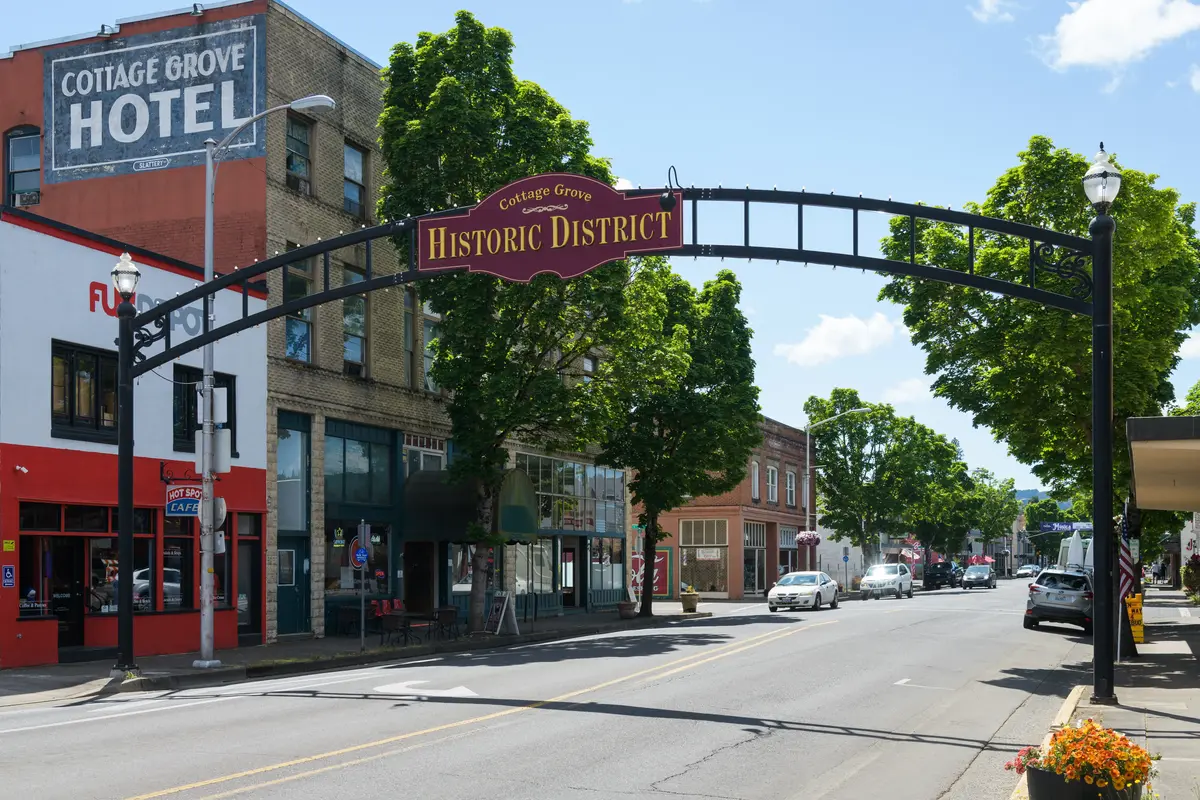
The outdoor infrastructure is the real draw. Cottage Grove Lake and Dorena Lake give the area two reservoirs within easy reach. Mosby Creek Covered Bridge is the most photographed of the historic covered bridges in the area — the Chambers Railroad Bridge, Currin Bridge, and Dorena Bridge are the others — and the whole corridor makes for a half-day drive that surprises people who expected flat farmland. The Cottage Grove Museum anchors the Historic District's identity alongside the downtown murals, which are more extensive than most visitors expect.
The seasonal surprise for California transplants is the rain. Cottage Grove gets 159 sunny days a year — more than Seattle, less than Sacramento. The Willamette Valley winters are gray and persistent in a way that the phrase "Pacific Northwest" doesn't fully communicate. Most people adapt. Some do not, and that's the honest reason a share of California transplants eventually leave: not the cost, not the schools, but January through March.
Looking to buy in Cottage Grove? Estimate your payment.
Enter your numbers to see an estimated monthly mortgage payment.
Estimate only. Excludes HOA fees and mortgage insurance. The interest rate above is a starting point, not a quoted rate — replace it with your own to see real numbers. Insurance is a flat placeholder, not a Cottage Grove quote.
Schools, Safety, and the Community Texture
South Lane School District carries a B- rating from SchoolDigger and Niche.com, with 2,636 students enrolled in 2025-26. On 2024-25 state assessments, 25.7% of students reached math proficiency and 34.7% reached reading proficiency — figures that track below Oregon state averages and should be read honestly. The district has active OSAA athletics programs, and Friday night football at Cottage Grove High School draws a real crowd in a way that signals genuine community investment in the schools, even when the academic metrics are mixed. For a deeper look at individual schools and what the district is doing, see the schools page.
The safety picture is more favorable. Cottage Grove has a violent crime rate of 2.7 per 1,000 residents and a property crime rate of 19.6 per 1,000 residents, both of which compare well against Oregon state averages. The safety page carries the full breakdown.
The community texture is specific to small-town Oregon in ways that take time to understand. People know each other at the hardware store. The Cottage Grove Museum is a volunteer-run institution that locals actually use. The historic downtown murals are a point of civic pride that predates the current interest in mural tourism. This is not a community that is performing small-town life for newcomers; it's one that has been operating this way for decades, which means Californians either find it genuinely welcoming or genuinely insular, depending largely on whether they show up willing to participate rather than just observe.
One friction point worth naming: the pace of services. DMV appointments, permit processing, contractor availability — all of it moves slower than what California residents are used to in larger metros. That's not a complaint unique to Cottage Grove, but it's worth knowing before your first Oregon winter requires an emergency repair and the schedule is two weeks out.
The Honest Case For and Against This Move
The case for moving to Cottage Grove from California is straightforward if your situation fits the profile: you have equity from a California home sale, you work remotely or are retiring, and you want the Willamette Valley without Eugene's prices. The typical home price of $405,035 (July 2026) against California's statewide typical home value of $773,735 is not a rounding error — it's a life-structure change. The zero sales tax is real money every month. The Row River Trail and the covered bridge corridor are genuinely beautiful.
The case against is equally direct. The school district's test scores are below state averages, which matters if your kids are in the thick of their academic years and you're comparing to a high-performing California district. The dining and retail footprint is small — not a temporary gap that's about to be filled, but a structural reality of a city this size. The income tax picture is more complicated than the headline top-rate comparison suggests, and if you're a middle-income earner without a California home sale funding the move, the financial logic is less compelling.
Californians who move here and stay tend to share a few things: they genuinely wanted a smaller life, not just a cheaper one; they had a financial cushion from the California sale; and they arrived in summer, which gives you enough time to fall in love with the place before you face your first February. Those who leave usually cite the weather, the limited job market, or the realization that the trade-off on services and amenities was larger than the spreadsheet suggested.
Eugene is about 25 minutes up I-5, and that proximity matters. Most of what Cottage Grove lacks — larger grocery stores, specialty retail, concerts, a broader dining scene — exists in Eugene, and the drive is genuinely short. Think of it less as "Cottage Grove instead of a city" and more as "a small town with a city nearby." That framing is what makes the move work for most people who stick around.
For a full picture of who this city tends to suit, and what the commute to Eugene actually looks like day-to-day, see the living in Cottage Grove hub.
Local Expert Takeaway: Cottage Grove is not a compromise destination — it's a deliberate one. The buyers who get the most out of this move are the ones who used California equity to dramatically reduce or eliminate their mortgage, who work remotely, and who wanted outdoor access and a slower pace as a feature rather than a consolation prize. The Row River Trail, the covered bridges, the short hop to Eugene on I-5 — these are the reasons people stay. The school district's academic metrics and the small retail footprint are the reasons some leave. Go in with eyes open on both, and this is a move that makes real financial and lifestyle sense for the right California household.
Quick Takeaways & FAQs
✅ Cottage Grove's typical home price of $405,035 (July 2026) sits well below California's statewide typical home value of $773,735, giving equity-backed California buyers a meaningful financial reset.
⚠️ Oregon's income tax brackets hit middle earners harder than California's do — the primary day-to-day financial win is the zero statewide sales tax, not the lower top income tax rate.
📍 California has consistently been the top source state for Oregon inbound movers, and Cottage Grove sits about 25 minutes from Eugene on I-5 — squarely inside one of the country's most active inbound migration corridors.
Is Cottage Grove actually affordable compared to California?
Do I pay California income tax if I move to Cottage Grove but keep a California employer?
What's the property tax rate in Cottage Grove, and how does it compare to California?
How are the schools in Cottage Grove for families moving from California?
What surprises Californians most after moving to Cottage Grove?
Moving to Oregon?
Tell us what you need help with and we'll connect you with local resources.
