
Search "is Cottage Grove safe?" and you'll get wildly different answers depending on which platform you land on. One commonly cited index places the city safer than roughly two-thirds of Oregon cities. Another puts it in a noticeably lower safety percentile. Neither source is fabricating numbers — they're drawing from the same FBI Uniform Crime Report data and then weighting and indexing it in ways that produce completely different conclusions. That gap is a methodology story, not a disagreement about what's actually happening on the ground. This guide cuts through it using a single consistent reporting series: Bureau of Justice Statistics, Crime Known to Law Enforcement, 2024.
The picture that emerges is more reassuring than a lot of those search results suggest. Cottage Grove, a city of 10,698 in the southern Willamette Valley about 25 minutes to Eugene on I-5, carries a violent crime rate of 2.7 per 1,000 residents — below the Oregon rate of 3.3 per 1,000 and well below the national rate of 3.7 per 1,000. The city also carries a property crime rate of 19.6 per 1,000 residents, which sits below the state's 24.5 per 1,000 figure but modestly above the national 18.4 per 1,000 baseline. That's the honest summary: a town that punches below average on violence but carries a real property crime load that varies significantly by part of town.
Where you land within Cottage Grove matters more than the city-wide rate. The northwest corner of town looks fundamentally different in the data than the commercial northeast, and that gap is meaningful for anyone choosing a neighborhood. The sections below walk through the headline numbers, where crime concentrates geographically, what the police department looks like in practice, and what you should actually pay attention to before settling on a part of town.

How Cottage Grove's Crime Rates Compare to Oregon and the Nation
The most important framing for Cottage Grove's numbers: this is overwhelmingly a property crime story, not a violent crime story. FBI 2024 calendar-year data shows the city's violent-to-property crime ratio is 0.14 — meaning for every violent incident, there are roughly seven property-crime incidents. That ratio tells you something important about the character of crime here.
Cottage Grove carries a violent crime rate of 2.7 per 1,000 residents, placing it below both the Oregon state rate of 3.3 per 1,000 and the national rate of 3.7 per 1,000 (Bureau of Justice Statistics, Crime Known to Law Enforcement, 2024, tables 2 and 3). For a small city in the southern Willamette Valley, that's a meaningful distinction. The city also carries a property crime rate of 19.6 per 1,000 residents — comfortably below the state's 24.5 per 1,000, while running modestly above the national 18.4 per 1,000 figure.
What the numbers don't capture is geography. A city-wide rate averages across very different parts of town — a quiet residential street in the northwest and a high-traffic commercial corridor near the highway count equally in that figure. The neighborhood picture, covered in the next section, is what actually matters when you're choosing where to live.
Where Crime Concentrates: A Neighborhood-Level Geography
The northeast part of Cottage Grove — where retail concentration along the commercial corridor is highest — accounts for the largest share of total reported incidents. That pattern reflects the reality of high-traffic commercial zones everywhere: more foot traffic, more parked vehicles, more targets of opportunity. Few of the people counted in that statistic actually live in that quadrant.
The northwest corner of the city tells the opposite story. Geographic data consistently shows the lowest incident counts in that part of town — a pattern attributed to lower commercial density, stronger owner-occupancy rates, and a residential street layout that discourages cut-through traffic. The Northwest Neighborhood fits squarely in this lower-incident zone.
The Southwest Residential Areas
Cottage Heights and View Heights, which occupy the elevated terrain to the southwest, also align with the lower-crime half of the city in geographic data. The topography itself plays a role: elevated neighborhoods with fewer through-streets naturally limit the kind of opportunistic movement that drives property crime in flatter commercial zones.
Downtown and the Historic District
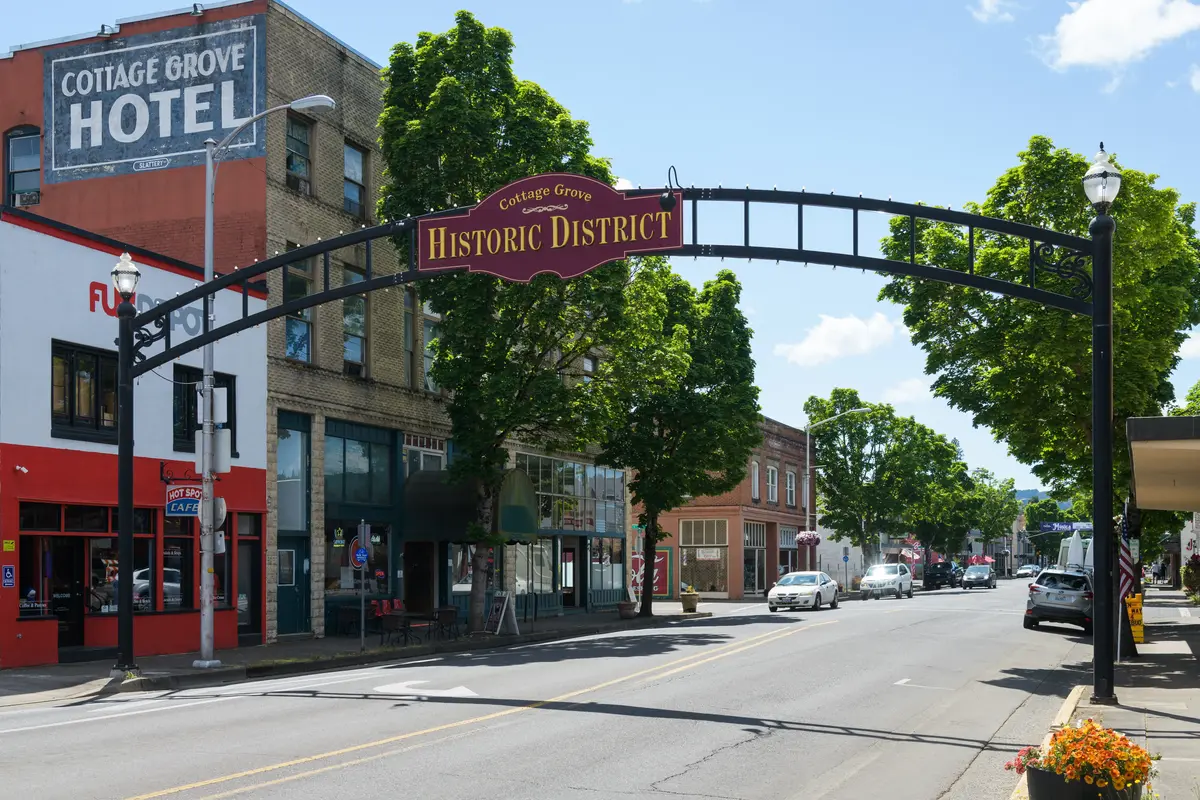
Downtown Cottage Grove carries the mixed profile typical of any active small-town main street. Daytime foot traffic is steady, the South Valley Farmers Market draws broad community participation, and the historic streetscape and murals give the corridor a genuinely welcoming feel. After dark on weeknights, foot traffic thins considerably, and a larceny-heavy property crime pattern — particularly involving parked vehicles — becomes more common. This isn't unusual for a small-city downtown, but it's worth knowing if you're choosing a home near the commercial core.
Gateway and Sunrise Estates
Gateway, which sits closer to the I-5 corridor, and Sunrise Estates on the eastern side of town carry profiles more consistent with the city-wide average than the quieter residential pockets to the west. Neither is a high-alarm area, but neither benefits from the geographic insulation that the northwest and southwest neighborhoods enjoy.
The practical takeaway: if property crime is your primary concern — and in Cottage Grove it should be, given the ratio — the northwest and southwest residential neighborhoods represent the most sheltered options. A closer look at Cottage Grove's neighborhoods covers the character and housing mix of each area in more detail.
What the Crime Statistics Don't Tell You
Platform-to-platform disagreement on Cottage Grove's safety ranking isn't a sign that the data is broken. It's a sign that different indexing methodologies produce different outputs from the same raw FBI figures. One site normalizes by population and compares Cottage Grove only to Oregon cities. Another weights offense severity differently. A third adjusts for demographics. None of them are lying — they're asking different questions.
The number that matters most to a resident rather than a researcher is simple: the overwhelming majority of crime in Cottage Grove is property crime, not violent crime. Theft from vehicles, shoplifting concentrated in commercial zones, and occasional residential burglary make up the bulk of calls. The city carries a violent crime rate of 2.7 per 1,000 residents — below both state and national figures — and that is what shapes the day-to-day feeling of living here.
One honest friction point: calls for police service increased in 2025, with property crimes among the most common offenses, according to the Police Department's 2025 Annual Report. More service calls don't automatically mean more crime — better reporting, population growth, and other factors contribute — but it's a detail worth sitting with rather than dismissing. The department itself presented this data to City Council in February 2026 as part of its accountability reporting, which is itself a transparency signal.
Small-city crime data also has a noise problem. Cottage Grove has 10,698 residents. A handful of incidents in a single category can shift a per-1,000 rate meaningfully. Treat the directional picture — below-average violence, near-average property crime, significant geographic variation — as more durable than any single year's precise figure.
Looking to buy in Cottage Grove? Estimate your payment.
Enter your numbers to see an estimated monthly mortgage payment.
Estimate only. Excludes HOA fees and mortgage insurance. The interest rate above is a starting point, not a quoted rate — replace it with your own to see real numbers. Insurance is a flat placeholder, not a Cottage Grove quote.
The Police Department: Staffing, Accreditation, and 911 Coverage
In January 2025, the Cottage Grove Police Department began pursuing accreditation through the Northwest Accreditation Alliance (NWAA), the U.S. Attorney General-designated independent credentialing body for Oregon law enforcement. The department received its Oregon Accreditation Alliance Certificate of Accreditation at a City Council meeting in February 2026 — a voluntary certification that most small police agencies in Oregon do not pursue.
That matters more than it might initially sound. Accreditation requires extensive documentation of policies, training standards, and compliance across dozens of professional benchmarks. For a department in a city of 10,698, completing that process is a meaningful institutional commitment. The department's training plan includes annual de-escalation tactics training, annual ethics training, and mental health and crisis intervention training — all mirroring Oregon DPSST certification requirements.
South Lane 911
The Police Department also houses South Lane 911, a 24-hour public safety answering point responsible for dispatching police and handling 911 call-taking for fire and emergency medical services across a 900-square-mile area. For newcomers, that's a reassuring piece of infrastructure: a single, locally operated dispatch center covering the city and a wide surrounding region, not a regionalized system that might deprioritize a small city's calls.
The Lane County Sheriff's Office and Oregon State Police provide additional coverage for the surrounding county areas, giving Cottage Grove a layered public safety structure that's proportionate to a city this size.
Staffing has been a stated priority. The 2025 Annual Report highlighted ongoing efforts to rebuild officer capacity — a challenge that's common to small-city departments across Oregon and not unique to Cottage Grove. The accreditation achievement suggests the department is investing in institutional quality even while managing the staffing constraints that come with a limited municipal budget.
What to Actually Look Into Before Choosing a Neighborhood
The city-wide rate is the starting point, not the answer. The gap between Cottage Grove's quietest residential pockets and its busiest commercial corridor is large enough that two people moving to different parts of town could have completely different lived experiences of safety — and both could accurately claim their experience matches the data.
The Questions Worth Asking
- Is the street primarily residential? The northwest and southwest neighborhoods, with their lower commercial density and contained street layouts, consistently show the lowest incident counts. A home on a residential street away from the commercial corridor will feel different from one adjacent to a high-traffic retail zone.
- What kind of property crime is most common nearby? Vehicle larceny — theft from parked cars — is the dominant property crime category in Cottage Grove, particularly around commercial areas and downtown after dark. Leaving valuables in a parked vehicle is a straightforward risk to manage.
- What's the owner-occupancy rate in the block you're considering? The northwest neighborhood's lower crime numbers are partly attributed to higher owner-occupancy rates, which correlates with longer-term residents and more consistent neighborhood attention.
A Seasonal Pattern Newcomers Miss
Summer brings a noticeable uptick in visitor and through-traffic volume — Cottage Grove sits between Eugene and Crater Lake on a common road-trip corridor, and the covered bridges and Dorena Lake draw seasonal visitors. More transient traffic historically correlates with more property crime opportunity, particularly vehicle break-ins near trailheads and popular parking areas. Residents who've been here a few years tend to treat it as a known seasonal rhythm rather than an alarm.
For a fuller picture of how Cottage Grove's neighborhoods differ in character and housing, the neighborhoods page covers the specifics, and the living in Cottage Grove overview sets the broader community context.
Local Expert Takeaway: Cottage Grove's safety picture is more nuanced than a single platform score suggests. Violent crime runs below both state and national averages, which is the number that most directly shapes daily life. Property crime — mostly vehicle larceny and theft — is the real consideration, and it concentrates heavily in the commercial northeast while the Northwest Neighborhood and the elevated southwest areas like Cottage Heights and View Heights report the city's lowest incident counts. The Police Department's voluntary accreditation through the Oregon Accreditation Alliance in early 2026 and the in-house South Lane 911 dispatch center are both credibility signals for a department this size. If you're weighing neighborhoods, start with the northwest or southwest residential pockets and ask specifically about vehicle break-ins rather than overall crime rates.
Quick Takeaways & FAQs
✅ Cottage Grove carries a violent crime rate of 2.7 per 1,000 residents — below Oregon's 3.3 per 1,000 state average and the national 3.7 per 1,000 figure — the most reassuring number in the city's safety profile.
⚠️ Property crime runs modestly above the national baseline, concentrated in the commercial northeast near the highway corridor, and vehicle larceny is the offense residents are most likely to encounter.
📍 The Cottage Grove Police Department received its Oregon Accreditation Alliance certification in February 2026 — a voluntary standard that most small Oregon agencies don't pursue — and houses the South Lane 911 dispatch center covering a 900-square-mile area.
Is Cottage Grove, Oregon a safe place to live?
Why do different websites give Cottage Grove such different safety ratings?
Which neighborhoods in Cottage Grove have the lowest crime rates?
What type of crime is most common in Cottage Grove?
How does the Cottage Grove Police Department compare to other small-city departments in Oregon?
Moving to Oregon?
Tell us what you need help with and we'll connect you with local resources.
