
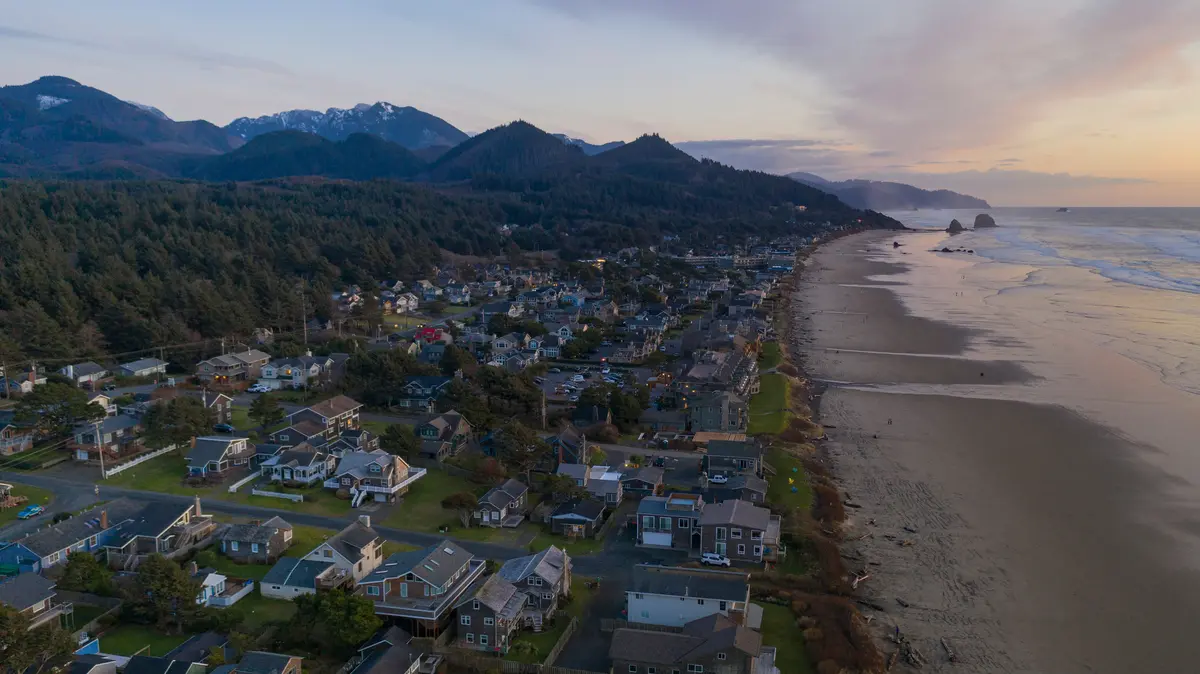
Maybe you've been coming to Cannon Beach for twenty years — the low-tide walks past Haystack Rock, the salt air through a gallery window, the way the fog burns off by noon on a clear day. Then you started doing the math and wondering if this could actually be where you spend the next chapter. The math is harder than the scenery. With a typical home price of $926,140 (Zillow Home Value Index, July 2026), Cannon Beach is not a retirement destination you ease into on a middle-class budget. It is a place you choose deliberately, with equity already in hand, and with eyes open about what the Oregon Coast does and does not offer in terms of medical infrastructure.
What draws retirees here is genuine. The town of roughly 1,500 permanent residents — the 139th-largest incorporated city in Oregon — operates at a scale that makes strangers into neighbors quickly. The Coaster Theatre Playhouse, the annual Sandcastle Contest, the Stormy Weather Arts Festival, and the volunteer culture around the Haystack Rock Awareness Program give the year-round calendar real texture. These aren't amenities bolted on to attract buyers; they are what the community runs on. Arts, coast, quiet, and a walkable downtown core: for the right retiree, Cannon Beach delivers all four simultaneously.
Oregon's tax treatment of retirement income is mixed but not punishing, and the absence of a state sales tax helps on everyday purchases. The bigger financial reality is the price of housing itself, which sits well above what most working households in town can carry — a gap that shapes who retires here and how. Daily costs outside real estate are moderate by coastal standards, and the full cost-of-living breakdown puts those figures in context.
This guide covers what you actually need to know before committing: the healthcare reality, the retiree tax picture, what walkability looks like on a rainy January Tuesday, the downsizing inventory available, and how Cannon Beach stacks up against nearby coast and river-town alternatives.

Why Retirees Are Choosing Cannon Beach
Cannon Beach is genuinely one of the most livable small towns on the Pacific Coast — but it fits a specific retiree profile, and being honest about that saves a lot of expensive mistakes. If you are arriving with significant equity from a California, Seattle, or Portland home sale, retiring here at a typical price of $926,140 (July 2026) is a real and increasingly common move. If you are arriving without that equity cushion, the numbers are steep enough that Seaside or Astoria deserve serious consideration first.
The retirees who thrive here tend to be the ones who genuinely want a small-town life — not as a compromise, but as the actual goal. A town of roughly 1,500 year-round residents means you will recognize faces at the Cannon Beach Farmers' Market and likely end up volunteering somewhere within your first year. That social density is the draw. It is also the constraint: if you want anonymity, big-city medical infrastructure, or a wide range of restaurants and services within walking distance, this is not your place.
The Oregon Coast's climate deserves a candid mention. Cannon Beach averages 124 sunny days a year. The winters are mild compared to the interior but genuinely gray and wet for months at a time. Retirees who love dramatic storm-watching from a warm living room do well here. Those who need sunshine for their health and mood tend to struggle through February and March. That seasonal rhythm is not a dealbreaker, but it is the thing locals mention most when asked what surprises newcomers after their first full year.
Healthcare & Medical Access in Cannon Beach
The honest answer on healthcare in Cannon Beach is that the town itself has very little of it. There is no hospital in Cannon Beach. For emergency care, the closest facility is Columbia Memorial Hospital in Astoria, about 23 miles away. That drive — along US-101 — matters when you are weighing retirement here against places with better immediate medical access.
Columbia Memorial Hospital in Astoria
Columbia Memorial Hospital is a critical access, not-for-profit hospital serving Clatsop County. It is not a community clinic — it offers emergency care, inpatient and outpatient surgery, cardiology, oncology, orthopedics, rehabilitation therapy, pulmonology, urology, hospice, and a women's health center. The hospital operates in partnership with Oregon Health & Science University (OHSU), which provides an academic medicine connection that meaningfully extends the specialty depth available at a facility of its size.
For routine specialist care — cardiology follow-ups, oncology monitoring, orthopedic consultations — Columbia Memorial covers most of what active retirees need. Where it cannot go is complex tertiary care: advanced cardiac procedures, neurosurgery, major cancer treatment protocols. For those, the practical answer is Portland, roughly 85 miles away. Retirees with significant ongoing medical needs should map that route and think hard about what two hours on US-101 in winter conditions means in a genuine emergency.
What This Means Practically
Cannon Beach does have a small clinic presence for primary care and urgent-care-level needs, but the staffing picture fluctuates at this scale of town. Many residents drive to Seaside — about 15 minutes away — for routine appointments. The honest framing: if you are in good health and managing stable chronic conditions, the Astoria-to-Portland corridor covers most situations. If you are managing complex, actively evolving health needs, the distance to advanced care is a real planning factor, not just a theoretical one.

The Retiree Budget in Cannon Beach
Oregon's treatment of retirement income has one clear bright spot and several things worth planning around. Social Security and Railroad Retirement benefits are completely exempt from Oregon state income tax — no income cap, no phase-out. That is a meaningful benefit for retirees whose income is primarily Social Security-based.
The Catch on Other Retirement Income
Pension distributions, traditional IRA withdrawals, and 401(k) income are taxed at Oregon's regular graduated rates, which run from 4.75% to 9.9%. There is no broad retirement-income exclusion, and a small retirement income credit that was available through 2025 has been scheduled to sunset beginning January 1, 2026. Retirees who modeled their budget around that credit should revisit the numbers with a tax professional. Oregon's top marginal rate is among the higher ones in the country, so a retiree drawing substantial pension or IRA income will feel it.
Property Tax and the Deferral Option
The effective property tax rate in Cannon Beach is approximately 0.69% — notably low for a state that can run higher on this figure in metro counties. On a high-value coastal home, that rate still produces a meaningful annual bill, which is why Oregon's senior property tax deferral program matters. Homeowners aged 62 or older whose household income does not exceed $60,000 (2025 threshold) can defer property tax payments until the home is sold, with the state paying the county directly and recording a lien at 6% simple interest. For retirees house-rich and income-modest, this is a genuine tool worth knowing about.
Estate Tax and No Sales Tax
Oregon's estate tax carries a $1 million exemption that is not indexed for inflation. Given that a typical Cannon Beach home already sits well above that threshold on its own, retirees with significant assets should work with an estate planner specifically on Oregon's exposure — many estates that clear the federal threshold easily are still subject to Oregon's tax. On the other side of the ledger, Oregon has no state sales tax, which helps on day-to-day spending. Groceries, clothing, restaurants, gear: none of it carries a sales tax line. For a retiree on a fixed income, that adds up across a year.
Daily costs outside housing run at small-town-Oregon levels — grocery prices are higher than a Portland suburb given the logistics of a coastal supply chain, and dining out in a tourist-oriented town trends more expensive than the inland alternatives. See the cost of living page for the full breakdown.
Looking to buy in Cannon Beach? Estimate your payment.
Enter your numbers to see an estimated monthly mortgage payment.
Estimate only. Excludes HOA fees and mortgage insurance. The interest rate above is a starting point, not a quoted rate — replace it with your own to see real numbers. Insurance is a flat placeholder, not a Cannon Beach quote.
Walkability, Community & Staying Active in Cannon Beach
Cannon Beach's downtown core is genuinely walkable in a way that not many towns of 1,500 can claim. The compact grid of galleries, restaurants, and shops means that once you are in the central area, most daily social life — coffee, a meal, browsing the Cannon Beach History Center & Museum — happens on foot. The NW Connector operates a local shuttle with connections to neighboring cities, which extends the car-free radius for retirees who prefer not to drive everywhere.
The Honest Walkability Reality
Outside the downtown core, car dependence returns. The residential neighborhoods — particularly The Heights east of US-101, or the quieter stretches of North End near Ecola Creek — require a vehicle for most errands. Terrain is relatively flat within the beach-level streets, which matters for retirees with mobility considerations, though some of the neighborhood streets east of the highway involve more grade. A serious grocery run or a big-box errand means driving out of town altogether.
Where the Community Life Actually Happens
For retirees, the social infrastructure here is anchored in arts and environment rather than traditional senior programming. The Coaster Theatre Playhouse draws a loyal year-round audience and offers consistent volunteer opportunities. The Haystack Rock Awareness Program — a well-established volunteer effort at the tidepool area — is one of the more meaningful ways retirees engage with the community. The volunteers in red jackets at the rock are, in practice, a substantial portion of Cannon Beach's active civic life.
The annual events calendar is unusually rich for a town this size. The Sandcastle Contest, a tradition of more than 50 years, the Stormy Weather Arts Festival in November, the Get Lit at the Beach literary gathering in April, and the Spring Unveiling in May give retirees a genuine civic rhythm through the year. Cannon Beach has been recognized as one of the best art towns in America, and the gallery scene is deep enough that volunteering or participating in it is how many retirees build their social circle here.
The beach itself — with low-tide walks to Haystack Rock and access to the Ecola State Park trails along the forested headlands — is the backdrop for daily life in a way that is hard to replicate. For retirees whose idea of staying active is a coastal walk followed by a farmers market stop, Cannon Beach delivers that without effort.
Right-Sizing: Downsizing in Cannon Beach
No 55+ communities were found in Cannon Beach. This is not a gap that is likely to close soon — the town's land constraints, coastal zoning, and tourist-economy real estate pressures work against the kind of purpose-built active-adult development that fills this role in larger markets. Retirees looking for that structure — gate, amenities, peer community, maintenance-free living — will need to look to Seaside, about 15 minutes away, for the nearest independent and assisted living options.
What the Single-Level Inventory Looks Like
The housing stock in Cannon Beach skews toward older construction — craftsman cottages, beach houses, and mid-century builds that range from genuinely charming to in need of significant updating. Single-level homes do exist, particularly in Tolovana Park and some of the original downtown-adjacent lots, but they are not the dominant form. Retirees who need step-free living should expect to search carefully and be prepared to compete for the limited inventory that fits those criteria.
Condos and patio-style homes are available but represent a small share of the total market. The advantage of the condo or smaller detached options is reduced maintenance burden — a real consideration on the coast, where salt air and moisture accelerate exterior wear and landscaping demands are constant. The trade-off is that even the entry-level attached or smaller-footprint options in this market carry prices that reflect the broader coastal premium.
The Practical Downsizing Decision
For retirees coming from a high-equity situation in a larger market, downsizing in Cannon Beach can mean trading a large suburban home for a smaller, well-maintained coastal cottage — freeing capital while landing in the community they actually want to live in. For retirees whose equity is tied up in a more modestly priced home elsewhere, the numbers rarely work without supplementing with significant other assets. The neighborhood guide covers which areas of town carry inventory closest to single-level and lower-maintenance stock. If assisted living or memory care becomes a future need, that conversation starts in Seaside or Astoria — there is no facility of that kind within Cannon Beach itself.
Cannon Beach vs Nearby Retirement Destinations
| City | Cost vs Cannon Beach | Primary Hospital | Walkability | Senior Living Depth | Overall Retirement Fit |
|---|---|---|---|---|---|
| Cannon Beach | — | Columbia Memorial Hospital (Astoria, ~23 mi) | Compact downtown walkable; errands outside core need a car | No 55+ communities; independent living requires driving to Seaside | Best for equity-rich, arts-oriented retirees who want small-town coastal life |
| Seaside | Noticeably lower | Columbia Memorial Hospital (Astoria, ~17 mi) | Flatter terrain; more walkable for errands than Cannon Beach overall | Strongest on the immediate coast; independent and assisted living options in town | Best for retirees who want coast access with more services and lower housing costs |
| Gearhart | Noticeably lower | Columbia Memorial Hospital (Astoria, ~20 mi) | Very quiet; car-dependent for nearly all errands | Minimal; very small community with few dedicated senior resources | Best for retirees seeking extreme quiet and a golf-oriented lifestyle |
| Astoria | Noticeably lower | Columbia Memorial Hospital (in town) | Hilly terrain; historic downtown walkable but physically demanding | Best on the north coast for senior services and medical proximity | Best for retirees who prioritize healthcare access and a real small-city infrastructure |
| Arch Cape | Comparable to Cannon Beach | Columbia Memorial Hospital (Astoria, ~30 mi) | Minimal; almost entirely car-dependent | None; unincorporated and extremely small | Best for retirees seeking genuine isolation with dramatic coastal scenery |
Astoria is the clear winner on healthcare access — Columbia Memorial Hospital is right there, and the city has more medical infrastructure than anywhere else in Clatsop County. If health concerns are the primary retirement planning variable, Astoria beats Cannon Beach on that dimension without much argument.
Seaside is the most practical alternative for retirees who love the Oregon Coast but find Cannon Beach's price point or its thin senior-services infrastructure a concern. The town has senior living options, a flatter walkable core, and sits noticeably lower on housing costs — all while staying well within the same coastal environment.
Cannon Beach wins on one thing decisively: the concentration of arts, gallery life, community events, and sheer physical beauty at a scale where you actually know your neighbors. For retirees whose retirement looks like morning beach walks, afternoon gallery time, and an active volunteer role at Haystack Rock — and who have the financial position to carry those home values — there is no better coastal Oregon option.
Local Expert Takeaway: Cannon Beach retirement works best when the lifestyle is the strategy, not the consolation prize. The retirees who settle in most successfully are the ones who arrived because of the Coaster Theatre and the Haystack Rock Awareness Program and the Stormy Weather Arts Festival — not despite the 23-mile drive to Columbia Memorial Hospital in Astoria. Get the healthcare logistics mapped early, understand Oregon's estate tax exposure at these property values, and know that your senior living options if your needs change will require a drive to Seaside or Astoria. Do those three things before you make an offer, and this small coastal town can be an extraordinary place to spend the next chapter.
Quick Takeaways & FAQs
✅ Oregon fully exempts Social Security income from state income tax, with no income cap — a genuine benefit for retirees whose income is primarily Social Security-based.
⚠️ No 55+ communities exist within Cannon Beach, and Columbia Memorial Hospital is 23 miles away in Astoria — retirees with complex health needs or who want purpose-built senior living should weigh those gaps carefully before committing.
📍 The Haystack Rock Awareness Program is a well-established volunteer-driven effort at the tidepool area and one of the primary ways year-round residents build community — it is where new retirees often find their people.
Is Oregon a good state for retirees from a tax standpoint?
What is the closest hospital to Cannon Beach?
Are there 55+ communities or senior living options in Cannon Beach?
Can I get around Cannon Beach without a car as a retiree?
Does Oregon have a property tax break for seniors?
Moving to Oregon?
Tell us what you need help with and we'll connect you with local resources.
