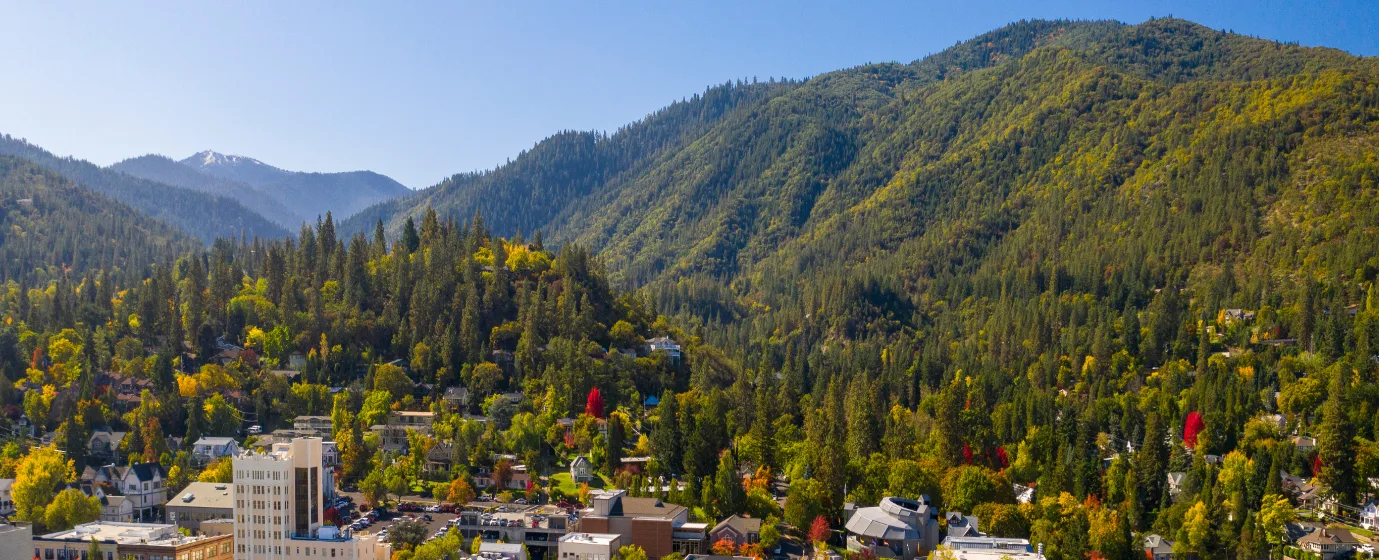
People who retire to Ashland, Oregon rarely describe it as a compromise. They describe it as the place they should have moved a decade earlier. A city of 21,259 tucked against the Siskiyou foothills at the southern edge of the Willamette Valley's shadow, Ashland sits where I-5 and OR-99 converge before the California border — which means good highway access but also a genuine remoteness that some retirees embrace and others eventually find limiting. The Oregon Shakespeare Festival, Lithia Park's 93 acres, and a walkable downtown core draw a disproportionately arts-educated, intellectually restless crowd. That crowd skews older, and it shows in the city's social fabric in ways that make a real difference in retirement.
The economic backbone here is Southern Oregon University and the Oregon Shakespeare Festival, which together shape Ashland's character more than any single employer could in a larger city. The result is a cultural density that feels closer to a small college town in Vermont than a southern Oregon mountain community — independent cafés, a year-round farmers market, continuing education opportunities through the Osher Lifelong Learning Institute (OLLI), and a civic life driven by people who chose to be here. That self-selection matters: retirees who move to Ashland for the theater and the trails find a peer group already waiting.
Cost is the honest friction. The typical home price sits at $559,336 (Zillow Home Value Index, July 2026) — noticeably above what nearby Medford, Phoenix, or Talent offer — and the median household income here is below what's needed to buy at that level. Ashland is priced for people who arrive with equity, not people who are building it. Oregon's lack of a sales tax helps on daily spending, and the effective property tax rate of approximately 0.74% is among the lower rates in the region, but the entry price is real and should anchor any budget conversation early.
The sections below cover who Ashland genuinely fits in retirement and who should look elsewhere, the changed healthcare picture at the local hospital, the retiree tax environment, walkability and community life, downsizing options including Mountain Meadows, and a comparison with nearby retirement destinations across southern Oregon.

Why Retirees Are Choosing Ashland
Ashland rewards retirees who want a retirement that looks nothing like coasting. The Oregon Shakespeare Festival runs a long season with rotating productions, the Rogue Valley Growers & Crafters Market keeps a genuine local food culture alive, and the university presence means lectures, concerts, and continuing education are woven into the calendar year-round. If your ideal retirement involves a morning walk through Lithia Park followed by an evening at the theater, Ashland delivers that combination with unusual consistency for a city this size.
The city also draws people who want walkability without a major metro's density. Downtown Ashland and the Railroad District have genuine on-foot access — coffee shops, restaurants, the plaza, independent shops — in a way that most southern Oregon communities simply don't. That matters as driving becomes a consideration, and it's one reason retirees who plan two or three decades ahead tend to weight it more than younger buyers do.
Who should look elsewhere? Retirees on a tight fixed income will find Ashland's home prices — $559,336 typical as of July 2026 — and rental market require substantial assets to enter comfortably. The city rewards people who arrive with home equity from a higher-cost market. It also rewards those comfortable with the distance to advanced medical care: as of spring 2026, the local hospital no longer offers inpatient services (more on that below). And if 198 sunny days a year sounds like a lot of cloud cover, it is — summers are genuinely bright and dry, but winters are overcast in ways that catch people from California off guard. Retirees who find gray skies depressing should factor that in honestly.
Healthcare & Medical Access in Ashland
The healthcare picture in Ashland changed materially in spring 2026, and prospective retirees need to understand what that means before they make a decision. Asante Ashland Community Hospital — the nearest hospital — completed its transition to a satellite campus of Rogue Regional Medical Center by spring 2026. The in-city facility retained its 24/7 Emergency Department and key outpatient services including surgery, lab, and imaging. What moved to Rogue Regional in Medford: inpatient beds and obstetrics.
In practical terms, if you need emergency care or a scheduled outpatient procedure, you can get it in Ashland. If you need to be admitted overnight, you will be stabilized locally and transferred to Rogue Regional in Medford — about 15 minutes to Medford on I-5. For most retirees in good health, that gap is manageable. For anyone managing a condition that could require frequent hospitalization, it is worth weighing seriously against the convenience of living closer to a full-service facility.
Rogue Regional Medical Center in Medford is a 378-bed facility and the regional hub for specialty care across southern Oregon and northern California. Asante, the not-for-profit health system that operates both facilities, serves nearly 600,000 people across a nine-county area. Specialty depth — cardiology, oncology, orthopedics — lives in Medford, not Ashland. For anything beyond outpatient and emergency care, Medford is your medical city, and the drive is short enough that most Ashland retirees build their specialist relationships there from the start.
Oregon Health & Science University (OHSU) in Portland is the state's academic medical center for complex cases. From Ashland, that's a roughly four-to-five-hour drive — a real consideration for anyone who anticipates needing tertiary care. For serious or complex diagnoses, the distance to Portland is one of the honest trade-offs of retiring in southern Oregon generally, not just Ashland.
The Retiree Budget in Ashland
Oregon's tax treatment of retirement income is a mixed picture, and the specifics matter. The good news: Oregon does not tax Social Security benefits, regardless of income level. The catch: virtually everything else — pension distributions, 401(k) and IRA withdrawals, annuity income — is subject to Oregon's graduated state income tax, which runs from 4.75% to 9.9%. Retirees drawing heavily from pre-tax accounts will feel that top bracket. Anyone whose retirement income is primarily Social Security will find the tax environment considerably more favorable.
Oregon has no statewide or local sales tax, which produces real, compounding savings on daily spending for retirees on fixed incomes. Groceries, prescriptions, clothing, restaurant meals — none of it carries the 6% to 9% drag common in most other states. For a household spending $4,000 to $5,000 a month on living expenses, the absence of sales tax is a meaningful line item over the course of a year.
The effective property tax rate in Ashland runs approximately 0.74%, which is on the lower end for Oregon. Oregon also offers a property tax deferral program for homeowners age 62 or older with household income below $60,000: the state pays the county property taxes directly and records a lien at 6% simple interest, repaid when the home is sold or at death. For retirees who own their Ashland home outright but have modest income, this program can eliminate the annual property tax burden entirely during their lifetime. See the cost of living page for a full breakdown of Ashland's tax and expense picture.
One planning note for retirees with larger estates: Oregon's estate tax applies to estates above $1 million — a threshold that hasn't moved since 2012 and isn't indexed to inflation — with graduated rates from 10% to 16% on amounts above it. In a market where a paid-off home plus retirement accounts can clear $1 million without feeling wealthy, Oregon's estate tax is worth a conversation with an estate attorney before you finalize a move.
Looking to buy in Ashland? Estimate your payment.
Enter your numbers to see an estimated monthly mortgage payment.
Estimate only. Excludes HOA fees and mortgage insurance. The interest rate above is a starting point, not a quoted rate — replace it with your own to see real numbers. Insurance is a flat placeholder, not a Ashland quote.
Walkability, Community & Staying Active in Ashland
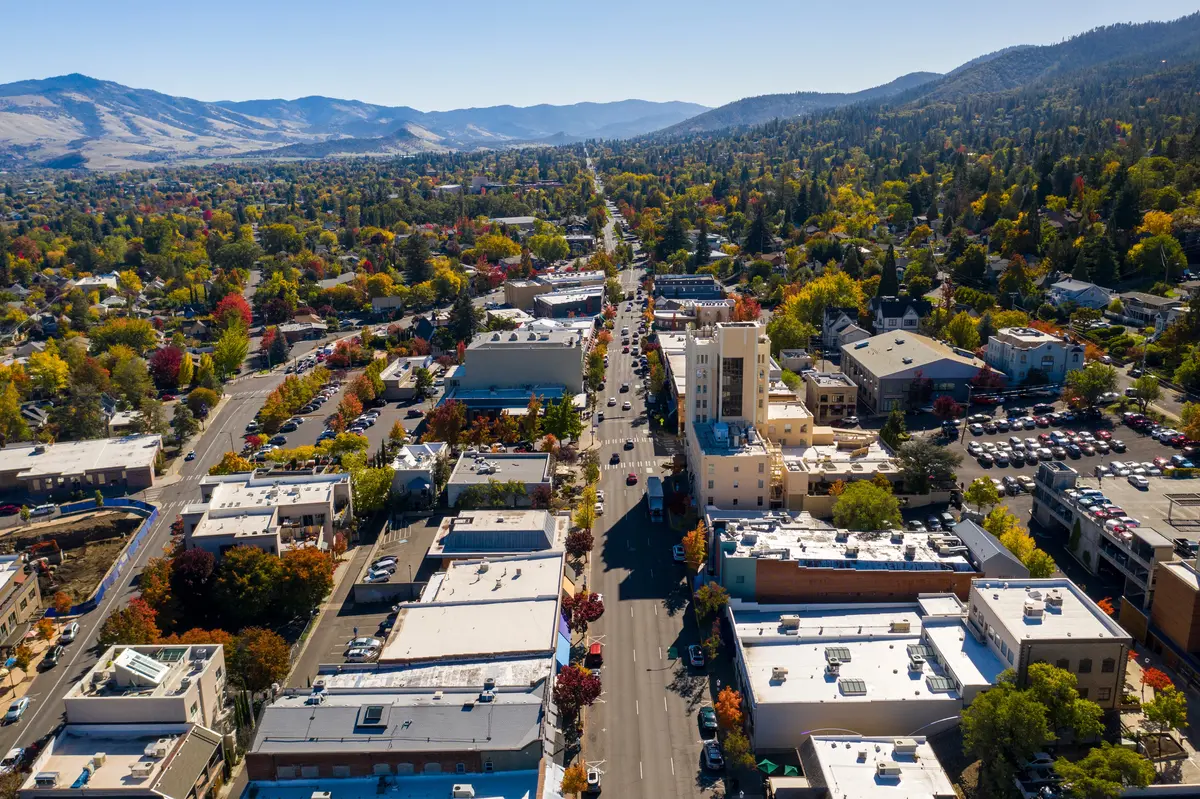
Ashland's walkability is real, but it isn't uniform across the city. The downtown core and the Railroad District are genuinely navigable on foot — the Ashland Plaza, the farmers market, independent coffee spots, and the theater district are all within a compact area. Among Oregon cities of its size, Ashland's center of town functions exceptionally well for pedestrians, which reflects how the streets and mixed-use blocks are laid out. Move a few blocks uphill toward the university or into the residential neighborhoods above downtown, and the terrain changes: Ashland is hilly, and hills matter more at 75 than they do at 55.
Transit is limited. Roughly one bus line serves the city, which means a car remains necessary for most residents who live outside the walkable core. Retirees who want to age in place without driving should look carefully at which neighborhoods genuinely support that, and plan accordingly — the Downtown Ashland and Railroad District neighborhoods are the realistic answers.
The community texture is genuinely active. Lithia Park's 93 acres run along Ashland Creek and absorb walkers, joggers, and people who simply want to sit near moving water on a warm afternoon. The Bear Creek Greenway and Ashland Creek Trail offer paved multiuse paths for cyclists and walkers at a grade most fitness levels can manage. Mount Ashland and Emigrant Lake draw retirees who ski, hike, and paddle. For 198 sunny days a year, the outdoor calendar fills up.
Intellectually, Ashland punches above its size. The Osher Lifelong Learning Institute (OLLI) offers continuing education courses that draw Mountain Meadows residents and the broader retirement community. The Oregon Shakespeare Festival's long season makes it easy to become a genuine theater regular rather than an occasional visitor. The Schneider Museum of Art at Southern Oregon University hosts rotating exhibitions worth building a monthly routine around. Volunteering with the festival, the farmers market, or local conservation organizations is how many retirees build the social fabric that makes Ashland feel like home rather than a beautiful place they happen to live in.
Right-Sizing: Downsizing in Ashland
Single-level living is harder to find in Ashland than the housing stock's overall size might suggest. Many of the city's older homes — particularly in the Railroad District and the neighborhoods surrounding downtown — are two-story craftsman and Victorian-era structures that require navigating stairs. Buyers looking for single-floor living often find their search narrowing faster than expected, which in a market with Ashland's price point can mean either compromising on the home or accepting a longer search timeline.
Condominiums and patio homes exist but don't dominate the inventory. The best-concentrated single-level and low-maintenance options in the city tend to cluster in planned communities, which brings the conversation directly to Mountain Meadows.
Mountain Meadows
Mountain Meadows is the only purpose-built 55+ active adult community in Ashland, and it has a national reputation that reflects genuinely well on the place. Spread across approximately 27 acres in North Ashland and home to around 300 residents, it was voted Best Small Active Retirement Community in America by the National Council on Senior Housing and the National Association of Home Builders. The community comprises both single-family homes and condominiums — both resident-owned, not rented from a corporate chain — and is self-governed rather than managed by an outside operator.
Amenities include a fitness and wellness center with an indoor pool, a clubhouse, an on-site dining room, a community garden, and a four-acre park with a pond. The resident-owned model means governance decisions stay with the people who live there, which Mountain Meadows residents consistently cite as meaningful. The community is philosophically committed to aging in place rather than transitioning residents through levels of care — it is independent living for active adults, not a continuum-of-care facility.
The honest caveat: Mountain Meadows is not a budget option. Homes here carry price tags that reflect both the community's quality and Ashland's overall market. Retirees who want the full Mountain Meadows experience should plan their budget accordingly and engage a local agent who knows the community's resale inventory, which turns over at its own pace and doesn't always wait for a buyer who's still deciding.
For retirees who want to downsize within Ashland but outside a planned community, the search is real. The Oak Knoll and Quiet Village neighborhoods have produced single-level options, and Northwest Ashland has newer construction that occasionally delivers the layout retirees are looking for. See the neighborhoods page for a fuller picture of where different housing types concentrate.
Ashland vs Nearby Retirement Destinations
| City | Cost vs Ashland | Primary Hospital | Walkability | Senior Living Depth | Overall Retirement Fit |
|---|---|---|---|---|---|
| Ashland | The anchor | Asante Ashland (satellite ER + outpatient); Rogue Regional in Medford for inpatient | Strong downtown core; hilly residential areas | Mountain Meadows (nationally recognized 55+ community) | Best for culturally active, equity-rich retirees |
| Medford | Noticeably lower | Rogue Regional Medical Center (378-bed full-service) | Car-dependent; sprawling layout | Broader inventory of senior and assisted-living options | Best for retirees prioritizing hospital access and lower price |
| Jacksonville | About the same | Rogue Regional in Medford (short drive) | Charming walkable historic core; limited daily errands | Very limited purpose-built senior options | Best for retirees wanting small-town historic character |
| Talent | Noticeably lower | Rogue Regional in Medford via I-5 | Limited walkability; car-dependent | Minimal dedicated senior community options | Best for budget-conscious retirees comfortable driving for services |
| Phoenix | Noticeably lower | Rogue Regional in Medford via I-5 | Limited walkability; still rebuilding significant housing stock lost in a 2020 wildfire | Limited senior-specific housing | Best for affordability; less developed amenity base |
| Central Point | Noticeably lower | Rogue Regional in Medford (very close) | Suburban; most errands require a car | Growing but limited senior-specific options | Best for retirees wanting Medford-area access at a lower price |
Medford is the most direct trade-off for retirees weighing Ashland: noticeably lower home prices, full inpatient hospital access right in town, and a broader inventory of senior housing — but without Ashland's walkable core, theater culture, or Mountain Meadows-caliber community. For retirees whose budget is stretched at Ashland's price level but who want to stay in the Rogue Valley, Medford delivers the practical infrastructure and Ashland becomes a place you visit for the festival and the park.
Jacksonville offers historic character and a genuinely lovely downtown, but it's a smaller stage with fewer daily services and no purpose-built senior community worth naming. It suits retirees who want peace, beauty, and proximity to Medford's services without the commuter-suburb feeling of Central Point or Phoenix.
Talent and Phoenix are the affordability options in the valley. Both are noticeably cheaper than Ashland, and Phoenix in particular is still recovering from significant housing losses in a 2020 wildfire that reshaped the community. For retirees comfortable driving for most errands and services, either can work on a tighter budget, but neither replicates the cultural density or walkability that makes Ashland worth its price premium for the right buyer.

Local Expert Takeaway: Ashland is one of the few small cities in the American West where retirement genuinely competes with where you're coming from. The Oregon Shakespeare Festival, Lithia Park, Mountain Meadows, the OLLI program, and the Rogue Valley Growers & Crafters Market create a social and cultural calendar that many larger cities can't match. The catch is honest: you need equity to enter, the local hospital no longer admits inpatients so Rogue Regional in Medford becomes your hospital for anything serious, and the winters are grayer than the tourism brochures suggest. Get those three things right in your planning, and Ashland tends to overdeliver.
Quick Takeaways & FAQs
✅ Mountain Meadows is the only nationally recognized 55+ active adult community in Ashland — resident-owned, self-governed, and genuinely difficult to match in southern Oregon.
⚠️ As of spring 2026, Asante Ashland Community Hospital no longer admits inpatients; retirees who need overnight hospital care will be transferred to Rogue Regional in Medford, about 15 minutes away.
📍 Oregon exempts Social Security from state income tax but taxes most other retirement income at rates up to 9.9% — the distinction matters significantly depending on how your retirement income is structured.
Is Ashland a good place to retire on a fixed income?
What happened to Asante Ashland Community Hospital?
What is Mountain Meadows, and is it the right fit for me?
Does Oregon tax Social Security and retirement income?
How does Ashland compare to Medford for retirement?
Moving to Oregon?
Tell us what you need help with and we'll connect you with local resources.
