
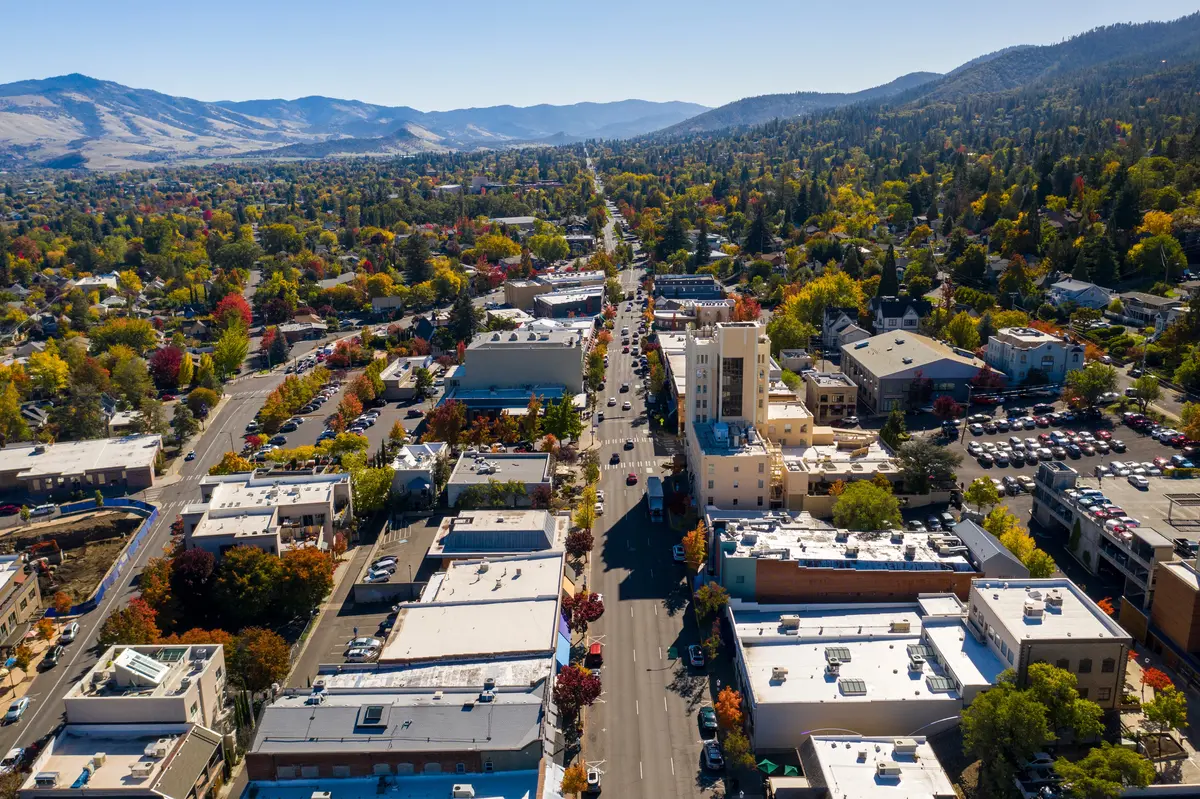
Ashland surprises people on the spreadsheet. A city of 21,259 in the southern end of the Rogue Valley, it sits at the foot of the Siskiyou Mountains along I-5, close enough to Medford for a real commute and far enough from Portland to feel like a different Oregon entirely. The Oregon Shakespeare Festival, Southern Oregon University, and a downtown built around Lithia Park give Ashland a cultural density that most cities its size simply don't have. That density comes at a price — and understanding exactly what you're paying for, and why, is the first thing anyone seriously considering a move here needs to do.
The economic backbone is a mix of education, the arts, and public-sector employment: Southern Oregon University anchors the University District and draws faculty, staff, and students who rent and buy in the city; the Oregon Shakespeare Festival pulls a hospitality and service economy behind it; and the Ashland School District and the City of Ashland itself round out the major employers. Most professional households either work locally in these sectors or commute about 15 minutes to Medford, where the Rogue Valley's medical, retail, and commercial jobs concentrate. Remote workers have increasingly chosen Ashland precisely because the cost gap with larger Pacific Coast cities is real, even if Ashland isn't cheap by Oregon standards.
Ashland's overall cost of living runs approximately 7% above the U.S. national average, with housing as the primary driver. Groceries run modestly above the national average, and transportation costs are slightly elevated for anyone who commutes. The offsetting surprise is electricity: Ashland Electric, the city's municipal utility, delivers power well below what most Oregonians pay and dramatically below national norms — a direct result of purchasing wholesale power from the Bonneville Power Administration and supplementing it with local hydropower. The no-sales-tax environment that defines Oregon shopping applies here, with one meaningful local exception worth knowing before you eat out regularly.
Whether you're weighing a move from the Bay Area, comparing Ashland against Medford, or trying to figure out whether your income actually works here, the sections below break down Ashland's housing market, rent versus buy calculus, everyday expenses, how the city stacks up against its neighbors, and the full tax picture.

What It Really Costs to Live in Ashland
Ashland is one of those places where the lifestyle premium is real and largely intentional. The typical home price sits at $559,336 (Zillow Home Value Index, July 2026) — noticeably above what you'd pay in Medford, Phoenix, or Talent, and above the Oregon statewide median as well. Housing is the dominant cost driver; once you account for it, most other line items land closer to average.
What drives the Ashland number isn't just square footage — it's the combination of a constrained geography (mountains to the south and east limit developable land), a national cultural draw that attracts buyers from California and the Pacific Northwest, and a university town dynamic that keeps rental demand persistently high. The city has limited room to sprawl, and that physical constraint keeps prices from softening the way they sometimes do in flatter, more buildable Rogue Valley cities.
The median household income in Ashland is $68,028 — below the income needed to buy the typical home here by a significant margin. That gap is the honest summary of Ashland's affordability picture: it's a city where many long-term residents are renters, where homeownership skews toward remote workers and retirees with equity from elsewhere, and where anyone buying on a local salary alone is working at the edge of what the math supports. For a full look at neighborhoods and what the housing stock looks like across the city, see the best neighborhoods guide.
Housing: Rent vs Buy in Ashland
Entry-level ownership in Ashland starts around $400,000 for older, smaller homes — typically condos, townhomes, or modest single-family houses on the city's edges. The typical home price of $559,336 (July 2026) reflects a market where even mid-range homes carry a real financial commitment. Homes that have been updated, sit close to downtown or Lithia Park, or offer mountain views push well above that figure.
The effective property tax rate in Ashland is approximately 0.74% — one of the lower rates in Oregon, which itself is a relatively low-property-tax state. On a home at the city-wide typical price, that rate keeps the annual tax bill meaningfully lower than buyers arriving from California, Texas, or other high-property-tax jurisdictions typically expect. The engine's mortgage calculator below lets you run your own numbers at current rates.
Renting is a genuine option in Ashland, and not just a fallback. The typical two-bedroom runs $1,950–$2,370 per month, with the city-wide typical rent at $2,117 (Zillow, July 2026). Demand from Southern Oregon University students and festival-season visitors keeps vacancy tight. Renting makes sense if you're relocating for a year or two to test the lifestyle before committing, or if you're waiting for the right property in a market where well-priced homes don't accumulate. Buying makes more sense if you have equity to deploy, plan to stay five or more years, and can absorb a purchase price that the local income base alone often can't fully support. The first-time homebuyer guide covers loan programs and down payment options in detail.
One thing renters and buyers both notice: the seasonal nature of Ashland's economy creates some churn in the rental market between summer and fall, as festival-adjacent short-term rentals return to the long-term pool. That timing can work in a renter's favor — or complicate a move planned for peak summer.
Everyday Costs Beyond Housing in Ashland
| Category | Typical Monthly Cost | Notes |
|---|---|---|
| Housing (typical rent) | $2,117/mo | City-wide typical rent. Buying? Use the calculator above for a mortgage estimate. |
| Utilities | $190–$280/mo | Electricity, gas, water, sewer, trash |
| Groceries | $580–$780/mo | Food at home, household of 2–3 |
| Transportation & Gas | $200–$350/mo | Fuel, and transit where it is a real option |
| Phone & Internet | $110–$185/mo | Mobile plan plus home broadband |
| Misc / Discretionary | $250–$480/mo | Dining out, entertainment, subscriptions |
Non-housing figures are estimates for a household of two to three, not a sourced index; housing is the city-wide typical rent (Zillow ZORI, July 2026). Refreshed with the rest of the city data.
Electricity is Ashland's most notable budget surprise — in a good direction. Ashland Electric, the city-owned municipal utility, purchases wholesale power from the Bonneville Power Administration and supplements it with a local hydropower plant and rooftop solar capacity. The result is electricity that runs well below the national average and well below what investor-owned utilities charge elsewhere in Southern Oregon. All city utilities — electricity, water, and sewer — arrive on a single monthly bill, and residents can add the city-owned Ashland Fiber Network (AFN) broadband service to the same statement.
One local quirk worth knowing: a 25% electric franchise tax is applied to all Ashland electric accounts, with revenue flowing into the city's general fund. That charge is already baked into the utility rate, so what you see on the bill is the all-in number — but it's the reason Ashland's municipal rate structure looks different from a standard investor-owned utility bill. Low-income households earning below 200% of the federal poverty line may qualify for a 30% monthly discount on city utilities through a city assistance program.
Groceries in Ashland run modestly above the national average — a common pattern in smaller cities where retail competition is limited and supply chains extend farther. Transportation costs are slightly elevated for anyone commuting out of the city, since Ashland has limited internal job density beyond its anchor institutions. Regional bus service through the Rogue Valley Transportation District connects Ashland to the broader Jackson County network; residents 62 and older can obtain a reduced-fare pass through the Ashland Senior Center. For most working-age residents, a car is still necessary.
Looking to buy in Ashland? Estimate your payment.
Enter your numbers to see an estimated monthly mortgage payment.
Estimate only. Excludes HOA fees and mortgage insurance. The interest rate above is a starting point, not a quoted rate — replace it with your own to see real numbers. Insurance is a flat placeholder, not a Ashland quote.
Ashland vs Nearby Cities: Cost Comparison
| City | Typical Home Price | Typical Rent | Cost vs Ashland |
|---|---|---|---|
| Ashland (this city) | $559,336 | $2,117/mo | — |
| Talent | $420,000 | $1,500/mo | 25% lower |
| Phoenix | $400,000 | $1,600/mo | 28% lower |
| Medford | $412,596 | $1,687/mo | 26% lower |
Source — home prices: Zillow ZHVI, July 2026; rent: Zillow ZORI, July 2026. Nearby-city figures are the same series, refreshed together.
Ashland carries a meaningful price premium over the rest of the Rogue Valley — the table below shows how the city compares to Talent, Phoenix, Medford, and the other communities buyers most often weigh it against.
Taxes & the Bottom Line for Ashland
Oregon Income Tax
Oregon's state income tax is among the highest in the nation by top marginal rate — four brackets ranging from 4.75% to 9.9% for tax year 2025. Single filers hit the top 9.9% bracket above $125,000 of taxable income; married joint filers reach it above $250,000. For most Ashland households earning near the median, the effective rate lands in the middle brackets — meaningful but not the full 9.9% headline rate.
Sales Tax — and the Local Exception
Oregon has no general sales tax, which lowers the effective cost of everyday goods purchases compared to nearly every other state. Ashland is the only jurisdiction in Oregon with a local food-and-beverage tax — a 5% levy on prepared food and non-alcoholic beverages at restaurants, in place since 1993. It won't crater a household budget, but if you eat out regularly, it adds up in a way that doesn't exist anywhere else in Oregon. The city also applies a 10% transient lodging tax to short-term stays, which affects visitors more than residents but shapes the local short-term rental market.
Property Tax
At approximately 0.74%, Ashland's effective property tax rate is low by national standards and competitive within Oregon. Buyers arriving from high-property-tax states often find this one of the more pleasant surprises in the overall picture — even at the home values described earlier in this guide.
Who Ashland's Budget Fits
Ashland works financially for remote workers who bring outside salaries into a market with lower property taxes and electricity costs than they're used to; for retirees with equity and fixed income (Oregon doesn't tax Social Security, and some retirees qualify for a retirement income credit); and for dual-income households where at least one partner earns above the local median. It tends to be a stretch for single-income households earning at or near the local median, for buyers who are relying entirely on local wages, and for anyone expecting to carry Ashland's home prices on Ashland's salary structure. The income-to-price gap described in the first section is real, and the taxes — particularly the state income tax — mean that gross income and take-home pay diverge more here than in many states. The honest bottom line: Ashland rewards people who arrive with assets or above-median incomes. For buyers and renters weighing the full picture, the retiring in Ashland guide covers the retiree tax picture in depth, and the moving from California guide addresses the California-to-Ashland cost and culture shift directly.

Local Expert Takeaway: Ashland's cost of living is driven by a housing market that prices above what local wages alone support — the typical home at $559,336 (July 2026) sits well above what the median household income can carry. The offsets are real but specific: electricity through Ashland Electric runs well below the national average thanks to hydropower, property taxes are low at approximately 0.74%, and there's no general sales tax. The city rewards buyers who arrive with outside equity or income. If your budget is tight and your income is local, Medford, Talent, or Phoenix will give you more room — and each is a short drive away.
Quick Takeaways & FAQs
✅ Ashland Electric's municipal utility delivers electricity well below the national average — a direct benefit of the city's hydropower supply and wholesale power contracts.
⚠️ The typical home price of $559,336 (July 2026) sits noticeably above Medford, Talent, and Phoenix, and the median local household income falls well short of what's needed to carry it.
📍 Ashland is the only city in Oregon with a local food-and-beverage tax — a 5% charge on restaurant meals that has applied since 1993, on top of the state's otherwise sales-tax-free environment.
Is Ashland, Oregon expensive to live in?
What is the average rent in Ashland, OR?
How does Ashland's property tax rate compare to the rest of Oregon?
Does Ashland have a sales tax?
Is it cheaper to live in Medford than Ashland?
Moving to Oregon?
Tell us what you need help with and we'll connect you with local resources.
