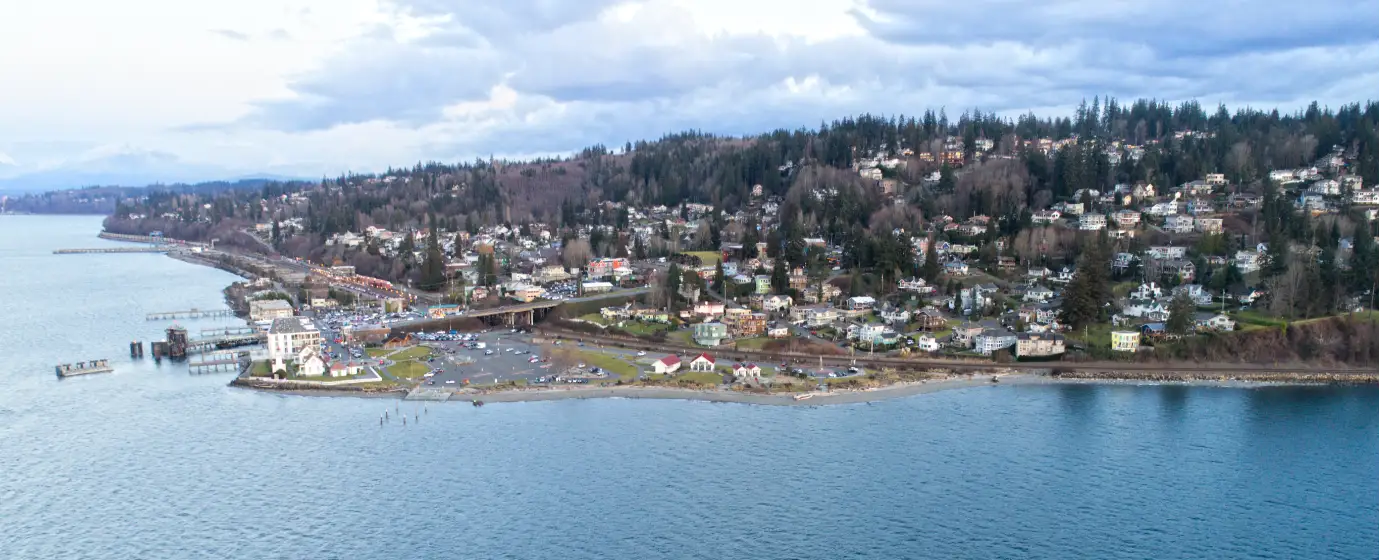
Most people researching Mukilteo expect a straightforward answer on safety, and mostly they get one — but the numbers require a bit of unpacking before they're useful. Mukilteo sits on the North Puget Sound waterfront in Snohomish County, wedged between Everett to the north, Edmonds to the south, and Lynnwood inland to the east. The Mukilteo-Clinton Ferry Terminal anchors the downtown waterfront and defines the city's western edge. Crime here breaks into two very different stories depending on whether you're looking at violent crime or property crime, and blending them into a single verdict misses what actually matters for day-to-day life.
The short version: Mukilteo's violent crime rate places it well below Washington state's own average and well below the national benchmark — a meaningful distinction in a state that consistently ranks among the highest nationally for property crime. Residents who've lived in Southgate or the Harbour Pointe corridor for years describe the city the way you'd hope a city of roughly 21,000 would be described: quiet streets, neighbors who know each other, the occasional catalytic converter theft or package grab making the rounds on Nextdoor. Serious violence is genuinely rare here.
Property crime is a more honest conversation. Washington state's property crime rate ranked third highest in the country in 2024, and Mukilteo — like most cities in the state — carries some of that regional burden. At 17 per 1,000 residents, the property crime rate isn't alarming in a local context, but it's worth understanding before you settle on a specific block or neighborhood. The good news is the overall crime rate fell 26% from 2023 to 2024 (City-Data, 2024 calendar year data), a trend that supports what most long-term residents already feel.
This guide walks through Mukilteo's violent and property crime figures in full, puts them in state and national context, breaks down what little neighborhood-level data exists, covers the Mukilteo Police Department's structure and community programs, and ends with practical guidance for anyone weighing safety as part of a relocation decision.
Violent Crime in Mukilteo: What the Numbers Actually Say
Mukilteo's violent crime rate comes in at 1 per 1,000 residents, based on NeighborhoodScout's analysis of 2024 FBI data. That translates to roughly 119 per 100,000 residents — a figure that sits approximately 68% below the national average, according to Areavibes' analysis of 2023 FBI data.
To put daily risk in perspective: Mukilteo's daily violent crime rate is more than three times lower than both the Washington state daily average and the national daily average. For a city of 21,299 people, that's a meaningful gap, not a rounding difference.
Washington state's own violent crime rate was 326 per 100,000 in 2024 — itself about 9% below the U.S. average. Mukilteo's violent crime rate of approximately 100 per 100,000 sits well below that state figure too, which means the city isn't just benefiting from a low-crime region — it genuinely outperforms its regional peers on this metric.
What This Looks Like in Practice
In a given year, Mukilteo reports around 25 total violent crimes. Spread across the city's waterfront neighborhoods, the established streets of Harbour Pointe, and the hillside corridors near the industrial edge, that figure produces a city where most residents will go years without direct exposure to a violent incident.
CrimeGrade.org independently confirms: considering violent crime alone, Mukilteo grades out safer than both the Washington state average and the national average. That's consistent across multiple data sources using different methodologies, which adds confidence to the conclusion.
| Geography | Violent Crime Rate (per 100,000) | vs. Mukilteo |
|---|---|---|
| Mukilteo, WA | ~100 | — |
| Washington State (2024) | 326 | Mukilteo noticeably lower |
| U.S. National Average (2024) | ~370 | Mukilteo substantially lower |
| Everett, WA (nearby) | Significantly higher | Mukilteo well below |
| Edmonds, WA (nearby) | Comparably low | Similar range |
| Mill Creek, WA (nearby) | Comparably low | Similar range |
Everett, which borders Mukilteo to the north and shares the same industrial corridor, carries a measurably higher violent crime rate — a distinction that matters if you're choosing between addresses near that city boundary.
Property Crime: The Honest Conversation
Mukilteo's property crime rate of 17 per 1,000 residents is the number that tends to give relocating buyers pause — and it deserves honest framing, not dismissal.
Washington state ranked third highest in the country for property crime in 2024, with a rate of 2,467 per 100,000 — approximately 40% above the U.S. average. Mukilteo exists inside that regional reality. The 17 per 1,000 figure reflects car prowls, package theft, and opportunistic break-ins more than organized burglary rings targeting occupied homes.
The State Context Changes the Interpretation
When crime aggregators compare Mukilteo's property crime rate against a national baseline, the city can appear roughly average or slightly above, depending on methodology. That comparison is less useful than comparing it against other Snohomish County or Puget Sound cities, where the regional baseline is already elevated. Within that local frame, Mukilteo holds its own.
The trend line also matters. The city's overall crime index fell 26% from 2023 to 2024 (City-Data, 2024 calendar year). That's a single-year drop significant enough to be meaningful, though a sustained trend over multiple years would be more telling. Residents and Nextdoor posts from 2025 and 2026 reflect what the numbers suggest: occasional property crime, but not a pervasive problem.
What the Local Posts Actually Say
On Nextdoor, Mukilteo residents flag the predictable suburban concerns — a car left unlocked on Chennault Beach Road, a package pulled from a porch near Lighthouse Park, a suspicious vehicle circling Harbour Pointe. What's notably absent from those threads is the kind of escalating alarm that shows up in higher-crime suburban communities. The tone is watchful, not anxious.
The practical implication: garages matter here. Leaving valuables visible in a parked car, especially near the ferry terminal or the industrial access roads where outsiders move through regularly, is the most common catalyst for a property crime report. It's not a reason to avoid the city — it's a habit worth forming wherever you land in the greater Seattle metro.

Neighborhood-Level Safety: Where the Lines Fall
Mukilteo doesn't have sharp crime hot spots the way a larger city would, but the neighborhood picture isn't perfectly uniform either. The full neighborhood breakdown covers character, price, and proximity in detail — here the focus is purely on what the safety data suggests about different parts of the city.
CrimeGrade.org's December 2025 analysis identifies the southwest portion of Mukilteo as the area residents generally consider safest. That geography corresponds roughly to the waterfront-adjacent streets near Lighthouse Park and the established corridors of Chennault Beach and Boulevard Bluffs — neighborhoods characterized by owner-occupied homes, cul-de-sacs with limited through traffic, and strong neighbor familiarity.
The Southwest Concentration
Harbour Pointe, on the city's higher ground near the local high school and Harbour Pointe Boulevard, is a large planned community with its own internal street network that limits cut-through traffic. Residents there tend to describe it as quiet in the way that a well-maintained HOA community with active block watch participation tends to be quiet.
Norma Beach and Wind & Tide sit closer to the waterfront and the ferry corridor. The foot traffic generated by the Mukilteo-Clinton Ferry Terminal adds a variable that doesn't exist in purely residential pockets — not a serious crime driver, but a reason to be more attentive about vehicle security if you park along the waterfront regularly.
The Industrial Edge
The area on the city's eastern and inland edge, where residential streets give way to industrial zoning along the outer boundary, carries a more mixed land-use pattern than the bluff-side neighborhoods. It's still within city limits and covered by the Mukilteo Police Department's patrol zones, but it doesn't carry the same residential quiet that the bluff-side and waterfront neighborhoods do. If you're evaluating specific addresses in this corridor, it's worth looking at the street-level data on CrimeGrade rather than relying on citywide averages.
| Neighborhood / Area | General Safety Character | Notable Factor |
|---|---|---|
| Harbour Pointe | Among the quieter residential areas | Planned community, limited through traffic |
| Chennault Beach | Low incident rate, established ownership | Southwest placement, strong neighbor familiarity |
| Boulevard Bluffs | Quiet, bluff-side residential | Southwest area flagged as safest by CrimeGrade |
| Lighthouse Park / Norma Beach area | Generally safe, some ferry-corridor traffic | Ferry terminal proximity adds foot traffic variable |
| Wind & Tide / Goat Trail | Established waterfront residential | Smaller pocket neighborhoods, owner-occupied |
| Industrial Edge (eastern boundary) | Mixed; more variable than bluff-side areas | Industrial edge proximity; check street-level data |
| Nelsons Corner | Suburban residential, generally quiet | Inland location, away from ferry corridor |
No neighborhood inside Mukilteo registers what you'd call a high-crime area by regional standards. The differences are relative, not alarming.
Looking to buy in Mukilteo? Estimate your payment.
Enter your numbers to see an estimated monthly mortgage payment.
Estimate only. Excludes HOA fees and mortgage insurance. The interest rate above is a starting point, not a quoted rate — replace it with your own to see real numbers. Insurance is a flat placeholder, not a Mukilteo quote.
Mukilteo Police Department: Coverage, Programs, and Community Engagement
The Mukilteo Police Department operates with 36 sworn officers providing around-the-clock patrol coverage for a city of roughly 21,000 — a ratio that translates to consistent presence in residential neighborhoods rather than reactive-only policing.
The department runs several programs worth knowing about before you settle on an area, because they're genuinely useful tools and not just PR line items.
Programs That Actually Matter for Residents
The Neighborhood Block Watch is the most visible community safety program, organized at the street level and coordinated through the MPD. Active Block Watch participation correlates strongly with the neighborhoods residents describe as safest — Harbour Pointe and Chennault Beach both have organized groups.
The Vacation Watch program is free and genuinely practical: you notify the MPD before you travel, and officers add your address to their patrol rotation for additional check-ins while you're away. For a city where package and vehicle break-ins generate most of the Nextdoor safety posts, this kind of low-cost deterrence matters.
Online non-emergency crime reporting means you can file a report for property crime without waiting for an in-person visit — a convenience that also improves the city's crime data completeness, which in turn makes the published statistics more reliable than in cities where under-reporting is common.
Community Academy and Youth Programs
The MPD runs a free eight-week Community Academy open to the public, meeting Thursday evenings at Rosehill Community Center at 304 Lincoln Avenue. It gives residents a direct look at how investigations, patrol decisions, and department operations actually work — useful for anyone who wants to understand the city's safety infrastructure rather than just read about it.
The Youth Police Academy, held at the local high school on Harbour Pointe Boulevard, runs for four days in late June and early July, targeting teens 14 and older with hands-on exposure to crime scene investigation, SWAT procedures, and defensive tactics. For families weighing Mukilteo specifically because of the youth environment, this kind of department investment in the next generation signals institutional stability.
One friction moment worth naming: the MPD's 36-officer force means coverage is good for a city this size, but it's not a large department. During high-demand periods — the summer ferry season draws significant regional traffic to the waterfront — response times for non-emergency calls can stretch. That's not a safety crisis, but it's the reality of a small-city department serving a geographically spread-out city with a busy tourist corridor.
What to Actually Check Before Choosing a Neighborhood
The citywide statistics give you the right frame, but the block-level reality is what you'll actually live with. Here's how to build a useful safety picture before committing to a specific area.
Use Street-Level Tools, Not Just City Averages
CrimeGrade.org lets you plug in a specific Mukilteo address and see crime concentration maps for that immediate area. The difference between a street that backs up to a commercial corridor on the industrial edge and a cul-de-sac in Chennault Beach is real, even though both addresses carry the same city-level statistics. Spend 20 minutes here before you narrow your list.
The Mukilteo Police Department's online portal allows non-emergency reporting and includes public-facing resources about crime patterns. Cross-referencing the MPD's published data with what CrimeGrade and NeighborhoodScout show gives you a triangulated picture more reliable than any single source.
What to Ask Neighbors Directly
Nextdoor is public-facing for research purposes even before you move in. Search the Mukilteo neighborhood feeds and look at the last six months of posts — not for the most alarming headline, but for the pattern. Are the posts about car prowls concentrated in a specific area? Are there repeat complainants describing the same block? That pattern tells you more than a crime-rate table.
One thing people discover after six months in Mukilteo: the ferry terminal changes the feel of the waterfront blocks in ways that a crime statistic doesn't fully capture. The Mukilteo-Clinton Ferry runs daily and brings vehicle and foot traffic through a concentrated waterfront corridor at all hours. Most of that traffic is entirely benign — commuters from the island destination, visitors drawn by the waterfront and the city's aviation heritage. But it does mean the streets near the terminal see more strangers than the bluff-side neighborhoods above, and occasional opportunistic property crime clusters near that corridor as a result. If you're between a waterfront block and a street three blocks up the hill, that distinction is worth weighing.
The Safety Picture Over Time
Mukilteo's 26% overall crime rate drop from 2023 to 2024 is encouraging. Single-year trends can reverse, but combined with the low violent crime baseline and the department's active community programming, it suggests a city moving in the right direction rather than one holding the line against a worsening trend.
For families specifically: the presence of organized Block Watch groups in Harbour Pointe and the MPD's visible investment in youth programs are soft indicators of a community that takes neighborhood safety seriously at a structural level — not just a statistical one. That kind of social infrastructure doesn't show up in crime indexes, but it's what residents actually rely on.

Local Expert Takeaway: Mukilteo's violent crime rate is genuinely low — well below both Washington state and national averages — and the 26% overall crime drop from 2023 to 2024 reinforces what most residents already say on Nextdoor: this is a quiet city by any regional measure. The property crime rate reflects Washington state's broader regional reality more than anything specific to Mukilteo. The southwest neighborhoods — Chennault Beach, Boulevard Bluffs, and the established streets of Harbour Pointe — carry the city's strongest safety reputation, while the industrial-edge corridor on the eastern side warrants a closer street-level look. Before settling on a specific block, run the address through CrimeGrade.org, check the Nextdoor feed for that immediate area, and ask whether the block has an active Neighborhood Block Watch through the Mukilteo Police Department. The MPD's Vacation Watch program and the free Community Academy at Rosehill Community Center on Lincoln Avenue are genuine resources, not just checkboxes.
Quick Takeaways & FAQs
✅ Mukilteo's violent crime rate sits approximately 68% below the national average, making it among the safer cities in the North Puget Sound region.
⚠️ Washington state's property crime rate ranked third highest nationally in 2024, and Mukilteo's rate of 17 per 1,000 residents reflects that regional context — vehicle and package security habits matter here.
📍 The southwest portion of Mukilteo — including Chennault Beach and Boulevard Bluffs — is identified by CrimeGrade.org as the city's safest area; the industrial-edge corridor on the eastern side warrants a street-level check before deciding.
Is Mukilteo, WA a safe place to live?
Which part of Mukilteo has the lowest crime?
How does Mukilteo's crime rate compare to Everett and Edmonds?
Does the Mukilteo ferry terminal affect safety near the waterfront?
What safety programs does the Mukilteo Police Department offer?
Moving to Washington?
Tell us what you need help with and we'll connect you with local resources.
