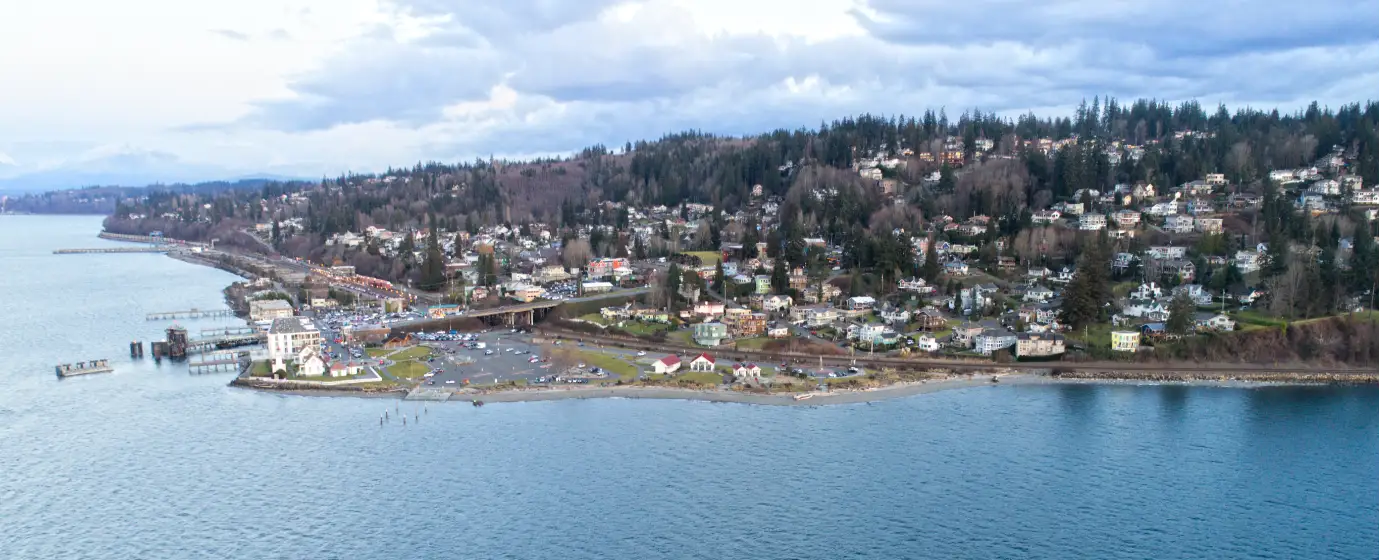
If you're choosing between staying in California and moving to Mukilteo, the decision rarely comes down to a single number. It comes down to what you stop paying and what you start getting. Mukilteo sits on a bluff above Puget Sound in Snohomish County, about 25 miles north of Seattle, flanked by the Boeing Everett plant to the east and a working ferry terminal that launches you to Whidbey Island in roughly 20 minutes. The commute to Seattle runs around 30 minutes on a good day — or you skip the freeway entirely and board the Sounder commuter rail at Mukilteo Station on First Street. It is not a suburb that grew by accident. The aerospace industry pulled it up, and the waterfront kept people here.
The economic backbone is Boeing, whose Everett factory — the world's largest building by volume at over 427 million cubic feet — sits adjacent to Paine Field and drives a significant share of the region's employment. Electroimpact, a precision aerospace tooling company, and Travis Industries, a manufacturer of wood, pellet, and gas stoves, round out the employer base. The Mukilteo School District holds a B+ rating, according to Niche, drawing families who want suburban stability without the commuter-suburb anonymity of farther-out Snohomish County towns. The people who move here from California tend to fall into two groups: aerospace and tech workers transferring or taking remote roles, and Bay Area or Los Angeles families who ran the numbers and realized they could stop renting someone else's dream.
The cost picture is the real story. Mukilteo's typical home value sits at $863,937 (Zillow Home Value Index, 2026) — a figure that sounds high until you price what the equivalent house costs in the Bay Area, coastal Orange County, or even Sacramento's better school zones. Washington collects no state income tax on wages, which for most California earners represents a meaningful annual raise the day they cross the state line. Health insurance premiums here run noticeably below what most Californians pay, though you will drive farther for specialist care than you would near a major California metro. Day-to-day life includes waterfront trails, Lighthouse Park, and direct Sound access — the kind of outdoor amenity that costs a premium in coastal California but comes standard in Mukilteo.
Whether you're mid-offer on a house here or still mapping out the move, the sections below break down what the California-to-Mukilteo shift actually looks like: taxes, home prices, lifestyle adjustments, what Californians get right about the move, and what they routinely get wrong.
The Tax Picture: Washington vs. California
The headline is true: Washington has no state income tax on wages or salaries. California taxes wage income at graduated rates up to 13.3% — the highest top marginal rate in the nation. At $100,000 in annual income, the estimated savings from relocating is approximately $5,762 per year, based on a direct state comparison. At $200,000, the gap widens considerably.
That's the good news. Here's where it gets more complicated.
What You're Trading For
Washington replaces income tax revenue partly through sales tax. Mukilteo's combined sales tax rate is 10.6% (6.5% state base plus a 4.1% local add-on), verified by the Washington Department of Revenue as of July 2026. California's statewide average runs noticeably lower. Every car, appliance, and furniture purchase you make after moving costs more at the register than it did in most California cities.
Washington also deducts a 0.58% payroll tax from gross wages to fund the WA Cares Fund, the state's long-term care insurance program. It's not income tax, but it does reduce your take-home pay slightly, and most California transplants don't see it coming on their first paycheck.
The Capital Gains Wrinkle
If you're a higher-earning tech worker or an investor selling appreciated stock, pay attention: Washington imposes a capital gains excise tax of 7% on long-term gains above approximately $278,000 (the 2025 indexed threshold), and 9.9% on Washington gains above $1 million. Gains from the direct sale of real estate are excluded. This matters most if you're selling California equities or vested stock options after you move — the timing of your move date relative to a sale can have real consequences worth reviewing with a tax advisor.
| Tax Type | California | Washington (Mukilteo) |
|---|---|---|
| State income tax (wages) | Up to 13.3% | None |
| Capital gains tax | Taxed as ordinary income (up to 13.3%) | 7% excise on gains above ~$278K; real estate excluded |
| Sales tax (combined) | ~8.68% statewide average | 10.6% (Mukilteo, July 2026) |
| Effective property tax rate | Varies; often 1.1–1.3% in coastal metros | 0.79% (Mukilteo) |
| Long-term care payroll tax | None | 0.58% of gross wages (WA Cares Fund) |
| Estate / inheritance tax | None | Washington estate tax above $2.193M threshold |
For most W-2 earners, the income tax elimination wins decisively. For investors with large unrealized gains, the math requires a closer look before moving day.
Home Prices: What Your California Budget Actually Buys
Mukilteo's typical home value is $863,937 (Zillow Home Value Index, 2026). That number stops most California buyers in their tracks — for about two seconds, until they price what the equivalent house costs where they're leaving from.
The California Comparison
In the Bay Area or coastal Orange County, that budget gets you a dated two-bedroom, possibly with deferred maintenance, in a neighborhood where you're competing against all-cash offers. Even in Sacramento — the perennial escape hatch for Bay Area buyers — well-located homes in top school zones push past that figure in active markets. Mukilteo's price is not cheap, but it is a different category of value when you stack it against where most California transplants are actually coming from.
What that budget realistically buys in Mukilteo: three to four bedrooms, often with a garage and a view of either Puget Sound or the Cascade Range foothills, in a community with a strong school district. Entry-level options exist closer to the Paine Field corridor — older construction with smaller lots — while bluff-side homes near the water push well above that figure.
The Property Tax Reality
Mukilteo's effective property tax rate is 0.79%. On a home at the city's typical value, that rate produces a meaningful annual figure — but it is substantially below the effective rates in many California coastal markets, which commonly run between 1.1% and 1.3% once Mello-Roos and local assessments are added. California's Proposition 13 caps annual increases for long-term owners, which can make a 20-year homeowner's bill look artificially low. If you're a buyer — not a current owner — comparing current effective rates, Washington comes out ahead on property tax.
What Californians Get Wrong at the Offer Stage
The most common mistake California buyers make in Mukilteo is treating the market like coastal California — assuming that proximity to water automatically means slow inventory and a price ceiling that keeps rising. Mukilteo's market can move quickly, particularly for bluff homes with Sound views, but it is not the same compressed, no-contingency frenzy you survived in the Bay Area. Working with a local agent who knows the specific micro-areas matters more than transplanting California bidding tactics. For more on the buying process itself, see the first-time homebuyer guide.

Lifestyle Shift: What Changes When You Land
Six months after moving to Mukilteo from Southern California, the comment you'll hear from nearly every transplant is some version of: "I didn't realize how much I'd miss being able to pick up specialty groceries at 10 p.m." Mukilteo is a city of about 21,000 people. It is not a late-night town, and it does not have the retail density of a California suburb three times its size.
What You Gain
The tradeoff is a waterfront that is genuinely accessible rather than blocked by private development or parking fees. Lighthouse Park sits at the edge of town near the Mukilteo Lighthouse, and the ferry terminal at the foot of the bluff gives you Whidbey Island in roughly 20 minutes — a weekend destination that California coastal residents would drive two hours to reach. Diamond Knot Brewery & Alehouse on Front Street is the kind of neighborhood anchor that Californians spend years trying to find in their own cities: a brewpub within walking distance of the water, open year-round, that functions as a genuine gathering spot rather than a tourist draw.
The Sounder commuter rail at Mukilteo Station on First Street runs four morning and four afternoon trips on weekdays into King Street Station in Seattle. If your California life involved sitting on a freeway for 90 minutes, trading it for a train that actually arrives on schedule will feel like a different era of transportation.
What Requires Adjustment
Gray matters here. Mukilteo averages over 150 cloudy or overcast days per year through the fall and winter — not the relentless rain that California mythology assigns to the Pacific Northwest, but a low, persistent overcast that takes until roughly May to fully lift. Californians from San Diego or the inland valleys typically report the adjustment as the single hardest part of the first year. People who came from the Bay Area, where coastal fog is already a season, adapt faster.
The outdoor recreation calendar is also different. The summers — July through September — are genuinely excellent: mild temperatures, long evenings, and easy access to Cascade Range trailheads within an hour. But those months are also when tourist traffic builds around the ferry terminal and Lighthouse Park. If you're planning to browse the parks and waterfront on a sunny July Saturday, arrive early or come prepared to share the bluff with half of Snohomish County.
Looking to buy in Mukilteo? Estimate your payment.
Enter your numbers to see an estimated monthly mortgage payment.
Estimate only. Excludes HOA fees and mortgage insurance. The interest rate above is a starting point, not a quoted rate — replace it with your own to see real numbers. Insurance is a flat placeholder, not a Mukilteo quote.
What Mukilteo Has That California Doesn't — and Vice Versa
The honest version of this comparison isn't a scoreboard. It's a list of things you stop having access to, and a list of things that become ordinary parts of your life that weren't before.
What Mukilteo Offers That's Genuinely Hard to Replicate
The Boeing Future of Flight Aviation Center — at 8415 Paine Field Blvd, seven days a week — is a world-class aviation museum with factory tours starting at $42. That sounds like a tourist attraction until you realize your kids are growing up treating the world's largest building by volume as something they can walk through on a Saturday. The aerospace culture here is not abstract: it shapes the schools, the neighbors' career paths, and the local economy in ways that are visible at the street level.
The ferry system itself is worth calling out. Washington State Ferries is the largest ferry system in the United States, carrying roughly 20.1 million riders system-wide in 2025. The Mukilteo-Clinton route to Whidbey Island is a piece of regional infrastructure that most Californians have no equivalent for — a car-and-passenger crossing that functions as a daily commute tool for some residents and a weekend escape valve for everyone else.
Crime benchmarks also look different. Mukilteo's violent crime rate runs at 1 per 1,000 residents — a figure that sits well below most California metro-area comparisons. See the full breakdown on the safety page.
What You'll Miss
Diversity of cuisine at the street level. California — particularly the Bay Area, Los Angeles, and San Diego — has a food ecosystem built over decades of immigration and density that Mukilteo, at 21,000 people, simply does not replicate. You'll find seafood worth eating, a bakery drawing regulars from across the region at Little Prague Bakery & Cafe, and independent options along the main commercial corridors. But the depth of options you had in a mid-size California city will not be here.
Direct flight access is also thinner than what most Californians are used to. Seattle-Tacoma International is roughly 40 minutes south — not close enough to be convenient for spontaneous travel, but not far enough to be a real barrier for planned trips. Paine Field runs a limited set of commercial routes that has grown in recent years, which helps for regional travel.
Who Moves to Mukilteo from California — and Who Thinks Twice
The California transplants who settle into Mukilteo quickest tend to share a few things: they have a job or a job offer tied to Boeing, Electroimpact, or the broader aerospace supply chain around Paine Field; they have children in or approaching school age; and they've made peace with trading restaurant density for square footage and water views. That combination makes Mukilteo a genuinely good fit rather than a compromise.
The Profile That Works
Aerospace and defense engineers transferring from Southern California facilities have the smoothest transition — the work culture, the Boeing campus familiarity, and the household income level ($132,861 median here) all align with what they're used to. Remote tech workers from the Bay Area who were already remote are the second-largest group: they buy for the price delta, stay for the schools and the ferry, and discover within a year that Seattle's tech ecosystem is accessible enough that the original reason for going remote matters less than they thought.
Parents with school-age children who've researched the Mukilteo School District tend to feel validated early — for more on how the district performs and which schools draw which neighborhoods, the schools page has the full breakdown.
Who Thinks Twice — or Leaves
Single professionals in their 20s who were drawn by the income tax savings but didn't price in the lifestyle gap sometimes regret the move within 18 months. Mukilteo's walkable commercial core is concentrated near the waterfront, not spread across the city, and the social infrastructure of a smaller city takes time to navigate. Many end up relocating to denser Seattle neighborhoods where the walkable streets and late-night options they miss are actually present — and absorbing the commute cost back in the process.
California buyers who've been in Proposition 13 protection for a long time also occasionally experience sticker shock at Mukilteo's property tax bill when they calculate what 0.79% means on an $863,937 purchase — especially if their California bill had been frozen at a 1978 assessment base. The rate is objectively lower than California coastal norms for current buyers, but the comparison against a long-term incumbent owner's frozen California bill doesn't work in Washington's favor. If that's your situation, run both numbers explicitly before signing. For the full tax and cost-of-living picture, see the cost-of-living page.
The people who make it work long-term are almost always the ones who came for a specific reason — a job, a school, a view, a family member already here — rather than a vague sense that the Pacific Northwest seemed like a better version of California. Mukilteo rewards intentionality. It will not substitute for what you had in California. It will give you something different.

Local Expert Takeaway: Most California transplants underestimate two things before moving to Mukilteo: how much the income tax elimination changes the feel of a paycheck by month two, and how much the gray November sky changes the feel of a Saturday by month four. The practical advice from people who've done it: bank the tax savings deliberately — it's real money — and build your outdoor routine around the Mukilteo Lighthouse trail and the Sounder train schedule before winter sets in, not after. Diamond Knot Brewery on Front Street and the ferry to Whidbey on a clear September evening will do more to make the place feel like home than any spreadsheet comparison ever will.
Quick Takeaways & FAQs
✅ Washington's zero wage income tax puts an estimated $5,762 per year back in the pocket of a Californian earning $100,000 — a concrete, immediate financial gain from day one.
⚠️ Mukilteo's combined sales tax rate of 10.6% noticeably exceeds California's statewide average, and the gray winters genuinely catch California transplants off guard — both require budgeting, one financial and one psychological.
📍 The Sounder commuter rail from Mukilteo Station on First Street runs four round trips to Seattle daily on weekdays — a practical alternative to I-5 that most California buyers don't discover until after they've already signed.
Is Mukilteo, WA cheaper than California?
Do I have to pay California income tax after I move to Washington?
What is Washington's capital gains tax and does it affect California transplants?
How hard is it to commute from Mukilteo to Seattle?
What surprises Californians most after moving to Mukilteo?
Moving to Washington?
Tell us what you need help with and we'll connect you with local resources.
