
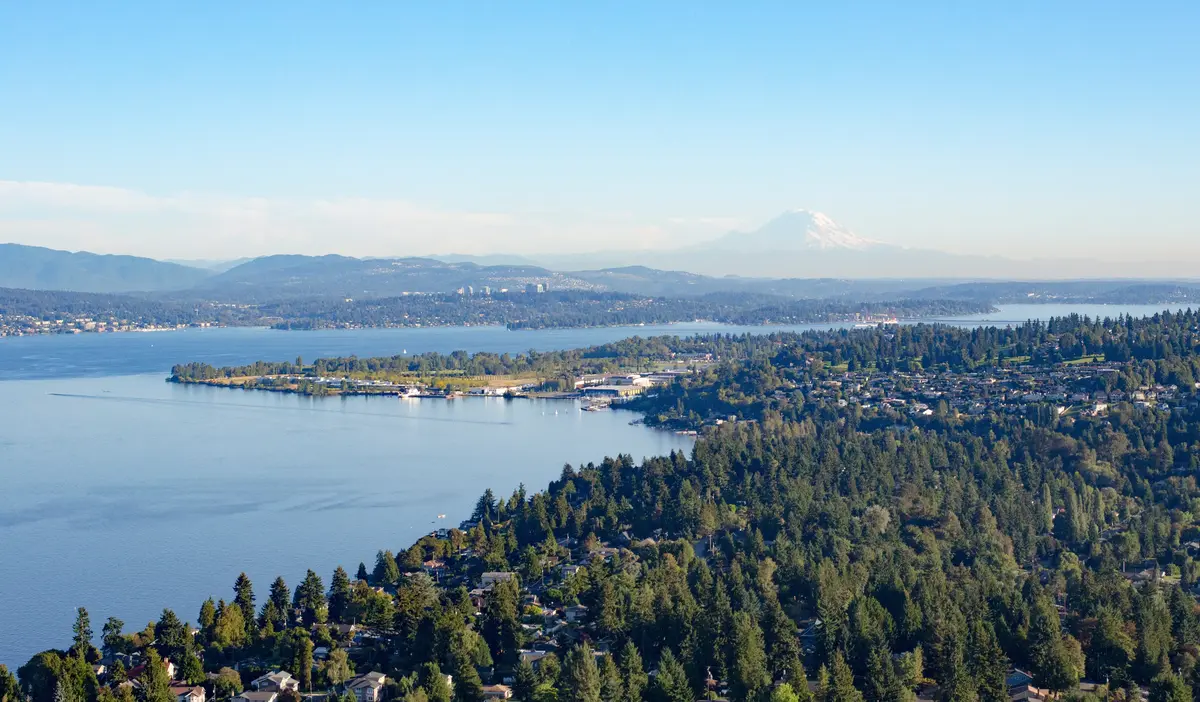
Most people who retire in Kenmore didn't plan on it. They planned on staying in Seattle, or maybe heading somewhere cheaper east of the mountains. Then they ran the numbers — no state income tax, Lake Washington out the front window, 316 acres of old-growth forest at Saint Edward State Park reachable on foot or by bike — and the math shifted. Kenmore sits at the northern tip of Lake Washington, 12 miles northeast of downtown Seattle, pressed between Bothell to the east and Lake Forest Park to the south. Highway 522 cuts through the middle of the city, connecting it to the rest of the metro, and the Burke-Gilman Trail runs along the lakeshore and into the city's emerging town center. Those two corridors shape where people spend their days here.
The city is small — about 24,000 residents — and it doesn't have the downtown density or transit depth that retirement planners often picture when they imagine aging in place. What it does have is immediate access to EvergreenHealth's primary care and urgent care clinic right in Kenmore, with the main hospital campus less than five miles away. Bastyr University, one of the country's leading naturopathic medicine institutions, is headquartered here, which has quietly shaped a health-conscious, community-oriented local culture that many retirees find genuinely appealing. The Northshore Senior Center network maintains an active Kenmore branch with everything from health clinics to art classes.
Cost is the real sticking point. The Zillow Home Value Index placed Kenmore's typical home value at $1,024,151 in June 2026 — firmly in seven-figure territory. That price point narrows the field to retirees who are either bringing significant equity from a previous home or have retirement portfolios that can absorb Seattle-adjacent real estate. For those who can make it work, Washington's complete absence of a state income tax means Social Security, pension income, and 401(k) distributions are entirely state-tax-free — an advantage that compounds meaningfully over a 20- or 30-year retirement. For a fuller breakdown of daily costs and tax comparisons, the cost of living page has the specifics.
Whether you're weighing Kenmore against Bothell, Lake Forest Park, or Kirkland, or simply trying to figure out whether this particular corner of the Seattle metro makes sense for your next chapter, the sections below cover healthcare access, the retiree tax picture, daily life on a fixed income, walkability realities, downsizing options, and how Kenmore stacks up against nearby retirement destinations.
Why Retirees Are Choosing Kenmore
The retirees who land in Kenmore and stay tend to share a profile: they want Pacific Northwest nature without full rural isolation, they have enough equity or savings to absorb a market where the typical home value sits at $1,024,151 (Zillow Home Value Index, June 2026), and they genuinely value proximity to Seattle — for grandchildren, for world-class medical specialists, or just for the option. Log Boom Park and the Burke-Gilman Trail are not selling points in a brochure; for active retirees, they are Tuesday afternoon.
Kenmore also rewards retirees who are done with yard work and maintenance overhead. The newer townhome inventory that has replaced older commercial strips in Uptown Kenmore — particularly around The Hangar at Town Square — gives downsizers something that most of King County's suburban stock doesn't: low-maintenance construction within walking distance of gathering places, without the full density of Seattle. That combination is rare at this price point in the region.
Who should look elsewhere? Retirees who need robust walkability — the ability to get groceries, see a doctor, or meet a friend without a car — will find Kenmore's Walk Score of 28 genuinely limiting. The Burke-Gilman Trail is excellent for recreation, but it won't substitute for an urban street grid on a rainy February afternoon when you don't want to drive. Retirees on tighter fixed incomes may also find the cost structure here unforgiving compared to Bothell or Shoreline. If your retirement budget is stretched, a city 10 minutes east or south can deliver a meaningfully different monthly picture. For more on who Kenmore fits overall, the living in Kenmore guide covers buyer types in depth.
Healthcare & Medical Access in Kenmore
What's Actually In the City
For a city of 24,000, Kenmore's in-city healthcare infrastructure is unusually strong. EvergreenHealth operates both a primary care clinic and an urgent care facility at 18151 68th Ave NE, Suite 100 — two blocks north of Highway 522, directly across from Kenmore City Hall. Same-day appointments are available, Saturday morning hours are offered, and the clinic accepts Medicare, WA Apple Health, and private insurance. That covers the vast majority of routine and urgent care needs without leaving city limits.
When You Need More
EvergreenHealth Medical Center — the full hospital campus — is approximately 4.3 miles from Kenmore Senior Living on NE 182nd Street, and realistically 10 to 15 minutes by car from most parts of the city, depending on Highway 522 traffic through Bothell. EvergreenHealth has expanded meaningfully over the past decade: it now includes a cancer center, cardiac services, orthopedics, and a neuroscience program. For most non-emergency specialty care, you won't need to go further.
Advanced Care and the Seattle Safety Net
Serious cardiac events, high-acuity cancer treatment, and complex neurosurgical cases generally pull toward Seattle's major medical centers — about 30 minutes from Kenmore under normal conditions, longer during peak traffic. That gap is common throughout the northshore corridor and is something retirees with complex chronic conditions should weigh honestly. Having an EvergreenHealth primary care physician who can coordinate referrals into the Seattle system matters more here than in cities with tertiary care on-site.
Senior Living In the City
Kenmore Senior Living at 7221 NE 182nd St provides assisted living and memory care within city limits — a relatively rare asset in a small suburban city. High-acuity care and medication management are available on-site, which means retirees or spouses needing memory care don't face an automatic move to Kirkland or Bothell. That said, the continuum of care options in Kenmore is more limited than in larger nearby cities; retirees who anticipate significant care needs in later years may want to explore communities in Kirkland or Shoreline, where senior living depth is considerably greater.
Bastyr University's presence in Kenmore also means access to integrative medicine, naturopathic physicians, and research-affiliated wellness programming that you won't find in most suburbs. For retirees interested in complementary care alongside conventional medicine, that proximity is a genuine differentiator.

The Retiree Budget in Kenmore
Washington's Income-Tax Advantage
Washington State collects no state income tax — zero. Social Security benefits, pension distributions, 401(k) and IRA withdrawals, and investment income are all untaxed at the state level. For a retired couple drawing $80,000 a year from a mix of Social Security and retirement accounts, the savings compared to states like Oregon (which taxes retirement income at up to 9.9%) or California are substantial and compound over time. This is the single biggest financial argument for retiring in the Seattle metro rather than elsewhere on the West Coast.
Property Taxes — and the Senior Exemption
Kenmore's effective property tax rate is approximately 0.83% — below the national average and meaningfully below most California counties, though the high home values mean the total bill is still significant. Washington's senior property tax exemption kicks in at age 61 — among the lowest thresholds in the country, where most states require 65. For King County, the 2025 income threshold was $88,998 or less in household income; qualifying homeowners get their home's assessed value frozen for tax purposes and receive an exemption from excess levies. That can reduce the effective tax burden substantially for retirees on moderate fixed incomes who own a home that has appreciated well beyond their current earnings.
A separate deferral program — available to homeowners age 60 and older — allows the state to pay your property taxes as a lien against the home, repaid at 5% interest when the home is eventually sold, up to 80% of equity. It's a meaningful cash-flow tool for retirees who are asset-rich but cash-flow-constrained.
Daily Cost Reality
Washington has no income tax but does collect sales tax, and King County's rate sits at the higher end of the state's range. Groceries are exempt from sales tax in Washington, which softens the daily impact. The larger cost challenge in Kenmore is the housing entry price: whether you're buying or renting, you're operating in a market priced for the Seattle metro's income levels, which run noticeably above national medians. Retirees who own their Kenmore home outright — or who brought significant equity from a prior market — find the monthly picture much more manageable than those entering the market fresh. For current rent ranges and a full cost-of-living comparison, see the Kenmore cost of living page.
Looking to buy in Kenmore? Estimate your payment.
Enter your numbers to see an estimated monthly mortgage payment.
Estimate only. Excludes HOA fees and mortgage insurance. The interest rate above is a starting point, not a quoted rate — replace it with your own to see real numbers. Insurance is a flat placeholder, not a Kenmore quote.
Walkability, Community & Staying Active in Kenmore
The Honest Walkability Picture
Kenmore has a Walk Score of 28 — officially classified as car-dependent. Running basic errands without a car is genuinely difficult across most of the city. The bus network includes roughly five lines, and service frequency is limited compared to Seattle proper or even parts of Shoreline. If you're planning a retirement where driving is a permanent given, that's fine. If there's any scenario where reduced driving ability affects your daily independence, Kenmore's layout requires a frank conversation during the planning stage.
The Burke-Gilman Trail is the compensating asset. It runs directly along the Lake Washington shoreline through the heart of Kenmore, connecting Log Boom Park to the town center and continuing south toward Kirkland and north toward Bothell. For active retirees, this is a legitimate daily-life amenity — flat, paved, scenic, and accessible by bike or on foot. On a weekday morning in spring, you'll find more retirees than commuters on it. It doesn't replace errands-on-foot, but it makes staying physically active something you'll actually do rather than merely intend to.
The Senior Center and Community Life
The Kenmore Senior Center operates as part of the Northshore Senior Center network, alongside locations in Bothell and Mill Creek. Programming includes health clinics, art and learning classes, social clubs, a computer lab, food access programs, and transportation assistance. The social and mental health services component is more robust than what you'd find at many suburban senior centers of comparable size — a reflection of the network's professionalism rather than just the city's demographics.
The town center around The Hangar at Town Square has quietly become the social gravitational point that Kenmore previously lacked. Independent cafés and restaurants have filled in around the square, and the Burke-Gilman Trail's Brew Row — anchored by the Copperworks Distilling Barrel House at NE 175th St, which was expanding to add a tavern and outdoor whiskey garden as of spring 2026 — gives retirees a genuinely walkable-from-the-trail gathering spot that doesn't require driving to Bothell. It's the kind of low-key, walkable social anchor that retirees often say they didn't realize they needed until they had it.
Nature Access as a Daily Practice
Saint Edward State Park's 316 acres border the city's eastern edge, with forested trails down to Lake Washington that are unlike anything available in most Seattle suburbs. Log Boom Park on the lakeshore hosts regular community gatherings and offers flat, accessible lakefront access year-round. For retirees whose activity plan centers on walking, kayaking, or simply being in Pacific Northwest scenery, Kenmore punches well above its size.
Right-Sizing: Downsizing in Kenmore
What the Market Actually Offers
Kenmore is not a city built for retirement-stage downsizing in the conventional sense. There is no large purpose-built 55+ active-adult campus in the city limits — the kind with a clubhouse, pickleball courts, and a waiting list. What exists instead is a patchwork of options that requires knowing where to look.
The clearest downsizing pathway in Kenmore right now runs through Uptown Kenmore and the town center. Newer townhome construction along NE 181st Street and the blocks surrounding The Hangar at Town Square has replaced older commercial buildings with attached housing that eliminates yard maintenance and brings residents within easy reach of the social and dining activity that has grown up around the square. These are typically two- to three-story townhomes rather than single-level, which is a real consideration for retirees with mobility concerns. Single-level condominiums in Kenmore are limited in inventory; when they come available, they move quickly.
The Equity-Unlock Option
Retirees selling a long-held Kenmore home often find that cashing out provides meaningful flexibility: buying a lower-maintenance townhome outright, relocating to a less expensive adjacent city, or funding a continuing-care community in Kirkland or Shoreline. For retirees who purchased decades ago, accumulated home equity is frequently the primary financial engine of the right-sizing decision — and in a market priced at Seattle-metro levels, that equity can be substantial.
In-City Assisted Living
Kenmore Senior Living at 7221 NE 182nd St is the city's primary option for retirees who need or anticipate needing assisted living or memory care. Having this within city limits matters: a spouse transitioning to memory care doesn't have to relocate to another city, and visits from a still-independent partner remain local. The facility's proximity to EvergreenHealth's main campus — approximately 4.3 miles — means medical coordination is straightforward. For retirees who need a fuller continuum of care (independent living through skilled nursing, all on one campus), Kirkland's senior living landscape is notably deeper and worth evaluating in parallel.
What Newcomers Don't Anticipate
One thing that catches retirees off guard after six months in Kenmore: the city's single-level housing inventory is genuinely thin. Ranchers and accessible single-story homes exist, but they represent a small fraction of a market dominated by two-story colonials and multi-level lots. Buyers specifically targeting step-free living sometimes find the search frustrating and end up looking more seriously at Lake Forest Park or Shoreline, where the mid-century ranch stock is more plentiful. If single-level is a hard requirement rather than a preference, plan your search timeline accordingly.
Kenmore vs Nearby Retirement Destinations
| City | Cost vs Kenmore | Primary Hospital | Walkability | Senior Living Depth | Overall Retirement Fit |
|---|---|---|---|---|---|
| Kenmore | Anchor | EvergreenHealth (in-city clinic; main campus ~4 mi) | Car-dependent (Walk Score 28); Burke-Gilman Trail offsets for active retirees | Moderate — one assisted living/memory care in-city; limited 55+ communities | Nature Quiet Strong for active, equity-rich retirees who drive |
| Bothell | About the same | EvergreenHealth main campus (in-city) | Slightly more walkable downtown core; still largely car-dependent | Moderate — growing senior living options near Canyon Park | Commuter Value Better for retirees who want the full EvergreenHealth campus close by |
| Lake Forest Park | Noticeably cheaper | EvergreenHealth via Highway 522 (~20 min) | Similar car-dependence; quieter residential character | Limited — fewer in-city senior living options | Quiet Nature Appeals to retirees prioritizing lower cost and a tight-knit residential feel |
| Kirkland | Pricier | EvergreenHealth Kirkland campus; Seattle Children's nearby | More walkable downtown waterfront district; still car-dependent overall | Deep — multiple continuing-care communities and 55+ options | Luxury Walkable Best overall senior living infrastructure in the northshore area |
| Shoreline | Noticeably cheaper | EvergreenHealth Shoreline clinic; Harborview and UW Medical via I-5 | More walkable along 15th Ave NE corridor; Link light rail coming | Moderate-to-strong — more mid-century ranch housing suited to aging in place | Transit Value Strong pick for retirees prioritizing budget and future transit access |
| Woodinville | About the same to slightly cheaper | EvergreenHealth Redmond; Overlake Medical via SR-520 | Car-dependent; wine country character rather than urban amenities | Limited — fewer senior living options; rural feel dominates | Nature Privacy Appeals to retirees seeking a quieter, less suburban environment |
Kirkland is the clear winner on senior living depth and in-city walkability — retirees who want a continuum-of-care campus or who want to walk to a waterfront restaurant should be looking there seriously, even at a higher price point. Shoreline wins on budget and is worth a hard look for retirees who want light rail access in the coming years and more single-level housing to choose from. Bothell's advantage is practical: having the EvergreenHealth main campus inside the city rather than a four-mile drive away matters more than it sounds at 2 a.m. with a cardiac concern.
Kenmore sits in the middle of this field — not the cheapest, not the most walkable, not the deepest in senior living, but strong on natural amenity, community feel, and Washington's powerful income-tax advantage that applies equally across all of these cities. The retirees who choose Kenmore over its neighbors typically care more about Lake Washington access, Saint Edward State Park, and a quieter pace than about amenity density — and for that profile, none of the nearby options quite match it.

Local Expert Takeaway: Kenmore rewards retirees who arrive with equity, own their home outright or close to it, and genuinely plan to use the Burke-Gilman Trail and Saint Edward State Park as part of daily life — not just as a selling point. Washington's no-income-tax structure and the senior property tax exemption starting at 61 are real money in a 20-year retirement budget. The EvergreenHealth clinic at 68th Ave NE handles the vast majority of routine care without leaving the city. Where Kenmore shows its limits is single-level housing inventory and assisted-living depth — if either of those is a near-term need rather than a distant one, Kirkland deserves serious parallel consideration.
Quick Takeaways & FAQs
✅ Washington State's zero income tax means Social Security, pensions, and retirement account withdrawals are completely state-tax-free — one of the strongest retiree tax environments in the country.
⚠️ Kenmore has a Walk Score of 28, which means a car is essential for daily errands; retirees who anticipate reduced driving ability should plan carefully or consider Kirkland or Shoreline instead.
📍 Washington's senior property tax exemption starts at age 61 — four years earlier than most states — and King County's income threshold for 2025 was $88,998, making it accessible to many retirees on moderate fixed incomes.
Is Kenmore a good place to retire on a fixed income?
What hospital serves Kenmore retirees?
Are there 55+ or active adult communities in Kenmore?
How does Washington's senior property tax exemption work for Kenmore homeowners?
How does Kenmore compare to Kirkland for retirement?
Moving to Washington?
Tell us what you need help with and we'll connect you with local resources.
