
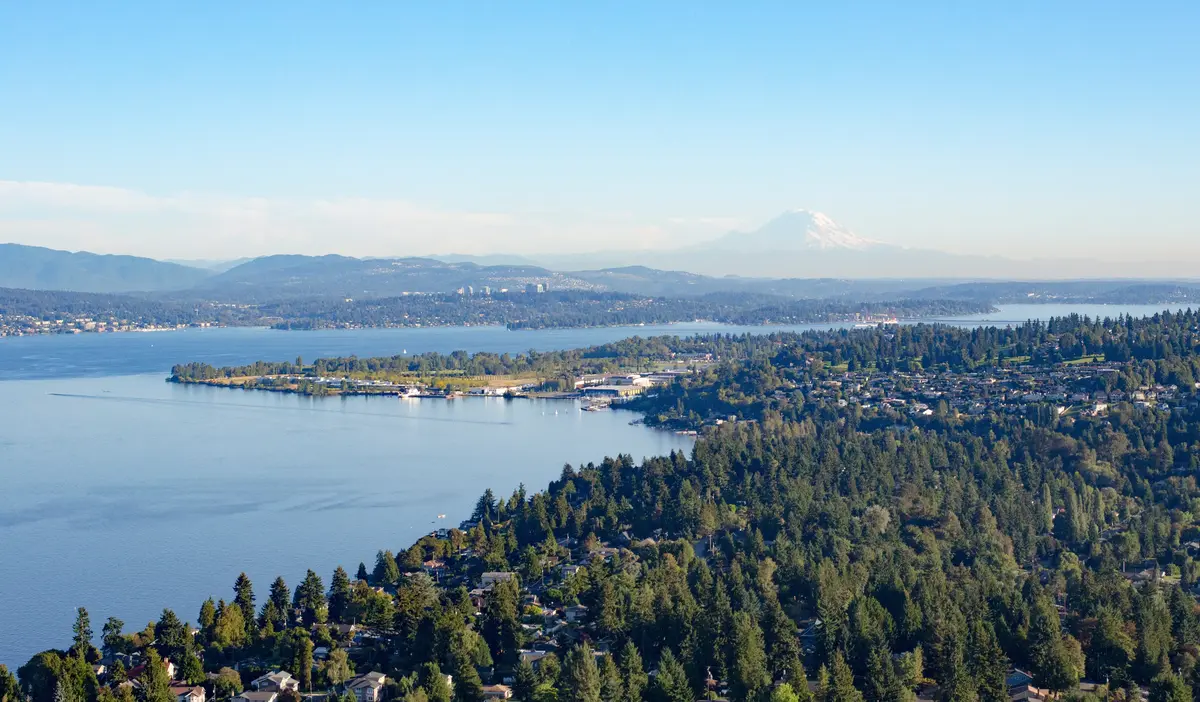
Most Californians who move to Kenmore say the same thing around month three: they can't believe how much lighter their paycheck feels. Washington has no state income tax on wages — none. If you were paying California's rate, which reaches 14.6% at the top end in 2026 when the uncapped SDI payroll contribution is included, that shift is not abstract. It shows up every two weeks. What surprises people is how quickly the financial math recalibrates when that single line item disappears from the ledger. Kenmore sits on the north shore of Lake Washington, about 30 minutes from downtown Seattle via SR-522, with the Burke-Gilman Trail running right through the heart of it and seaplanes lifting off from Kenmore Air Harbor at the end of the lake.
The city that receives you is not a sleepy bedroom community. Bastyr University anchors a health-focused academic presence here, Kenmore Air Harbor is the nation's largest seaplane-only commercial air facility, and the broader economy connects to the Seattle tech corridor — major tech campuses on the Eastside are a short drive east, and Seattle's core employers are reachable via I-405. The Northshore School District, which serves Kenmore, holds an A rating, according to Niche, and ranks among the top performers in Washington public schools for both math and reading proficiency. Families relocating from high-performing California districts are generally not stepping down.
The cost of living runs 43% above the U.S. national average, driven primarily by housing. The typical home value sits at $1,024,151 (Zillow Home Value Index, June 2026) — comparable to many Bay Area suburbs and noticeably above Southern California's mid-tier markets. You are not moving here to find cheaper real estate. You are moving here because the tax structure, the school quality, the lake access, and the livability-per-dollar calculus tips in Kenmore's favor once you run the full numbers. Health insurance premiums tend to run noticeably below what California residents typically pay, though you will drive farther for specialist care than you would in a major California metro.
Whether you are being relocated by a tech employer, priced out of a Bay Area neighborhood you loved, or simply ready for four seasons and a slower pace along the water, the sections below break down Kenmore's California-to-Washington tax shift, home prices, lifestyle trade-offs, school and community picture, and what daily life here is actually like after the move.
The Income Tax Difference: What You Stop Paying on Day One
Washington has no state income tax on wages. For someone moving from California, this is the single largest financial change — and it happens automatically the moment you establish residency.
California's combined top marginal rate on wages reaches 14.6% in 2026, once you layer the 13.3% income tax together with the now-uncapped SDI payroll contribution added by SB 951 in January 2024. That figure applies at higher income brackets, but even middle-income earners in California face rates between 6% and 9.3%. Washington charges zero on the same earnings.
A Californian earning $100,000 annually saves approximately $5,762 per year in state income tax alone by moving to Washington. At $200,000, the savings compound significantly as California's brackets stack. For dual-income households common among Seattle-area tech workers, the combined annual savings can easily reach five figures.
The Capital Gains Question
Washington taxes 7% on long-term capital gains above a $278,000 standard deduction for 2025, rising to 9.9% on gains above $1,000,000. Critically, gains from the sale of a primary residence are explicitly excluded. If you are selling a California home and rolling the proceeds into a Kenmore purchase, you will not trigger Washington's capital gains tax on that transaction.
Where it matters: investment portfolios, RSUs, and business sales above the threshold. If you are arriving from a California tech role with significant equity compensation, talk to a Washington state-licensed tax professional before your first vesting event as a resident.
The Estate Tax Gap
One tax that catches Californians off guard: Washington imposes a state estate tax on estates above $2.193 million, with rates ranging from 10% to 20%. California has no state estate tax at all. If you are moving significant inherited or accumulated wealth, this is worth building into your long-term planning before the move, not after.
| Tax Category | California (2026) | Washington / Kenmore (2026) | Impact for Relocating Californian |
|---|---|---|---|
| State income tax (wages) | Up to 14.6% combined (incl. SDI) | None | Immediate paycheck increase |
| Capital gains (primary home sale) | Up to 13.3% | Excluded from WA cap gains tax | No WA hit on home-sale proceeds |
| Capital gains (investments above threshold) | Up to 13.3% | 7% on gains above $278K (2025); 9.9% above $1M | Lower rate, but still applies |
| Sales tax (combined) | 7.25–10.75% (varies by city) | a combined state and local sales tax rate of 10.3% | Comparable to high-tax CA cities |
| Groceries in sales tax | Generally exempt | Exempt | No change on food spending |
| State estate tax | None | 10–20% above $2.193M | New exposure for larger estates |
Kenmore has a combined state and local sales tax rate of 10.3%, comparable to what you'd pay in San Francisco or Los Angeles — high, but groceries are exempt, which softens the daily impact meaningfully.
Property Taxes: Prop 13 Is Gone — Here Is What Replaces It
If there is one tax conversation that catches California transplants unprepared, it is property tax. Not because Kenmore's rate is punishing — it isn't — but because the entire structure works differently, and the difference is consequential over time.
What You Lose: Prop 13 Protection
California's Proposition 13 caps annual assessed value increases at 2% per year, regardless of how much the market moves. A homeowner who bought in Marin County in 2005 may be paying taxes on an assessed value less than half the current market price. Washington has no equivalent cap. Your assessed value can and does rise with the market, and your tax bill follows.
What You Get: A Competitive Rate
Kenmore's effective property tax rate is 0.83%. On the city's typical home value of $1,024,151 (Zillow Home Value Index, June 2026), that produces an estimated annual property tax bill of roughly $8,500. For context, California's nominal rate sits near 1.1% to 1.25% in most counties once you add local Mello-Roos assessments and parcel taxes — so a buyer purchasing a comparable home in California today at market price would likely pay more in absolute property tax dollars, not less.
The Prop 13 comparison only cuts against you if you are leaving a home you have owned for 15 or 20 years with an artificially low assessed base. A long-held Bay Area home assessed at $400,000 on a current $1.4 million market value carries a tax bill well below what Kenmore would charge on a new purchase. If that describes your situation, account for it explicitly in your monthly budget projections.
| Scenario | California Property Tax | Kenmore Property Tax (est.) | Annual Difference |
|---|---|---|---|
| First-time buyer, $1M purchase | ~$11,000–$13,000/yr (1.1–1.3% incl. local) | ~$8,300/yr (0.83%) | Kenmore noticeably lower |
| Move-up buyer, $1.2M purchase | ~$13,200–$15,600/yr | ~$9,960/yr | Kenmore lower |
| Seller of long-held CA home (Prop 13 base $350K) | ~$3,850–$4,550/yr (on old base) | ~$8,300–$10,000/yr (new purchase) | Kenmore significantly higher vs. old bill |
| New CA purchase (same price as Kenmore) | ~$10,200–$12,600/yr | ~$8,500/yr | Kenmore lower at point of purchase |
| Annual cap on increases | 2% max (Prop 13) | No cap — tracks market | Long-term risk in fast-appreciating market |
| Supplemental reassessment | Yes, upon purchase | Yes, annually | Similar at purchase; diverges over time |
The honest read: if you are buying new in both states, Kenmore wins on property tax rate. If you are leaving a decades-old Prop 13 home, your monthly housing cost will rise on the tax line — plan for it.

Home Prices: What $1 Million Buys Here vs. Where You Left
Kenmore is not a budget market. The typical home value is $1,024,151 (Zillow Home Value Index, June 2026), which puts it squarely in the range of well-established Seattle suburbs like Kirkland and Bothell. You are not saving money on the purchase price compared to most Bay Area markets. You are, however, getting more square footage per dollar than you would in Marin, the Peninsula, or the Westside of Los Angeles — and a fundamentally different tax structure on the income you use to service the mortgage.
What the Price Buys
At the median, $1 million to $1.1 million in Kenmore typically means a 1,800 to 2,400 square foot craftsman or mid-century home on a wooded lot — often with Lake Washington views accessible from nearby streets, proximity to the Burke-Gilman Trail, and a yard that actually exists. Entry-level homes — older construction, smaller lots, occasionally needing updates — come in noticeably below the median. The neighborhood guide covers specific area character in depth.
Where California Buyers Typically Land
Bay Area transplants, accustomed to competitive bidding, generally adapt quickly to Kenmore's market dynamics. Southern California buyers — particularly those coming from areas like the Conejo Valley, Pasadena, or coastal San Diego — sometimes find the price point higher than expected. Kenmore is not a cheaper version of where you left. It is a comparably priced market with a structurally different tax environment and a different set of lifestyle trade-offs.
One friction point that surprises people: the rain. Not the volume — Seattle's annual rainfall is actually lower than Miami, Boston, or New York — but the relentlessness of grey skies from November through March. Californians who thought they understood Pacific Northwest weather after a few visits often find month four of clouds genuinely difficult. This is not a reason not to move. It is a reason to plan your first winter here deliberately: get outside along the Burke-Gilman Trail anyway, find the Saint Edward State Park trails, and resist the instinct to hibernate.
| Market Comparison | Typical Home Price (2025–2026) | State Income Tax | Effective Property Tax Rate |
|---|---|---|---|
| Kenmore, WA | $1,024,151 | None | 0.83% |
| Marin County, CA (suburban) | Noticeably higher | Up to 14.6% combined | ~1.1–1.3% (incl. local) |
| Peninsula / South Bay, CA | Significantly higher | Up to 14.6% combined | ~1.1–1.3% |
| Conejo Valley / Ventura Co., CA | Comparable to slightly lower | Up to 14.6% combined | ~1.1–1.3% |
| Kirkland, WA (nearby) | Somewhat above Kenmore | None | ~0.8–0.9% |
| Bothell, WA (nearby) | Comparable to Kenmore | None | ~0.85–0.95% |
The income tax line is where the total-cost argument for Kenmore becomes compelling. A dual-income household earning $300,000 combined in California and paying top marginal rates is sending a significant portion to Sacramento every year that simply stops leaving in Washington.
For buyers navigating the financing side of a purchase at this price point, the first-time homebuyer page covers down payment programs and loan options available in Washington.
Looking to buy in Kenmore? Estimate your payment.
Enter your numbers to see an estimated monthly mortgage payment.
Estimate only. Excludes HOA fees and mortgage insurance. The interest rate above is a starting point, not a quoted rate — replace it with your own to see real numbers. Insurance is a flat placeholder, not a Kenmore quote.
Daily Life in Kenmore: The California Comparison Nobody Tells You
The financial case for leaving California is easy to build. The lifestyle adjustment is subtler — and more interesting than the spreadsheet suggests.
What You Get That California Mostly Can't Match
Lake Washington is not a park amenity. It is the organizing fact of daily life in Kenmore. Log Boom Park puts you at the water's edge on weekday mornings when it is quiet enough to hear the seaplanes taking off from Kenmore Air Harbor. The Burke-Gilman Trail runs 27+ miles and connects the city to the broader Seattle cycling and running network — it is a genuine piece of infrastructure, not a weekend-only recreation path. Saint Edward State Park, a former seminary campus, sits on 316 acres of old-growth forest with trails running down to Lake Washington's shore.
Brew Row is a walkable cluster of breweries and distilleries along the Burke-Gilman Trail corridor — a legitimate gathering spot in a city that otherwise lacks the dense downtown of nearby Kirkland. Postdoc Brewing is an anchor of that scene, and the annual Kenmore Oktoberfest draws the kind of crowds that signal a real community culture, not just a municipal event. California transplants who assumed the Pacific Northwest was all outdoor gear and hiking poles tend to be pleasantly surprised by how much social infrastructure exists at a neighborhood level.
What You Give Up
Kenmore has no light rail stop. Getting to Seattle without a car means a bus connection or a seaplane ticket. The SR-522 corridor is functional but not elegant — the 30-minute drive to Seattle works on paper and in off-peak reality, but I-405 south toward Kirkland and Bellevue can add significant time during peak commute windows. Californians accustomed to traffic will recognize the dynamic; they will not love it more here. See the living in Kenmore guide for a full commute breakdown.
The restaurant and retail scene is growing but honest: Kenmore is a city of 24,000 people. There is no equivalent of a Santana Row or a Larchmont Village. Neighboring Bothell and Kirkland fill some of that gap, but you will adjust your habits around a smaller local footprint than many California suburbs of comparable price offered.
Where Families Actually Gather
On weekend mornings, Log Boom Park is where you will find parents with kids at the water, dogs in tow, watching the seaplanes. The Northshore School District's calendar anchors the community rhythm in ways that Bay Area parents will recognize immediately — sports through the Washington Interscholastic Activities Association, strong academic programming, and a school-community connection that feels tighter in a smaller district than in the sprawling systems many Californians left behind.
The Honest Reckoning: Who This Move Makes Sense For
Not every California-to-Kenmore move is a clean win. The calculation depends heavily on where you are coming from, what you are earning, and what you are giving up on the tax-protected side.
This Move Works Best If:
- You are a W-2 earner in a California bracket above 9.3% — the income tax elimination is immediate and compounding.
- You are buying at market price in California and comparing a new California purchase to a Kenmore purchase — the property tax math favors Kenmore.
- You have school-age children and are leaving a district you were lukewarm on — the Northshore School District consistently performs among the top public school districts in Washington.
- You want outdoor access without a weekend drive — the Burke-Gilman Trail, Saint Edward State Park, and Lake Washington are daily-use amenities, not destination trips.
- You work on the Eastside tech corridor in Kirkland, Bothell, or the broader Redmond area — the reverse commute from Kenmore is meaningfully easier than fighting into Seattle.
Run the Numbers Carefully If:
- You are leaving a long-held California home with a deeply discounted Prop 13 assessed value. Your property tax bill will likely rise even at Kenmore's lower rate.
- You have a large investment portfolio generating annual long-term gains above the Washington threshold — Washington taxes 7% on long-term capital gains above a $278,000 standard deduction for 2025, rising to 9.9% on gains above $1,000,000, though the rate is still below California's top rate.
- Your estate is above $2.193 million. Washington's estate tax has no California equivalent and needs dedicated planning with a local estate attorney.
- You rely on frequent specialist care — routine care costs run noticeably below California rates, but you will travel farther for advanced treatment than you would in a major California metro.
- Your social life depended on a dense walkable downtown. Kenmore's Brew Row and Log Boom Park are genuine, but they are not substitutes for an urban core.
The Six-Month Reality Check
Most California transplants who stay past six months stay for good. The ones who leave cite the grey winter light more than any financial or practical reason. That is not a small thing — it is worth being honest about before you make an offer. The ones who stay tend to have found the trail, found a community around the brewery row or the school system, and recalibrated their relationship to weather in a way that California had never required of them.
The full living guide covers who Kenmore suits across buyer types and life stages, including the remote-work picture that has reshaped the city's daytime character since 2020.

Local Expert Takeaway: The income tax elimination is real and it is large — but the Californians who thrive in Kenmore are the ones who understood before arriving that they were trading urban density and year-round sun for lake access, elite public schools, and a paycheck that goes noticeably further. Walk the Burke-Gilman Trail from Log Boom Park on a clear October morning when the Cascades are visible across the water and Postdoc Brewing is opening up along Brew Row — that is what you are buying, alongside the tax math. The ones who struggle are usually the ones who did the spreadsheet and skipped the February site visit.
Quick Takeaways & FAQs
✅ Washington's zero state income tax on wages can save a Californian household $5,762 or more per year at the $100K income level alone — immediate and compounding.
⚠️ Kenmore's typical home value is $1,024,151 (Zillow Home Value Index, June 2026) — comparable to Bay Area suburbs, not a cheaper alternative, so budget accordingly.
📍 Washington has no Prop 13 equivalent: your property tax assessment rises with market values, which matters if you're leaving a long-held California home with a discounted tax base.
How much do I actually save on income taxes by moving from California to Kenmore?
Is Washington's capital gains tax a problem if I'm selling my California home and buying in Kenmore?
Will my property taxes go up when I move from California to Kenmore?
How do Kenmore's home prices compare to the California markets most people are leaving?
Does Washington's estate tax affect Californians who move to Kenmore?
Moving to Washington?
Tell us what you need help with and we'll connect you with local resources.
