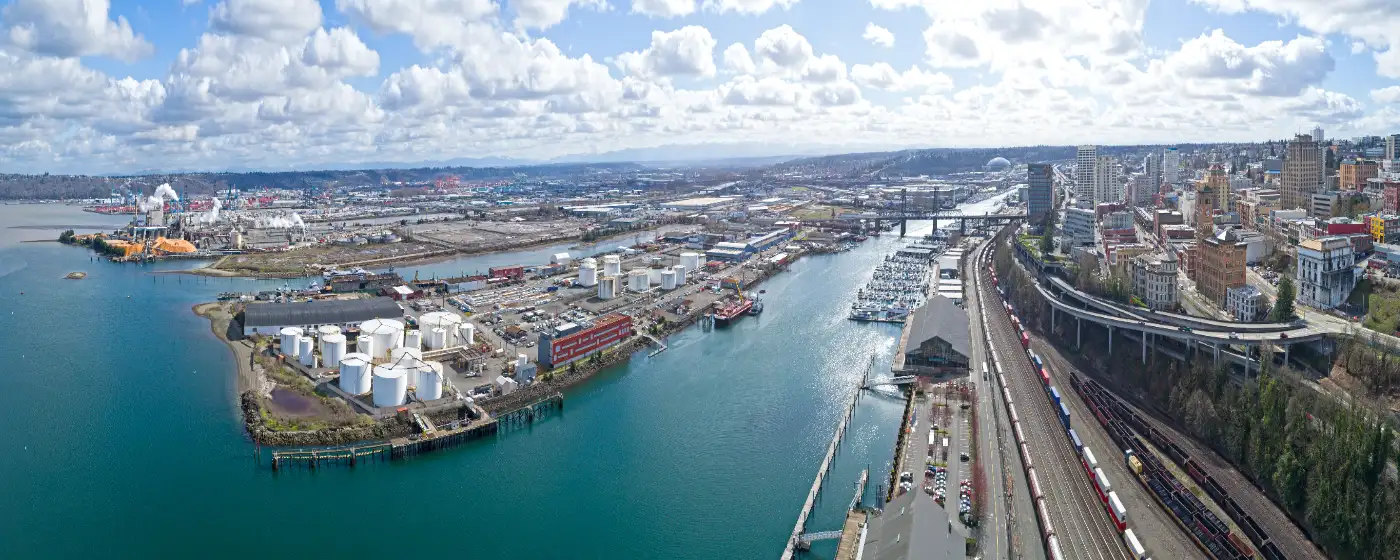
If you've been priced out of the Bay Area, Sacramento, or coastal Southern California, someone has probably already mentioned that Washington has no state income tax. What they may not have mentioned is that Fife — a small city of about 11,000 people wedged between Tacoma and the Port of Tacoma along I-5 — is one of the more affordable entry points into the South Puget Sound, with direct freeway access to Seattle in roughly 40 minutes. The city isn't a resort town or a tech campus suburb. It's a working logistics and distribution hub that happens to sit next to Tacoma's amenities, within reach of mountains and saltwater, at a price point that genuinely surprises people arriving from California.
The economic backbone here is distribution and logistics — US Foods, Home Depot's distribution center, and the Emerald Queen Casino are among the largest employers, and the Port of Tacoma keeps a steady industrial rhythm along the waterfront. The Fife School District holds a B rating, according to Niche, which draws families who want a community that functions without the sticker shock of Bellevue or Kirkland. What actually drives relocation here is a combination: housing prices that remain noticeably below the broader Seattle metro, a location that keeps both Tacoma and Seattle genuinely reachable, and a tax structure that hits differently if you've been writing checks to California's Franchise Tax Board for years.
On the cost side, Fife's cost of living reflects its working-city character — groceries, utilities, and everyday expenses run close to the regional average, not the inflated baseline you may be used to in California. The median home sale price was $529,612 as of June 2026 (Redfin). For most California coastal buyers, that figure doesn't compute at first — it's the kind of number that requires a second look before it registers as real. Health insurance premiums typically run noticeably below California rates, though you'll drive farther for specialist care than you would in a major metro.
Whether you're relocating for a job, following family, or simply doing the math on what your California equity buys here, the sections below break down Fife's California-to-Washington tax picture, the housing reality, what daily life looks like after the move, what surprises people most in their first year, and how to make the domicile change stick so California stops following you.

The Tax Picture: What You Stop Paying and What You Start Paying
The headline is real: Washington levies no personal income tax on wages or salary. You pay $0 in state income tax regardless of what you earn — a permanent, immediate change the moment you establish Washington domicile. California's top marginal rate runs 12.3%, rising to 13.3% on income above $1 million. For a household earning $150,000, the annual difference is material. For a dual-income tech or healthcare household earning $300,000 or more, the savings reshape a budget.
There is one caveat worth understanding. Washington enacted ESSB 6346 (signed into law March 30, 2026), which will impose a 9.9% state income tax on household income above $1 million, effective January 1, 2028. Through at least 2027, the state remains fully zero-income-tax for everyone. And for households near Fife's median income of $90,532, the 2028 change is irrelevant entirely.
Capital gains are a separate story. Washington taxes 7% on long-term capital gains above a $278,000 standard deduction for 2025, rising to 9.9% on gains above $1,000,000 — but real estate sales are explicitly exempt from that tax. California taxes capital gains as ordinary income at rates up to 13.3%. If you're selling stock, business interests, or other non-real-estate assets after the move, the Washington treatment is still considerably more favorable for most sellers, but it is not the zero-tax environment the income-tax headline implies.
Where Washington Costs More: Sales Tax
Fife's combined sales tax rate runs approximately 10.2%–10.3% in 2026, compared to California's 7.25% statewide base rate. That gap adds up on big purchases — appliances, furniture, a car. More notably, Washington taxes groceries at the full rate, which California does not. You'll feel this at the register within the first week.
| Tax Category | California | Washington / Fife | Net Effect for Mover |
|---|---|---|---|
| State income tax (wages) | Up to 12.3% | 0% | Significant annual savings |
| State income tax (>$1M, from 2028) | 13.3% | 9.9% | Still lower in WA for high earners |
| Capital gains tax | Up to 13.3% (ordinary income) | 7% on long-term capital gains above a $278,000 standard deduction for 2025, rising to 9.9% on gains above $1,000,000; real estate exempt | Lower in WA; real estate sellers unaffected |
| Sales tax (combined) | 7.25% base (varies by county) | ~10.2%–10.3% in Fife | Higher in WA — noticeable on large purchases |
| Grocery tax | Generally exempt | Taxed at full rate | Higher ongoing household cost in WA |
| Retirement income tax (Social Security, pensions, 401(k), IRA) | Taxed as ordinary income | $0 — no state income tax | Meaningful advantage for retirees |
| Effective property tax rate | ~0.75%–0.80% statewide (Prop 13 caps longtime owners lower) | 0.94% in Fife | Slightly higher rate, far lower purchase price |
The property tax line deserves its own moment. Fife's effective rate of 0.94% is slightly above California's statewide average — but California's Prop 13 caps annual assessment growth at 2% for longtime owners, meaning a neighbor who bought in 2003 may be paying a fraction of what you'd pay as a new buyer in the same neighborhood. In Fife, there's no equivalent cap, so what you see is what you pay. On a $529,612 purchase, you're looking at roughly $4,978 per year in property tax. See the full cost-of-living breakdown for how that fits into the broader monthly picture.
The Home Price Reality for California Buyers
Fife's median sale price was $529,612 as of June 2026 (Redfin). Sit with that number if you're coming from the Bay Area, San Diego, or coastal Los Angeles, where medians routinely clear $900,000 and regularly exceed $1.2 million. The same down payment that barely cleared escrow on a California starter home can buy you a house with a yard here — without a bidding war that strips away every contingency.
That said, Fife is not the cheapest community in Pierce County. It's a practical, well-located city with freeway access that buyers across the income spectrum compete for. Entry-level inventory — older ranches and smaller townhomes — starts noticeably below the median, while newer construction and larger single-family homes push above it. The neighborhood breakdown covers where different price points concentrate across areas like Fife Heights, Fife Highlands, and West Fife.
What Your California Equity Actually Buys
Californians who sell a home in a coastal market and arrive with substantial equity are in a genuinely different position than first-time buyers here. Equity from a Bay Area sale can translate to a cash purchase or a very low loan-to-value position in Fife — a situation that almost never existed for the same family back home. That dynamic explains why California buyers are consistently a meaningful slice of Fife's and Pierce County's buyer pool.
The catch on financing: if you carry a California mortgage into a Washington purchase, your lender will still qualify you on Washington income and assets. But if you're self-employed or run a pass-through business and California is still claiming you as a tax resident, your income documentation gets complicated fast. Sort the domicile question before you make an offer, not after.
One thing California buyers sometimes underestimate: closing costs in Washington include an excise tax on the sale. The seller typically pays it, but in a negotiation it factors into net proceeds. Your California experience won't have prepared you for this line item. Ask your agent to walk through it before you make assumptions about seller concessions. For more on the buying process, the first-time homebuyer page covers Washington-specific financing mechanics in detail.

Making the Domicile Change Stick — The Part California Won't Let You Skip
California's Franchise Tax Board doesn't wave goodbye when you leave. It is widely regarded as one of the most aggressive state tax authorities in the country when it comes to auditing high-income departing residents. Moving your body to Washington isn't enough. You have to move your legal and financial life as well.
To establish Washington domicile and end California's claim on your income, the checklist is specific: get a Washington driver's license, register your vehicles here, update your voter registration to a Washington address, transfer your primary banking relationships, and update any professional licenses. If you maintain a California home — even a vacation property or a rental you haven't sold — the Franchise Tax Board will use it as evidence that California is still your domicile. Spend fewer than 183 days in California per year, and document it.
The $200K+ Earner Warning
If your household earns above roughly $200,000, this is not a situation to manage casually. California auditors look at where you spend your time, where your doctors and dentists are, where your club memberships are, and where your children go to school. A half-executed domicile change — Washington address on the mail, but California gym membership and a house in Marin — will not survive a serious audit. The income-tax savings are real and substantial. So is the risk of losing them if the paperwork doesn't match the reality.
The practical timeline: plan on 90 to 120 days to fully execute the switch. Do not wait until tax season. Start the day you take possession of your Fife property, or the day you sign a lease if you're renting first. Every week of delay is a week California can point to as evidence of lingering domicile.
Looking to buy in Fife? Estimate your payment.
Enter your numbers to see an estimated monthly mortgage payment.
Estimate only. Excludes HOA fees and mortgage insurance. The interest rate above is a starting point, not a quoted rate — replace it with your own to see real numbers. Insurance is a flat placeholder, not a Fife quote.
What Daily Life Looks Like After the Move
Fife sits in a corridor that most people drive through on I-5 rather than stop in. That's the honest geographic truth, and it shapes the character of the place. Pacific Highway East runs through the commercial spine, lined with the kind of strip malls, distribution lots, and regional chain stores that signal a working-class logistics city rather than a planned suburban village. If you're arriving from Marin County or coastal Orange County expecting a farmer's market on every corner, the adjustment is real.
What Fife actually delivers is access. Tacoma's museums, waterfront, stadium district, and independent dining scene are under 10 minutes away. Seattle is roughly 40 minutes north on I-5. Mount Rainier's foothills are visible on clear days and reachable for a day hike in under an hour. The Olympic Peninsula and Cascade passes are within a two-hour drive. The trade Californians make when they move here isn't quality of life — it's concentration of amenities within the city limits versus regional access to them.
Where Locals Actually Go
On Pacific Highway East, Pick-Quick Drive In has been a Fife institution for decades — the kind of burger-and-milkshake stand that California cities replaced with fast-casual franchises years ago. If you want smoked brisket on a Saturday, Warthog Barbeque Pit on 20th Street East has a following that extends well beyond Fife's city limits. Neither place is trying to be anything other than what it is, which is a reasonable metaphor for the city itself.
The Fife History Museum on Pacific Highway tells the backstory of a community shaped by early farming settlement, the arrival of the freeway, and the subsequent shift to logistics and warehousing. It's small, but it's specific — the kind of local history that helps a newcomer understand why the city looks the way it does. Parks and outdoor options in the immediate area are modest; the payoff is regional, not hyperlocal.
The Six-Month Surprise
Almost everyone who moves here from California says the same thing around month five: they didn't expect the grey to be that persistent. The Pacific Northwest's overcast season runs from roughly October through April, and Fife — unlike some parts of eastern Washington — sits squarely in it. Californians who moved for the tax savings and the home price don't always account for what seven months of low cloud cover does to their mood. Locals handle it with outdoor routines that don't depend on sunshine. You'll adapt, but it's faster if you plan for it from day one rather than hoping the weather data was an exaggeration.
Who Moves to Fife from California — and Who Finds It Isn't the Right Fit
The clearest fit is a household that's done the math and landed on a specific conclusion: the income-tax savings plus the home price difference make Fife financially transformative compared to staying in a California coastal market. Dual-income households in the $120,000–$300,000 range benefit from the income-tax change immediately and can buy into Fife without competing against all-cash equity buyers from the Seattle tech corridor. Remote workers who no longer need to be in a California office but still want Pacific time zone alignment and airport access find Fife practical.
Families with school-age children are a consistent presence. The Fife School District functions well and the community is stable. Parents who were previously choosing between a California public school with overcrowding and a private school bill they couldn't really afford find the district a reasonable middle ground.
Who Tends to Move Out
People leave Fife for a predictable set of reasons. Some buyers arrive expecting a city with walkable streets, a downtown coffee shop culture, and evening dining within a five-minute walk — and find instead that nearly everything requires a car. Others underestimate how industrial the I-5 corridor feels when you live near it rather than just driving through it. The freight traffic on Pacific Highway is constant, and if you're placing your quality-of-life expectations on the immediate surroundings rather than the regional access, the city will disappoint.
High earners who move without fully executing the domicile switch sometimes find themselves in a California audit two or three years after the move — and the resulting bill erases years of intended savings. That's a paperwork and planning failure, not a Fife failure, but it's worth naming as a real reason some California moves here don't work out the way they were supposed to.
The buyers for whom Fife works best are pragmatic about what a city of 11,000 in a logistics corridor can and can't offer — and clear-eyed about what they're buying: a financial reset, regional access, and a stable community, not a lifestyle upgrade in the traditional California sense of that phrase. The living in Fife overview covers who the city suits across different life stages.

Local Expert Takeaway: The income-tax math is real, and so is the housing price gap — but the Californians who land well in Fife are the ones who execute the domicile change completely, walk into Pick-Quick Drive In on Pacific Highway East without expecting it to be something it's not, and treat Tacoma's waterfront and the Cascades as their backyard rather than looking for those amenities within Fife's own city limits. The city rewards pragmatic buyers who know what they're trading away and exactly what they're getting instead.
Quick Takeaways & FAQs
✅ Washington's zero state income tax is immediately effective the moment you establish domicile — for a household earning $150,000+, the annual savings versus California are substantial and start from day one.
⚠️ Fife's combined sales tax rate of approximately 10.2%–10.3% — including on groceries — is noticeably higher than California's base rate, so the tax story here isn't a clean win in every category.
📍 California's Franchise Tax Board actively audits high-income departing residents; get your Washington driver's license, voter registration, and banking transferred within the first 90 days of the move, not at tax time.
Does moving to Fife really eliminate California state income tax?
How does Fife's home price compare to what I'm used to in California?
What taxes are actually higher in Washington than California?
Is there a Washington state capital gains tax I should know about?
What surprises California transplants most about living in Fife?
Moving to Washington?
Tell us what you need help with and we'll connect you with local resources.
