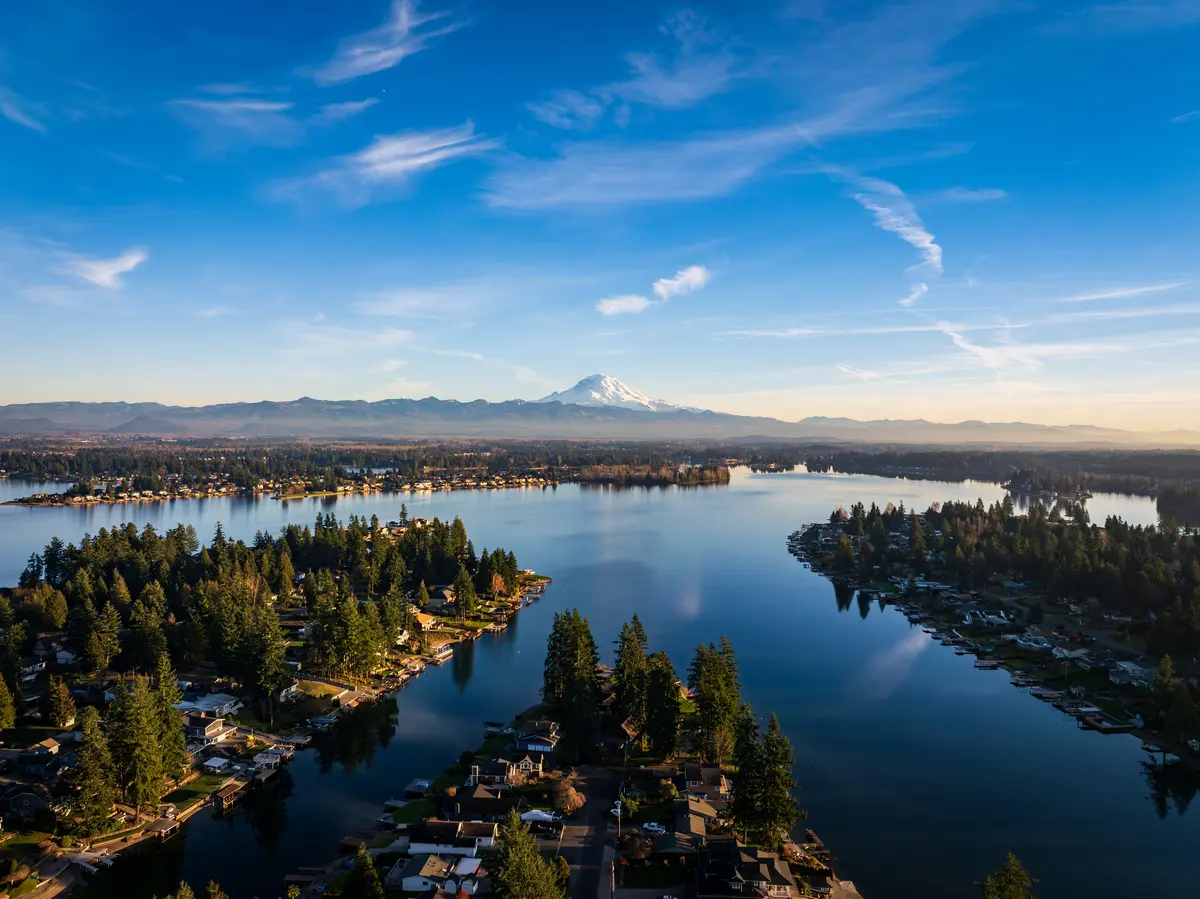
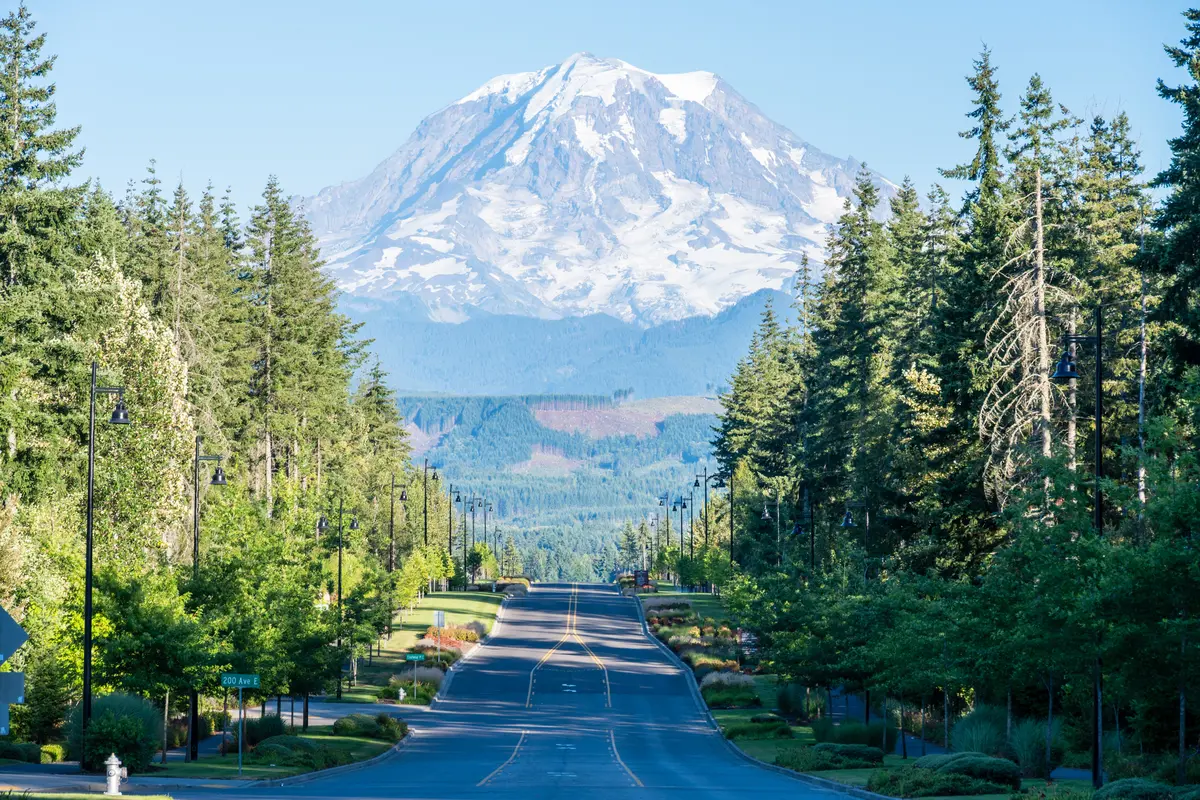
Maybe you're pricing out of the Seattle core and someone mentioned Bonney Lake. Maybe your adult kids live in Puyallup or Sumner and you want to be close but not on top of them. Either way, the first thing to know is that Bonney Lake is not a retirement-marketed destination — it's a working Pierce County suburb, perched above Lake Tapps on SR-410, with views of Mount Rainier that genuinely stop people mid-sentence. Retirees who land here tend to do so because family pulled them in, or because the price point relative to the Seattle metro made the math work for the first time in years. The Zillow Home Value Index puts the typical home at $641,907 (2026), which is real money — but noticeably below what comparable square footage costs closer to Seattle's ring suburbs.
What holds the city together economically has little to do with retirees specifically. Fred Meyer, Safeway, and a deep trades workforce are the employment anchors, and most working-age residents commute toward Boeing's Auburn operations or Amazon's South Puget Sound facilities. That context matters for retirees: this is not a city built around senior amenities the way some Sun Belt markets are. The senior center on Bonney Lake Blvd is active and well-used, but you will not find the density of senior programming, walkable downtowns, or specialist medical offices you'd get in a city that actively recruits retirees.
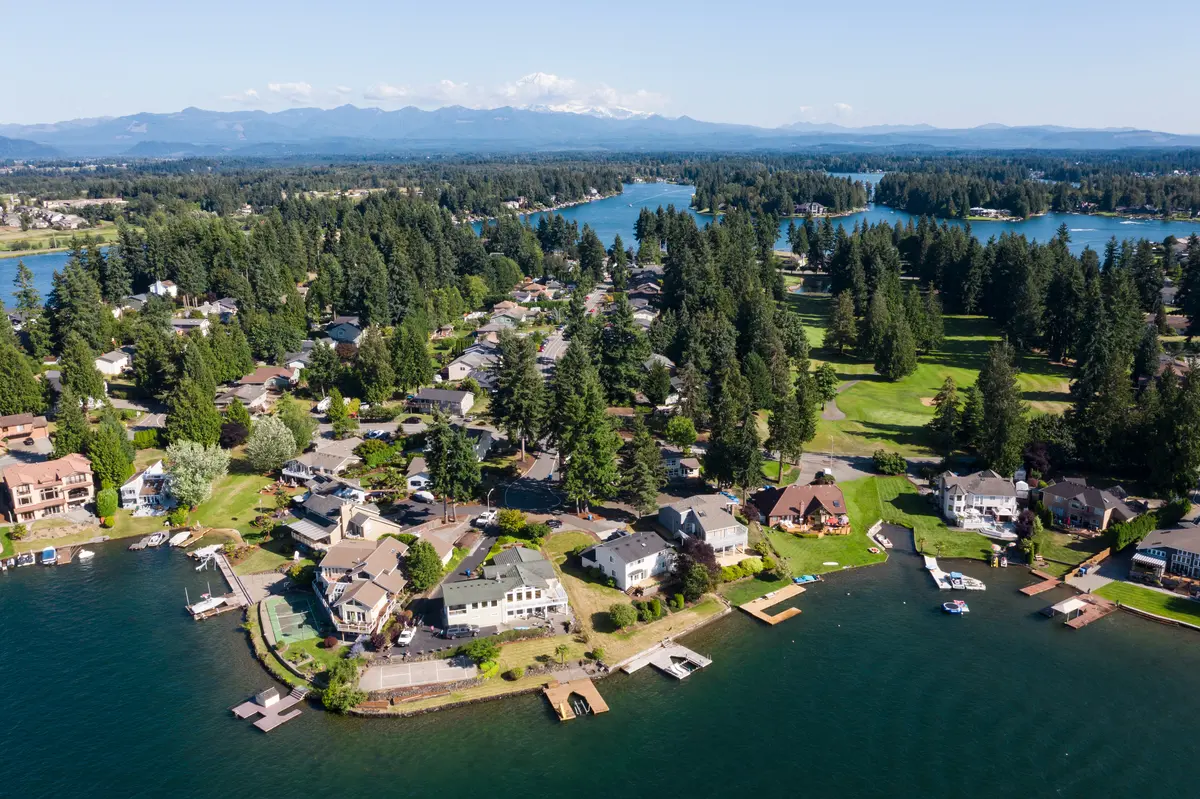
The trade that most retirees here consider worth it: Washington's tax posture on retirement income is genuinely excellent. Social Security, pension distributions, and withdrawals from 401(k)s and IRAs face zero state income tax. Property taxes at an effective rate of approximately 0.94% are moderate for the Seattle metro. Daily costs for groceries, dining, and services run close to Puget Sound norms — not cheap, but not Seattle-premium either. For outdoor-oriented retirees, Allan Yorke Park on Lake Tapps and the network of trails feeding toward Mount Rainier provide low-impact activity within minutes of most neighborhoods. The catch — and it matters more as you age — is that this city demands a car for nearly everything, and advanced specialist medical care requires a drive to Puyallup or Tacoma.
Whether you're seriously weighing a move or just running early comparisons, the sections below break down Bonney Lake's healthcare access, retiree tax picture, daily cost of living, walkability, senior housing inventory, and how the city stacks up against nearby retirement alternatives.

Why Retirees Are Choosing Bonney Lake
The retirees who thrive in Bonney Lake share a few things in common: they own a car, they love being outdoors, and they either have family in the South Puget Sound area or moved here specifically to be near them. This is not a city you choose for its downtown scene or walkable café culture. You choose it because the Zillow Home Value Index puts the typical home at $641,907 (2026) — meaningfully below the price floor in Bellevue or Kirkland — and because Washington's income tax situation is one of the most favorable in the country for people living on retirement savings.
The Mount Rainier viewpoint on Highway 410 isn't just a landmark — it's the daily backdrop. Retirees in the Panorama West area and around Lake Tapps often cite the views and the access to quiet water as the core reason they stay. Allan Yorke Park provides easy walking loops along the lake's edge, and the trail network connecting to Victor Falls Park suits anyone who wants low-impact outdoor time without driving to a trailhead. If your retirement vision involves kayaking, fishing, or simply sitting somewhere genuinely beautiful with a cup of coffee, Bonney Lake delivers that without requiring a destination trip.
Who should look elsewhere? Retirees who depend on walking for daily errands, who want a dense senior social scene with programming every day of the week, or who anticipate needing specialist medical care frequently will find Bonney Lake's infrastructure thin. The city also isn't the right call if your priority is a pedestrian-friendly downtown where you can age in place without a car. For that, Puyallup's older commercial core or a waterfront community with true walkability are more honest fits. Bonney Lake rewards independent, mobile retirees — people who are choosing a quieter chapter, not people who need a city to do the work for them.
Healthcare & Medical Access in Bonney Lake
What's Actually In the City
Bonney Lake has more in-city medical infrastructure than its size would suggest, and that's largely thanks to MultiCare's footprint here. MultiCare Emergency – Bonney Lake, at 9550 195th Ave E, operates 24 hours a day, seven days a week, staffed by board-certified emergency physicians. This is not a freestanding ER that stabilizes and transfers — it functions under the MultiCare Good Samaritan Hospital license, which means true emergency-level care without the Puyallup drive for most acute situations.
For non-emergency needs, MultiCare Indigo Urgent Care at 21186 WA-410 is open daily from 8 a.m. to 8 p.m., accepts walk-ins, and has on-site digital X-ray and lab capability. That combination — a 24/7 emergency department and a seven-day urgent care — covers the day-to-day and acute-care needs that retirees encounter most often. Primary care and specialty outpatient offices are also present along the SR-410 corridor, though the selection is narrower than you'd find in Puyallup proper.
The Honest Distance-to-Advanced-Care Reality
MultiCare Good Samaritan Hospital in Puyallup — the nearest full-service inpatient facility with the specialist depth retirees may eventually need — is approximately 8 miles from Bonney Lake. On a Tuesday at noon, that's a 15-minute drive. On a Friday afternoon when SR-410 backs up through Sumner, it can run closer to 35 minutes. That gap matters if you're managing a cardiac condition, undergoing cancer treatment, or anticipating orthopedic surgery with follow-up appointments several times a week.
For subspecialty care at the level of a major academic medical center — complex oncology, advanced neurology, organ transplant — you're looking at major health system facilities in Tacoma, roughly 20–25 miles away. Seattle-based academic medical systems are a 40-plus-mile trip. Retirees with serious ongoing specialist needs should weigh this distance honestly before committing to Bonney Lake over a city that sits directly adjacent to a regional hospital campus.
The local infrastructure is solid for a city of Bonney Lake's size. The gap is in subspecialty depth and inpatient complexity — and that gap narrows significantly if you're in generally good health and need emergency or routine care far more often than you need a neurosurgeon.
The Retiree Budget in Bonney Lake
Washington's Tax Posture for Retirees
Washington levies no personal state income tax. That means your Social Security check, your pension distribution, your 401(k) withdrawal, and your IRA income are all untaxed at the state level. For retirees moving from California, Oregon, or Minnesota, this difference is not marginal — it is one of the most meaningful structural advantages of retiring in Washington.
One caveat worth knowing if your portfolio includes a large taxable brokerage account: Washington taxes 7% on long-term capital gains above a $278,000 standard deduction for 2025, rising to 9.9% on gains above $1,000,000. This does not touch Social Security, pensions, or retirement-account withdrawals — it's relevant primarily for retirees selling appreciated stock or investment real estate in a single tax year. For most fixed-income retirees, it's a non-issue.
Property Taxes and the Deferral Option
Bonney Lake's effective property tax rate is approximately 0.94% — moderate by Seattle metro standards. Washington also offers a property tax deferral program for qualifying seniors: rather than eliminating the tax, the state lets you defer it, effectively lending you the money and collecting only when the home is sold or ownership transfers. For retirees who are house-rich but watching monthly cash flow carefully, this is a meaningful tool that many don't know to ask about.
Daily Cost of Living on a Fixed Income
Groceries and everyday essentials track with broader Puget Sound pricing — Fred Meyer and Safeway are both present in the city, so you're not driving to Puyallup for a weekly shop. Dining out along the SR-410 corridor runs the full range from fast casual to sit-down options. For a fuller picture of overall cost of living in Bonney Lake, including rent and utility benchmarks, that page has the detailed breakdown.
Assisted living costs, if that stage arrives, are worth knowing early: facilities in Bonney Lake typically run $5,500 to $8,000 per month (2025 figures), with adult family homes averaging $4,500 to $6,500 per month. Those fees generally cover meals, housekeeping, transportation, and activities. Planning for that range now, while you're still in the decision phase, is the move most financial advisors wish their clients had made earlier.
Looking to buy in Bonney Lake? Estimate your payment.
Enter your numbers to see an estimated monthly mortgage payment.
Estimate only. Excludes HOA fees and mortgage insurance. The interest rate above is a starting point, not a quoted rate — replace it with your own to see real numbers. Insurance is a flat placeholder, not a Bonney Lake quote.
Walkability, Community & Staying Active in Bonney Lake
The Walkability Reality
Bonney Lake is car-dependent. Most of the residential fabric — Tapps Island, Ponderosa Estates, Willow Brook, the hillside streets above Lake Tapps — was designed around the automobile, and the commercial spine sits along SR-410 in a configuration that does not invite pedestrians. If your retirement plan involves walking to the coffee shop, the pharmacy, or the grocery store on a regular basis, this city will frustrate you within the first month.
That said, the walking that is here is genuinely pleasant. Allan Yorke Park on Lake Tapps has shaded benches and easy looping paths that suit low-impact daily movement. Victor Falls Park connects to quieter trail networks away from traffic. These are retirement-appropriate walks — flat enough for most fitness levels, scenic enough to actually want to do them. The distinction is between recreational walking, which Bonney Lake supports well, and utilitarian walking for errands, which it largely does not.
For retirees who want occasional transit access without driving all the way to Seattle, the Bonney Lake Park-and-Ride connects via Sound Transit Express 596 to Sumner Sounder Station, where you can board Sounder commuter rail into Tacoma or downtown Seattle. It is not a substitute for daily mobility, but it makes a medical appointment or a day trip to Seattle viable without dealing with I-5.
The Senior Center and Social Life
The Bonney Lake Senior Center at 19304 Bonney Lake Blvd is the social anchor for older adults in the city. Beyond programming and activities, it runs a transportation service — shared van rides for adults 55 and older for a suggested donation of $6, scheduled at least one day in advance. For retirees who stop driving before they're ready to leave Bonney Lake, that program is worth knowing about early.
The social scene outside the senior center is what you'd expect from a close-knit suburb rather than a purpose-built retirement community. Neighbors gather at lakeside spots around Lake Tapps on summer evenings. George's Bonney Lake Tavern draws a regular crowd of longtime locals. The rhythms here are quieter and more self-organized than you'd find in a master-planned active-adult development. Retirees who make friends easily and prefer low-key routines tend to settle in well; those who need a robust institutional social calendar may find it thin.
Right-Sizing: Downsizing in Bonney Lake
Bonney Lake's housing stock skews toward single-family homes built in the 1990s through 2010s — three- and four-bedroom houses on sloped lots that made sense for a family of four and become more complicated as mobility changes. Finding a single-level home with no stairs is possible but takes patience; much of the inventory in the Ponderosa Estates and Panorama West areas involves split entries or multi-level layouts that work fine until they don't.
The most direct downsizing path in Bonney Lake runs through its two established senior communities. Wesley at Tehaleh is a faith-based nonprofit community offering independent living, assisted living, and memory care on one campus — the full continuum of care, which means you can move in at the independent living stage and transition without relocating if your needs change. Cedar Ridge by Bonaventure, near Bonney Lake's downtown corridor, covers retirement and assisted living with 24-hour care, restaurant-style dining, scheduled outings, and suites ranging from one-bedroom to two-bedroom two-bath configurations. These are the two named options with verified, current operations in the city — not a long list, but both represent real infrastructure rather than a marketing promise.
Patio homes and smaller newer construction do exist in the Tehaleh master-planned community adjacent to Bonney Lake — this is where a wave of newer single-level and low-maintenance homes has been built over the past decade. If your priority is newer construction without stairs and a manageable HOA, Tehaleh is worth including in your search, though it sits at the higher end of the local price range and carries ongoing HOA fees that matter on a fixed income.
Inventory of true 55+ age-restricted communities in Bonney Lake proper is limited compared to larger retirement markets. If a purpose-built active-adult neighborhood with a clubhouse, pool, and daily programming is the goal, you'll find a deeper selection in Puyallup, Sumner, or Auburn. Bonney Lake's downsizing pitch is quieter: less density, real lake and mountain views, and two solid care-continuum communities if you need them.
Bonney Lake vs Nearby Retirement Destinations
| City | Cost vs Bonney Lake | Hospital Access | Walkability | Senior Living Depth | Overall Retirement Fit |
|---|---|---|---|---|---|
| Bonney Lake | — | In-city 24/7 ER; full-service hospital 8 miles in Puyallup | Low — car required for errands; good recreational trails | Moderate — Wesley at Tehaleh, Cedar Ridge by Bonaventure | Strong for mobile, outdoor-oriented retirees near family |
| Puyallup | About the same | MultiCare Good Samaritan — on-site | Moderate — older downtown core with some walkable blocks | Strong — multiple senior communities near hospital | Better for retirees who want hospital proximity and more walkable errands |
| Sumner | Noticeably cheaper | Full-service hospital approximately 5 miles away | Low-moderate — small downtown with some on-foot access | Limited — fewer dedicated senior communities | Good value option for retirees who drive and want a quieter small-town feel |
| Orting | Noticeably cheaper | Full-service hospital approximately 15 miles away | Low — rural layout, car essential | Minimal | Best for retirees who want rural character and lower costs; Rainier lahar zone is a real planning consideration |
| Auburn | About the same | Regional medical center — on-site | Moderate — transit-accessible, light rail nearby | Good — several senior communities along the Green River corridor | Better for retirees who want transit options and hospital adjacency without Seattle prices |
| A waterfront Pierce County community | Pricier | Regional hospital — in-city | Moderate-high — walkable waterfront and downtown | Strong — multiple communities, active senior population | Top pick for retirees who want walkability, waterfront beauty, and full senior infrastructure — at a higher cost |
Puyallup is the most direct competitor: similar pricing, a full-service hospital you can walk into rather than drive to, and a modest downtown that gives retirees at least some on-foot options. If hospital proximity is your single biggest concern, Puyallup wins the comparison without a close second.
Sumner and Orting offer real cost advantages for retirees on tighter budgets, but both require accepting thinner medical infrastructure and almost no walkability. Orting carries the additional consideration of sitting in a lahar hazard zone from Mount Rainier — that fact belongs in any honest retirement conversation about the area, and it is one most real estate listings don't volunteer.
Auburn gives retirees something Bonney Lake genuinely lacks: meaningful transit access. With Sounder rail and a bus network connecting into Seattle, Auburn suits retirees who want to keep visiting the city without owning two cars or relying on family for rides. The premium waterfront options west of Bonney Lake offer walkability and a well-developed senior living ecosystem — but the price point reflects all of that. Bonney Lake sits comfortably in the middle: not the cheapest, not the most walkable, but a quieter and genuinely scenic option for retirees who are mobile, love the outdoors, and want to stay close to the broader South Puget Sound family without moving into a retirement community by default.
Local Expert Takeaway: Bonney Lake is a realistic retirement choice for one specific profile: a mobile retiree who drives, values outdoor access over urban amenities, and has family in the Pierce or King County area. The in-city MultiCare emergency department at 9550 195th Ave E removes the most common healthcare objection to smaller suburbs. Wesley at Tehaleh handles the care-continuum question if you want to plan that far ahead. The tax situation — zero state income tax on Social Security, pensions, and retirement accounts, with a property deferral option for qualifying seniors — is genuinely favorable. What the city cannot give you is walkability, a dense senior social calendar, or subspecialty medical depth without a drive to Puyallup or Tacoma. Know that going in, and Bonney Lake delivers on what it promises.
Quick Takeaways & FAQs
✅ Washington taxes zero state income on Social Security, pensions, and IRA withdrawals — Bonney Lake retirees keep more of every dollar they draw down.
⚠️ Bonney Lake is built for drivers: retirees who stop driving before leaving will find daily errands genuinely difficult without the Senior Center's van transportation program.
📍 The MultiCare emergency department at 9550 195th Ave E operates 24/7 with board-certified physicians — meaningful for a suburb that isn't adjacent to a full hospital campus.
Is Social Security taxed in Washington state for retirees in Bonney Lake?
What is the closest hospital to Bonney Lake for retirees?
Are there 55+ or active-adult communities in Bonney Lake?
Can you get around Bonney Lake without a car as a retiree?
What does assisted living cost in Bonney Lake?
Moving to Washington?
Tell us what you need help with and we'll connect you with local resources.
