People who move to Bonney Lake from Seattle or Tacoma often expect a suburb that's just cheaper and quieter — and on the safety front, that expectation holds up. With a violent crime rate of 2 per 1,000 residents (FBI UCR 2024 data, via NeighborhoodScout), Bonney Lake sits meaningfully below the U.S. national average of approximately 3.59 per 1,000. The story on property crime is more nuanced, and it's the one worth reading carefully before you settle on a neighborhood.
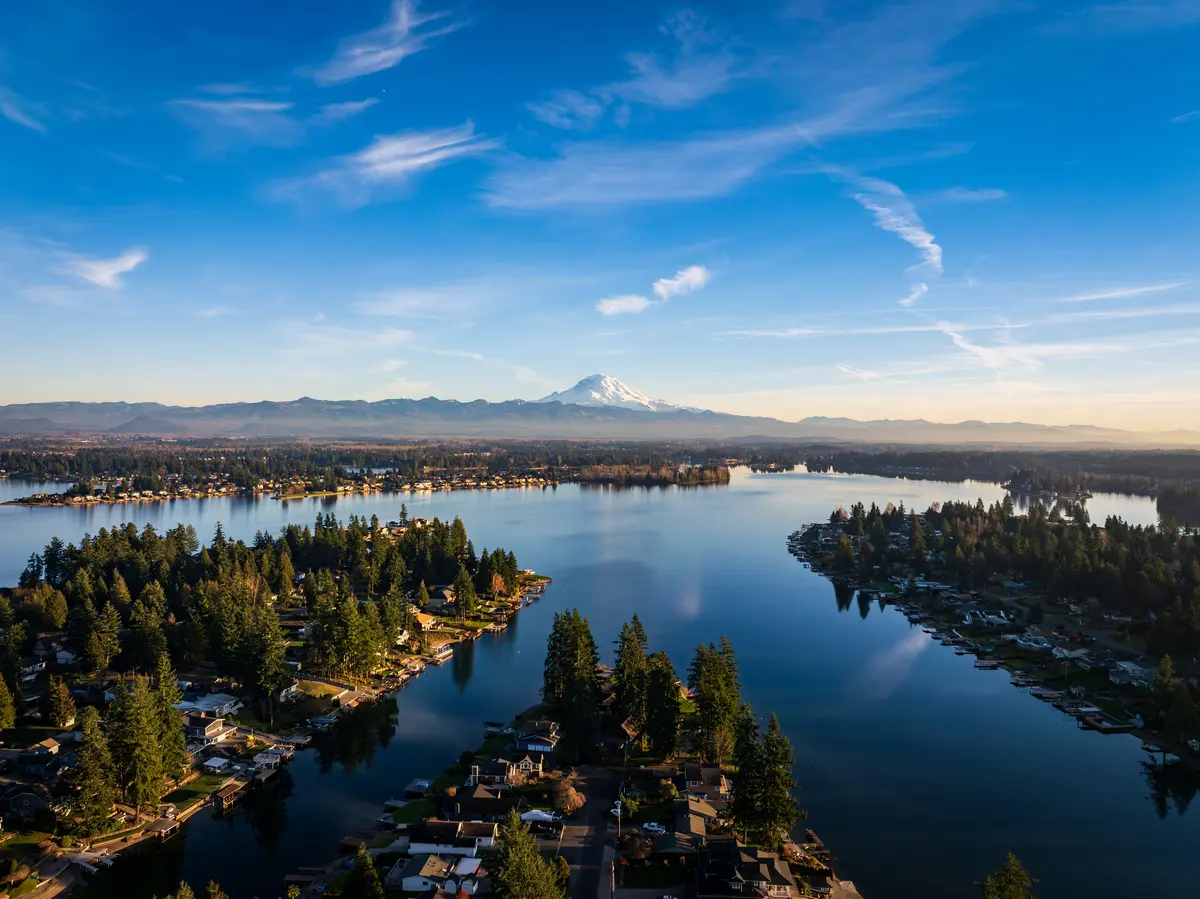
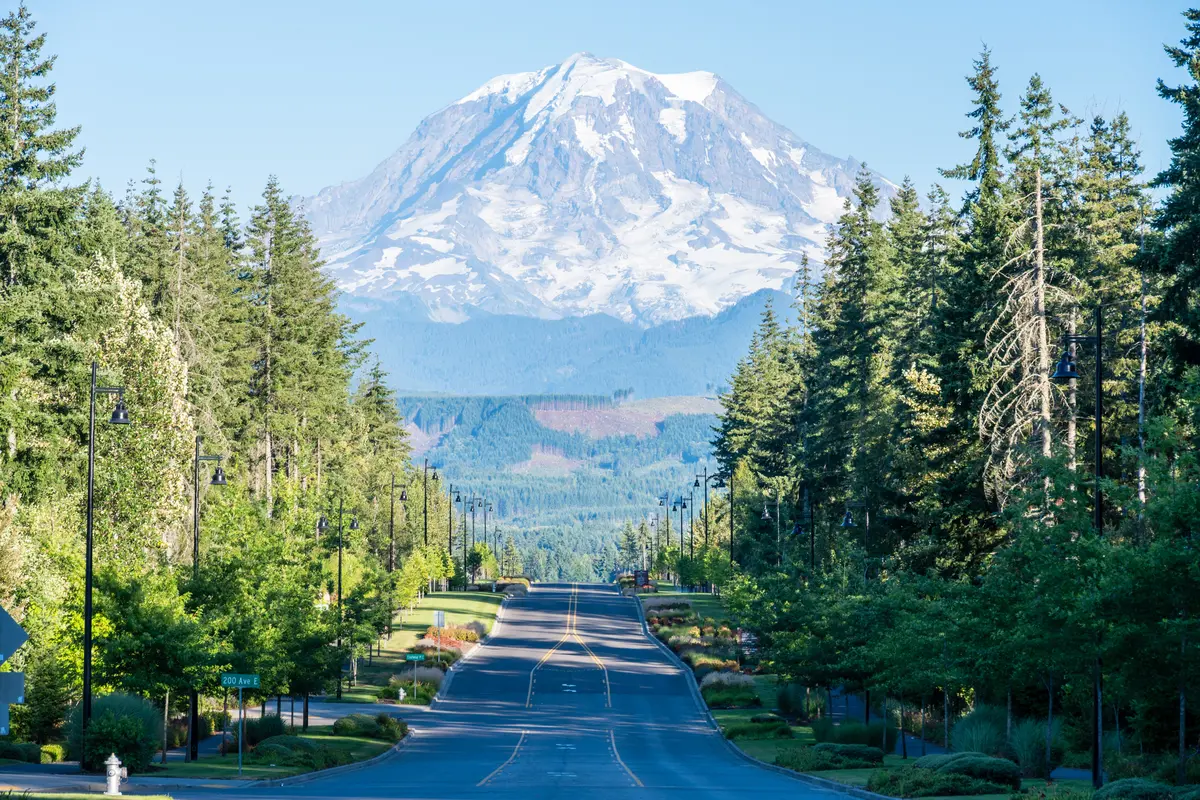
Bonney Lake is a city of roughly 22,145 people tucked into the foothills east of Puyallup along State Route 410, with Lake Tapps anchoring its southwestern edge and Mount Rainier filling the windshield on clear mornings. Many residents commute west to Boeing or Amazon, which means the city functions more as a residential community than a commercial hub — and that matters for crime patterns. Retail corridors attract a different crime mix than quiet cul-de-sacs, and knowing which is which saves you from a neighborhood decision you'll regret after month six.
The headline numbers lean positive. Total crime fell 13.5% year-over-year in 2024, and the city's overall crime rate of 1,887.1 per 100,000 is well below the national figure of 2,752.3 per 100,000, according to FBI 2024 data analyzed by CrimeBycity.com. Violent crime ticked up 13.9% within that same period — a detail worth acknowledging — but in absolute terms it remains low, at roughly 184 per 100,000. The city also launched new tech tools and a coordinated park-safety plan in 2024 and 2025, which signals an administration paying attention rather than managing decline.
Whether you're narrowing down a neighborhood or trying to understand how Bonney Lake stacks up against nearby Sumner, Puyallup, or Auburn, the sections below break down the violent and property crime figures, the neighborhood-level safety picture, what the police department is actually doing, and the honest caveats every prospective resident should know.

Bonney Lake Crime Rate: The Numbers in Context
Violent Crime: Below Average, by a Meaningful Margin
Bonney Lake's violent crime rate of 2 per 1,000 residents compares favorably against both state and national benchmarks. Washington State's 2024 violent crime rate runs approximately 329 per 100,000 residents (FBI UCR 2024); Bonney Lake's equivalent figure of roughly 184 per 100,000 sits at nearly half that. Nationally, the average is around 359 per 100,000 — Bonney Lake is well below both.
CrimeGrade.org places Bonney Lake in the 63rd percentile for violent crime safety, meaning it is safer than 63% of U.S. cities on that specific metric — a "B" grade. That's not a perfect score, but for a suburb of this size in the greater Seattle metro, it reflects a community where serious crime is not a daily reality for most residents.
Murder in particular is notably low. CrimeBycity.com's analysis of FBI 2024 data shows Bonney Lake's homicide figures well below the national rate — a category that tends to be the first thing relocating families ask about and, here, the least cause for concern.
Property Crime: Close to the National Average
The property crime picture is less clean. At 18 per 1,000 residents, Bonney Lake's property crime rate sits just slightly above the U.S. national average of approximately 17.6 per 1,000 (FBI UCR 2024). This is the honest caveat in an otherwise positive profile.
| Crime Type | Bonney Lake (per 1,000) | U.S. National Avg (per 1,000) | Assessment |
|---|---|---|---|
| Violent Crime | 2.0 | 3.59 | Well below average |
| Property Crime | 18.0 | 17.6 | Slightly above average |
| Total Crime (per 100K) | 1,887.1 | 2,752.3 | Well below average |
| Violent Crime (per 100K) | 183.9 | ~359 | Well below average |
| Murder Rate | Particularly low | Baseline | Favorable |
| Year-over-Year Trend (2024) | Total crime −13.5% | — | Improving |
Sources: NeighborhoodScout / FBI UCR 2024 data (released October–August 2025); CrimeBycity.com (FBI 2024 data, February 2026).
Property crime in suburban Washington tends to concentrate around retail corridors and park-and-ride lots — places with high vehicle turnover and low foot traffic after hours. That geographic pattern matters when you're choosing between neighborhoods, as discussed in the next section.
Neighborhood Safety: Where Bonney Lake Divides
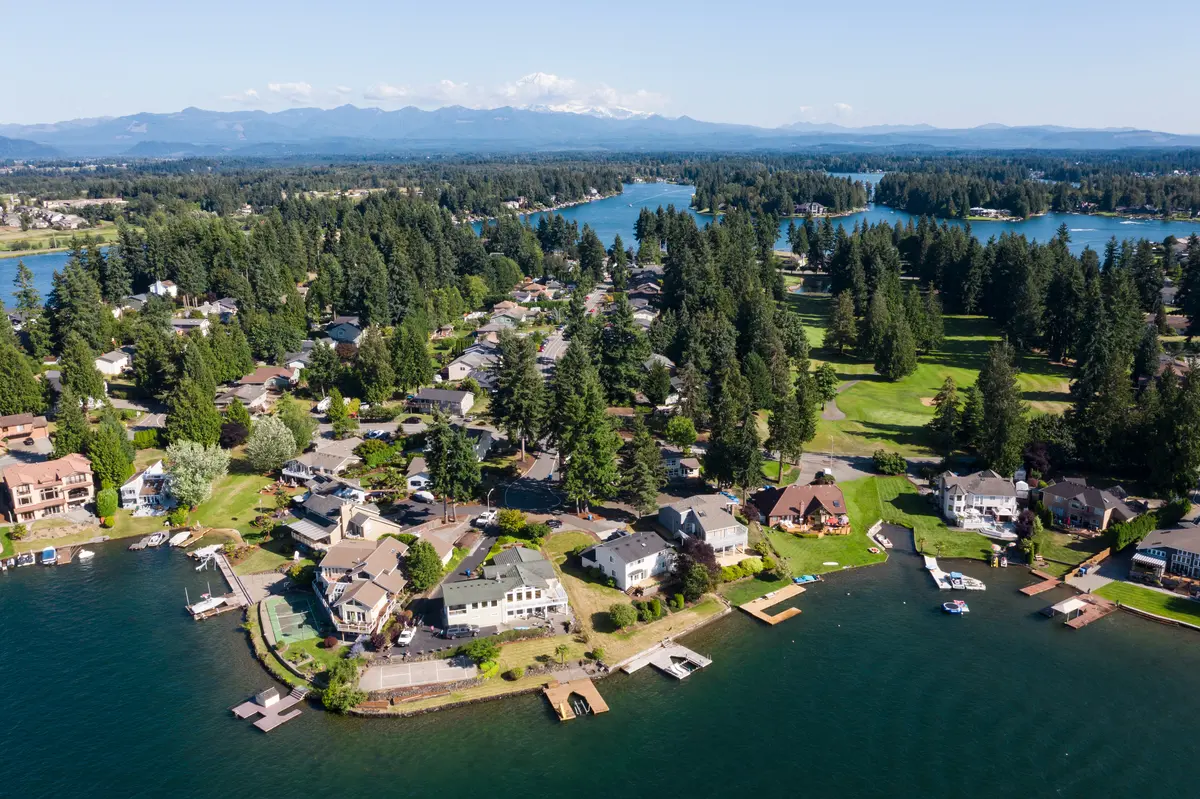
Bonney Lake is not a uniform safety story. The geography — SR-410 running through the commercial core, Lake Tapps anchoring quieter residential pockets to the south, and newer subdivisions fanning out to the east — produces meaningfully different day-to-day experiences depending on where you land.
For the full neighborhood character breakdown, see the best neighborhoods in Bonney Lake guide. What follows is the safety-specific lens on each area.
Tapps Island and Lake Tapps
These are among the quieter residential pockets in the city. The gated access on Tapps Island reduces through-traffic — a structural factor that tends to suppress opportunistic property crime. Residents here describe concerns that skew toward the mundane: the occasional package theft, boat storage security.
Best for: Families Quiet
Ponderosa Estates and Rhododendron Park
Established, tree-lined neighborhoods with long-term homeownership patterns. Lower turnover and tight neighbor familiarity tend to correlate with lower property crime, and that holds here. These areas sit far enough from the SR-410 retail strip that cut-through traffic is minimal.
Best for: Families Quiet
Eastown and the SR-410 Corridor
The commercial activity along State Route 410 — where you'll find Fred Meyer, Safeway, and a strip of independent dining options — brings the property crime exposure up. Parking lot vehicle break-ins and retail-adjacent theft cluster here. Residents close to the commercial core report a pattern of attempted car thefts and catalytic converter thefts on neighborhood forums rather than violent incidents.
This doesn't make Eastown a neighborhood to avoid — it's the most walkable part of the city — but it's the right mindset adjustment if you're comparing it to the lake-side residential pockets.
Best for: Walkable Commuter
Willow Brook, Panorama West, and Inlet Island
Newer subdivisions with cul-de-sac layouts that limit through-traffic. The structural design of these neighborhoods — long residential streets that don't connect to arterials — is itself a modest deterrent to the drive-through opportunistic theft that affects busier corridors. Neighbors tend to know each other by face, which matters.
Best for: Families Value
Allan Yorke Park: Know the Recent History
Allan Yorke Park is the city's largest recreational anchor, and for most of the year it's a normal suburban park — National Night Out Against Crime is held there annually, most recently on August 5, 2025. Following a shots-fired incident in 2023, the city launched a formal Operational Plan in 2024 involving the Police Department, Risk Management, and Emergency Management to systematically restore safety there.
That coordinated response is a good sign. Going into the park at night without knowing that backstory is the kind of thing newcomers do that locals don't.
Bonney Lake Police Department: Staffing, Tools, and Trends
Who Covers the City
The Bonney Lake Police Department runs 33 fully commissioned officers and 3 limited commissioned officers for a population of approximately 22,145 — a ratio of roughly 1.5 commissioned officers per 1,000 residents. That aligns with the Washington State average, which is worth knowing in context: Washington ranks 51st among all U.S. jurisdictions for police officers per capita, with 1.38 officers per 1,000 residents versus the national average of 2.31 (Washington Association of Sheriffs and Police Chiefs, 2024 Annual Report).
This is a statewide structural reality, not a Bonney Lake-specific failure. The city is neither over-staffed nor dangerously thin relative to its peers. Response times in a city of this geographic spread — where Lake Tapps and Tapps Island are a meaningful drive from the eastern subdivisions — are a legitimate question to ask when you're researching specific areas.
New Technology: Flock License Plate Readers
In 2025, the department deployed a Flock automated license plate reader system across the city. At the Public Safety Committee meeting in May 2025, Chief Berry reported that two separate crimes were solved within a two-hour period using the system — the kind of result that tends to accelerate community buy-in and officer morale simultaneously.
Automated license plate readers are particularly effective against the property crime categories where Bonney Lake has its greatest exposure: vehicle theft, car break-ins, and retail-adjacent theft where suspects drive in and out quickly. It's a targeted tool for the city's actual problem profile.
Washington State's 2024 Crime Trend
Bonney Lake's improvement didn't happen in a vacuum. Statewide, overall crimes dropped from 526,994 in 2023 to 480,875 in 2024, and violent offenses fell from 31,711 to 29,210, according to the Washington Association of Sheriffs and Police Chiefs annual report released July 2025. Bonney Lake's 13.5% total crime decline tracks with — and in some categories outpaces — the broader state trend.
Looking to buy in Bonney Lake? Estimate your payment.
Enter your numbers to see an estimated monthly mortgage payment.
Estimate only. Excludes HOA fees and mortgage insurance. The interest rate above is a starting point, not a quoted rate — replace it with your own to see real numbers. Insurance is a flat placeholder, not a Bonney Lake quote.
What Residents Actually Experience Day to Day
The Nextdoor Reality
Nextdoor conversations in Bonney Lake skew toward the minor end of the crime spectrum: attempted car thefts, package theft from porches, phone and online scams targeting older residents. Residents describe the city as generally safe. Violent crime doesn't dominate the feed the way it does in parts of Tacoma or south Auburn.
That matches the numbers. A city at 2 violent crimes per 1,000 residents is not producing daily incidents that crack the police blotter. Most people who live here for a year will experience property crime anxiety — checking whether their car is locked, securing bikes in garages — but not the persistent awareness of personal safety risk that characterizes higher-crime environments.
The Six-Month Surprise
Here's what catches newcomers off guard: the SR-410 corridor feels safe in daylight and significantly less so after 10 p.m. The gas stations and parking lots near the main commercial strip are where most vehicle-related property incidents concentrate. Families who move here expecting everything to feel uniformly suburban-quiet sometimes discover this after their first car break-in near the Fred Meyer parking lot — not a dangerous encounter, but an annoying one that feels disproportionate given what they paid for the house.
The practical adjustment is simple: treat the commercial corridor the way you'd treat any suburban retail corridor after dark. Park under lights, don't leave valuables visible, use a steering wheel club if you drive an older Toyota or Honda (the most-targeted makes for catalytic converter theft statewide). These are habits, not reasons to avoid the city.
Community Safety Investment
One thing that gets undersold in raw crime statistics: Bonney Lake's city government is actively engaged on public safety in a way that smaller Pierce County cities often are not. The formal Operational Plan for Allan Yorke Park, the Flock system deployment, and the annual National Night Out at the park all point to an administration that treats safety as a managed outcome rather than a background fact.
That institutional attention tends to matter more over a five-year horizon than the specific rate in any single year.
How to Research Safety Before Settling on a Neighborhood
Use the Right Data Sources
Three sources give you the most reliable picture of Bonney Lake's crime landscape: NeighborhoodScout (which uses FBI UCR data broken down at the city level), CrimeGrade.org (which produces percentile rankings that put raw numbers into comparative context), and the City of Bonney Lake's own Public Safety Committee meeting packets (published at bonneylake.gov), which tell you what specific issues the department is actively working on.
Avoid aggregator sites that pull crime data from unverified sources or that haven't updated since 2022. Washington's crime reporting saw methodology shifts with the transition to NIBRS reporting, and some older datasets reflect incomplete reporting rather than actual crime levels.
Ask the Right Questions About a Specific Address
City-wide rates tell you the average; they don't tell you about the block. Before settling on a specific street, consider checking:
- Distance from SR-410 and the commercial corridor — property crime exposure rises near retail nodes and high-traffic parking areas.
- Neighborhood structure — cul-de-sacs and limited-access streets (including gated Tapps Island) suppress drive-through opportunistic crime.
- Nextdoor activity — the neighborhood-specific feeds will show you what type of incidents neighbors are actually reporting, which is more useful than a city aggregate.
- Proximity to Allan Yorke Park — the park is an asset with a recent history that's being actively managed; knowing that context helps you ask better questions about the immediate surroundings.
Put the Numbers in Perspective
Bonney Lake is not a zero-risk environment — no suburban city of 22,000 is. But a violent crime rate at roughly half the Washington State average, a total crime rate meaningfully below the national figure, and a 13.5% year-over-year decline in overall crime add up to a profile that most relocating families find reassuring.
The property crime rate sitting just above the national average is real and worth planning around — but it's the kind of risk you manage with behavior and neighborhood selection, not the kind that should move Bonney Lake off your shortlist.
Local Expert Takeaway: Bonney Lake's violent crime numbers are genuinely good — below both the Washington State average and the national figure, with a downward trend backed by real city investment in tools like the Flock license plate reader system and the Allan Yorke Park Operational Plan. The honest friction point is property crime, which runs just above the national average and concentrates around the SR-410 commercial corridor near Fred Meyer and Safeway. If you're weighing neighborhoods, the lake-side areas — Tapps Island, Lake Tapps, Ponderosa Estates — offer the quietest safety profile. The SR-410-adjacent blocks offer walkable convenience with a higher risk of parking-lot and vehicle-related incidents. That distinction, more than any headline statistic, is what shapes day-to-day life in Bonney Lake.
Quick Takeaways & FAQs
✅ Bonney Lake's violent crime rate of 2 per 1,000 residents is well below both the Washington State average and the U.S. national average, based on FBI UCR 2024 data.
⚠️ Property crime sits just above the national average and concentrates near the SR-410 retail corridor — vehicle break-ins and catalytic converter theft are the recurring complaints, not violent incidents.
📍 The city deployed an automated license plate reader system in 2025 and launched a formal safety plan for Allan Yorke Park in 2024 — both signs of a department actively managing its specific problem areas.
What is Bonney Lake's violent crime rate compared to the national average?
Is property crime a problem in Bonney Lake?
Is Allan Yorke Park safe?
How does Bonney Lake compare to nearby cities like Puyallup and Auburn for safety?
How many police officers does Bonney Lake have?
Moving to Washington?
Tell us what you need help with and we'll connect you with local resources.
