
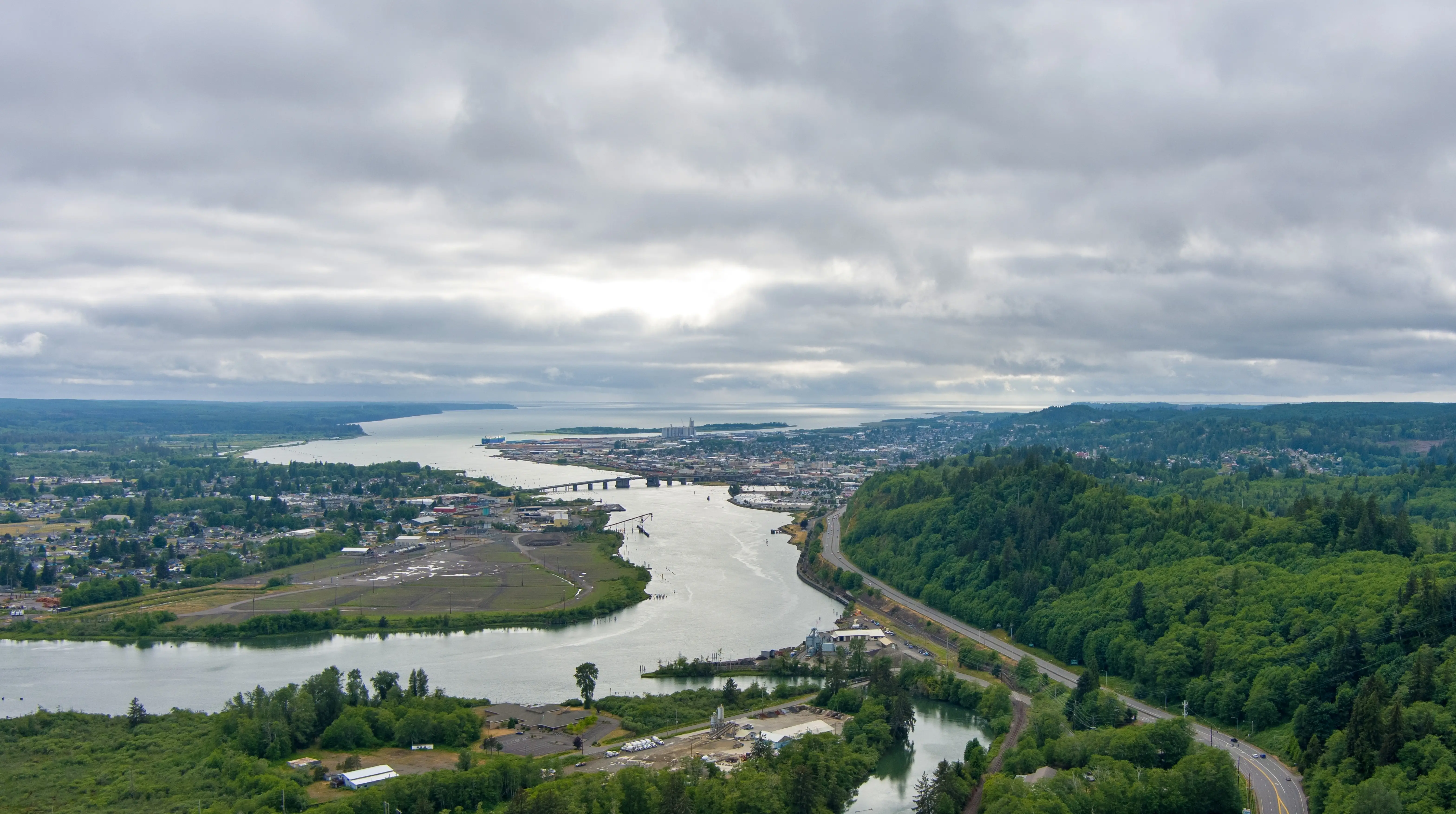
Maybe you've been priced out of Olympia and someone mentioned Aberdeen. Maybe you pulled up Zillow, saw a $253,790 city-wide typical home value (Zillow Home Value Index, July 2026), and assumed there had to be a catch. There is — but it's not what most people expect. Aberdeen sits at the junction of the Chehalis and Wishkah Rivers on Washington's Olympic Peninsula, straddling U.S. Highway 101 about 100 miles southwest of Seattle. Daily life here is shaped less by a single freeway divide and more by which river corridor you end up near, how far west you can stretch your budget, and whether the persistent coastal rain feels like home or like a slow form of punishment.
The economic backbone of Grays Harbor County runs through Aberdeen. The Port of Grays Harbor handles commercial shipping and timber from regional lumber operations, while the Aberdeen School District educates most families with kids in the area. Ocean Spray's cranberry cooperative brings food-processing jobs, and Walmart is the dominant retail employer downtown. The city draws a mix of longtime working families, artists and musicians drawn by Kurt Cobain's legacy, and an increasing number of remote workers who've traded Puget Sound rents for a waterfront community at a fraction of the cost.
Aberdeen's cost-of-living index sits at 88.4 — meaningfully below the U.S. average of 100 — and that gap is most visible in housing. For buyers, this is one of the rare Washington markets where a median income household can still compete without a six-figure down payment. For context on how that city-wide figure translates to your monthly budget, see the cost of living breakdown. Day-to-day life involves Sam Benn Memorial Park for summer evenings, the waterfront near the Lady Washington tall ship for weekend walks, and seafood dining along West Heron Street. The Quinault Rain Forest and Pacific beaches are under an hour away.
Whether you're seriously considering a move or just mapping out the options, the sections below break down Aberdeen's eight neighborhoods by price range, character, and buyer type — along with the common mistakes buyers make here and where renters find the best value.
The Aberdeen Reality
The single most important thing to understand about buying in Aberdeen is the west-to-east quality gradient. Aberdeen's most desired residential areas sit in the western portions of the city — North Aberdeen, Bel-Aire, and Pinewild — while the more affordable (and more variable) housing concentrates in the eastern sections near the industrial waterfront and Highway 12 corridor. Buyers who shop purely by price and ignore this axis routinely end up in parts of East Aberdeen or Downtown that don't match their expectations for condition, neighbor stability, or resale trajectory.
The Chehalis River is the city's second major dividing line. Neighborhoods south of the river — South Aberdeen, Paradise Harbor — feel more contained and residential. Central Park, technically its own community north of the Chehalis, operates with a slightly different character than the Aberdeen city core and is worth treating as a distinct decision rather than an extension of North Aberdeen.
School boundary awareness matters here too. The Aberdeen School District serves the whole city, but which elementary school feeds a given block can influence neighborhood feel and parent community significantly. Families who skip the boundary research and buy on price alone sometimes find themselves reassigning mid-year. For a full school-by-school look, see the Aberdeen schools guide.
Neighborhoods at a Glance
| Neighborhood | Best For | Price Range | Vibe |
|---|---|---|---|
| Downtown | Walkable Renter | $130,000–$200,000 | Historic, gritty, walkable to waterfront and West Heron St dining |
| South Aberdeen | Families First-Time | $185,000–$260,000 | Quiet, residential, modest lots south of the Chehalis River |
| East Aberdeen | Value First-Time | $130,000–$210,000 | Working-class, entry-level, close to Highway 12 and industrial corridor |
| North Aberdeen | Families School | $220,000–$310,000 | Elevated, quieter streets, closer to the western quality tier |
| Paradise Harbor | Views Nature | $200,000–$290,000 | Waterfront-adjacent, relaxed pace, scenic Grays Harbor access |
| Bel-Aire | Families Quiet | $230,000–$320,000 | Established west-side neighborhood, larger lots, mature trees |
| Pinewild | Luxury Privacy | $270,000–$380,000 | Aberdeen's upper tier — wooded, private, best-condition homes |
| Central Park | Commuter Value | $180,000–$255,000 | North of the Chehalis, mixed residential and commercial, Highway 101 access |
Best Neighborhood by Buyer Type
| Buyer Type | Best Neighborhood | Why |
|---|---|---|
| First-Time Buyer | South Aberdeen | Entry-level prices with more stable residential character than East Aberdeen, giving first-timers a better shot at appreciation without inheriting deferred-maintenance surprises. |
| Luxury Buyer | Pinewild | Aberdeen's highest price tier, with wooded lots, better-condition homes, and the most privacy the city offers. |
| Walkability Seeker | Downtown | Billy's Bar & Grill on E Heron St, Rediviva on E Wishkah St, and the International Mermaid Museum are all on foot from the historic core. |
| Families with Kids | Bel-Aire | Larger lots, mature neighborhood feel, and proximity to the western school feeds make it Aberdeen's most consistent family destination. |
| Commuters | Central Park | Highway 101 access from Central Park shaves meaningful time off the roughly 55-minute run to Olympia compared to crossing back through downtown Aberdeen. |
| Large-Lot Buyers | Pinewild | Wooded parcels here give the most separation between homes of any Aberdeen neighborhood, a rarity in a city this size. |
| Renters | Downtown / East Aberdeen | The city's highest rental supply concentrates in these two areas, keeping competition lower and options wider for tenants. |
Looking to buy in Aberdeen? Estimate your payment.
Enter your numbers to see an estimated monthly mortgage payment.
Estimate only. Excludes HOA fees and mortgage insurance. The interest rate above is a starting point, not a quoted rate — replace it with your own to see real numbers. Insurance is a flat placeholder, not a Aberdeen quote.
Most Popular Neighborhoods
Downtown
Downtown Aberdeen is the city's commercial and cultural spine, with the Aberdeen Art Center, the Kurt Cobain Memorial Park, and the waterfront dock where the Lady Washington tall ship berths all within walking distance. On-foot access to Billy's Bar & Grill on E Heron St and Rediviva's Pacific Northwest dining on E Wishkah St is genuinely useful. The trade-off is that housing stock here skews older, often needs work, and the area sees more foot traffic and activity than any other neighborhood — which is either a plus or a dealbreaker depending on what you want. Prices for livable homes run $130,000–$200,000, and many listings require honest renovation budgets before moving in. Best for: walkability seekers, renters, and buyers comfortable with urban Aberdeen's pace and patina.
South Aberdeen
South Aberdeen sits south of the Chehalis River and is the neighborhood most often described by locals as genuinely residential — quieter streets, more owner-occupied homes, and a pace that feels removed from the downtown corridor even though it isn't far. Most of the single-family stock here is mid-century construction on modest lots, which means lower price points but also more maintenance attention than newer builds. Homes typically range $185,000–$260,000, and parents with school-age children appreciate the more contained neighborhood feel. Best for: families with kids, first-time buyers, and anyone prioritizing quiet over urban convenience.
East Aberdeen
East Aberdeen is where Aberdeen's affordability ceiling is lowest and the quality variation is widest — you can find a structurally sound home for well under $175,000, but the block you're on matters more here than anywhere else in the city. The eastern sections sit closer to the Highway 12 industrial corridor and the working port, which creates noise and truck traffic that buyers from quieter markets consistently underestimate. Prices run $130,000–$210,000, and the compromise is clear: maximum entry-level affordability in exchange for less predictable immediate neighbors and longer renovation timelines. Best for: value hunters, investors, and buyers who've walked the specific block and done their due diligence.
North Aberdeen
North Aberdeen occupies the city's middle tier — better than East Aberdeen in condition and street stability, not quite as polished as Bel-Aire or Pinewild. The elevation here gives some streets actual views over the river corridor, and the neighborhood edges closer to the western quality gradient that distinguishes Aberdeen's better-performing residential areas. Prices typically land $220,000–$310,000, which puts it in reach for buyers priced out of Bel-Aire but unwilling to accept East Aberdeen's variability. The catch: North Aberdeen's school assignments vary by street, so confirming the elementary boundary before making an offer is worth the phone call. Best for: families seeking a step up from entry-level, buyers targeting long-term appreciation, and school-conscious parents who verify boundaries first.
Paradise Harbor
Paradise Harbor is Aberdeen's most scenically positioned neighborhood, sitting near Grays Harbor with a waterfront-adjacent character that's hard to find elsewhere in the city. Homes here tend toward older construction on larger-than-average lots, and the relaxed pace is a genuine selling point for buyers who want proximity to the water without paying coastal Ocean Shores prices. The practical downside is that some streets flood seasonally and the area's distance from downtown services means more driving for daily errands. Prices range $200,000–$290,000. Best for: buyers who prioritize views and nature, retirees, and anyone who has specifically researched the flood zone maps for their target parcel.
Bel-Aire
Bel-Aire is the neighborhood Aberdeen families most consistently point to when asked where they'd choose to buy if budget weren't the constraint. Mature trees, larger lots, and established streetscapes give it a stability that newer subdivisions can't manufacture, and its position on the west side keeps it in the more desirable half of the city's geography. The honest downside is that inventory here is thin — when a well-maintained home hits the market in Bel-Aire, it doesn't sit for long. Prices run $230,000–$320,000, which is above the city-wide typical but reflects what buyers are actually willing to pay for west-side quality. Best for: families with kids, buyers prioritizing neighborhood stability, and anyone planning a long hold with an eye on resale.
Pinewild
Pinewild is Aberdeen's upper residential tier in every measurable way — price, lot size, tree coverage, and separation between homes. The wooded character creates genuine privacy unusual for a city of 17,000 people, and the homes here are generally in better condition than the Aberdeen median. The downside is cost and availability: at $270,000–$380,000, this is the city's most expensive neighborhood, and buyers expecting Pinewild inventory to move slowly will often be surprised. If you're relocating from a larger market and need to feel like your home has some breathing room around it, this is where to focus. Best for: luxury buyers, large-lot buyers, privacy seekers, and remote workers who want a quiet home office environment.
Central Park
Central Park is technically a separate community north of the Chehalis River from the Aberdeen city core, but it functions as part of the broader Aberdeen market and is worth treating as its own decision rather than an afterthought. The mix of residential and commercial uses gives it a small-town-within-a-town feel, and the Highway 101 positioning is genuinely useful for anyone commuting east toward Olympia or north toward the Puget Sound metro. Prices run $180,000–$255,000, landing it squarely in the affordable middle of the Aberdeen range. The honest trade-off is that Central Park lacks the neighborhood cohesion of South Aberdeen or Bel-Aire — it's practical and affordable, but it doesn't have a strong residential identity. Best for: commuters, value buyers, and renters who need quick highway access without paying downtown premiums.
Common Mistakes Buyers Make in Aberdeen
Treating East Aberdeen and West Aberdeen as Interchangeable
The street-level quality gap between East Aberdeen near Highway 12 and the western neighborhoods like Bel-Aire and Pinewild is wider than a zip code search reveals. Buyers who filter by price alone and tour both ends of the city in the same afternoon often end up making offers in East Aberdeen thinking they're getting Aberdeen's typical residential experience — they're getting its most variable one. Walk the specific block at different times of day before you commit.
Skipping the Flood Zone Check in Paradise Harbor
Some Paradise Harbor parcels sit in FEMA-designated flood zones along the Grays Harbor shoreline. Buyers who fall in love with the waterfront views and skip the flood map review get an insurance bill that changes the monthly math significantly. The Grays Harbor County GIS parcel viewer is public — pull it before you pull the trigger on any Paradise Harbor address.
Assuming the School Boundary Follows Neighborhood Lines
Aberdeen School District elementary boundaries don't align cleanly with neighborhood names. Two houses on the same North Aberdeen street can feed different schools depending on which side of an invisible boundary they sit on. Buyers who assume "North Aberdeen = one school" and don't verify the specific address with the district sometimes end up reassigning their kids the first fall after closing.
Underestimating Downtown's Renovation Reality
Downtown Aberdeen homes listed in the $130,000–$170,000 range often photograph better than they live. The historic building stock along E Wishkah St and surrounding blocks carries deferred maintenance that isn't always visible at a showing — roof systems, electrical panels, and drainage issues from decades of Pacific Coast rain. Buyers stretching to make the purchase math work often have nothing left for what the inspection reveals. Budget renovation reserves before you write the offer, not after.
Best Areas to Rent in Aberdeen
| Area | Ideal For | Typical Rent Range | Trade-off |
|---|---|---|---|
| Downtown / West Heron St Corridor | Walkability Seeker Renter | $850–$1,100/mo | On-foot access to dining and waterfront; older buildings, higher activity level |
| South Aberdeen | Families Quiet | $1,000–$1,250/mo | Quieter, more stable; fewer available rentals, so inventory moves fast |
| East Aberdeen | Value First-Time | $750–$1,050/mo | Lowest rents in the city; block quality varies significantly, so location research matters |
| North Aberdeen | Families School | $1,050–$1,300/mo | Better condition rentals on average; limited supply, especially for single-family homes |
| Central Park | Commuter Transit | $900–$1,150/mo | Highway 101 convenience; mixed commercial surroundings reduce residential feel |
Aberdeen's rental market sits well below Washington state norms, which gives renters meaningful flexibility compared to Olympia or Tacoma. The downside is that the rental supply in the desirable western neighborhoods is thin, and well-maintained single-family rentals in South Aberdeen or North Aberdeen lease quickly when they do appear. Budget-conscious renters who are flexible on East Aberdeen's variability will find the most options and the lowest competition.

Local Expert Takeaway: Aberdeen's neighborhood decision comes down to one axis more than any other: west vs. east. The $100,000 price gap between a Pinewild home and an East Aberdeen fixer isn't arbitrary — it reflects genuine differences in housing condition, neighbor stability, and long-term trajectory. If your budget puts you in the $130,000–$200,000 range, spend extra time in South Aberdeen before defaulting to East Aberdeen; it's a quieter, more cohesive neighborhood at overlapping prices. And if you're drawn to the waterfront character of Paradise Harbor, check the parcel-specific flood zone map before you fall in love — the neighborhood's Grays Harbor proximity is its biggest draw and its biggest risk in the same breath.
Quick Takeaways & FAQs
✅ Aberdeen is one of the few Washington markets where a median-income household can still buy a single-family home without a six-figure down payment — the city-wide typical home value is $253,790 (Zillow Home Value Index, July 2026).
⚠️ The quality gap between East Aberdeen and the western neighborhoods (Bel-Aire, Pinewild) is wider than the price gap suggests — buyers who shop only by price often end up on the wrong side of it.
📍 Billy's Bar & Grill on E Heron St and Rediviva on E Wishkah St are both walkable from Downtown Aberdeen — a genuine perk for renters and buyers who want urban on-foot access at Pacific Northwest prices.
What is the cheapest neighborhood in Aberdeen, WA?
What is the best neighborhood in Aberdeen, WA for families?
Is Aberdeen, WA a good place to buy a home in 2026?
How much does it cost to rent in Aberdeen, WA?
What is the difference between Aberdeen and Central Park, WA?
Moving to Washington?
Tell us what you need help with and we'll connect you with local resources.
