
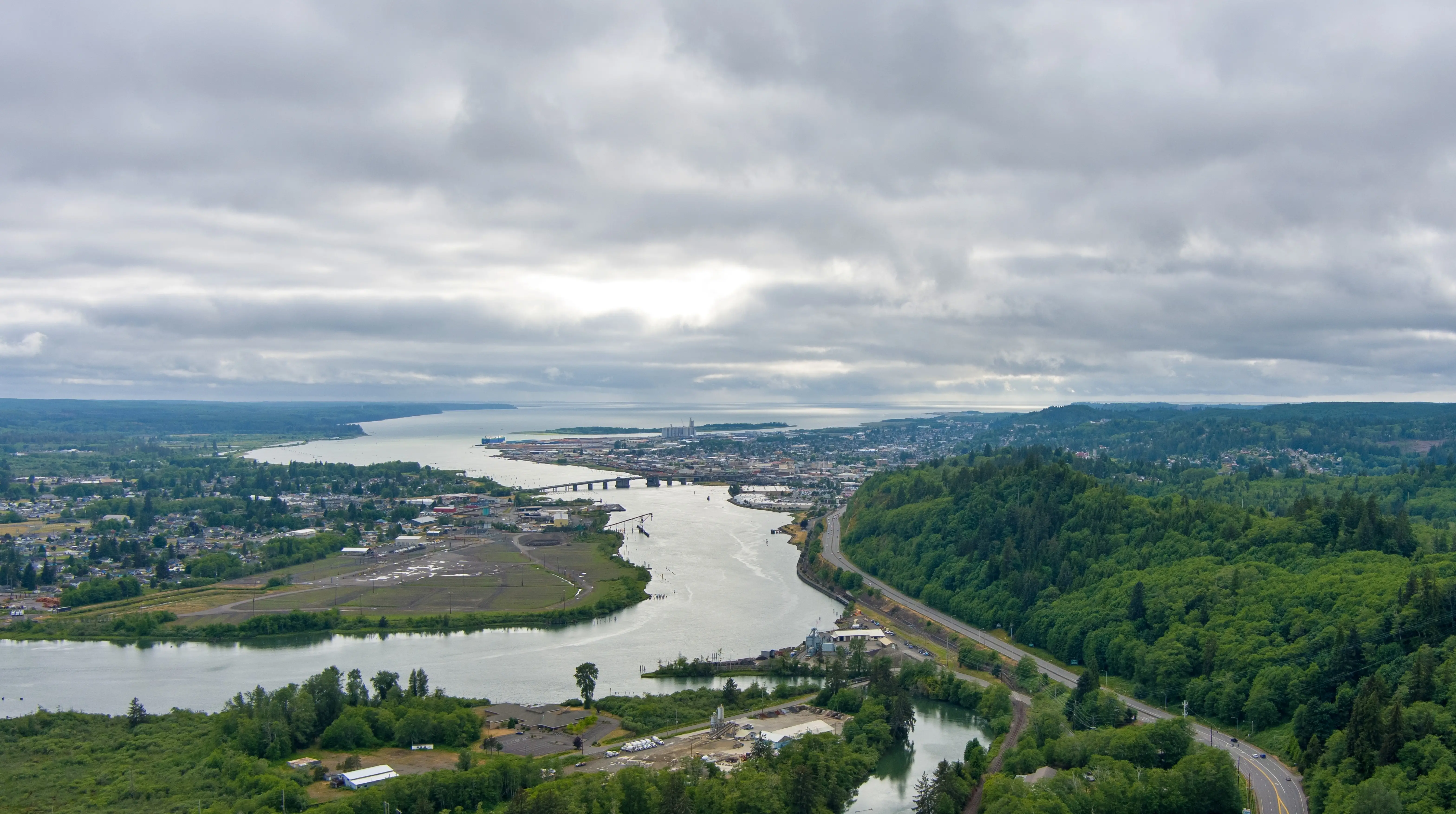
You've probably heard that Washington has no income tax — but you may not have heard that Aberdeen's typical home value sits at $253,790 (Zillow Home Value Index, July 2026), making it one of the most affordable places to actually own property on the coastal Pacific Northwest. For retirees who've been priced out of western Washington or who are arriving from California or the Bay Area with equity to burn, that combination is genuinely rare. What you give up is proximity to a major metro. What you get is a working-class coastal town on the southern Olympic Peninsula, where the Chehalis and Wishkah rivers meet, with a regional hospital on site and the coast a short drive west.
The community backbone here is honest and unglamorous: Grays Harbor Community Hospital — now operating as Harbor Regional Health — has been the anchor institution for decades, serving over 72,000 residents across Grays Harbor County. The port, the timber industry, and Ocean Spray's cranberry cooperative round out the economic base. Aberdeen is not a retirement resort town dressed up with wine bars and pickleball clubs. It's a real place where residents have deep roots, where retirees who want authenticity over amenities tend to settle in quietly and stay.
Cost of living on a fixed income is genuinely manageable here — no state income tax means your Social Security, pension, and IRA withdrawals face zero state withholding. The daily cost picture is more mixed: Washington's combined sales tax can approach 10.6%, which adds up on everyday purchases. But housing costs remain well below the statewide median, and for the retiree who doesn't need a Seattle address, that gap matters more than any sales tax line. For outdoor access, Aberdeen's parks and recreation options include proximity to the Olympic National Forest and the Chehalis River system.
Whether you're comparing Aberdeen to nearby coastal towns, weighing it against Montesano's quieter pace, or just trying to figure out what retired life here actually looks like day to day, the sections below cover healthcare access, the retiree tax picture, walkability, downsizing inventory, and an honest side-by-side with nearby alternatives.

Why Retirees Are Choosing Aberdeen
Aberdeen fits a specific kind of retiree: someone who values affordability over polish, wants a real hospital in town rather than a 90-minute drive to one, and finds meaning in a community with actual history rather than a master-planned lifestyle enclave. The Lady Washington tall ship calls the port home. Kurt Cobain Memorial Park and the Aberdeen Art Center give downtown a cultural gravity that manufactured retirement communities can't replicate.
The honest pitch is simple. With a typical home value of $253,790 — see the full context at Aberdeen's cost-of-living page — retirees arriving from Seattle, Portland, or California can often purchase outright or carry a minimal mortgage. That frees retirement income for living rather than housing. Parents with school-age grandchildren nearby will find a functional community; those hoping for resort-style dining and boutique retail will find the inventory thin.
Aberdeen is a poor fit if you need walkable access to specialists without a car, require a dense senior-amenity ecosystem, or want the kind of social scene that comes with a larger retiree population. The rain is real — this is one of the wettest cities in the continental United States, averaging well over 80 inches of precipitation annually. Retirees who discover this in month two and weren't warned are often the ones who leave within three years. Go in knowing the gray winters are long and the summers are genuinely beautiful, and you'll calibrate correctly.
Healthcare & Medical Access in Aberdeen
Aberdeen's healthcare anchor is Harbor Regional Health (915 Anderson Dr), the community hospital that operates around the clock and serves the entire Grays Harbor region. It offers 28 specialties across 8 clinic locations, with emergency care, cardiology, orthopedics, and a rehabilitation program all on-site. For most routine and many acute needs, retirees in Aberdeen don't have to leave town.
The depth of specialty care is what matters most to retirees weighing a smaller city, and Harbor Regional Health covers the fundamentals well. Cardiology and orthopedics — the two specialties most commonly needed in the 65-and-older population — are both available locally. The family birth center matters less to retirees, but its presence signals that this is a full-service facility, not a stripped-down critical-access hospital.
The honest distance-to-advanced-care reality: for oncology, complex cardiac surgery, neurosurgery, or major transplant needs, Olympia is approximately 55 minutes east, and Seattle's major academic medical systems are roughly two hours away. If you or a spouse has a complex chronic condition requiring frequent specialist visits, that drive becomes a real part of your life. For most retirees in average health, Harbor Regional Health handles the load.
The Lown Institute Hospitals Index ranked Harbor Regional Health first in Washington State for Community Benefit in its 2025–26 evaluation — an independent assessment measuring financial assistance to patients, Medicaid share, staff pay equity, and clinical value across more than 3,500 hospitals nationwide. That's not a marketing award; it reflects how the hospital actually functions for lower- and moderate-income patients, which matters on a fixed income.
Washington's ArrayRx prescription discount card offers retirees meaningful savings: generic medications typically discounted up to 60%, brand-name drugs around 20% less. For retirees managing ongoing prescriptions outside Medicare Part D, that program is worth picking up at any participating pharmacy.
The Retiree Budget in Aberdeen
Washington's No-Income-Tax Advantage
Washington has no personal state income tax. Social Security benefits, pension distributions, IRA and 401(k) withdrawals, and defined-benefit plan payments are entirely exempt from state taxation. For a retiree pulling $55,000 a year from a mix of Social Security and a pension, the state-level tax bill is zero — a meaningful structural advantage over states like Oregon, where those same dollars face a state rate starting at 8%.
Washington's 2023 capital gains tax is worth understanding but unlikely to affect most Aberdeen retirees. It applies only to gains above $278,000 (2025 standard deduction) from sales outside of retirement accounts. Transactions through 401(k)s, IRAs, Roth IRAs, and defined-benefit plans are explicitly exempt. Retirees who sold a business or hold significant non-retirement investment assets should verify their exposure; most won't have any.
Property Tax Relief Programs
Washington's senior property tax exemption program is one of the more useful state benefits available here. Homeowners aged 61 or older — or those who are disabled — can qualify to freeze their home's assessed value and receive partial exemptions or deferrals based on income, with three tiered relief levels in 2026. The deferral option lets qualifying seniors defer property taxes entirely, with a lien placed on the property, preserving monthly cash flow without losing the home. For a retiree on a fixed income in a period of rising assessments, this program is worth filing for early.
Aberdeen's effective property tax rate is approximately 0.90% — slightly above the Washington state average of roughly 0.84%, but well below the rates in high-cost western Washington metros. At Aberdeen's typical home value, that rate translates to a modest annual obligation by Pacific Northwest standards. Pair that with the senior exemption program and the no-income-tax baseline, and the overall tax posture for retirees here is genuinely favorable.
Daily Cost Picture
The sales tax offset is real and worth planning around: Washington's combined state and local sales tax can reach 10.6% in Grays Harbor County. Groceries are exempt from state sales tax, which softens the blow considerably — but appliances, clothing, home goods, and restaurant meals all carry it. Retirees on tight budgets should account for that in their monthly spending models.
Dining in Aberdeen is modest in price and modest in variety. Billy's Bar & Grill and Rediviva are among the downtown spots that locals return to regularly. For specialty groceries or big-box shopping, Walmart on the east side handles most household needs; the nearest Trader Joe's is in Olympia, about 55 minutes away. That round trip is an occasional errand for most retirees here, not a weekly inconvenience.
Looking to buy in Aberdeen? Estimate your payment.
Enter your numbers to see an estimated monthly mortgage payment.
Estimate only. Excludes HOA fees and mortgage insurance. The interest rate above is a starting point, not a quoted rate — replace it with your own to see real numbers. Insurance is a flat placeholder, not a Aberdeen quote.
Walkability, Community & Staying Active in Aberdeen
The Walkability Reality
Aberdeen's city-wide Walk Score is 44 out of 100 — car-dependent for most errands if you're in an outer neighborhood. The picture changes significantly in the downtown core and central Aberdeen, where scores reach as high as 84, qualifying as Very Walkable. Retirees who prioritize on-foot access to groceries, pharmacies, dining, and services should focus their home search on central and downtown locations rather than the periphery.
The terrain is flat along the river corridors — an important consideration for retirees with mobility concerns. Downtown Aberdeen and South Aberdeen along the Wishkah River offer level, navigable streets without the hills that make walking challenging in some nearby coastal communities. Roughly 47 restaurants, bars, and coffee shops operate within the city, and the density of options in the downtown core means that for centrally located retirees, daily errands on foot are genuinely viable.
Social Life and Community
Aberdeen's senior social infrastructure is functional rather than elaborate. The Grays Harbor Senior Activity Center serves as the primary gathering point for structured programming — fitness classes, day trips, potlucks, and volunteer coordination. It's not a glossy active-adult complex, but the community that shows up is consistent and welcoming to newcomers who make the effort.
The Aberdeen Art Center draws retirees with creative interests into classes, exhibitions, and volunteer roles that provide year-round social connection. Sam Benn Memorial Park sees regular use by older residents for walking and quiet mornings. Retirees who move here and wait for the social scene to come to them are often disappointed; those who walk into the Art Center or the Senior Activity Center in the first month tend to find their people quickly.
One seasonal surprise: Aberdeen sits within easy reach of the Washington Coast's razor clam season, which draws a genuinely enthusiastic local crowd each fall and winter. If clamming, fishing, or coastal birding is part of your vision for retirement, Aberdeen's position at the edge of Grays Harbor and the Olympic Peninsula puts you in the right place. For full details on trails and outdoor programming, the parks and recreation page covers the specifics.
Right-Sizing: Downsizing in Aberdeen
What the Inventory Looks Like
Aberdeen is not a market built around retirement product. There are no purpose-built 55+ active-adult communities within the city limits in the same form you'd find near larger metros. What the market offers instead is a practical abundance of single-story homes — the bungalow and ranch-style inventory from Aberdeen's early-to-mid-20th-century building periods — at prices that make right-sizing financially straightforward even for retirees on modest budgets.
Single-level living options do exist across several neighborhoods, particularly in South Aberdeen and parts of Bel-Aire, where older ranch homes on manageable lots give retirees flat-floor living without stairs. These homes vary significantly in condition; updated interiors with modern mechanicals are the exception rather than the rule at the lower price points, and retirees should budget for deferred maintenance that's common in the housing stock here.
Condo and Low-Maintenance Options
The condominium market in Aberdeen is thin. There are some attached and townhome-style units in the area, but true lock-and-leave condo inventory is limited compared to what retirees might expect from larger markets. Buyers seeking minimal exterior maintenance may need to look toward Montesano or Olympia for deeper condo selection, or factor in the cost of a property management arrangement on a single-family home.
Nearby coastal communities about 25 minutes west have a more developed market for smaller single-level homes and condominiums oriented toward retirees and second-home buyers — though at different price dynamics and with their own tradeoffs in terms of services and healthcare access. For retirees whose priority is walkable, low-maintenance living in a true single-level space, comparing Aberdeen's inventory against those options and Montesano before committing is worth the time.
The Downsizing Math
For retirees arriving from higher-cost markets with significant equity, Aberdeen's price point creates a clear opportunity: selling a home in the Seattle suburbs or coastal California and purchasing in Aberdeen outright — or with a small mortgage — while banking the difference is a real, achievable strategy here in a way it simply isn't in most of western Washington. That equity gap, invested or held in reserve for care costs, changes the retirement security picture materially.
Aberdeen vs Nearby Retirement Destinations
| City | Cost vs Aberdeen | Primary Hospital | Walkability | Senior Living Depth | Overall Retirement Fit |
|---|---|---|---|---|---|
| Aberdeen | Anchor | Harbor Regional Health — full-service, 28 specialties, on-site | Car-dependent overall; downtown core Very Walkable | Thin — single-story resale homes; no dedicated 55+ communities | Value Nature Strong for budget-focused retirees with health needs |
| Hoquiam | About the same | Shares Harbor Regional Health (adjacent city, same system) | Car-dependent; slightly less walkable core than Aberdeen | Thin; similar older single-family stock | Quiet Comparable to Aberdeen; smaller downtown, fewer dining options |
| Montesano | Noticeably cheaper on average | No on-site hospital; closest is Harbor Regional Health ~18 miles west | Small-town walkable core; very limited daily errands on foot | Very thin; mostly single-family resale | Privacy Quiet Best for retirees prioritizing peace and low cost over services |
| Coastal communities west | Slightly pricier for comparable size | No hospital on-site; urgent care available; Aberdeen ~25 min | Car-dependent; resort-style but spread out | Moderate — more condo/townhome inventory than Aberdeen | Views Renter Good for beach-lifestyle retirees; healthcare access is the compromise |
| Cosmopolis | Noticeably cheaper | No on-site hospital; shares Aberdeen's Harbor Regional Health nearby | Minimal; essentially car-dependent for all errands | Very thin; small inventory | Value Ultra-affordable but tiny; Aberdeen is the practical service center |
| Olympia | Noticeably pricier | Multiple hospital systems; deeper specialty depth | Strong — one of Washington's more walkable mid-size cities | Meaningful — multiple 55+ communities and assisted-living options | Transit Luxury Best overall retirement infrastructure; significantly higher cost of entry |
Olympia is the clear winner on retirement infrastructure — deeper healthcare, more senior living inventory, and far better walkability — but it comes at a substantially higher price point than Aberdeen. For retirees who need that depth of care or want to eliminate car dependence entirely, the extra cost may be justified.
Coastal communities to the west make sense for the beach-lifestyle retiree who's healthy and self-sufficient, but the lack of an on-site hospital is a genuine risk factor as health needs increase with age. Montesano and Cosmopolis are the value alternatives for retirees who want an even quieter pace and can comfortably drive into Aberdeen for medical care and services. Hoquiam is functionally Aberdeen's twin — similar price, similar access — and worth considering if a specific property appeals. Aberdeen itself hits the best balance of affordable ownership, on-site hospital access, and a real community with cultural texture, for the retiree who doesn't need the amenity depth of a larger city.

Local Expert Takeaway: The retiree who thrives in Aberdeen is the one who stops at Billy's for a burger, picks up their ArrayRx discount card at a local pharmacy, and walks to the waterfront on a clear Tuesday morning when the Lady Washington is in port. The tax picture is genuinely favorable — no state income tax, a senior property tax freeze available at 61, and a home price low enough that many retirees can purchase outright. The catch is that Aberdeen rewards engagement: the Senior Activity Center and the Aberdeen Art Center are where social life actually happens, and retirees who wait for the community to find them often leave disappointed. Show up early, accept the rain, and this small coastal city at the edge of the Olympic Peninsula can stretch a fixed income further than almost anywhere else on the Washington coast.
Quick Takeaways & FAQs
✅ Harbor Regional Health on Anderson Drive provides full emergency, cardiology, and orthopedic care without leaving Aberdeen — rare for a city this size.
⚠️ Aberdeen averages well over 80 inches of rain annually; retirees who don't research the gray-season reality before moving often leave within three years.
📍 Washington's senior property tax exemption program lets qualifying homeowners aged 61 or older freeze their assessed value — file early and the savings compound over time.
Is Social Security taxed in Aberdeen, Washington?
What hospital serves retirees in Aberdeen, WA?
Are there any 55+ or active-adult communities in Aberdeen?
Is Aberdeen walkable enough for a car-free retirement?
How does Aberdeen's property tax rate compare for retirees?
Moving to Washington?
Tell us what you need help with and we'll connect you with local resources.
