What Is Living in The Woodlands, Texas Like?
You've done the spreadsheet. The Woodlands checks the boxes — top-rated schools, a median household income of $140,701, prices below what you'd pay in similarly positioned suburbs in other major metros. But spreadsheets don't tell you what it feels like to live inside a 28,500-acre master-planned forest 27 miles north of downtown Houston, where the trees aren't an amenity bolted on after the fact but the organizing principle the whole community was built around in 1974. The real tension here isn't about the suburb versus the city — it's about whether you can handle the commute math, because The Woodlands gives you an extraordinary place to live and then asks you to drive about 45 minutes to Downtown Houston to get to work.
The economic backbone here is substantial and diversified in a way many suburbs can't match. Chevron Phillips Chemical and Huntsman Corporation anchor the petrochemical and industrial side. The Conroe Independent School District, which serves The Woodlands, is one of the largest employers in the area and holds a B rating, according to the Texas Education Agency. The 2025 Economic Development Partnership report counted 84 major non-retail employers and 41,103 total jobs in the wider area — healthcare alone accounts for nearly a third of the major-employer workforce. People move here from Houston's Energy Corridor, from the Texas Medical Center, and increasingly from out of state, drawn by the combination of a genuine job base and a community that feels nothing like a standard Houston suburb.
On cost of living, The Woodlands sits at the premium end of the Houston metro — the typical home price sits well above what you'd pay in Spring or Conroe, and the median household income runs below what's needed to buy at that price point without a substantial down payment. Texas's lack of a state income tax softens the blow somewhat, and the effective property tax rate of 1.38% is worth factoring into your monthly math. For that price, you're buying into 151 parks, more than 220 miles of pathways, a 200-acre freshwater lake, and an open-air amphitheater that seats 16,500 people. See the full cost-of-living breakdown for utilities, groceries, and tax comparisons.
Whether you're being relocated by a petrochemical company, pricing out of the Heights, or just researching whether Houston's most ambitious master-planned community is right for your family, the sections below cover The Woodlands' neighborhoods, housing market, commute realities, local employers, and what daily life here is actually like.
The Woodlands at a Glance
Looking to buy in The Woodlands? Estimate your payment.
Enter your numbers to see an estimated monthly mortgage payment.
Estimate only. Excludes HOA fees and mortgage insurance. The interest rate above is a starting point, not a quoted rate — replace it with your own to see real numbers. Insurance is a flat placeholder, not a The Woodlands quote.
Why Are People Moving to The Woodlands?
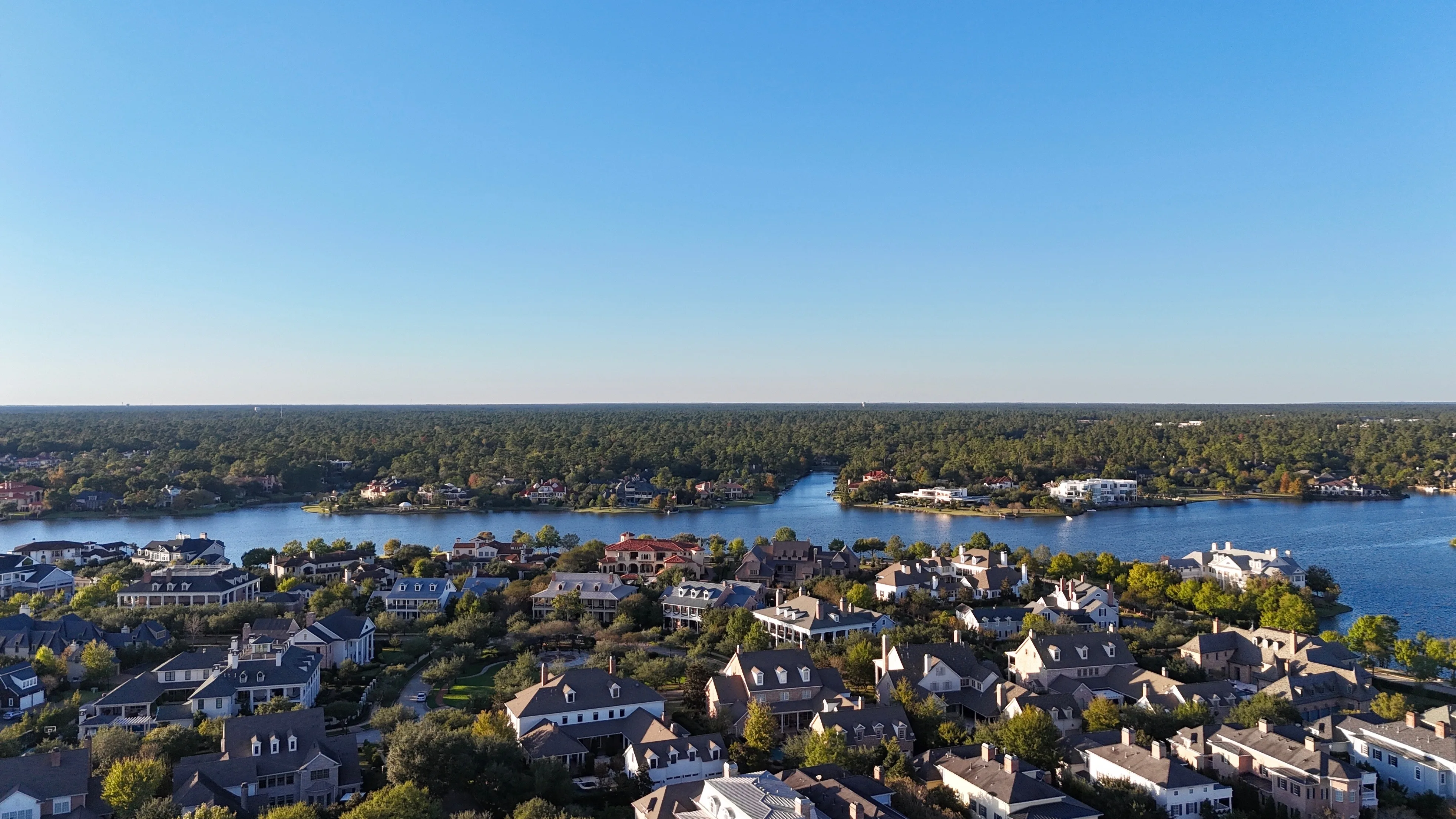
The draw is easier to explain than most suburbs. This isn't a place that happened to grow up around a highway interchange — it was conceived from the beginning as a community where 4,445 acres of open space would be preserved as the forest grew up around it. That original commitment still shapes everyday life in ways that are genuinely unusual for a community of 121,002 people.
The Job Pull
Chevron Phillips Chemical and Huntsman Corporation put The Woodlands on the energy-industry map decades ago, and both remain significant local anchors. Healthcare has quietly become the dominant sector, representing 32.6% of the major-employer workforce across 84 non-retail employers — a concentration that makes the area meaningfully recession-resistant compared with single-industry suburbs. ExxonMobil's large campus is in nearby Spring, and a lot of residents drive to that campus for work.
Higher education options reinforce the professional profile. Lone Star College-Montgomery and Sam Houston State University satellite campuses sit within or adjacent to the community, giving residents and their families access to workforce training and continuing education without driving to Houston.
The School Argument
Conroe Independent School District holds a B rating, according to the Texas Education Agency, covering 72,757 students enrolled in 2025-26. On 2024-25 state assessments, 58% of students reached math proficiency and 64% reached reading proficiency. The district supports active UIL athletics programs, and Friday night football is genuinely a community event here — the stands fill. For a deeper look at campus-level performance and school boundaries, the schools page has the full picture.
The Safety Numbers
The Woodlands posts a violent crime rate of 2.864 per 1,000 residents and a property crime rate of 14.52 per 1,000 residents — both well below Texas state benchmarks and national figures. For the full crime breakdown by area, see the safety page.
Who Actually Moves Here
| Buyer Type | What Draws Them | Best Fit |
|---|---|---|
| Energy-sector professionals | Proximity to petrochemical employers and the Energy Corridor | Commuter |
| Parents with school-age children | CISD schools, parks, organized youth activities | Families School |
| Remote workers from out of state | Texas tax environment, space, forest setting | Nature Value |
| Medical Center commuters | Express bus service, quieter living, top schools | Commuter Transit |
| Downsizers from larger Houston homes | Walkable Waterway district, lower maintenance options | Walkable Quiet |
| Luxury buyers | Waterway-adjacent homes, Lake Woodlands frontage, gated villages | Luxury Views |
The buyer mix skews heavily toward dual-income households with children, which shapes everything from the restaurant scene to the programming at the community's 14 pools.
What Daily Life Feels Like in The Woodlands
The thing newcomers from other Houston suburbs don't expect is how quiet the residential streets are — not because there's nothing to do, but because the pathways pull people off the roads. More than 220 miles of connected trails mean that on a weekday morning you're more likely to see a cyclist or a jogger than a car on many neighborhood stretches.
The Geographic Reality
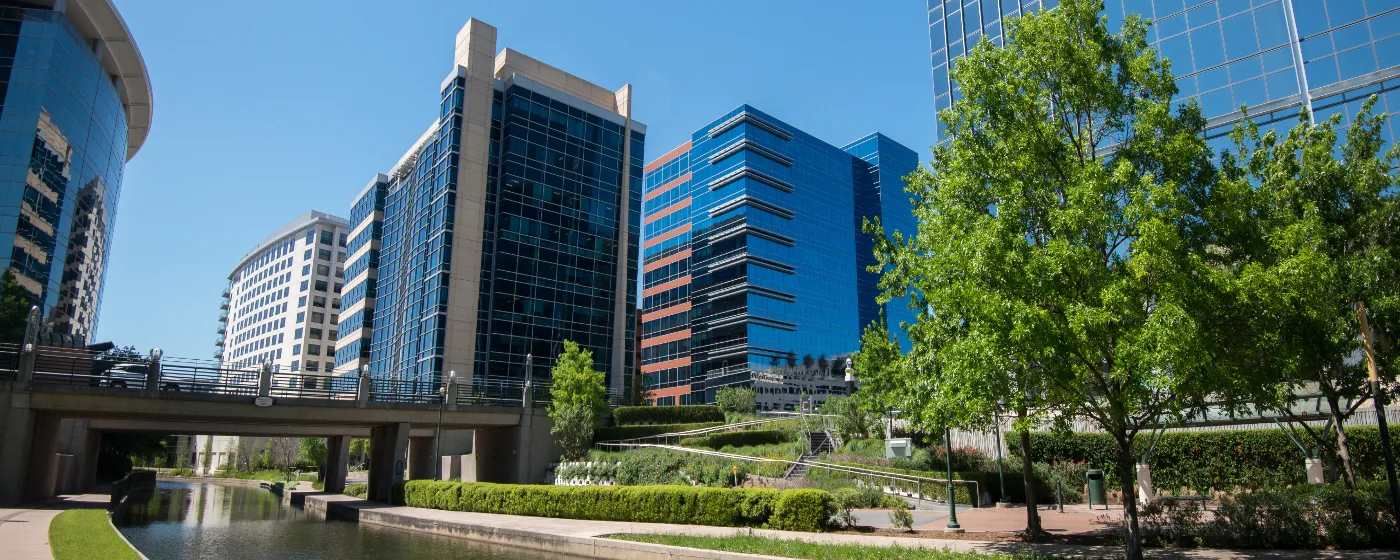
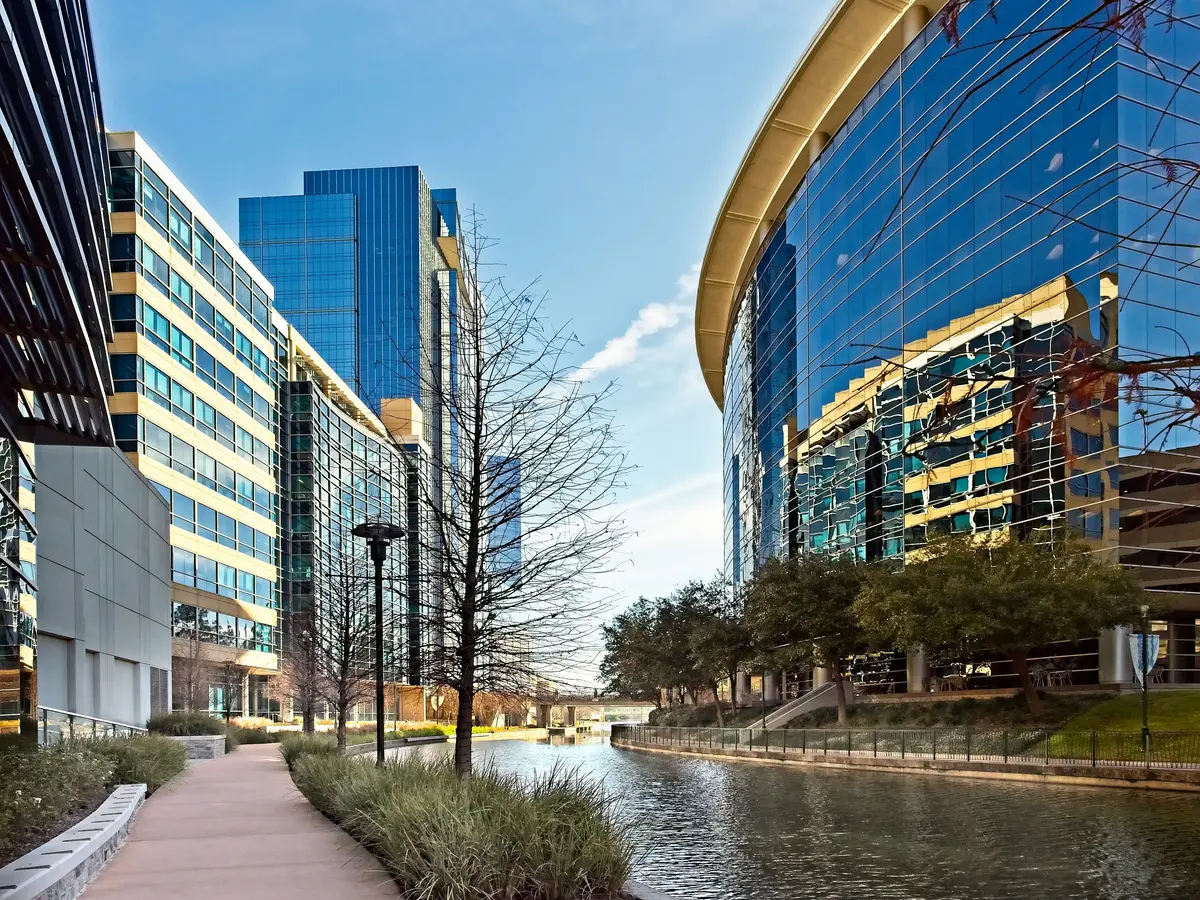
The Woodlands is organized into distinct villages — Alden Bridge, Grogan's Mill, Panther Creek, Sterling Ridge, Cochran's Crossing, Indian Springs, Creekside Park, and College Park — each with its own pocket parks and neighborhood feel, but all connected by the same pathway system. The Woodlands Waterway is the civic spine: a two-mile waterway running through the town center, lined with restaurants, retail, and the Riva Row Boat House. Market Street and The Woodlands Mall sit within walking distance of the Waterway, making that corridor the closest thing here to a genuine walkable town center.
What Locals Know
The summer heat is the honest downside of Texas forest living. June through September can be brutal — high humidity and temperatures that make the trails uncomfortable by 9 a.m. Locals who run or bike learn to go at first light, or skip it until October. The upside of that same climate is that winters are mild enough to use the pathways almost year-round, and the forest canopy does measurably reduce temperatures compared to Houston's concrete neighborhoods.
What surprises many people after six months here is how rarely they feel the need to drive into Houston at all. The community's 84 major employers, the retail corridor, and the event calendar at the Cynthia Woods Mitchell Pavilion — a 16,500-seat open-air amphitheater that consistently draws major national acts and ranks among the largest outdoor venues in the country — mean that most weekends, there's no reason to leave. That's either a selling point or a warning, depending on how much you value the city.
The Forest Is Not a Metaphor
The George Mitchell Nature Preserve spans 1,700 acres within the Creekside Park and Indian Springs villages alone, with nearly 40 miles of linear trails connecting to Spring Creek. It is not a decorative greenway — it is a working forest preserve where residents canoe, hike, and mountain bike without leaving their own community. That commitment to open space — 38.3 acres per 1,000 residents, well above the national average — is the clearest difference between The Woodlands and every other Houston suburb at this price point.
For the full picture on trails, pools, and recreation programming, see the parks and recreation page.
The Woodlands Housing Market Right Now
The typical home price here is substantial, placing The Woodlands at the premium end of the Houston metro — a community with a $32.1 billion assessed property value and over 49,000 housing units ranging from older village homes in Grogan's Mill to newer construction in Creekside Park and College Park. For the precise current figure and how it compares to nearby markets, see the cost-of-living page.
The effective property tax rate of 1.38% is the figure to build your monthly budget around. For detailed comparisons with nearby markets and a full breakdown of what your dollar buys, the cost-of-living page has the complete picture.
What the Market Looks Like in Practice
The Woodlands is not a homogeneous market. Some villages trade significantly above the community median, particularly those with Waterway frontage or Lake Woodlands access. Others, particularly older sections of Panther Creek and Grogan's Mill, offer an entry point well below that figure for buyers who prioritize the school district and the pathway system over newer construction finishes. See the neighborhoods page for a character-level look at each village.
One honest note on affordability: the median household income here — strong as it is — runs below what's needed to buy at the typical price point without a substantial down payment. This is not a market where the median earner buys the median home. Most buyers here are either dual-income households, bringing equity from a previous sale, or relocating with employer assistance. For buyers earlier in their homeownership journey, the first-time homebuyer page covers loan programs and financing options worth knowing.
Storm Resilience Is Part of the Value Proposition Now
Infrastructure improvements in The Woodlands ahead of the 2025 hurricane season included underground power lines and storm-hardened electrical infrastructure. For buyers coming from markets where power outages after major storms are a given, this is a meaningful and relatively recent upgrade to what you're buying into.
The Woodlands Neighborhoods
The Woodlands has several distinct areas — each with its own character and appeal. Here’s a breakdown to help you narrow down where to focus your home search.
🏡 Alden Bridge
One of the larger villages in The Woodlands, Alden Bridge has a well-established feel with mature trees, a mix of housing sizes, and easy pathway access to both Panther Creek and the Town Center corridor. It suits families looking for a settled neighborhood with strong community infrastructure already in place.
🏠 Grogan's Mill
The original village of The Woodlands and still one of its most walkable, Grogan's Mill sits closest to the Waterway and Market Street, giving residents the most on-foot access to dining and retail of any part of the community. The housing stock skews older, which translates to more character and more variation in condition.
🌳 Sterling Ridge
Sterling Ridge is known for its larger lots and more recent construction, drawing buyers who want more space and a quieter residential feel while staying connected to the broader pathway system. Rob Fleming Park, home to the Texas TreeVentures aerial adventure course, anchors the recreational side of the village.
🏘 Cochran's Crossing
A mid-community village with a reputation for strong neighborhood cohesion and well-maintained streets, Cochran's Crossing appeals to families with school-age children who want proximity to CISD schools without being in the busier Town Center zone.
🏔 Panther Creek
One of the earlier villages to develop, Panther Creek has a mix of housing types and price points that make it one of the more accessible entry points into The Woodlands. The trail system runs directly through it, and the neighborhood parks are some of the most used in the community.
🌆 Indian Springs
Indian Springs sits at the western edge of The Woodlands and borders the George Mitchell Nature Preserve, giving residents some of the most direct trail and creek access in the community. It suits buyers who moved here specifically for the outdoor lifestyle and don't need to be close to the Town Center on a daily basis.
Pros & Cons of Living in The Woodlands
The Pros
- Top-rated Conroe ISD schools with strong college-prep outcomes
- Extensive parks, trails, and waterway green space
- Major corporate employers reducing long commutes
- Upscale shopping and dining at Market Street and the Waterway
The Cons
- Higher-than-average property taxes once MUD and school levies stack up
- Hot, humid summers typical of the Gulf Coast
- I-45 traffic congestion during peak commute hours
Getting Around & Commuting in The Woodlands
The commute question is the one that ends more relocation conversations than any other. The Woodlands is about 45 minutes to Downtown Houston — on a good day, on I-45, outside rush hour. During weekday morning and evening peak times, that number stretches, and it stretches routinely enough that most residents plan their lives around it rather than hoping it improves.
The Road Network
I-45 is the primary artery, carrying most of the commuter traffic toward Houston. SH-99 runs along the western edge and connects to the broader metro ring, making it the route of choice for residents commuting to the Energy Corridor or other western Houston employment centers. SH-242 handles east-west movement across the community, and a $42.63 million reconstruction project along a 1.6-mile I-45 corridor — plus an eastbound flyover on SH-242 — is designed to reduce the bottlenecks that define peak-hour driving here. FM-1488 and FM-2978 carry local traffic through the community's western and northern reaches.
The Bus Option Is Real
The Woodlands Express commuter bus service runs routes to downtown Houston, the Texas Medical Center, and Houston's Energy Corridor — and it is not a token service. The township board approved a $24.3 million contract for a new commuter bus fleet in November 2025, fully covered by federal funds, with delivery expected in September 2026. The new fleet will include substantially improved passenger amenities. For residents commuting to the Texas Medical Center in particular, the bus is often faster than driving once you account for parking costs and downtown congestion.
Within the Community
Inside The Woodlands, the 220-plus miles of pathways do real work. Many residents bike or walk to Market Street, the Waterway, and neighborhood retail centers on a regular basis — this is one of the few Houston-area communities where that's a practical daily choice rather than a weekend indulgence. The township secured a federal grant for a new 5-mile bicycle and pedestrian pathway starting at FM-1488, expanding that network further.
George Bush Intercontinental Airport (IAH) is 23 miles from The Woodlands — a meaningful advantage for frequent business travelers, who find the proximity to a major international hub one of the quieter selling points of living this far north.
The Honest Commute Reality
If you work in downtown Houston or the Medical Center and don't use the Express bus, the I-45 commute will shape your mornings and evenings. People who move here from closer-in Houston neighborhoods almost universally say it took three to six months to fully internalize what that drive means in practice. The community is exceptional; the road between it and the city is not.
Schools in The Woodlands
Families relocating to The Woodlands have public, private, and higher-education options nearby. Here’s a quick overview.
🎓 School District
Conroe Independent School District serves K–12 students across The Woodlands and the surrounding area. Rated B (source: Texas Education Agency, 2025 A-F accountability rating (2024-25 school year)).
🏆 Graduation Rate
The 4-year high-school graduation rate here is approximately 95.6%.
📚 Higher Education
Texas’s public universities — the University of Texas at Austin, Texas A&M University, and the University of Houston — offer four-year degrees statewide, with one of the largest community college systems in the country (50+ public community college districts) providing two-year and workforce programs.
🌐 Online Learning
UT Austin Online and Texas A&M University Online offer fully accredited online degrees for remote learners across the state.
Safety in The Woodlands
A quick look at how The Woodlands compares on the numbers that matter most when weighing a neighborhood or a move.
🛡 Violent Crime
Approximately 2.864 per 1,000 residents.
🔒 Property Crime
Approximately 14.52 per 1,000 residents.
Compared to the most recent national figures from the Bureau of Justice Statistics (2024), The Woodlands’s violent crime is below the national average (about 3.7 per 1,000), and property crime is below the national average (about 18.4 per 1,000).
Against Texas as a whole, The Woodlands’s violent crime is roughly two-thirds of the state average, and property crime is roughly two-thirds of the state average (Bureau of Justice Statistics, Crime Known to Law Enforcement, 2024 (tables 2 and 3)).
Crime rates can vary a lot within a single city, so the citywide numbers above are only a starting point. Some neighborhoods in The Woodlands run well below these averages, while others run higher — the kind of block-by-block detail that matters most when you’re actually choosing where to live. The full guide below breaks it down neighborhood by neighborhood.
Working in The Woodlands
The Woodlands’s largest employers span several industries — here are some of the anchors of the local job market.
💼 Chevron Phillips Chemical
Petrochemicals
💼 Huntsman Corporation
Chemicals
🎓 Conroe Independent School District
Education
💼 ExxonMobil
Oil and gas, located in Spring
Parks & Recreation in The Woodlands
Some of the outdoor spaces that shape everyday life in The Woodlands.
🌱 Lake Woodlands
The Woodlands residents don’t have to go far for green space — spots like Lake Woodlands are part of everyday life here, whether that’s a morning walk, a weekend hike, or just somewhere to unwind outside. The full guide below covers more of what The Woodlands has to offer for parks and outdoor recreation.
Retiring in The Woodlands
The Woodlands draws retirees for its balance of amenities, outdoor access, and cost. Here’s what to weigh.
🌤 Climate
Winters in The Woodlands are mild — temperatures rarely dip below freezing and the trail system stays usable through most of January and February. Summers are the trade-off: humidity and heat peak from June through September, and outdoor activity is most comfortable in the early morning or after dark. Spring and fall are the seasons most retirees describe as the reason they stay.
🍴 Lifestyle
The Woodlands offers a genuinely active retirement environment — 14 community pools, more than 220 miles of pathways, and a concert venue that draws major performing arts organizations alongside national touring acts. The Waterway corridor has a strong dining scene anchored by independent restaurants, and the weekly farmers' market is a consistent social anchor through the cooler months.
🏚 55+ Communities
Windsor Hills, part of the College Park village, is the established 55+ community within The Woodlands. It offers a lower-maintenance housing option within the same pathway system and school-district boundaries as the broader community, without the full size commitment of a larger single-family home.
✈ Getting Around
Most daily errands within The Woodlands require a car, though the Waterway and Market Street corridor are genuinely manageable on foot or by bike for residents in adjacent neighborhoods. George Bush Intercontinental Airport (IAH) is 23 miles away — a practical advantage for retirees with family spread across the country.
🏛 Texas Taxes for Retirees — What to Know
- No state income tax — Texas has no personal income tax — constitutionally protected under Article VIII, Section 24. Social Security, pensions, 401(k)/IRA withdrawals, and annuity payments are all untaxed at the state level, with no state return to file.
- Sales tax is the tradeoff — The state sales tax is 6.25%, and cities, counties, and districts can add up to 2.0% more, capping the combined rate at 8.25%. Groceries and prescription drugs are exempt.
- Property taxes — the real tradeoff — Texas’s effective property tax rate averages about 1.40%, among the highest in the country, since property tax (not income tax) funds most local government and schools.
- Over-65 homestead exemption and school-tax freeze — Homeowners 65+ (or disabled) get an additional $60,000 exemption from their home’s value for school district taxes, on top of the general homestead exemption — $200,000 off school taxable value combined, following November 2025’s Proposition 11 (SB 23), which raised the over-65 exemption to $60,000, and Proposition 13 (SB 4), which raised the general homestead exemption to $140,000. Once claimed, your school district tax bill is frozen at that year’s amount and cannot increase as home values rise, and the ceiling can transfer if you move to a new home within Texas.
- Deferral option if cash is tight — Homeowners 65+ can defer property tax payment entirely for as long as they live in the home, rather than paying it currently — interest accrues, but no forced sale.
- No estate or inheritance tax — Texas has no estate tax, no inheritance tax, and no gift tax.
- No separate capital gains tax — Because Texas has no state income tax, capital gains — including on investments and home sales — are not taxed at the state level at all, unlike states such as Washington that tax capital gains separately from income.
Tax laws change frequently and individual situations vary. This is general information, not tax advice — always consult a qualified Texas tax professional or CPA for personalized retirement tax planning.
Weekends & Local Favorites in The Woodlands
The weekend calendar here runs on outdoor events and live music more than bar-hopping or urban nightlife, which suits most residents who chose this community specifically to avoid that kind of city texture.
On the Water and on the Trails
The Woodlands Waterway is the social center on a warm evening — the two-mile stretch through Town Center draws walkers, cyclists, and people taking the water taxis between the two ends. The Riva Row Boat House rents kayaks and paddleboards, and Lake Woodlands, at 200 acres, supports catch-and-release fishing and open-water recreation. Northshore Park sits along the lake's edge and is one of the primary gathering spots for families on weekends. Rob Fleming Park is home to Texas TreeVentures, an aerial adventure course that's become a reliable weekend destination for families with older kids.
For serious trail runners and mountain bikers, the George Mitchell Nature Preserve's nearly 40 miles of linear trails — along with Spring Creek canoe access — put The Woodlands in a different category from any comparable suburb in the Houston metro. The IRONMAN Texas triathlon and The Woodlands Marathon both route through these waterways and trails, drawing competitors from across the country each year.
Live Music and Arts
The Cynthia Woods Mitchell Pavilion is the community's most obvious cultural asset and one of the largest outdoor venues in the country. National touring acts, the Houston Symphony, and performing arts organizations cycle through its 16,500-person capacity across the spring and fall seasons. Residents walk from Waterway-adjacent neighborhoods to major concerts — that proximity is one of the details people mention most when they talk about why they chose this specific part of the community.
Where Locals Eat and Drink Coffee
The local dining scene has genuine range for a suburb. LOCAL Public Eatery - The Woodlands and The Kitchen anchor the more casual end of the lineup. The Republic Grille serves a reliably local crowd, while Schilleci's New Orleans Kitchen and Morton's Grille round out the options for a proper sit-down dinner. None of them are downtown Houston caliber, but that's rarely the point on a Tuesday night when you're 27 miles from the city.
On the coffee side, the community has earned a real independent café culture. Third Gen Coffee, Blue Door Coffee Company, Conduit Coffee, Ruah Café, and Bluestone Lane The Woodlands Cafe give residents meaningful choices beyond the chain alternatives. The Woodlands Farmers' Market is the other weekly anchor — a genuine produce-and-local-vendor market that draws a consistent crowd through the cooler months.
The Seasonal Quirk Nobody Warns You About
From late spring through early summer, the Cynthia Woods Mitchell Pavilion concert schedule and the Waterway events calendar converge, and parking near Market Street becomes genuinely difficult on weekend evenings. Residents who live close enough to walk learn that quickly; those who drive in from the outer villages find it one of the more frustrating realities of an otherwise well-planned community. The fix, as locals will tell you, is to arrive early or not at all.
Local favorites in The Woodlands
Restaurants
- LOCAL Public Eatery - The Woodlands
- The Kitchen
- The Republic Grille
- Schilleci's New Orleans Kitchen
- Morton's Grille
Outdoors
- The Woodlands Waterway
- Lake Woodlands
- George Mitchell Nature Preserve
- Rob Fleming Park
- Northshore Park
Coffee
- Third Gen Coffee
- Blue Door Coffee Company
- Conduit Coffee
- Ruah Café
- Bluestone Lane The Woodlands Cafe
Farmers Markets
- The Woodlands Farmers' Market
Top Things Locals Say About The Woodlands
The best intel about a city comes from the people who actually live there. Here’s what The Woodlands residents say when newcomers ask the questions everyone’s thinking.
“I knew it was far from downtown before we moved. What I didn't expect was how quickly I stopped thinking of downtown as part of my life — the Pavilion, the trails, the Waterway, it all just becomes your world. The commute only bothers you if you're making it every day.”
— Recent The Woodlands home buyer
“What's the most surprising thing about living in The Woodlands?”
How complete it feels. Most people expect a bedroom community and find something that functions more like a real town — a farmers' market, a world-class concert venue, a serious trail system, and enough local employers that a lot of residents never need to go to Houston at all during the week. The other surprise is the summer heat: the forest canopy helps, but July and August still send everyone indoors by mid-morning.
“What do locals love most about The Woodlands?”
The pathways. Once you're in the habit of biking to Market Street or running a loop through the Panther Creek trails in the morning, it's hard to imagine living somewhere without that infrastructure. The other thing people consistently mention is the Cynthia Woods Mitchell Pavilion — having a venue that size within walking distance of a residential neighborhood is genuinely unusual.
“What should newcomers to The Woodlands know?”
Learn the I-45 timing fast. There's a window in the morning and a window in the evening — miss either one and you're sitting in traffic for considerably longer than the 45-minute baseline. If you're commuting to the Medical Center, the Express bus is worth trying before you write it off. Also: get on the trails before 8 a.m. in summer, or plan to wait until fall.
“How much do you need a car in The Woodlands?”
For anything outside the Waterway and Market Street corridor, you need a car. The pathway system is excellent for recreation and for reaching neighborhood retail, but a serious grocery run, most medical appointments, and any errand outside the town center means driving. Residents in Grogan's Mill and Panther Creek can reach the Waterway corridor on a bike realistically; those in Creekside Park or College Park are almost entirely car-dependent for daily logistics.
Cities Near The Woodlands
Other communities near The Woodlands worth a look — each with its own character and price point.
| City | Distance | Best For | Vibe | Median Rent | Median Buy |
|---|---|---|---|---|---|
| Spring | 7 mi | Value seekers, ExxonMobil commuters | Sprawling, established, price-conscious | $1,780 | $369,011 |
| Conroe | 15 mi | Budget-conscious families, lake access | Growing, affordable, small-city feel | $1,579 | $315,986 |
| Shenandoah | 3 mi | Small-town feel, lower price point | Compact, quiet, retail-adjacent | $1,995 | $530,075 |
More Helpful Guides for The Woodlands
Going deeper on The Woodlands? Our blog series covers everything from first-time buying to retiring here — explore the guides below.
Local Expert Takeaway: The Woodlands is a genuinely exceptional place to live — and it knows it. The 151 parks, the forest preserve, the Cynthia Woods Mitchell Pavilion, the commuter bus to the Medical Center: these are not aspirational claims, they are functional daily-life features that most Houston suburbs can't match. The honest catch is the price point and the I-45 commute. If you work downtown and drive, that 45-minute number will define your mornings. If you work locally in the healthcare or petrochemical sectors, or can take the Express bus, the trade-off largely disappears. The buyers who thrive here are the ones who commit to the community rather than treating it as a launching pad to Houston every day.
Quick Takeaways & FAQs
✅ The Woodlands has more than 220 miles of connected pathways and 151 parks — an infrastructure of outdoor access that makes it functionally different from every other suburb at this price point in the Houston metro.
⚠️ The typical home price sits well above what the median household income here can comfortably carry without a substantial down payment or equity from a prior home sale.
📍 The Woodlands Express commuter bus runs routes to downtown Houston, the Texas Medical Center, and the Energy Corridor — and a new federally funded fleet approved in late 2025 will upgrade the ride significantly.
Is The Woodlands a good place to raise a family?
How far is The Woodlands from downtown Houston?
What are the property taxes like in The Woodlands?
What neighborhoods are in The Woodlands?
What is there to do in The Woodlands on weekends?
Helpful Links for Moving to The Woodlands
Moving to Texas?
Tell us what you need help with and we'll connect you with local resources.
